In the meantime, I've added some camouflage to the Panther tank. The pattern was inspired by an example used in Italy in 1944 (stolen from an Osprey). So it's decals and done.
It took some days before I got to the decals, but the are now applied as well.
Broers shows that Napoleon's hold over Europe was contested in almost all places, but that rebellion could only survive at the edge of his empire, in southern Italy and Spain. In the plains, the empire ruled, and often with the consent and collaboration of the elites.
However in the rugged areas the resistance to the new laws of the empire and most importantly against conscription continued, merging with older traditions of local self rule, smuggling and banditry.
Broers uses the stories of famous bandits and tries to separate the truth from the myth. But equally interesting is the story of Napoleon's henchmen who ruthlessly crushed rebellion, drove the mobile columns that chased the bandits and took whole villages hostage to achieve their goals.
Interestingly, there is also a chapter on Spanish America, a reason to return to this book at some other time.
Invaluable for anyone that tries to understand Napoleon's empire, how it worked and why it failed.
Just because I like graphs, I've visualised my New Years Resolutions, which forced me to make some of them SMART (uche). I've tried to set them all to 100% for ease of comparison.
So I want my part of The Book 85% done by the end of this year (meaning a concept, but lots of editing to follow in 2015)
New Games Played and Old Games Removed is fairly easy, but any games bought this year (8 Minute Empire) increase the target I'm actually putting off the removal of games and lead pile to the latter third of the year.
Books read is based on my Goodreads Challenge of 150. Buying books is tentatively set at 100 books for ease of counting. Actually not a target, but I have assumed that I would buy some books that aren't Napoleonic or non-Napoleonic second hand below 10 pounds. So there have been some trangressions, but not many.
Blog is fairly straightforward: once a week is 53 in 2014. I am doing (too) well.
Each non-Waterloo project picked up is -10%. An arbitrary figure but useful.
The book argues that because (most) people didn't know that transport to the east meant instant death in most cases, the Jews often chose transport over the perils of hiding (where the consequences of being found were well known to be severe). It also meant that the non-Jewish population didn't offer as much help and put up as much resistance as they might have otherwise.
Van den Boom bases much of his argument on a study of 160 wartime diaries by Jewish and non-Jewish Dutch.
I'm sorry that these talks are only available in Dutch.
The first part asks whether the Holocaust was an act long in planning or an improvisation
The second part deals with the question why so many Germans cooperated in the Holocaust.
The third part talks about the attitude of ordinary Dutch towards the persecution of the Jews
In the fourth part van den Boom deals with the reasons behind the high rate of Jews that were deported from the Netherlands. Using new research, like the book by Griffioen and Zeller, comparing the reaction and resistance to the Holocaust in the Netherlands to that in France and Belgium.
The fifth part question whether ordinary Dutch (both Jewish and non-Jewish) knew about the Holocaust
Today in the Netherlands we commemorated those killed, wounded or otherwise damaged by war since WWII. So a bit of a different post this time.
I went looking for this movie a couple of months ago because a miniatures company had posted the box art for its new Elite German Infantry 1939-1943 (read: SS) accompanied by 'hot' and 'awesome'. Some people commented that is was bad taste, others ended up saying something on the line of 'war is hell', and referred to war crimes by allied armies in WWII and Guantanamo Bay.
As worried as I am by Guantanamo Bay and drone attacks in Afghanistan, and although I am aware that there were serious war crimes perpetrated by Allied forces during WWII I think that it goes to far to equate this to the Holocaust. In terms of principle and size, the mass murder of 6 million Jews and hundreds of thousands of gypsies (and other 'unwanted') is of a different order.
The following movie for me sums up why.
This movie gave me a profound insight into the Holocaust. I saw it first in the Imperial War Museum exposition on the Holocaust, without the commentary. But the commentary is spot on and ends with the same thing that I took away from it: the soldiers involved look kind of bored. I can still see the guy throwing down his cigarette and stamping on it as he moves of, shoulders sagging, to fetch another batch of victims.
Yes. Mass murdering German soldiers were bored while doing it.
It shows an emotional withdrawal, but also a routine. How this works has been described in general by Milgram's sociological experiments, but detailed in Ordinary Men by Brown and Daniel Goldhagen's Hitler's Willing Executioners.
Since the 1990s historical research has shown that the Holocaust was not a matter of a few SS Sonderkommando's and a few Vernichtungslager. No, it was a massive organisation. About half of the Jews murdered were shot close to their homes, not gassed. Many Wehrmacht units were involved as well as police battallions.
But the cigarette flicked away by a bored soldier shows why this could happen again easily (as it has already in Yugoslavia, Rwanda and the Sudan): we humans have an incredible ability to adapt to the most deplorable circumstances. I hope that soldiers had nightmares for the rest of his life (like my grandfather had of his wartime) but I doubt it.
The only hope we have is to make that kind of moral autism as difficult as possible. Tell your friends, tell your kids that this happened and how, and why it could happen. Don't take their moral compass and courage for granted.
I have been busy modelling and painting: finished of the Panther, assembled M3s and M5A1 Stuarts. Also started on my bats and rats.
Collected my WWII Yanks in 20mm last weekend. They are awesome. Thanks again René for a painting job well done! Pics after the weekend.
Blogwise I came up with a fair number of posts and with quite a lot of variety. Happy with that too.
I also played more games than I expected to. Three new games: Mice & Mystics, Mission Red Planet and 8 Minute Empire (4 times). Also another game of Civilization and two of King of Tokyo. A good score, which made up for my lapse in NYR by buying 8 Minute Empire. I'm now at 6 new games for this year, halfway the target. But I need to get rid of another 24 games before the end of the year.
As a result, in terms of books, this was a slow month. I only read 6, of which three Ospreys. Two old skool Men At Arms on the Dutch army of the Napoleonic Wars and the King's German Legion, and a better though still not perfect one on the Bayonne and Toulouse campaign.
The main course were the two volumes of Hofschröer's Waterloo campaign. I finished off the month with John Sweetman's biography on Fitzroy Somerset, or Lord Raglan.
Slipped up from my reading target, but there should be enough catching up later in the year. I ordered a bunch of Waterloo books by the end off the month which I think will be very interesting.
No new projects started. But I have been thinking of a 'Napoleonic' rpg, mostly set in the period 1813-1821, that is the decline and fall of Napoleon's empire and the conspiracies afterwards. Ample space for Cossack mission for French booty, assassinations of important people, duplicitous dealings, duels and the sense of soldier's honour. Throw in some Italian carbonari and Austrian secret services at the congress of Vienna and you have an unlimited source of backgrounds and storylines to pursue. I don't think the actual mechanics matter that much, but the setting does. Might be named 'In the Shadow of the Eagle' or something ominous like that.
Spray painting and simple designs have actually got me going! After some tests in the last month, this week I set in motion an old project.
I had bought quite a few sets of Warhammer swarms in a sale. So I've got 25 each of bats, rats, spiders and goblins. Oh yes, and six bases with metal rat swarms. So on a sunny morning I applied the can.
Spray painting was easy, but I decided to try two different sets of rats: some with a light (bone white) base coat, and the rest brown.
I then started off on five bats, to see what effect might be achieved with drybrushing. I actually did some reseach on bats and that's why they look so cuddly.
These are the metal rat swarms. I just love those pink tails! More on the big rats later.
The biggest pleasure is of course that I got it all done in a few hours. All this goes really well with a Skaven army, but is also really handy in stand alone dungeoneering. There's still a bunch of spiders lurking in the box but that will be a bit harder to spray paint due to their model.
I don't often disagree with Keith Flint, but this time he's wide off the mark. Have a look at his post on the future of the wargame glossies.
Keith argues that the 3 glossies are now all too diverse.
It's time to get back to basics. Every wargamer knows in his heart that playing battles with model soldiers has just three periods - ancients, horse and musket, and modern. [...] Every issue of a wargames magazine should have at least one decent article dedicated to each one of these periods.
But it seems to me the three glossies are not saturating the market, or otherwise they would be specialising (either on periods or modelling/painting etc). Now what might change the dynamic is when there would be a new, specialised glossy. It might not be as big as the other three, but it would cater to a more clearly defined demographic, with potentially similar profitability.
Last Saturday by some coincidence I biked all the way from Leiden to Houten, a distance of some 73 km. It was a pretty epic endeavour from my perspective as it has been some time since I spent 3 hours in the saddle and because I needed to be on time for another three and a half hours of frying fries and cleaning up afterwards. It left me pretty much broken at the end of the day.
Entrance to fort Wierickerschans along the Oude Rijn between Bodegraven and Woerden
I also ran a flat tire, but luckily this was only 100 meters from my destination.
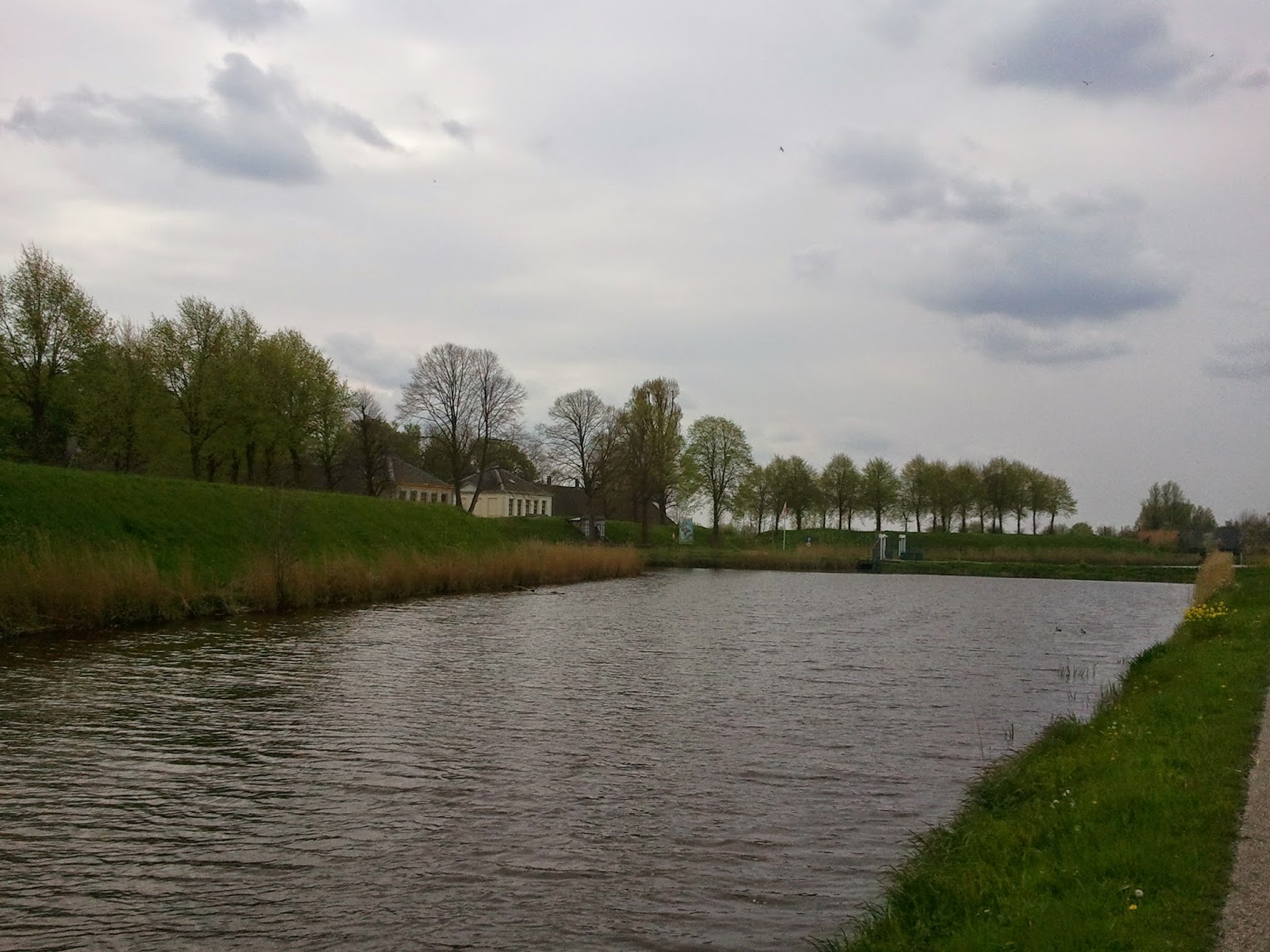
However, it took me through the two most heralded Dutch lines of fortifications: the Old and New Water Line. While the 17th century line runs from north to south (the IJsselmeer to the main rivers) to the west of Utrecht, the 19th century line runs to the east of the city.
The old line had it's day in the sun in 1672/3 when it stopped the best army and generals of its time. The later line was saved the embarrassment, although Dutch troops fell back in good order on the line during the night of May 13th and 14th 1940 after the breaching of the Grebbe Linie.
Fort Jutphaas in Nieuwegein now shelters a wine shop
Although in this case I didn't have enough time to make a relaxed visit, fort Jutphaas (and several others of the New Water Line) are within easy cycling distance of Houten, where my iron horse has now been parked. Once I get my tube fixed, I'll start exploring them.