Monday, 14 November 2016

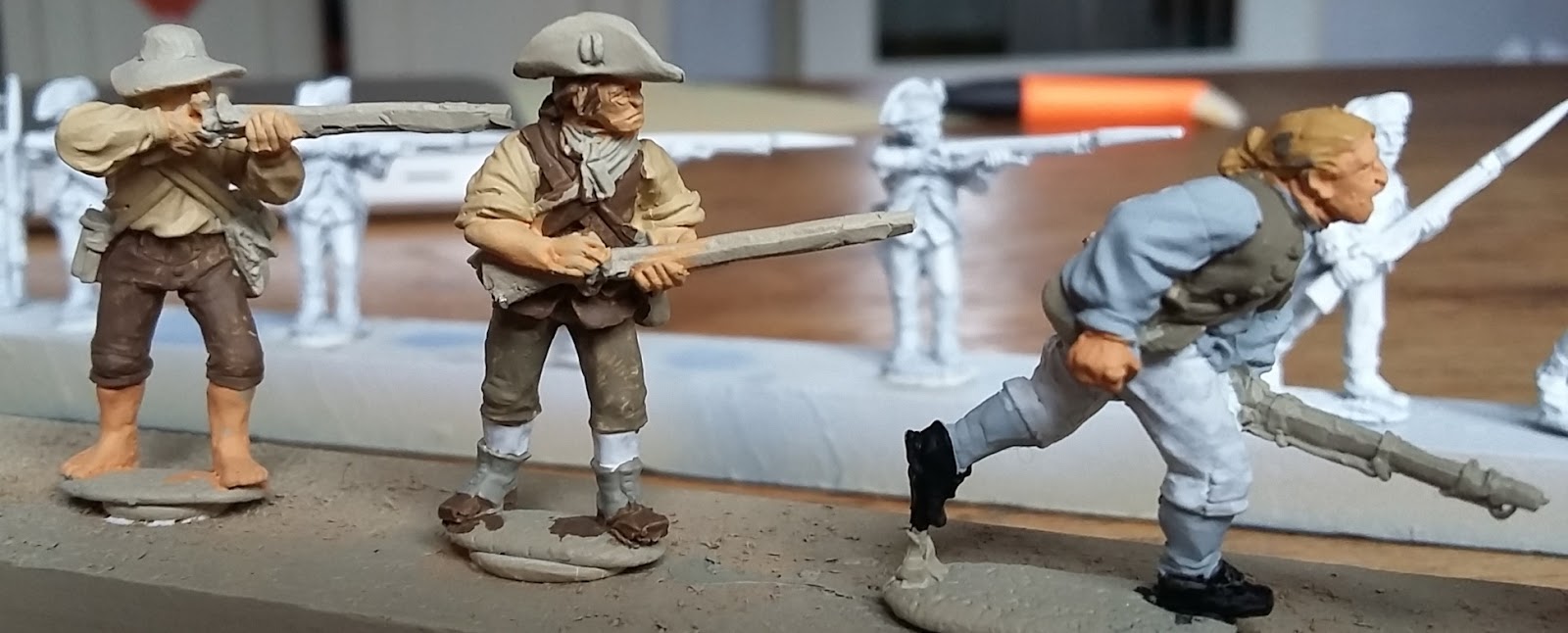
The Mercurial Militia

(AWI project retrospective, part 5)

Few discussions on the American War of Independence have been as lively and enduring as that on the militia. Its proponents, pointing at the impact of Lexington, Concord and Bunker Hill, claim it as the winning factor in the conflict. Detractors bring up the desperate correspondence of US generals decrying the inability of militia to win big battles. So who is right?


As you may have gathered from my previous post, I am unwillingly but irrevocably drawn to the history of the period. What seems to attract my interest most, is the widespread use of militia forces. Let me try to explain my fascination.

Even more so than in the northern states, militias dominated warfare in the south. First of all, because the main effort by the Continental army was and remained in the north, but also because by the time the British strategy was redirected to the south, the British commanders increased their efforts to enlist loyalist inhabitants to their cause.

The main problem of the militia was its unpredictability. No commander could tell how many would show up at muster, because most men decided themselves whether the work at home was more pressing than duty in the field. Militiamen deserted when it suited them, perhaps considering the enemy either too far away from their homes, or too close. As Washington once quipped: “here today & gone tomorrow”.

Similarly in battle, militia units could not be counted upon. The quality of the units varied depending on who turned up and discipline tended to be lax. Later in the war, militia units might be bolstered by returning veterans from the Continental army. So a unit could run one battle and stand the next.

At Camden, the Virginia and North Carolina militias almost entirely ran without putting up a fight. But not much later, almost the same militia forces achieved a notable success at Cowpens where they were handled with consideration for their specific character and in combination with Continentals.

Still, the role of the militia off the field of battle was probably more important than on it. Maintaining military control over areas ensured political control, which in turn harnessed supply of men and materials for the wider war. Knowledge of local terrain and situation made the militia an indispensible partner on an operational level.

And given the scarcity of regular troops, especially in the south, the allegiance of large parts of the colonies was in the hands of regional militia forces of both sides. And this contest was generally won by the revolutionaries.

So while the militia on its own could not have forced the British Empire to acknowledge American independence, a regular army on its own could not have sustained itself.


This blog was first published on the Wargames, Soldiers & Strategy blog on February 25th 2016

Sunday, 13 November 2016

The Beginning of the End in the Pacific

Another recent acquisition that I want to take a closer look at. The Osprey Duel book on Kamikaze vs US Navy Ships is very interesting as it comes much closer to the essence of that series by opposing two entirely different weapon systems. The differences in performance between two tanks is mostly overcast by their tactical employment (is your army on the strategical offensive/defensive?), but in this case the kamikazes were a fundamental departure in Japanese air operations, and it took the Americans considerable time to adapt.


Author Mark Stille provides a lot of relevant detail and analysis on kamikaze tactics, anti aircraft defense and damage control. The book also contains extensive descriptions of actual kamikaze attacks, which gets a bit repetitive. And the technical detail comes at the expense of the psychological aspects of the kamikaze. But all in all one of the better Ospreys in this series that I've encountered.

As a relative noob to the Pacific Theatre I hadn't realised how badly the Japanese navy and air force had been beaten in the Marianas and early stages of the Philippines campaign. This meant that I had missed the level of desperation the Japanese leadership had already been reduced to by that time. It also means they were cynical and criminal in pursuing the war for another year when it was obvious they could not win it.

So when I saw that John Prados had been interviewed on exactly this subject by New Books in Military History about his Storm Over Leyte: The Philippine Invasion and the Destruction of the Japanese Navy, I listened to the podcast. 

Prados has many interesting things to say about the fundamental shift in Japanese naval strategy at this stage, which effectively gave up their old doctrine for big surface fleet action for targetting an invasion force. The book goes deep into the intelligence side of the preparations for the campaign (which is where Prados has professional expertise) and how it affected strategy. A good interview that left me much more knowledgeable. 

Check out the other books in the NBiMH series as well!

Saturday, 12 November 2016

No better way to read my mind

Than to watch my recent acquisitions. I'd saved up quite a few book coupons which now have been turned into paper (and some digital books). So what's come in recently?


Remy Limpach, De brandende kampongs van Generaal Spoor

A book's just come out on Dutch atrocities during the Indonesian War of Independence (1945-1949).This has had a considerable impact because these have been dismissed in the 1960s as incidents and this author shows that retributions against the population were widespread, even if not part of policy. It also becomes clear that these occurrences were brought to the attention of higher ranks who actively suppressed the facts. If anybody was still under the impression that Dutch colonial rule was somehow more benevolent than of its contemporaries, that can now be dismissed.


Paul Dawson, Crippled splendour. The French cavalry from Valmy to Toulouse

Also in is the new book by Paul Dawson, a very thorough researcher who has done a lot of work in French archives on French cavalry of the Napoleonic Wars. This book is no change to his previous work in that it focusses on composition of units, replacement horses and logistics over tactics and individual actions. Therefor it is a very valuable companion to most other studies, who tend to focus on the latter.

Pat Harrigan & Matthew Kirschenbau, Zones of Control, Perspectives on Wargaming

Something of a handbook on (war)game design. It has contributions by well known designers such as Peter Perla, Phil Sabin, Brian Train and Joe Miranda. It ranges from historical background to views of the future (but not so much on computer gaming) and from deadly serious gaming for defense to card-driven commercial games to Warhammer 40K. It also includes a chapter on cultural wargaming by Jim Wallman, my favourite game designer, which outlines how games can help bring up unspoken assumptions and behaviour and create discussion about them. Valuable background to a serious study of state of the art wargaming.

James Waterson, Defending Heaven, China's Mongol Wars 1209-1370

An appealing book I picked up at Crisis about the Mongol conquest and loss of China. Waterson thinks the Mongol conquest created the present borders of China (except, notably, Mongolia itself) but also, that it never succeeded in making a mark culturally. Although the Song dynasty in south China was finally defeated, its legacy was the basis for the eventual evictions of the descendants of the great Khans.

Also in (but not dug in as deep yet):
  • Colin Galloway, The American Revolution in Indian Country
  • Edward Erickson, Ottoman Army Effectiveness in World War I
  • Chris Tyerman, How To Plan a Crusade
  • Colin Galloway, The Shawnees and the War for America

Friday, 11 November 2016

Read it and weep!

(AWI project retrospective, part 4)

Although I got my painting mojo back in January, progress was not prodigious. I got about halfway into my second militia unit of eighteen figures. So it was probably a good thing I was too late entering the Painting Challenge. Better to tell you a bit more on my other line of preparation for the battle in August.


At the start of this project I kept telling myself I wasn’t going to read upon the background of the Revolutionary War. Just focus on painting, and be done with it. But there I was browsing through new books about warfare in North America in the second half of the 18th century. And a group of us decided to recreate on the Battle of Camden for the battle in August.


Of course, there are the Osprey books for uniforms and equipment, and the campaign series offers good introductions to the battles. The recent combat series book on the combat tactics used by both the British and the rebels in the Southern campaign adds new light by using more contemporary eyewitness accounts. And there was a new campaign book about the Battle of Camden planned for publication in March, so that seemed like an obvious addition to my AWI shelf.

But all that proved to be just the beginning. I started out with a little gem I have long kept: Greg Novak’s “We have always governed ourselves” about the organisation and strength of both armies in the northern states, later expanded as the two-part American War of Independence.


Then Jasper Oorthuys (who also introduced me to Muskets & Tomahawks) pointed me to With Zeal and With Bayonets Only by Matthew Spring, about the development of the strategy and tactics of the British army in North America. Then there was John Grenier’s First Way of War about frontier warfare against the indigenous population. Although it only briefly talks about the Revolutionary war, it gives a good account of the style of warfare that the Americans were used to and which they would also employ against the British, and against their patriot neighbours.

So apart from painting project, this also turned into a reading project. Oh noes!

This blog was first published on the Wargames, Soldiers & Strategy blog on January 14th 2016

Thursday, 10 November 2016

Painting mojo

(AWI project retrospective, part 3)

Progress had not been good since my previous post. But nothing helps to get you going like playing a game and seeing other people’s progress. In November 2015 over a dozen Dutch gamers came together to try out a couple of rule sets, among which Land of the Free. You’ll be hearing more about this rule set later.

As the meeting included quite a few of the people in the AWI project, the post-game chat provided some more inspiration. As a result, I got my minutemen to the point where they could be dipped.


At the games day I also received the new miniatures from the communal AWI order. Some more militia and Stockbridge Indians to complete my rebel force, and also some British and loyalists. I needed some opposition, didn’t I? 

I considered signing up to Curt’s (of Analogue Hobbies) Painting Challenge. It’s good to have that extra motivation to paint. The challenge runs from December to March so effectively three months in the darkest period of the year. Dozens sign up, and I always look enviously at their results. As tempting as that seemed, I didn’t get round to signing up and I wasn’t as productive in the winter as I’d have liked.

This blog was first published on the Wargames, Soldiers & Strategy blog on December 3rd 2015

Wednesday, 9 November 2016

Essen 2016

We're a couple of weeks on, but no reason not to briefly glance back at what I learned in Essen this year.


It was a relaxed trip for me because I didn't feel I had to buy anything except simple games to play at night. This saved me a panicked last minute chase along the stands of companies that I'd missed. There were some good games and bad, but nothing that stuck out for me.
  • Barcelona, The Rose of Fire, a hefty game about the late 19th century development of the city, pitting influential families against each other and homeless poor. I almost bought it but finally left because I hadn't seen the end game.
  • The Grizzeld/Les Poilus, very nice cooperative game about survival  on the WWI battlefield (picked up by a friend so I've had a chance to try it again). Sad trivia: the guy who did the artwork was killed in the January 7th attack on the premises of the French satirical magazine Charlie Hebdo.
  • Beer Empire, a development from a previous version. A pretty streamlined eurogame that let's you brew specialist beers (to win prizes) as well as shitty lager in cans that brings in lots of money.
  • Fabled Fruit, a very simple game with subdued graphics that I felt was overpriced
  • Topoum, a nice tactical game, but overpriced
  • London Markets, a pretty standard but pleasant worker placement game.
  • Lincoln, an unpublished Martin Wallace design for a strategic game about the American Civil War. It's mostly card play and could use some more play testing. 
In the end I arrived home with: Pax Pamir - Khyber Knives expansion, Treatment, Lord of the P.I.G.S. and Rock, Paper, Wizard.

We played Treatment and Rock, Paper, Wizard at the hotel and restaurant in Essen. And I repeated that feat recently with friends. Treatment is a conventional card game with a nice theme. Rock Paper Wizard is 15 minutes of fun, and a nice cross of Cash 'n' Guns with a pumped up version of Rock Paper Scissors (as the name implies).

I've also managed two games of Lord of the P.I.G.S.. It focuses on the struggle between the conflicting interests of politicians, industrial and financial elites in the economically challenged countries of Southern Europe (ie Portugal, Italy, Greece and Spain). The game proves a bit tougher to occassional gamers than I thought, because the turn order isn't intuitive, but I like it.

Only Pax Pamir Khyber Knives remains to get it cherry popped, but this is a promising score so far so I don't feel the need to pursue a project Spiel 2016. I'll focus on playing some stuff that's been gathering dust on the shelf. In fact I've been clearing out quite a lot of stuff from my shelves, but it needs to leave the house as well ;-)

Tuesday, 8 November 2016

First world problems

(AWI project retrospective, part 2)

 I left you just about when I was picking up my can of spray-paint to lay down a base coat for my minutemen. This was all still very much in that first wave of excitement I told you about. In fact, in that weekend I got a considerable amount of brush painting done as well. This left me with a few questions of painting technique.


Just so you know: I’m a pretty mediocre painter. I lack practice and have spent years hardly painting at all. Due to time constraints, a few years ago I overcame my antipathy towards letting somebody else paint my miniatures and in this way I have obtained beautiful Dark Age Saxons and WWII Americans for skirmish games. I have even bought armies and single units, so that I now have a nice medieval Norman force and an eclectic collection of fantasy figures.

But as you may have noticed I’ve found I quite enjoy the painting, and when a limited amount of miniatures is combined with a reasonable deadline, I even get things done. Which is why 80 miniatures and 10 months seemed so attractive. But I still realised I wasn’t very good at painting and quite slow. To save time I adopted the army painter philosophy, which I used previously on my Prussian Landwehr and some medieval monks. Overall I’m pretty pleased with the results.

But what about highlighting? Experience suggests that only extreme highlighting works in combination with dipping (although I don’t actually dip. Does anyone really dip?). I finally decided against it as I was displeased with test result.


My other question was how to get a good balance between diversity and uniformity for my minutemen. I’ve seen some beautiful examples of far better painters than me using understated hues to great effect: no miniature is the same, but there is a real sense of unity to them.

What I was afraid of was having a very colourful collection of minutemen who would not look very good as a collective. And of course, even if I managed to configure a balanced palette, I’d still be a mediocre painter, and it wouldn’t look as good as the pros.

You know… first world problems!

This blog was first published on the Wargames, Soldiers & Strategy blog on November 5th 2015

Monday, 7 November 2016

To explore strange new worlds

(AWI project retrospective, part 1)

There’s no feeling like starting on a new project. The adrenaline rush of exploring a new topic, the possibilities opening up, the ooooh shiny!

So I was very excited as two dozen Dutchmen embarked upon the new adventure to recreate a number of battles from the American Rebellion all on one day almost a year from now. And in this case the good news was that I was slightly ahead of the pack as I already had the relevant miniatures at home.


Actually, I had just been contemplating what painting project I was going to take on for 2016. My Foundry Americans were high on the list because I wanted to play Musket & Tomahawk, a rule set that I liked straight away when I played it first. That was right up my alley then.

In fact, my force was already about complete. I had about 80 miniatures consisting of Continentals, militia and minutemen. They could be used as a 400 - 500 point force for M&T, but also as about a brigade’s worth in other rule sets. Maybe a few additions would be needed, but I really didn’y plan on overdoing it because this was about the number I could see myself finishing in the period set.

Just to make life difficult for myself, I was enticed to participate in a combined purchase of miniatures. The siren’s call of creating an opposing force for my Americans proved too strong. Some British regulars and a few loyalists… Okay, and maybe some militia from the Southern states, and a few Continentals to create the right size of units. Inevitably, this resulted in me having to paint more.

Of course then loomed the choice of units, which would decide the uniforms to be painted. To put off this important but time consuming question, I decided to start out on my minutemen. So the enterprise began…

This blog was first published on the Wargames, Soldiers & Strategy blog on October 8 2015.


Sunday, 6 November 2016

Picking up

Yesterday was a good day. Returning to Crisis in Antwerp after three years it was great to meet many old friends and acquaintances. The most flattering meeting was with Sidney Roundwood, one of the most friendly and supportive people I’ve come across, who said he missed my blog posts. It is the best kind of compliment you can get and so here I am. I guess it’s mostly about getting back into the habit.


What have I been up to this year? I’ve mostly worked on the American War of Independence. This was the theme for the third painting project by the Dutch Miniature Wargames facebook group, which culminated in a day of battles late last August.

This marked my return to the painting table in the first sustained campaign in ages. I painted over a hundred miniatures since the start of this year, which is impressive enough for me. Of course I fell for the temptation of buying more, even after the project has ‘officially’ended.

Why, would you ask? Because despite my initial determination to stick to painting and not read any books on the subject, the opposite has happened. I’ve become enchanted by North American warfare in the long 18th century (1700-1815), a unique mix of colonial rivalry, indigenous resistance and civil war.

You can see my descent into madness over the course of a couple of blog posts that I made on the Wargames, Soldiers & Strategy blog, which I will reproduce here in the coming weeks. I think the breaking point really occurred when I diverted from the AWI into the War of 1812 and several Indian Wars in this period. So I will be painting and reading on this a lot more in the coming months.

But I’ve also done my share of board gaming, including the annual trip to Essen. I’m digging through my book and game collections to make room. And there is the lure of new projects. Enough to talk about, I'd say.

Monday, 9 May 2016

Little sisters

Today will see Russia's annual victory parade, and while this may feel a bit uneasy in the light of recent events, let's focus on events 75 years ago. I spent the last week reading Svetlana Alexiyevich's War's Unwomanly Face. It's been devastating.


The book was first published in dying years of the Soviet Union, but there was still considerable censorship. The translation of a later edition includes more graphic detail. It's not a book for a relaxed read. You will find yourself hit with strong emotions but, thank goodness, also an occasional smile.

There's so much in this book: the naive enthusiasm of the girls to get to the front, their camaraderie and their perseverance. The women are very frank about their experiences. Alexiyevich must have been a very good listener to get these very personal accounts out of these women, while all the focus in (post)Soviet history is on the glorious achievements of the Red Army.

It was tough to be a woman on the eastern front. There wasn't room for female comforts, like there wasn't for male comforts. No extra underwear during periods, but then again, the war ruined hormonal cycles for many women, sometimes for good.

The most gripping passages come from the women that fought behind the lines in the partisan groups. Not only was this the most brutal conflict, it also directly involved family members. The accounts of seeing your own mother being driven before a German patrol is harrowing, and so are those of the woman carrying around her baby and coding machine whilst fleeing for German sweeps. And that's not the worst incident.

Life remained tough when they came back. Just like the men, they often found their homes and families broken up and the environment of reconstruction harsh. Their bodies were broken because they suffered hunger and physical exhaustion during their late puberty. Their chances of finding a husband were smaller because they were not considered womanly anymore.

Remembrance at the Grebbeberg memorial, May 4th 2016

It's been a busy few days remembering the end of World War II and more will follow. But if you can spare a few moments for the little sisters fighting on the eastern front. And if you can get a copy of this book, don't hesitate.