Wednesday, 26 June 2013

Upcoming: Slavery Statistics in the Dutch West Indies

Working on a short article with stats about the abolition of slavery in the Dutch West Indies, 150 years ago next Monday. It will be published in Dutch, but you might like an English version.


My source: Het Staatkundig en Staathuishoudkundig Jaarboekje


Tuesday, 25 June 2013

La Religieuse, Riducule and the War That Made America

I very much enjoyed the French movie La Religieuse, based on the late 18th century book by Denis Diderot, better known for his encyclopedia.


The story is about a daughter of lower gentry that gets send to a convent because her parents can't afford her a dowry. She doesn't want to go but is lured in, then refuses to take the vows. But as she brings shame on her family, it is even more difficult to escape the life of a nun and she goes back, more or less of her own free will. Of course she comes to regret it and the movie then documents her struggle to get out.

It was an interesting look at 18th century society, and gives a bit of background to 18th century gaming.

Another French movie I can recommend for this period is Ridicule. In Ridicule, a lowly nobleman travels to Paris to ask the king's aid in financing a project to improve his village. But as the king is bored with audiences the only way to gain access is through the court circuit in which wit and sarcasm provide the means to attract attention. 

But of course, you guys want hardcore military history, so my last recommendation is through the Bloggers for Charity, not only a lofty cause, but cleverly combined with the miniature refight of the Battle of La Belle Famille in 1759.

The War That Made America is a four part documentary on the French & Indian Wars and has some interesting combat sequences with reenactors. It is also surprisingly good on introducing the perspectives of Britons, Americans, French and Indians of various persuasions. It takes George Washington's experiences as a main lead, and I see this as inescapable if you consider he was involved in some of the actions and that that is the best way to gain the attention of the general audience.

Tuesday, 18 June 2013

Dutch and Belgians at Waterloo Ospreys

Yes, the day before yesterday was the 198th anniversay of the Battle of Quatre Bras, and so today is that of the Battle of Waterloo. And then I found out I was not the owner of the two Osprey Men at Arms about the Dutch and Belgians in the campaign! Incredible. So I rectified that omission last Friday. I hope nobody noticed them missing in my collection...


Monday, 17 June 2013

Napoleonic and Native American Cavalry

Two more books I ordered some time ago and only arrived recently. I was very much impressed by Paul Dawson's thesis on the rebuilding of the French cavalry in 1813. It had lots of stuff on the organisation of remounts and the corners Napoleon could cut to rapidly increase his number of horses. Dawson argues that it wasn't a shortage of remounts but rather a shortage of trained cavalrymen combined with a breakdown of logistics that hamstrung Napoleon's army in the autumn campaign.


Not surprising that I was interested when Paul's Au Galop. Horses and riders of Napoleon´s Army was published on the French cavalry from an equestrian viewpoint. There is certainly a lot of the stuff in here, but not all the exciting bits of his thesis.

In one fell swoop I also picked up from the same publisher The Warhorse in the modern era by Ann Nyland, which does the same for a much longer period but in less depth. It is also somewhat older. Unexpected boon were the chapters on the use of horses by the Indian Plains tribes.


Of course these books are on the list for reading after this weekend, when we play the Leipzig campaign in one day with over forty guys in two large rooms. It's a double blind map game, with each team representing a headquarters or political leaders. So if I don't post much in the coming days, you know what I'm doing..


ps I vaguely recall a post not long ago in which I said I didn't expect much in the mail for the future. I guess I was fooling myself there.

Sunday, 16 June 2013

Maroons and slave revolts

When my interest was raised in slavery at university, I also learned about the maroons (called bosnegers in Dutch controlled Surinam). These escaped slaves formed communities in hard to reach areas of British Jamaica, Surinam, French Saint-Domingue (present day Haiti). I assume there were also maroon communities in North and Latin America.
 These include the French, Haitian, British and even Dutch units involved in the
Napoleonic Wars in the Caribbean, in my possession since last Friday 
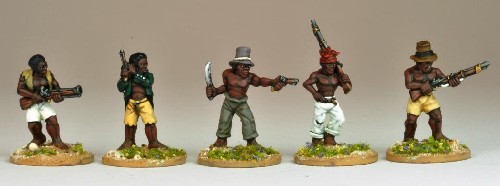
The subject has not left me since but was rekindled with the 150th anniversary of abolition of slavery in the Dutch West-Indian colonies coming up on July 1st (more on this later). It made me wonder why there have been no wargame rules that included maroons or slave revolts in their rules, at least none that I know of. But there's references in a few Ospreys (shown above) and at least I've found a miniature manufacture, Trent Miniatures, that offers maroons, Haitian rebels and regulars.

For the rules, I've been looking at Muskets and Tomahawks, as it also focuses on 18th century skirmish wargaming in the North American colonies. I think it can be easily adapted to include actions in the Caribbean. As it uses card driven scenarios, it could be well suited for the raiding, tracking and harassing expeditions of slave societies.

Revolting slaves by Trent Miniatures, from NorthStar website
It could also include scenario's based on the larger slave rebellions, like the one on Saint-Domingue in 1792 that led to its independence. With British, Spanish and French attempts to (re)gain control, there's all kinds of interesting angles to take.

So I've done myself a big favour by getting a few relevant Ospreys and ordering Muskets & Tomahawks, and the Trent minis (as well as some French and Indians for the French & Indian wars). This isn't a project yet, and will have to wait a while, but I'm looking forward to working on it. René, are you reading this?

Saturday, 15 June 2013

Crisis in Binni - Operation Succesful, Patient Deceased

Two weeks ago I joined in for Crisis in Binni, the megagame about humanitarian intervention in a failing African state (think of Somalia in the early 1990s) as the commander of the US contingent to the international force. I was going to write peacekeeping force, but then realised that was not our mission. Remember this, because it is important.


When the UN decided to intervene in Binni, there had been low level conflict in the country for some years, with the autocratic government of President Ancongo having suppressed rebellions in the north of the country. The direct occasion for action was a famine developing in the northern region.

While the security council (formed for this game of the US, Britain, France and Italy) worked out our exact mission, the commanders of the military contingents planned for their role, in coordination with the UN refugee commissariat and World Food Programme.

As US commander my aims were to keep the commitment of ground troops to a minimum, but to still be seen as the leading nation. I managed to circumvent this seeming paradox by providing the expensive HQ, airbase and transport and attack helicopters for the mission. A few marines were used for protecting the force HQ, airbase and UN depots in Binni’s capital, out of harm's way. And as the Security Council resolution that formed the basis for our deployment implicitly put the US in command, I just treated that as a fait accompli which nobody questioned.

My briefing material for the game, with extensive historical information

The UN military force got a very limited brief: to protect the aid workers and refugees under their care. This also meant very restricted Rules of Engagement, effectively to only shoot when shot at.

My next priorities were to establish a unified command structure and get men on the ground as soon as possible to get a feel for the developing situation. The first French troops were on the ground in a month, with other contingents following two weeks later.

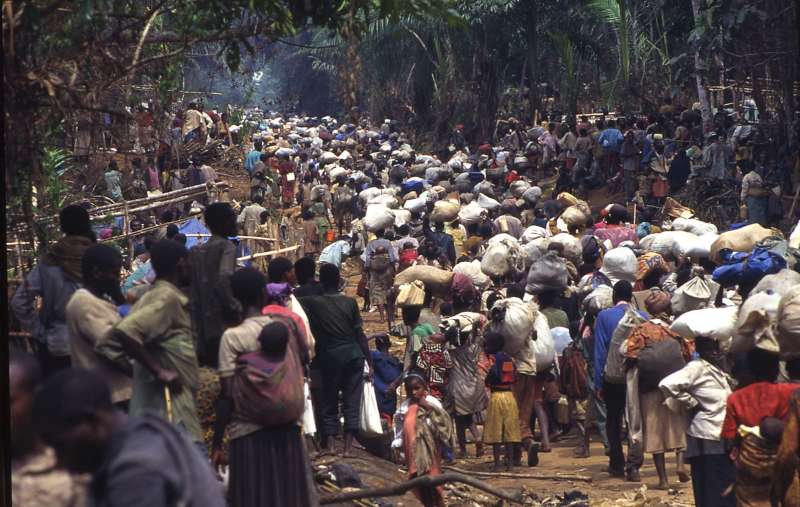
By that time the north of the country had seen extensive ethnic cleansing, with several thousand refugees shot to encourage others to make a move. The smart warlords then corralled the refugees in their area into large camps and waited for UN officials to turn up.


This actually helped the UN aid operation a lot, because it allowed them to concentrate on a few locations. That also made the military mission easier. Part of the aid flowed through Binni’s northern neighbouring country, which was expensive, but saved us the costs and risks of a very long line of communications. We also established on refugee operation in the north based only on air transport to which the same applies.

As expected, the government tried to squeeze us for money, but I was determined to prevent outright bribes as much as possible. So when president Ancongo demanded money to supply his troops, I agreed to a convention that only committed us to paying government troops that would be used solely to protect our refugee camps. In that way I hoped to limit the amount of units we had to support and also gain some leverage over them should push come to shove.

This deal may however been the reason for government troops to try to forcibly take over protection of the refugee camp at Cleopatra from the local warlord. This resulted in a three week battle over the town which gave us some headaches. Mostly because our forces in the area were split: a single British company guarding the camp to the north of the town and a slightly bigger garrison of the UN depots to the south.

We were afraid some of the indigenous force would find the 90,000 lightly protected refugees as a far more alluring target than the opposition and turn on the camp. We solved this by having our Black Hawks flying constantly over the refugee camp to discourage such thoughts. The commander of the British contingent remained anxious and enquired when and how he would be allowed to pull out. Of course I wasn´t keen on UN troops running off from their primary mission when put to the test, but I also understood that a company would not be enough to hold against a determined attack. So I put a number of transport helicopters on call to extract his force when attacked in force and this seems to have been enough to assure him. Anyway we were lucky we weren´t attacked.

UN military personnel at the gate of Cleopatra Refugee Camp

But apart from this and a few pot shots taken at a convoy the game was rather quiet for the UN military. In this we were really helped by the ´constructive´ stance taken by the warlords and the government. As long as they could make some money from us, they had no incentive to create trouble for us. In all I think that the level of bribing in this game was probably lower than in reality, and it was definitely only a small part of our total expenses.

Meanwhile, another neighbouring country had decided to take advantage of the internal turmoil in Binni to invade a disputed region. The Ancongo government therefore kept holding its hand up for money, but the US Ambassador was eventually able to wrench a promise of elections from the president for it.

The Battle of Cleopatra also proved an incentive for the US president to take an interest in the operation, and the US ambassador managed to broker a ceasefire and peace talks. This resulted in a government of national unity and a photo opportunity for the US ambassador.

Of course these peace talks were mainly meant to allow the government to turn on the invaders, which they had duly expelled by the end of the game. On the other hand, the power sharing didn’t fare well with Ancongo’s other clan leaders and rumours were rife of a coup by that time.

Nothing of the sort happened

The generally cooperative behaviour of the warlords and Ancongo government gave the UN a relatively easy game. Those refugees that we got to in time were saved and the concentration worked to our benefit. However, outside UN reach the world was less safe. The Security Council whisked away independent reports on human rights violations by the Ancongo government and evidence of ethnic cleansing and death marches in the north in order to maintain a working relationship. Of course, that didn’t mean that by the end of the game Binni was in a better position for the future.

I think that the UN could have had a lot more criticism in how it dealt with the crisis: the limited brief, the bribes, the support for an autocratic government, no attempts to create peace or safety for ethnic minorities. From all sides there was a lot of Realpolitik and very little principled behaviour. I guess that is due to a general disillusionment with human intervention and what it can achieve in the long run. As far as I understand, UN forces in earlier games were more ambitious and ready to get stuck in. So after six runs of Crisis in Binni, maybe it’s time to shift the situation in Binni by 20 years as well.

... and I approve of this message


Friday, 14 June 2013

Go There Rather Than Here

After yesterday´s general dissing of blogs, I´d like to counter by pointing you to one of the best wargaming blog posts ever: Sidney Roundwood´s ideas on creating a game that feels like being there. Very much enhanced by excellent pictures and illustrations.


Thursday, 13 June 2013

Wargames magazines vs blogs

Let me draw your attention to a very good post by Keith Flint on wargames magazines. I think Keith is entirely correct when he writes

"there are far too many trivial posts and comments out there that contribute very little to our hobby, and which fail to communicate very much in terms of ideas or inspiration. Indeed, some forum posters seem to have quite a lot of trouble spelling words properly and grasping the basics of punctuation, let alone having anything worth saying. Far too many blogs make do with battle reports featuring no maps or scenario outlines, thus giving no idea of what's going on, and support this thin fare with a series of badly lit and/or out of focus photos."

There is a lot of low quality stuff out here (including mine) that is only relevant to a few people that know me well. On the other hand, that's the essence of a blog. It's a trade of between personal and immediate and objective standards of quality. That is also the reason why there will always be room for magazines (in paper or digital form).

On the other hand, it was a long time ago that I was subscribed to one of the glossies and I frankly lost interest because of the indifferent quality of the articles. I'm glad that the both revamped Wargames, Soldiers and Strategy and Miniature Wargames seem to be improving on that.

For me Keith's crie de coeur is a good reason to think about what I can do to improve my blog, without it becoming an online magazine.

The front of Keith's own blog

Keith's criticism is not limited to the blogs however. He is also critical of the 'rather bland and forgettable' contributions of 'prominents figure in the hobby' like Rick Priestly and Richard Clarke. And he engages the debate about the quality of painting shown in magazines and
"articles that purport to pass on their 'secret' of producing wonderful figures in record time. [...] Unfortunately, amongst all the tips and wrinkles, one does not have to read between the lines of such articles very much to discover that the real 'secret' is to spend every waking hour painting figures, often with as much shading and general fiddling about as possible."
 Also Keith argues that
"The emphasis on painting creates a distraction from the task in hand, which is of course to get some wargaming in."
 So by all means, read Keith's blog and take up his recommendations to read the magazines involved.

Wednesday, 12 June 2013

All Shill For Quatre Bras book by Erwin Muilwijk

Also in the mail last week: Erwin Muilwijk's second volume in his history of the Dutch army during the Waterloo campaign: Perponcher's Gamble. This concerns the Battle at Quatre Bras, where a Dutch vanguard managed to hold out long enough for the rest of the Allied army to come up and hold the cross roads at the village.

The black & white and the colour version

Erwin's book fills some gaps that English (and other) writers have neglected to lack of Dutch language skills or the fact that Wellington was having a chat with Blücher somewhere else at the time. For them the battle only starts when Wellington returns.

The maps and illustrations add a lot to the story, because some episodes were confusing even to the participants. It helps to figure out what was going on and where. I heartily recommend the colour version to take full advantage of them, but for the cheapskates (and all others) there is a downloadable version of the maps.

The two extra contributions by Ab Küchler on the Quatre Bras painting by Pieneman and Marco Bijl on the Bois de Bossu also provide added value.

I did have a small role in getting this book to the printer, although I still think a native speaker would have done much better.

Next up is the book on the Battle of Waterloo itself, to be published in about a year from now. Must read for anyone that is interested in the Waterloo campaign or the Dutch army of the Napoleonic and restauration period