The day before Essen. We have a drop out for medical reasons but a promising replacement. It will be a little bit weird this year, with probably a couple of games back home on Saturday.
Check me out on twitter @jurdj the coming days as I play stuff and post images.
It's been some time since I set up my watch list for Essen 2013, but I've been watching the updates and there's some good stuff out there for the Ameritrash minded.
The 10 games that I look forward to most are:
Ace Detective. Richard Launius + 'noir storytelling card game that rewards imagination'
Corto. I love the Corto Maltese comics, so I'm certainly going to check this one out. The fact that Seb Pauchon is involved is a good sign!
Coup. The buzz is good, and some new editions are on the way.
Duel of Ages. The new edition has been very favourably reviewed by two Mikes! see for Mike 1 and Mike 2.
The Mushroom Eaters. A game by Nate Hayden (of Cave Evil and After Pablo fame) is bound to be special. I'm interested in the action path mechanic and of course the highly original theme
Pathfinder. See Michael Barnes' rave review
The Rats in the Walls. Henning Poehl´s fun games, great artwork and the Lovecraft setting might just be awesome.
Sigismundus Augustus: Dei gratia rex Poloniae. The theme of the game appeals, but it's quite heavy and worker placement, not a stand up conflict game. There's a favourable review at Little Metal Dog
A study in Emerald. Gaiman + Wallace + Lovecraft. It's almost to good to be true. Either elation or deep disappointment
Veto by Kuznia Gier. Polish 17th century history, political infighting an intrigue! However, the company is going through a rough patch and is unlikely to attend the show. I'll check anyway.
On the Essen 2012 front, I managed to get a game of the Lupin III expansion set in as evidenced by my review. But I will give myself a pass for Signum Mortis, which was late in delivery anyhow. That is also a good warning for me to trim down the loot to the absolute necessary this year and forget about games that I don't have the time for to learn.
Of course, time is a matter of priorities.
Thursday, 24 October 2013


Saturday, 12 October 2013
Followers: 39 Reasons To Be A Happy Blogger #4
Continuing the honours list of my followers:
#16 Millsy, ´Mad wargamer´ with an interest in Dark Ages and GW; blogger at Canister & Grape

#15 Phil Broeders, convincingly backs up his claim of dedication to all kinds of wargaming at The Wargaming Site

#14 Mik, of Mik´s Minis where he shows there are no bounds to creativity when it comes to wargaming. Fantasy, scifi, Lego, historical etc etc

#13 Ian Willey of the Blog With No Name, who indeed manages to get the better of me most of the time with his series of Terribly Obscure Wars

#12 Jim Hale, the man with more blogs than split personalities (I hope), Arlequin's Wargames, War of Burgundian Succession, Brush Fire Wars, France d'Abord, La Carretera de la Muerte, Dark City, contributing as well to the Interbellum blog on imagi-nations

#11 Erwin Blonk, smart guy, fantasy wargamer, music fan, dad, in no particular order

#10 The Frontline Gamer. Blogging in a class of his own, with his Sunday Sermons providing me with some weekend's reflection.

#9 Bert van Hal of Little Lions Wargaming blog. He plays WH fantasy, 18th century, and is interested in much more...

#16 Millsy, ´Mad wargamer´ with an interest in Dark Ages and GW; blogger at Canister & Grape

#15 Phil Broeders, convincingly backs up his claim of dedication to all kinds of wargaming at The Wargaming Site

#14 Mik, of Mik´s Minis where he shows there are no bounds to creativity when it comes to wargaming. Fantasy, scifi, Lego, historical etc etc
#13 Ian Willey of the Blog With No Name, who indeed manages to get the better of me most of the time with his series of Terribly Obscure Wars

#12 Jim Hale, the man with more blogs than split personalities (I hope), Arlequin's Wargames, War of Burgundian Succession, Brush Fire Wars, France d'Abord, La Carretera de la Muerte, Dark City, contributing as well to the Interbellum blog on imagi-nations

#11 Erwin Blonk, smart guy, fantasy wargamer, music fan, dad, in no particular order

#10 The Frontline Gamer. Blogging in a class of his own, with his Sunday Sermons providing me with some weekend's reflection.

#9 Bert van Hal of Little Lions Wargaming blog. He plays WH fantasy, 18th century, and is interested in much more...

Thursday, 10 October 2013
Lupin III
Hard to tell how big an impact childhood TV shows actually have, but I remember a few of them very well. There was Robbi, Tobi en het Frawatuig, De Stratemaker op Zee-Show and later Inspector Gadget. The impact on Pierluigi Frumusa must have been the same for Lupin III, a Japanese cartoon series about the grandson of Arsène Lupin, the French 19th century equivalent of Robin Hood.
Lupin III and his gang, consisting of gun toting Jigen, modern samurai Goemon and vamp/action woman Fujiko, are always intent on pulling off great and improbable heists. At the same time they are pursued by gruff inspector Zenigata, who by force of the plot must always fail.
This gives the game a natural set up of a match between the gang players and the inspector. But the gang contains one weak joint: Fujiko. She has her own agenda and might in some cases decide to keep the prize to herself. The possibility of a three-way stand off gives the game an edge over many other coop games.

The theme is further integrated into the gameplay as all the characters have unique stats and a set of mission cards, which give you different options (like Lupin's penchant for disguises and Fujiko's betrayal). This reinforced by the excellent graphic design and the inclusion of five plastic figures of the main characters is a bonus.
Every game is based on a scenario, drawn from the cartoon series. The original game includes a double sided board for the first two scenarios, the expansion two more. Every scenario comes with a few specific rules as well.
Another feature of the game is that it includes a planning phase, in which the gang decides on the way to execute the heist. They have a limited budget with which to buy equipment, from shovels to guns to paragliders.
Finally there's the limited visibility. As long as they are not in sight, the gang are not on the board, which is why Inspector Zenigata has a challenge on his hands setting up his policemen at the start of the game.
Together, the heist scenarios, planning phase, hidden movement and conflicting goals of the players with unexpected twists in the execution phase make the game feel very much like the cartoon original. I think that´s a major achievement for a designer.
So, what's not to like about Lupin the 3rd, a good looking game dripping with theme and some interesting and rare mechanics? As in other cases (Gen-X, I'm looking at you here) English rules written by non-native speakers are not the easiest to digest. A combination of weak translation and sloppy rules writing leaves considerable gaps and confusion that players need to sort out during the game. Luckily there´s a revised English rulebook and a FAQ to provide some help.
As one of my friends said: rather than not playtesting it enough, they have probably playtested it too much and forgotten how much is assumed in the rules that we're not told about.

The visibility issues also can become problematic, which is why I think playing with an umpire is a good idea, especially when introducing players to the game. Does that diminish the game? I think not. But then I am used to half finished games where umpires and players work with the mechanics and role play rather than try to break it. If you are up for a unique game, brimming with theme, don't let these glitches stop you.
 |
| Basic game and expansion |
This gives the game a natural set up of a match between the gang players and the inspector. But the gang contains one weak joint: Fujiko. She has her own agenda and might in some cases decide to keep the prize to herself. The possibility of a three-way stand off gives the game an edge over many other coop games.

The theme is further integrated into the gameplay as all the characters have unique stats and a set of mission cards, which give you different options (like Lupin's penchant for disguises and Fujiko's betrayal). This reinforced by the excellent graphic design and the inclusion of five plastic figures of the main characters is a bonus.
 |
| Special character cards, and yes: only in Italian |
Another feature of the game is that it includes a planning phase, in which the gang decides on the way to execute the heist. They have a limited budget with which to buy equipment, from shovels to guns to paragliders.
 |
| A few suggestions for your shopping list |
Finally there's the limited visibility. As long as they are not in sight, the gang are not on the board, which is why Inspector Zenigata has a challenge on his hands setting up his policemen at the start of the game.
 |
| Lupin pops up near Stonehenge to the surprise of inspector Zenigata and his agents |
Together, the heist scenarios, planning phase, hidden movement and conflicting goals of the players with unexpected twists in the execution phase make the game feel very much like the cartoon original. I think that´s a major achievement for a designer.
So, what's not to like about Lupin the 3rd, a good looking game dripping with theme and some interesting and rare mechanics? As in other cases (Gen-X, I'm looking at you here) English rules written by non-native speakers are not the easiest to digest. A combination of weak translation and sloppy rules writing leaves considerable gaps and confusion that players need to sort out during the game. Luckily there´s a revised English rulebook and a FAQ to provide some help.
As one of my friends said: rather than not playtesting it enough, they have probably playtested it too much and forgotten how much is assumed in the rules that we're not told about.

The visibility issues also can become problematic, which is why I think playing with an umpire is a good idea, especially when introducing players to the game. Does that diminish the game? I think not. But then I am used to half finished games where umpires and players work with the mechanics and role play rather than try to break it. If you are up for a unique game, brimming with theme, don't let these glitches stop you.
Tuesday, 8 October 2013
A Hint of Gamer Dad
I started this blog out of a sense of giving up time while gaining a family, but it is nice to see that these things can be combined occasionally. Surprisingly, the kids come asking to paint and build model tanks with me. So in the past month we've
Many thanks to my step parents for gifting this one bringing this as a gift!
which the kids can paint as well. The advantage of US plain colour scheme is apparent immediately.
And to top off last Sunday,
Not so bad at all.
 |
| built a 1:72 Supermarine Spitfire |
Many thanks to my step parents for gifting this one bringing this as a gift!
 |
| and GW Skaven warriors |
 |
| built and painted M3 half tracks |
 |
| while I worked on two M3A4 Shermans |
which the kids can paint as well. The advantage of US plain colour scheme is apparent immediately.
And to top off last Sunday,
 |
| we built bows and arrows in the woods |
Not so bad at all.
Tuesday, 24 September 2013
Followers: 39 Reasons To Be A Happy Blogger #3
Well, since I've started to celebrate my followers, I've picked up a new one every week, so let's keep going!Newly enlisted #39 is Peter, who blogs at Comes Britanniae and Oldhammer Fantasy Battle (yes, that's an interest in Arthurian warfare, but also fantasy and Napoleonics).Welcome Peter, hope we can inspire you on reentry from your hiatus.

and continue the countdown to my most loyal followers:
#24 Jim Duncan, wargamer. Blogs about Ancients, SciFi, WWII, with an special interest in Too Fat Lardies rules.

#23 Michael Peterson, aka the Mad Padre, with a great interest in Platoon Forward (a campaign system for WWII skirmish games), which I awarded one of my five Liebster Awards.

#22 Barks, an Australian blogger with an interest in colonial, ancients and fantasy warfare. Plus some Ameritrash boardgaming

#21 Sidney Roundwood. Roundwood´s World is a nice combination of eye candy (WWI French Verdun project) and great insights into participation games.

#20 Aaron, (taken from his blog roll) is an avid miniature wargamers with a wide interest.

#19 Christopher, aka Axebreaker. Blogs at Bunker Hill about ACW, Dark Ages and 18th century wargaming (and more). Nice brushwork as well..

#18 Sapper Joe, blogs at ...Wargaming Toys. With some interesting insights into wars of decolonisation, modern and pulp miniatures and cheap kindle books(!).

#17 MiniMike, who shares his Ministories but especially the eye candy.

and continue the countdown to my most loyal followers:
#24 Jim Duncan, wargamer. Blogs about Ancients, SciFi, WWII, with an special interest in Too Fat Lardies rules.
#23 Michael Peterson, aka the Mad Padre, with a great interest in Platoon Forward (a campaign system for WWII skirmish games), which I awarded one of my five Liebster Awards.

#22 Barks, an Australian blogger with an interest in colonial, ancients and fantasy warfare. Plus some Ameritrash boardgaming

#21 Sidney Roundwood. Roundwood´s World is a nice combination of eye candy (WWI French Verdun project) and great insights into participation games.
#20 Aaron, (taken from his blog roll) is an avid miniature wargamers with a wide interest.

#19 Christopher, aka Axebreaker. Blogs at Bunker Hill about ACW, Dark Ages and 18th century wargaming (and more). Nice brushwork as well..
#18 Sapper Joe, blogs at ...Wargaming Toys. With some interesting insights into wars of decolonisation, modern and pulp miniatures and cheap kindle books(!).

#17 MiniMike, who shares his Ministories but especially the eye candy.
Sunday, 22 September 2013
An Age of Tough Commanders?
After my extensive post yesterday, I wondered if perhaps the burden of command was heavier in the revolutionary and Napoleonic wars than in the 18th century in Western Europe and later in the 19th century.
Like yesterday, I´m inviting you to think with me here.
More than in the previous and following ages was Napoleonic (and revolutionary) leadership based on the physical courage and stamina of the men involved. This had much to do with the changing social and political conditions where merit and ability became more important than pedigree and court favouritism. General officers were not expected to just direct the battle from the rear, but to intervene tactically and inspire their men by example.
This is most evident in the case of the French marshals, despite Napoleon´s political considerations in his selection. But it is unlikely that Blücher could have risen to such high status in an earlier of later age. He loathed politics and with boorish manners he was unlikely to gain favour in court. Only his ability, popularity and drive and the desperate state of Prussia in early 1813 secured his return to command .
It would appear to me, but this is something I need to back up at some point, that the average age of general officers in Napoleonic armies (with that of the coalition forces following behind the French at a respectful distance) was considerably lower than before and even after. The physical requirements and selection criteria for promotion on merit probably both worked to this end, although of course Blücher is the odd one out in this case.
In the later age, with armies growing even larger and availability of comfort increasing, field commanders were less exposed to the fighting and moved with greater ease. Long distances could be traversed by train and later motorised transport. And although general officers kept getting killed, this was more often the result of distant artillery and air bombardment than of exposure in the front line.
It seems that Eisenhower suffered stress mostly from the office politics of his staff and the quarrels of his subordinates. Generals leading their men into battle became rare, like Rommel (who incidentally also wrote many letters to his wife relating his health problems). In that sense, he was one of the last heirs of the Napoleonic legacy.
Would you agree=
More than in the previous and following ages was Napoleonic (and revolutionary) leadership based on the physical courage and stamina of the men involved. This had much to do with the changing social and political conditions where merit and ability became more important than pedigree and court favouritism. General officers were not expected to just direct the battle from the rear, but to intervene tactically and inspire their men by example.
This is most evident in the case of the French marshals, despite Napoleon´s political considerations in his selection. But it is unlikely that Blücher could have risen to such high status in an earlier of later age. He loathed politics and with boorish manners he was unlikely to gain favour in court. Only his ability, popularity and drive and the desperate state of Prussia in early 1813 secured his return to command .
It would appear to me, but this is something I need to back up at some point, that the average age of general officers in Napoleonic armies (with that of the coalition forces following behind the French at a respectful distance) was considerably lower than before and even after. The physical requirements and selection criteria for promotion on merit probably both worked to this end, although of course Blücher is the odd one out in this case.
In the later age, with armies growing even larger and availability of comfort increasing, field commanders were less exposed to the fighting and moved with greater ease. Long distances could be traversed by train and later motorised transport. And although general officers kept getting killed, this was more often the result of distant artillery and air bombardment than of exposure in the front line.
It seems that Eisenhower suffered stress mostly from the office politics of his staff and the quarrels of his subordinates. Generals leading their men into battle became rare, like Rommel (who incidentally also wrote many letters to his wife relating his health problems). In that sense, he was one of the last heirs of the Napoleonic legacy.
Would you agree=
Saturday, 21 September 2013
Blücher, or the Burden of Command
Reading Roger Parkinson´s biography of Marshal Blücher I was confronted, more than in other military biographies, by the physical and emotional strain of military life, and command in particular. It may be Parkinson's inclusion of many fragments of Blücher's letters to his wife, in which he is very frank about his ailments and condition, that pointed this to me so strongly.
What I want to do in the following, is to sketch the elements of physical and emotional hardships to which the Hussar General and his contemporaries were exposed. This is probably not a complete list and I would appreciate if any reader would use the comment section to provide further suggestions and examples.

Throughout the book you get a good idea of how tough it was to be a commander in the Napoleonic age. The challenges were physical and mental, and sometime both at the same time. The marshal is also a good example of how commanders dealt with the stress.
The Physical
Campaigning was hard business. Commanders were expected to travel long distances on horseback on the march and on the battlefield. This was also not particularly comfortable, with bad roads and lots of cross country riding, so it helped to be an experienced rider. Since this was the fastest and most flexible mode of transport, commanders only reluctantly switched to carriages. Blücher did this only when he was not fit enough to travel on horseback, but never in battle.
Apart from travel, commanders spent time on administrative duties although Blücher was happy to leave that to his staff. Correspondence with other general officers and political could not be delegated as easily.
Although for officers accommodation was often much better than for the rank and file, there are a number of instances where even the Prussian commander in chief slept on the field wrapped in a cloak. Because of the amount of travel and other duties in a day, sleep was mostly short and night were often broken with urgent messages. Most letters to the home front contained some reference to tiredness.
In these conditions and with full exposure to the weather, it is not surprising that illness was a regular feature of campaign life, and Blücher caught a few bad ones in addition to some recurring ailments. When worn out he would often complain of inflammation of his eyes, which reduced his sight. After the victorious battle of Laon, the marshal's health failed completely and he was unable to exert effective command for weeks.

The Mental
Command was draining emotionally as much as physically. The responsibility for the lives of so many and the political consequences of failures were high. Throughout the campaigns of 1813 to 1815, Blücher was driven by his memory of the humiliation of 1806 and the near dissolution of the Prussian state as a result. Knowing the ability of Napoleon to bounce back from defeat, he drove as hard as possible to make the most of his victories by hot pursuit and keeping pressure to keep his enemy off balance.
Responsibility became personal when it led to the loss of close colleagues, friends and relatives. Blücher was deeply shaken by the death of his friend and chief of staff Scharnhorst.
Leadership also included overcoming opposition from your own side. Corps commanders Yorck and Langeron posed considerable challenges to Blücher's authority. Differences of opinion would mix with conflicts of character to ruin plans and paralyse operations. Blücher's letters to his wife are full of frustrations over missed opportunities and misinterpreted communications.
But superiors could prove as troublesome as subordinates. Monarchs intervened in campaigns out of political considerations, reducing the freedom of the field commander. The 1813-1814 campaigns were particular examples of this due to the presence of the monarchs in the theatre of operations. Blücher was so disappointed in the lenient terms of the Paris peace treaty in 1814 that he offered the King his resignation. This soured his relationship with his old friends Gneisenau and Hardenberg in the early stages of the Waterloo campaign.
High command could be a very lonely place. Although the Prussian marshal was relatively open and friendly with his staff, French marshals were known to be withdrawn and reluctant to share information and privacy with their subordinates. Ney, who had been a fairly approachable general, changed to a more reticent nature when he became a marshal and often dined alone. The deepest emotions could often only be shared with close relatives. Blücher, Ney and Davout poured out their hearts to their wives in their letters, but saw them very seldomly.
Where The Twain Meet
But the biggest and most traumatic element of command was combat. With the importance of example and intervention on the battlefield, commanders often exposed themselves in the front lines to rally retreating troops, to react to enemy moves and to lead attacks. Cannon balls would reach furthest, but generals were often close enough to the front to be within musket range or even get tangled up in melee.
Considering the state of battlefield surgery and medicine, getting wounded was life treathening even if not immediately lethal. So it was proved by Blücher's chief of staff Scharnhorst, who died in June 1813 of a neglected wound.
As a cavalry commander, Blücher would often lead its charges. In one such instance at the close of the battle of Ligny, his horse was wounded by a musket ball, and fell upon him. The quick reaction of his adjudant Nostitz prevented his capture by French cavaly, but his fall left him unconscious for several hours and he only came to in the nick of time to direct the Prussian army towards Wavre, rather than Liège.
At Lützen (or Groß Görschen as the Prussians would argue), a musket ball grazed his back as he led yet another cavalry charge. This superficial wound made horse riding most uncomfortable, with the wound occasionally opening again.
Nevertheless, it is clear that the old hussar was in his element in this environment and his staff often had to urge him to be more cautious. So physical courage should be considered a necessary condition for a field command. It was so much part of the officer ethos that I have found very few examples from this age admitting fear. If officers talked about disgust or emotion, it was mainly over exceptionally brutal behaviour, such as after storming of cities.
But the case of Blücher's son Franz is a good illustration of the mental impact of a physical wound. Blücher junior was wounded by a blow to the head (probably at the battle of Dresden) and captured by the French. Although he returned to active service after his liberation from a French hospital in the autumn of 1813, he later developed a mental condition (post traumatic stress disorder?) which led to his institutionalisation until his death. This was a cause for much grief to his father.
Release Or Breakdown
Even though most of these men can be considered experienced campaigners who had seen it all, it is clear that the trauma and stress was too big to shrug off. So they found release in alcohol, gambling, dancing and sex. The field marshal was very fond of the first three (even raking up such debts in his later years that he needed to ask his monarch to help out) but I have found no reference to the latter. Given the common occurrence of mistresses and prostitutes in this period among his colleagues, I think it unlikely that Blücher would not have joined in the fun.
Sometimes even that was not enough. Wellington, prime example of the Etonian stiff upper lip, was moved to tears after Waterloo. But it could get worse...
It seems that the iron will of the marshal sometime pushed him over the edge. His most celebrated mental breakdown occurred in the years after Jena and Auerstädt, when he was sidelined as commander in Pommerania while he saw Prussia constantly humiliated by Napoleon. He developed hallucinations and even claimed that he was pregnant with an elephant. This condition lasted for several months.
The story of Blücher´s physical collapse in March 1814 also shows how precarious the hierarchy was. Hallucinating and blinded by infected eyes, he was restricted to bed and incapable of command. When Gneisenau started to issue orders in the absence of the chief, experienced but troublesome corps commander Yorck almost immediately handed in is resignation and could only be recalled by waking Blücher temporarily from his hallucinations.
Gneisenau, although a great chief of staff, seemed paralysed by the responsibility and the senior corps commander, French émigré in Russian service, Count Langeron also stepped back. The decision was therefor made to keep the patient in nominal command until he recovered. But the army was effectively immobilised for almost two weeks.
And by the summer of 1815, the old marshal finally had had his fill of warfare, as he wrote in a letter to his wife. He longed for home, his wife and quiet.
Monday, 16 September 2013
Followers: 38 Reasons to be a Happy Blogger #2
Nice! Another new follower:
#38 Phyllion, a gaming magpie, with a steady brush and an interest in ancient Greek warfare..

When I did a post on my latest followers last week, I realised I hadn't done that for my longest and truest believers. So let me introduce you to:
#32 James Brewerton, not content with just one blog, but needs three. Also involved in bloggers for charity and BlogCon.

#31 Edwin King from the Thoughts of a Depressive Diplomatist blog. If you don't like dead bishops (how can you not like them?) there's shiny medals and interesting reviews.

#30 Jan-Willem van der Pijl, aka Pijlie. A shining beacon for participation games in the Netherlands and all round good lad.

#29 Hankesslinger. Also not a blogger, so can´t say much more.

#28 Michael Awdry, who doesn't restrict himself to 28mm Victorian Warfare to provide eye candy

#27 Schrumpfkopf, for your interest in German liberation wars and Westfalia miniatures. He´d be mad with my crappy painted Minifigs 15mm Saxons

#25 and #26 Pugglemonster aka SP aka Pete S aka SPPprojectblog. Obviously someone with multiple personality disorder, and probably the butterfly interest to go with it. No less welcome!

If you feel my short introduction is selling you short to the rest of the world, please chip in and I'll update your bio.
#38 Phyllion, a gaming magpie, with a steady brush and an interest in ancient Greek warfare..
When I did a post on my latest followers last week, I realised I hadn't done that for my longest and truest believers. So let me introduce you to:
#32 James Brewerton, not content with just one blog, but needs three. Also involved in bloggers for charity and BlogCon.

#31 Edwin King from the Thoughts of a Depressive Diplomatist blog. If you don't like dead bishops (how can you not like them?) there's shiny medals and interesting reviews.

#30 Jan-Willem van der Pijl, aka Pijlie. A shining beacon for participation games in the Netherlands and all round good lad.

#29 Hankesslinger. Also not a blogger, so can´t say much more.

#28 Michael Awdry, who doesn't restrict himself to 28mm Victorian Warfare to provide eye candy

#27 Schrumpfkopf, for your interest in German liberation wars and Westfalia miniatures. He´d be mad with my crappy painted Minifigs 15mm Saxons
#25 and #26 Pugglemonster aka SP aka Pete S aka SPPprojectblog. Obviously someone with multiple personality disorder, and probably the butterfly interest to go with it. No less welcome!

If you feel my short introduction is selling you short to the rest of the world, please chip in and I'll update your bio.
Saturday, 14 September 2013
650 Pages of Annoying Your Audience
Spare me the lame attempts at humour based on national stereotypes. Even if they claim to aim for the opposite. Stephen Clarke´s 1000 Years Of Annoying The French is the kind of book that makes you weep for the insult to the trees felled to print it on.
I read the part on the Napoleonic Wars to see how it is dished up to a modern British audience. It includes the studied Anglo-Saxon arrogance you'd expect and duly repeats the Nelson mythology. Surprisingly, it gives Napoleon quite some credit for his civil reforms while noting his misogynist streak in law making. It even notices that Waterloo couldn't have been won without the Prussians and that there were Dutch and Germans present.
It is in fact too even handed and serious. This light weight history of Anglo-French relations lacks the consistent wit of 1066 And All That. Had it displayed over the top jingoism at least you could have laughed at that. But adding the odd French bon mot doesn't make up for satire. I honestly recorded only one audible snigger. And it had better been restricted to 200 hundred pages.
Somebody please shout out and deliver me of this. Postage is on me.
 |
| A bore of a book |
It is in fact too even handed and serious. This light weight history of Anglo-French relations lacks the consistent wit of 1066 And All That. Had it displayed over the top jingoism at least you could have laughed at that. But adding the odd French bon mot doesn't make up for satire. I honestly recorded only one audible snigger. And it had better been restricted to 200 hundred pages.
 |
| It was about this annoying |
Somebody please shout out and deliver me of this. Postage is on me.
Thursday, 12 September 2013
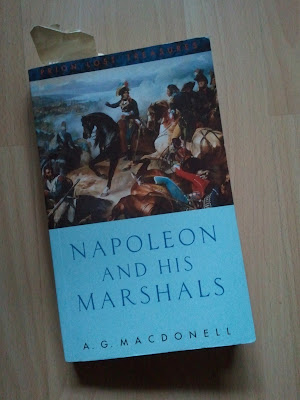
Napoleon and his Marshals by Macdonell
This book is very well written: the story flows, with anecdotes sprinkled liberally but always in the service of the characterisation of the marshals. Those characterisations are masterful and bring to life men from two centuries ago, although maybe not always free from Macdonells preconceptions.
We follow the story ofFrance
But to Macdonell, that lack of moderation was not what brought down the Empire. He paints the decline after 1807 in gloomy colours as talented young commanders like Lasalle, Montbrun and Lannes die fighting for it. The opposition to Napoleon’s attack onRussia
Then again, this book was written eighty years ago and it shows in many other ways. For example when Macdonell reassures us that although there is no bibliography, the reader should trust that every detail is backed up by a source. But it is hard to find a better book to read by the fireside and imagine yourself just for a second next to Ney as he guards the rear of the Grande Armée, musket in hand, against the swarming cossacks in the cold and snow.

We follow the story of
Macdonell makes two more exceptions from the description of military campaigns. The first is the story of the coup of Brumaire1799 and the second of the failed 1804 coup against Napoleon and his creation of the marshalate. To Macdonell these events were closely related.
The French revolutionary army was highly politicised, and republican and Jacobin factions competed with those that put more emphasis on return to order. This power struggle was behind the coups, and Napoleon’s creation of the marshalate was an attempt to reconcile those factions and bind them to his regime. The 1804 coup provided him with the opportunity to found a monarchy and dynasty but also removed credible alternatives for the opposition to rally around, like Moreau and Bernadotte.
In that way the list of marshals reflects Napoleon’s desire: old revolutionary heroes like Kellermann and Sérurier, Jacobins from the Army of the Rhine like Jourdan and Augereau, and his own supporters from Egypt (Davout), Italy
As a whole the marshals performed their task loyally and dutifully, but their loyalty was to Napoleon, or France Russia
 |
| Year of birth of the marshals, most were older than Napoleon |
But to Macdonell, that lack of moderation was not what brought down the Empire. He paints the decline after 1807 in gloomy colours as talented young commanders like Lasalle, Montbrun and Lannes die fighting for it. The opposition to Napoleon’s attack on
By 1813, the lust for glory and belief in the genius of the chief was no longer driving the marshals, but rather duty and loyalty. And in the end their lack of faith in the military and political judgement of the emperor led to his downfall a year later.
Even some of his oldest friends, like Marmont, switched their allegiance to the Bourbons. Others watched from the fence as he returned from Elba, professing their allegiance to France command at Waterloo
With so few loyal supporters left, Napoleon was forced to place his best commanders, Davout and Soult, in Paris
A lesser book would have spent more pages on Napoleon, but Macdonell resists that temptation and focuses on the motivations and interrelations of the marshals. Their many feuds and occasional friendships. Of course, there is more to say about the marshalate as the apex of a new military aristocracy, and its diplomatic and political role. A present day researcher might take a more systematic approach to this subject.
Then again, this book was written eighty years ago and it shows in many other ways. For example when Macdonell reassures us that although there is no bibliography, the reader should trust that every detail is backed up by a source. But it is hard to find a better book to read by the fireside and imagine yourself just for a second next to Ney as he guards the rear of the Grande Armée, musket in hand, against the swarming cossacks in the cold and snow.
Subscribe to:
Posts (Atom)