Showing posts with label Italy. Show all posts

Monday, 4 November 2019

Gaming goals - October update


This can be a very short post as I didn't do anything in terms of gaming goals. Yup, not one block changed colour this October. I didn't lift a brush, rolled no dice, dumped no book.

Technically I did play three games of Lost Cities, but that doesn't count.

I hardly cycled as well. Not even 200km.

The reason? Holidays and the big project still lumbering in the background.

Ten days cruising to Italy and back was awesome enough, though, and I slipped in the odd bit of (military) history. Looked upon Fortress Ehrenbreitstein in Koblenz, walked the 17th century walls of Lucca and spent the night on the battlefield of Arcis-sur-Aube.

Ehrenbreitstein

Lucca


Porto Venere


There was good food, beautiful countryside...

View from the hammock

Cinque Terre


and some awesome art

Werner Bischof, Dresden 1945
Barbari Baldi poster for Lucca Games & Comics

Jeffrey Catherine Jones at Lucca Games & Comics

But November will have to be different: the 1672 project needs work for a credible outing in February. So I need to make a decision on my painting method soon.

Also, PolderCon is back on the menu (yeah, I know...). Hope to see you there on February 2nd in Utrecht !

Monday, 19 December 2016

Borgia

It's been a long time, but I came back to playing The Prince: The Struggle of the House Borgia (sold as Borgia in the Netherlands) last week. The Italian renaissance has a strong attraction to game designers, it combines economic growth with art and architecture and intellectual growth. Princes of Florence, La Citta, Fresco, Leonardo Da Vinci and Medici are just some examples of games combining these elements. And that is ignoring all the games covering the exploration of the world in the same period.


But there's another side to the renaissance that attracts designers and that's the Machiavellian politics. When you want a game that has conflict and backstabbing as well as the above, the exploits of the condottiere and scheming of the renaissance popes offer a good background.

Not for nothing one of the games that takes this approach is named after the Florentine politician and philosopher. But there's others as well: Martin Wallace's Princes of the Renaissance and Borgia. While Machiavelli is a more detailed version of Diplomacy, the latter two games leave the physical map and use cards and counters to portray the expansion of power.

Borgia is the less complex of the latter two games. It plays in three phases where auctioning resource and action cards and attacking each other's resources make up the player's turns. The attacks can always be made on unprotected resources, ie they are not combined with a city. Otherwise it needs playing a condottiere card. They can be defended by playing condottiere cards as well.


The phase ends when all available cards have been auctioned. Then income is gathered and a papal election held, followed by a point tally. The points come from cities, famous artists and being chosen pope.

What proved interesting is that you can have a fun game threatening other players by attacking unprotected resource cards and then not play a condottiere card, hoping that the other player plays one, effectively wasting it. The downside is that you waste one of your limited actions and get nothing in return.


It became a very close run game in the end, with me losing by 151 to 147 points. I managed to take out a very valuable artist from my rival by stealing the medicine card of him first and then playing my plague card.

But he saved his victory by good defensive pairing of his stronger but less valuable cities to his artists and his weaker but more valuable cities to independent families that increased the defensive value. That meant that my condottiere cards were too weak to take them on and sway the game my way,

A sturdy game, but nothing can change my love for Princes of the Renaissance. Not even the fact that I suck at bidding games.

Friday, 5 July 2013

Leisurely Myths of Pisa

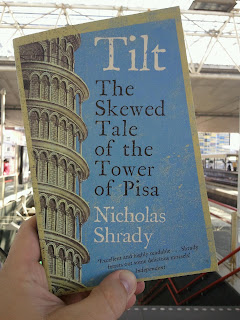
Nick gave me this book for my birthday and I guess the presents were themed with myth. Tilt busts a few of those and probably prolongs a few more. Shrady provides a pleasant read of the kind you like to have to hand driving in or out of the holiday town du jour. Meandering from this pretty view to that interesting story and on to that amusing anecdote with a paperified tour guide.


No escaping that tilted shot

Tilt nicely weaves the history of the iconic tower with that of the city and some of its famous inhabitants. It stages Pisa's sudden rise to greatness as a maritime republic, and its equally dramatic fall. The revolutionary architecture of the cathedral, baptistry and bell tower built upon its riches. The slowly increasing gradient and the attempts to arrest it (16 commissions over 8 centuries couldn't do it and the last had to fail before it succeeded). How Galileo didn't do his experiments in gravity from the tower. Even Mussolini gets a concrete cameo.

Friday, 31 August 2012

Why Italy came to dinner with only a plate and no cuttlery

I've posted the first 'review' in my Italian trilogy, John Whittam's The Politics of the Italian Army 1861-1918.

Find it her on the Maximum Effort blog


Next week I hope to offer a review of Thompson's White War, followed by Behan's The Resistable Rise of Benito Mussolini. I think I might need a post after that to address certain contentious issues.

Friday, 17 August 2012

The opening of the Memorial for le Mille on May 9th 1915

On May 9th 1915, the monument was christened for the 1,000 redshirts that accompanied Garibaldi on his trip to Sicily in 1860, beginning the 'liberation' of Southern Italy.

I put liberation in quotations because it soon became clear that the replacement of the Bourbon dynasty with that of Savoy didn't make that much of a difference to the Apulians, Sicilians and Calabrians. For decades the new Italian army was involved in putting down the ongoing revolt in the south, and banditism continued well into the 20th century.

The opening ceremony stood in the light of the Italian intervention in WWI at the side of the Entente. Italy had been allied to Germany and Austria-Hungary since 1882 but now opportunistically threw its weight on the other side, claiming not only the Trentino, Friuli and Triëste, but large parts of the Dalmatian coast in the secret treaty with Great Britain and France.

Gabriele d'Annunzio, Italy's most famous poet was recalled from Paris to whip up public fervour for war. France paid off his debts so he wouldn't be arrested.

On May 9th he promised, demanded bloody sacrifice: 'Blessed are the merciful, for they shall have splendid blood to wipe away, radiant pain to bind up'.

I'd think d'Annunzio got what he wanted. By 1918 over 670,000 Italians had lost their lives.

Thursday, 16 August 2012

Alpini, Go Home!


The Alpini are the Italian elite mountain troops. They earned their distinctions during the mountain battles of WWI, but also elsewhere in WWII. I've come across quite a few memorials in Italian towns and villages specifically for them.

They have characteristic hats with a feather. You can almost make it out in the picture.

However, the love is not universal, as you can see. Taken in Genova last week.

Saturday, 11 August 2012

Uniform of the Carabinieri Genovese

The Carabinieri Genovese were formed in 1851 as a rifle association.

The club was heavily influenced by the desire for Italian unity and many members were involved in the failed 1857 plot in Milan, Garibaldi's Cacciatory delle Alpi in 1859 and the Mille that set sail for Sicily with Garibaldi in 1860.

The uniform is on display in the Risorgimento museum in Genova.

Friday, 10 August 2012

Mussolini at the helm

Another fine painting from the Wolfsonia collection in Nervi.

Close to the outbreak of WWII, this shows Mussolini at the helm (it's called 'Il Nocchiero').

I like it a lot, with the crazy references to barbed wire, but also airplanes and the map of Europe.

Thursday, 9 August 2012

Fascist fascination with flight

This painting from the Wolfsonia collection in Genova-Nervi shows how the Futurist obsession with movement and action perfectly fitted fascism.

It is hard to separate the ideas of Futurism, which are grotesque and become soiled with fascist ideology, from the products, which are beautiful.

I went back early this morning to Nervi, just to see this collection, because I think it's a brilliant combination of design objects, graphics and more conventional forms of art. The trip was well worth the trouble.

I had to rush back for the train to Levanto.

Wednesday, 8 August 2012

Bust of Garibaldi

This bust is displayed at the Risorgimento museum in Genova.

It's an old school museum in transition, now having some multimedia displays.

Yet, it has an intreaguing collection because nationalists and revolutionaries Mazzini and Garibaldi had links to the city. Mazzini lived in the building for a while.

The museum doesn't expect non-Italians, I guess. There were few English texts and promotional material is only in Italian.

Tuesday, 7 August 2012

Women in times of war

A painting by Alba Giuppone from 1942-3 called Donne in tempo di guerra from the Galeria d'Arte Moderne in Genova-Nervi.

Nervi, a former upper middle class sea resort near Genoa, houses some nice art museums.

The GAM holds a few works of Futurist and later fascist influence, but this on transcends political lines, I feel.

Sunday, 5 August 2012

Gate of St Matteo church in Genoa

The S Matteo church was the private church of the Doria family, as can be seen from the eagle motives next to the door.

Inside is buried Andrea Doria, the legendary Genovese admiral, who led a coalition of Spain, Genoa, Venice and the Papacy to victory over the Turks in 1571 at Lepanto.

Thursday, 2 August 2012

Monument for the fallen of the Risorgimento in Tortona

This momument was erected around 1890 in Tortona to commemorate those fallen in the Risorgimento battles.

The period spans from 1848 to 1867

.

The list of battlefields includes all those I knew and a few more: Milano, Santa


Lucia, Peschiera (1848) Novara (1849), Palestro, San Martino, Peschiera, Solferino (1859), Milazzo (1860), Custoza, Villafranca, Montesuello (1866) and one battle from 1867 which I can't decipher and can hardly imagine. Not sure whether there was much fighting in 1867, or maybe this guy died of his wounds.

In terms of lives, the 1859/60 campaign was the most costly: 27 lives were lost, of which 10 at Solferino. The 1848/49 war cost 10 lives, and the 1866 campaign 5.

Remarkably, there are three deaths credited to the Crimea in 1854/1855, possibly the Battle of the Chernaya, but equally likely deaths of disease. It is interesting to see the Italians reckoning their participation in the Crimean War so directly to the Risorgimento. A quid pro quo for French intervention in Italy in 1859.

Anyway, 45 deaths in 20 years was a considerable sacrifice for an agricultural community.

Tuesday, 31 July 2012