Showing posts with label Prussian. Show all posts

Friday, 28 August 2015

The Phases of a Miniature Painting Project

Tomorrow I will be participating in one of four simultaneous battles from the Waterloo campaign. Slight problem is that the rules will be Black Powder for which I have little love, or any ruleset of its ilk. I go there to meet some really nice people. And because I bought a bunch of figures. Which has become a bit of a circular argument.


As I progressed with the painting last weekend, I started to recognise a number of phases in my painting. Whilst I have enjoyed preparing the miniatures and spray painting them, the painting itself became increasingly discouraging. Trying to follow the Army Painter philosophy you should refrain as much as possible from highlighting. I did a few highlights in blue, put a layer of light gray under the white trousers. Once I got to the white leatherwork, the many mistakes started to get me down. Although I persevered in the belief that Army Painter dip would solve all my problems, my religion was sorely tested when a came to the piping of the Landwehr field caps.


My hand may have been less steady, or I was starting to get irritated by not being able to reach the miniatures as easily when individually mounted. I was disappointed in the result and I resolved to go over all the caps again to redress the mistakes. I went over most colours. That made me feel better, but it also required extra time.


But what a difference the army painter dip made. It is very forgiving! By this time I was pretty happy with the look of the miniatures. The hardest part still had to come: basing them. I got a lot of useful suggestions from my facebook friend at Dutch Miniature Wargames, but I was being stupid and didn't have the right tools to hand for applying the plaster, but when I improved a sort of plastic spatula my aggression levels dropped off a bit.


I still believe that basing is the worst kind of job and psychologically at the toughest time in the process as you try to finish the project in time. I also am happy to go on record to say that re-basing miniatures is of the devil and a clean waste of time. No ruleset is worth that kind of shit.

Sunday, 23 August 2015

Zieten's Landwehr To Reach Waterloo In Time

Hurrah for deadlines! Significant strides were made painting my Landwehr. Now preparing to base the minis and allocating magnabase. I might not have to do frantic last minute work on Friday evening...


I've been able to do some painting the last two weekends, so that I got it almost done tonight. All that remains to be done is the drum and the drummer's shoulder wings. I also need to do the shoulder straps of the soldiers. I only decided today what unit they were going to be. I wanted them to be from Zieten's Corps at Waterloo because then they can fight at Ligny as well as Waterloo. Which basically leaves you with Westphalian Landwehr. Not the best of troops, but probably more fun and challenging than the French Guard. I've picked the 4th Westphalian regiment because I like light blue. 

It's not high quality painting of course. But it's fit for purpose and so far within the project constraints. There is still one issue outstanding, though. I still haven't got the materials to base my troops on. I also haven't prepared anything for basing: no flock no other stuff. I might just leave them as they are and just stick em on.

Monday, 31 March 2014

Review: Yorck and the Era of Prussian Reform, 1807-1815


Yorck and the Era of Prussian Reform, 1807-1815 by Peter Paret

My rating: 5 of 5 stars


Great book on the Prussian reforms before and after Jena-Auerstädt. Shows that it was not just a case of noble and visionary reformers vs dumb reactionaries, but a struggle in which military theories and practice were linked to but also conflicted with legal privileges, social attitudes and personal rivalries.

Considering the opposition it is amazing how much was achieved and one wonders what might have happened if Scharnhorst hadn´t died so young and peace hadn´t come so soon. In any case, the reforms turned the Prussian army from a laggard into a front runner, despite the rough edges.

Yorck´s role in all of this is much more interesting than many historians have it (and that includes recent historians who have simply repeated the myths of the past). Yorck was in many ways closer to the reformers than most, looking at his practice as a commander of the Jäger and the infantry regulations and training programmes he helped to write. On the other hand, he was quite aware that the consequences of the social change not only undermined his status and legitimacy as a noble, but thereby also that of other institutions. And he was a pain in the arse to work with.

All this lovingly analysed and extensively researched by the author.


View all my reviews

Thursday, 16 January 2014

A Bold and Ambitious Enterprise by Andrew Bamford

In December 1813 the British cabinet decided to create a force to operate in the Low Countries to assure that the area came under friendly rule, for which a suitable dynasty was quickly found in the House of Orange. Task of the force was to ensure the security of the new regime, then the expansion of that regime in to present day Belgium and the destruction of the French fleet in Antwerp if not the capture of the town. This book relates the story of that ‘bold and ambitious enterprise’.


I found the book interesting for three reasons:

A Bold and Ambitious Enterprise tells the story of a significant part of the army that would fight Napoleon at Quatre Bras and Waterloo a year later. It was led by the aged but capable general Graham, who had served with Wellington in the Peninsula. Its origins were not very fateful, cobbled together from units recovering and rebuilding from service elsewhere. Many of the men were only partially trained or otherwise unfit for service. It took time to gather enough strength to take aggressive action, but in reality was unable to do so without support from allied troops.

Although the troops performed as well as might be expected in two small scale attacks against the defences of Antwerp, the force failed its toughest test: the storming of Bergen op Zoom. This weak and isolated French garrison was a thorn in the flesh of the allies, occupying troops that Graham wished to employ against his main objective. The failure of the attack resulted mostly from insufficient troops employed and failure of leadership by senior commanders. Some went off on their own, thus leaving troops leaderless, other showed a lack of initiative. It all ended in half of the forces killed, wounded or captured. All this bodes ill for the performance a year later.

De Gevangenpoort or Prisoners Gate between the town centre and harbour
A British section held out here until forced away in the morning

The book also provides a counterpoint to the better known developments in France. Although this is just a sideshow, it shows the ways in which the area might have been more important had Napoleon successfully held off the Schlesische Armee and the Hauptarmee. It is interesting to see how the course of the war in France progressively allows or demands more troops to be shifted south.

Finally, it has more consideration for the position of Britain´s allies, ie the Dutch and Prussians, than most British authors. This prevents the book from the all too familiar blame game. Although Graham kept trying to get his allies to cooperate in a move against Antwerp (his main objective), it was understandable that their efforts were limited by overriding considerations elsewhere. The book also shows that quite a few people in prominent places during the Waterloo campaign had already acquainted themselves with their allies and struck up a workable relationship (eg Cooke, Bülow and Van Gorkum). That would prove useful.

The book is well written and makes good use of personal accounts. Although I didn’t care much for the details of British involvement, it was nice to read about the attack on Bergen op Zoom, having visited the town in September. Too bad not much of the fortress has remained.

Tuesday, 5 November 2013

Blücher at the Burgtor

It is time to set the spotlights on Gebhard Leberecht von Blücher, the charging Hussar general who once believed he was pregnant with an elephant (true story!). That didn't stop him from some prodigious feats on the battlefield while in his seventies and of giving Napoleon and his marshals a few bloody noses.

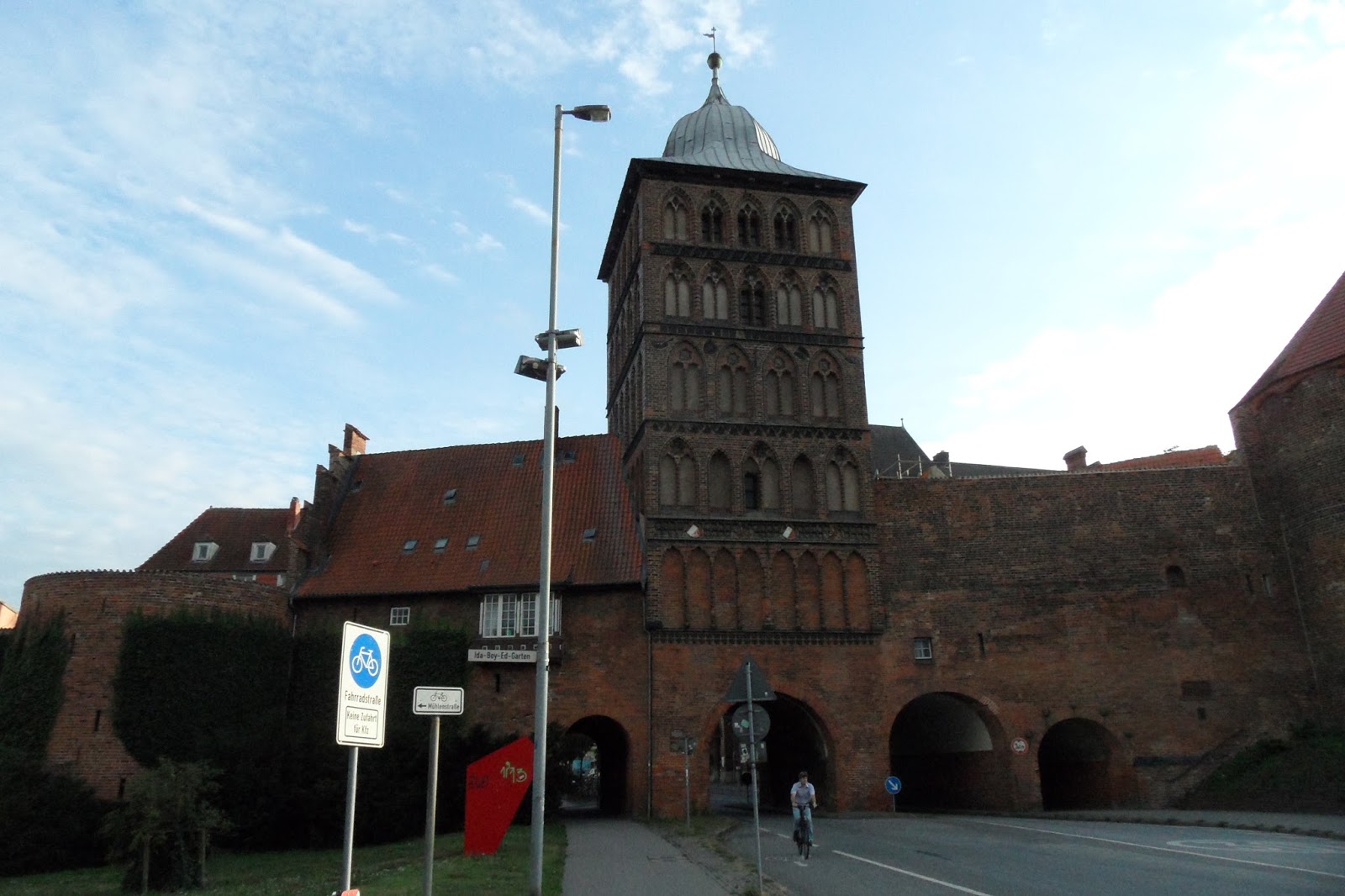
The Burgtor, or Castle Gate

This is the site from where he made the leap to national hero. On holiday in Hamburg last summer, we made a day trip to Lübeck and the nearby beach at Travemünde. When you enter the town from the east, you do so through the Burgtor.

Commemorative plaque on the wall of the gate

In the autumn of 1806, with the Prussian army in flight from its humiliating defeats at Jena and Auerstädt, Blücher was one of the few that kept ahead of the furious French pursuit. On November 5th his troops reached Lübeck and he set out to prepare the city for defence.*

The Burgtor from a slightly different angle

Next day the French attacked the city and managed to enter through the Burgtor, which was defended with little competence. Desperate counterattacks failed to throw the invaders back and Blücher's chief of staff, Scharnhorst was taken captive. The general himself managed to fight his way out of the city with the remnants of his force. However, on 7th November his men and ammunition were exhausted and there was nowhere left to run as they had entered Danish territory. The general realised that further resistance was futile and accepted a French demand for surrender.

The fight for the Castle Gate from a contemporary  print
(wiki commons)
* Some of you will know that Lübeck was then still an independent city. Blücher demanded access to the city from the city council. The French sacked Lübeck as they would have any defended city, not knowing that it had been against the wishes of the population.