Showing posts with label history. Show all posts

Friday, 3 May 2019

2 movies and some commemorations - part II

So this was another movie I went to (see yesterday's post) and it is wry humour that does the trick in this one. Although you could argue that most of the characters come out of this all too well, there is no doubt that many remarks in the movie have a kick if you realise what they would have meant in practice. The summary executions now are portrayed as comic rather than beastly, and Malenkow now comes across as an obseqious toad, without his direct and indirect responsibilities for the deaths of hundreds of thousands.


I remember reading parts of the Black Book of Communism (which sounds better in the original French) and being stymied by 100,000 deaths per page (for a 1,000 pages long if you can bear it).


The Mayday celebrations and the commemoration of Karl Marx' 200th birthday of course reopened that old discussion. While right wingers dismissed Marx completely and blamed all 100 million deaths of Communism on him, left wingers at least defended his scientific contributions, even if his predictions were widely off.

The allure of Whataboutism


The temptation of taking the easy way out it great. You can go a long way fending of the challenges to your beliefs by pointing out that crimes committed in the name of another belief were worse. We can try and just argue why imperialism was a worse crime than nazism or communism or slavery. As if determining which crime is worse would actually solve our dilemmas today.

So what if communism should prove to have made more deadly victims than any other ' bad thing', would that mean that inequality is okay and slavery too? Do the Gulags justify the Holocaust, or the other way around? Do the Crusades justify the bombing of the Twin Towers? Why even get close to such a trap?


We are not alone


But my promise to myself this year is that I will no longer stand idly by in these discussions. Not by outshouting others or letting go of the good manners in discussion just to win once. Because civilisation is not built on winning one argument, but on setting the conditions for resolving many arguments. Be it through laws, democratic process, rules for argumentation or  'good behaviour'.

In that way, even if we are not as committed to a cause as some others, by sticking to nuance and understanding, we set an example and show the value of those ideas. And we shall be beacons to those like us, also reluctant to join the fray. We are not alone. In fact, we are the majority. And our values are worth standing up for. So we need to be out there (wherever the discussion takes place) and visible/audible and support each other.

We can leave the floor to those on the extremes, but if any of the above commemorations should teach us anything, it is that if one extreme wins out, not just the other extreme loses out, but we all become limited in our freedoms, accomplices in the crimes of murderous regimes and chance victims of the violence they bring.


Like the mother in In Syria, we can't keep the world out. When it knocks on our door, it will be too late.

Thursday, 2 May 2019

2 movies and some commemorations - part I


About a year ago I went to watch In Syria, a very powerful movie about a woman and her extended family trying to make it through a day in war torn Damascus. The camera work is excellent drawing you into the claustrophobia of the appartment, even more powerfully than the tank in Lebanon.

What made it even more powerful to me is that these people are recognisable, westernised and hip, worrying about shaving their legs and the availability of broadband on their phones. It emphasises how much out of place are the bombardments and bouts of gunfire close by. And even though the  door of the appartment is blockaded, the sanctity of the home will be violated.

I cannot recommend this movie strongly enough to you.

Commemorating 'the war'


On May 4th last year, the official day of commemorating the war victims in the Netherlands, I joined the commemoration at Kamp Amersfoort, a concentration camp where the Germans in WWII kept Dutch high profile hostages from political parties and civic organisations to disencourage sabotage as well as people suspected of being part of the resistance. Over half were at some point moved on to camps in Germany, often with fatal results. Several hundred were shot or died from cruel treatment or the bad conditions during the war.

It was cathartic to file past the monument on the execution place in silence, with nothing but the evening sunlight and the spring chatter of birds.

Further on, at eight o' clock we kept the two minutes silence. As always, I thought of my grandfather who fought the German invasion in May 1940 and later survived as a POW in eastern Europe. But thanks to In Syria, I was now also more aware of the plight of those at home trying to keep going as best they could.

Whose commemoration is it anyway?


But the past isn't the past. It's here every day and part of today's struggles. The Dutch commemoration on the 4th of May has become part of the discussion about integration and inclusion. Anticolonial activists demanded that the commemoration also include the victims of the Dutch decolonisation wars, on the grounds that the Dutch soldiers killed in those wars were being commemorated as well.

On the other hand some right wing commentators tried to debunk the narrative that Moroccan soldiers (and other French colonial subjects) were actively involved in the defense of the Netherlands in 1940.

While there is no use in overstating the impact of Moroccan soldiers in this instance, it is good to realise that millions of Moroccans, Algerians, Senegalese and others from French colonies, but also similar amounts of Africans and Indians from British colonies, and Indonesians from Dutch colonies were enrolled in the armies that liberated Europe, Africa and Asia.

Many of them volunteers, many of them motivated by the struggle against nazism, or otherwise to show that by liberating others they were worthy of their own independence. At least, they are as worthy of our thanks as the American, British, Canadian, French and Russian soldiers.

Not to mention the length the colonial powers went to extract resources from these countries, even if it caused famine and poverty. Millions died in famines like that in Bengal, where food was denied the population to feed troops at the front, or working in mines, plantations or field works, or as carriers. It is a side of the war that doesn't always get its fair share.

And if we want immigrants to identfy with their new home, there is no harm in showing that at that point in time we were on the same side, the right side. And that the fruits of that struggle are for them to reap as much as anyone.

Some people disagree with changing anything about the commemorations on the grounds that 'things have always been done like this'. But I was enlightened by a historian pointing out that only from 1966 did the official commemoration in the Netherlands include the victims of the Holocaust. The most important lesson for me is that we should be very critical of the argument that 'this is how we've always done it'. People's memories are very poor and short.


More in tomorrow's post.

Sunday, 18 March 2018

Some of my recent reading: dark ages Frisia

Another couple of books I read the past moths were triggered by plans for some medieval wargaming. Somebody suggested that we should try the Battle of Vlaardingen in 1018, a smallish affair by today's standards. It was pretty momentous however, as it established the independence of the counts of Frisia against the Holy Roman Emperor.


Sadly the execution wasn't compatible with stuff I already had lying, waiting to be used, so my project will deal with the Battle of Hastings. But I read the stuff on Frisia anyway...


And the most amazing I learned is that the Dutch coast was mostly deserted in the 3rd and 4th centuries AD. Apparently rising water levels, combined with moving sand dunes made life extremely hard so it essentially depopulated. The people that came to inhabit the area afterwards were not the original Frisians of Roman times, but migrants from present day Northern Germany and Scandinavia, with a different material culture and different language. However, they were named after the area and for a long time people assumed there was a continuous link of Frisian inhabitation.

Sunday, 11 March 2018

Some of my recent reading: military innovation

So I'm on for a new adventure, starting in October. I'll be cooperating on a part of a larger series of handbooks about Dutch military history. Personally, it looks like I will mostly be writing on the 1813-1870 period.


Of course there'll be several themes discussed in this book, but I have taken a special interest in the development of technology and how it's integrated into military practice. It's become an interesting field in this century, since the military revolutions / revolutions in military affairs discussion blossomed up. Mostly this is a discussion about how you can foster innovation and draw the right lessons from the past to guide technological development towards succes while avoiding the pitfalls.


Part of that discussion focusses on where in the military organisation this innovation takes place? Is it top down (reforms of Prince Maurice or Gustavus Adolphus), is it bottom up (battlefield adaptation in WWI)? Or is it perhaps a complex interaction of military entrepreneurs in the military hierarchy that may or may not succeed in catching the ear of those with decision making power. And perhaps, I add as an historian, this changes based on social structures over time and space?


So I'm diving into some old and new literature...


Mostly on the 19th century, but if a valid theoretical point seems to be made, I'm happy to look beyond.


Let's say I'm pretty psyched about this project


Monday, 4 December 2017

An introduction to Angkor

Angkor is one of the world's biggest archeological treasures. The site contains hundreds of structures, many of which have not been recovered yet. They were built between 800 and 1300 AD and are of impressive size and artistry.

Ta Prohm

Part of the mythical aura that surrounds Angkor stems from its recovery from the jungle. The city was abandoned in the 15th century after the capital had been sacked by a Thai army. Although people used to live there for a long time after and foreigners visited the site in the 16th and 17th century, much of the city was overgrown after centuries.

Ta Keo, rebuilt with Chinese help
From the 1920s French archeologists (Cambodia was a French colony at the time) have started to recover and restore the temples. After the peace process in the 1990s and a listing as a UNESCO world heritage site these works, supported by archeologists from all over the world, have sped up.

The top structure of Pre Rup. An early temple, with lots of bricks
What makes Angkor interesting is that there are structures built over a period of 500 years, and you can see different styles interacting. Those style changes also reflect changes in religion, for example the shift in focus between Hindu gods Shiva and Vishnu and later to Buddhism.


Stone surrounded by jungle
On the other hand, all that remains now is stone, surrounded by jungle. That makes it very hard to imagine the living city of a millenium hence, with the stone plastered, painted and covered in copper or gold, the wooden buildings and the surrounding countryside cut by rice paddies and irrigation canals.

And of course the people of the city are missing. Angkor must have had tens if not a hundred thousand inhabitants. Officials and traders from the provinces under Angkorian control must have visited, as well as foreigners. A late 13th century Chinese diplomat has left an account that adds a lot of colour to our understanding of daily life, but it is hard to envision in the present environment.

Water reservoir at Sras Srang

One touch of nuance however. Apart from the temples there remains another element in the landscape: the baray, or water storages. The two largest of them, to the west and east of the city, measure several square kilometers. It is still discussed whether they were built to supply water to the inhabitants and/or irrigation system, or for purely symbolic reasons, but they are still visible and in some cases partially filled to this day.

Sunday, 3 December 2017

Back from South East Asia

It's been two and a half fascinating weeks. First ten days travelling through western Thailand in the footsteps of the 100.000 POWs who contributed to the construction of the infamous Burma railway (together with thousands of Japanese and perhaps 200.000 South East Asians). Then five days in Cambodia around the fabled temples of Angkor.

The party of premier Hun Sen, a former Khmer Rouge cadre, has effectively ruled Cambodia since 1979


It's been a lot of information to take in, even though much of that was self-inflicted. And as always while travelling, full of impressions that go beyond the immediate subjects of the trip. You can't help to notice that both Thailand and Cambodia have shed much of the essence of democracy despite still maintaining the trappings. Thailand is ruled by a military junta (that isn't very good at listening to the people) and the Cambodian government has just had the major opposition party banned.


Police booth in Kanchanaburi, Thailand


Yet life seems to be going on anyway. Military and police presence are light. In Bangkok and Siem Reap the Christmas season has started. Around the royal palace in downtown Bangkok we experienced the perfect storm of tourists, graduation day at university and the last opportunity to visit the ashes of revered former king Bhumibol (the exhibition has since been extended).

Tourist entrance to the inner sanctum of the royal palace, Bangkok


The poverty gap in these countries is still huge between those in the airconditioned zone (including us tourists) and those outside. Yes, I caught a cold.

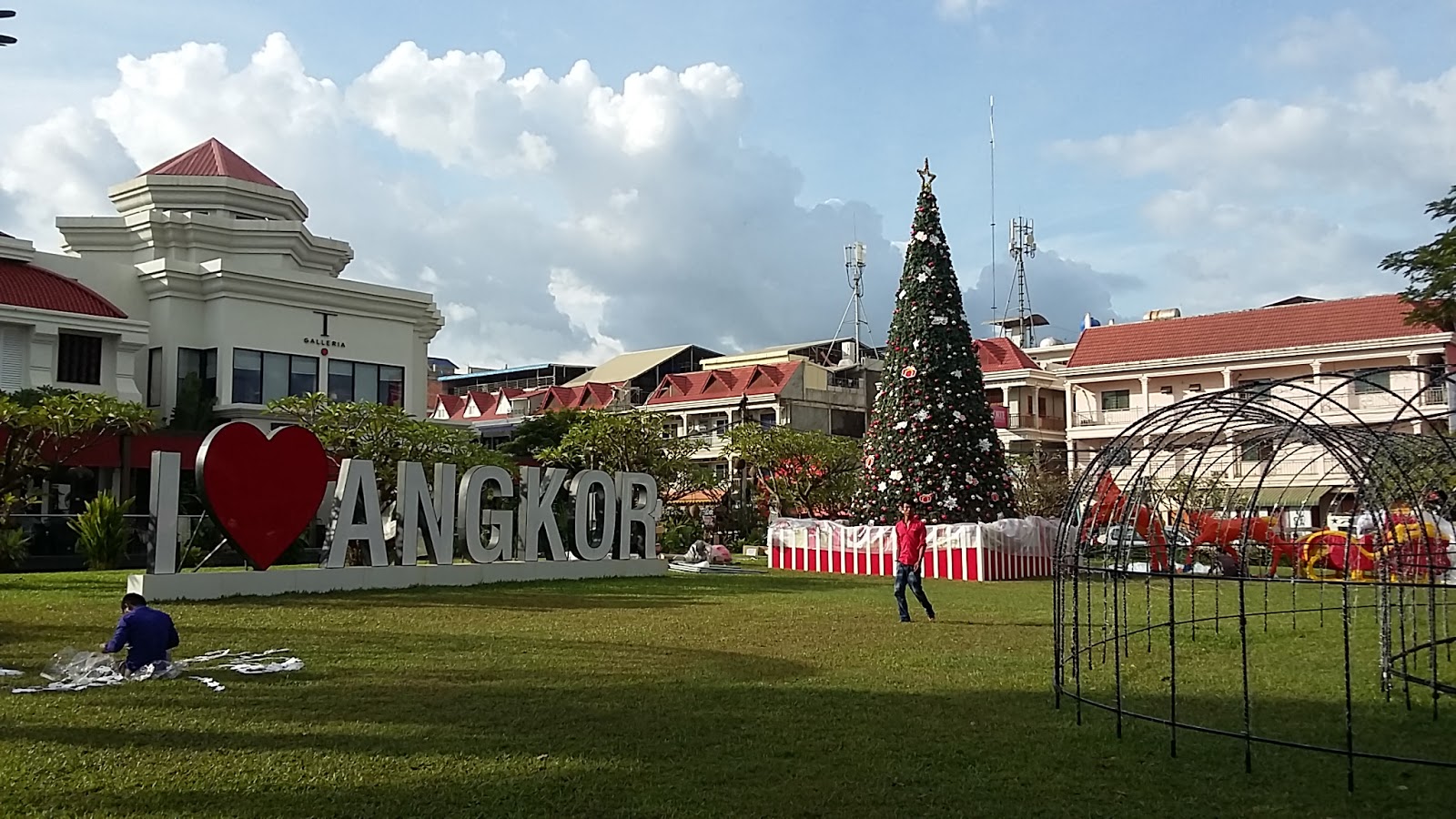
Christmas decorations are prepared before the luxury mall in Siem Reap (opened in 2016)
And Bangkok is a powerhouse, ever expanding its network of flyover roads and sky trains. I remember that the first skytrain rode between my first two trips in Thailand in 1999 and 2000. Now there are several lines and an underground. Then there were 6.3 million inhabitants, now 9.6 million.

Flyover roads under construction, Bangkok


It was also intense to make this trip. I'm not a group travel person and when you are around 35-40 co travellers, that takes some energy out of me. Most of these people had a direct personal relation to the railway, which for them made it an emotional experience that I could only relate to from a distance. I wouldn't have survived if it had not been for my travel companion Michael. We never ran out of topics to discuss and events to comment on, however silly.


I will be posting a few bits from the Angkor part over the next week, but the Thailand-Burma railway story will arrive after that and in a different format as I have a distant personal stake in it.

Sunday, 12 November 2017

Forgotten colonial war revisited

Ok, just a small step back to one of the books about colonial wars I posted on some time ago. I follow the excellent podcast series New Books in Military History, which has an interesting selection of new material. Some time ago I listened to a comparison of genocide and conquest on the Eastern Front in WWII and the the American West.


What I found interesting is that the author, Westermann, took up this project based on discussions in his classes, where he found the students would naturally compare different forms of genocide. When it comes to genocide, Nazi Germany remains the archetype/Idealtype, although the last decades our historical knowledge of other genocides has widened.

Of course looking at genocide involves a discussion of the definition, but most definitions go farther than just the mass murder of a particular group with the intent of total destruction. Some include the destruction of culture and separate identity.

While it easy to dismiss referring to the Holocaust as a Godwin, in this vase it is actually helpful.

Westermann notes that what happens 'at the sharp end' of policy doesn't necessarily align with what happens at the centre. And while what happens at the sharp end may seem very similar in both cases, Westermann argues that the main difference between the American and the German case is that in the former, the authorities were not bent on genocide and in the latter they were.

It's worth listening to his argument in full.


Sunday, 5 March 2017

Symmetry on the western front in WWII

The bazooka vs panzer book whetted my appetite for some more WWII western front stuff (I still have that 20mm US army miniatures hanging around), so I picked up this new Osprey pitting German and US armoured infantry against each other.


There didn’t seem to be much difference between the Panzergrenadier and armoured infantryman when it comes to equipment and armoured fighting vehicle. There were some differences in replacement policy but those went for the armies as a whole and didn’t affect tactical and operational employment. Zaloga refers to a German preference for attacking mounted in their AFVs, but that is not what happens in the examples, so we don’t have any idea how that plays out.

Armoured divisions on both sides suffered when defending because they had a smaller infantry complement than an infantry division. And while the Americans had the luxury of being on the strategic offensive and thus only having to defend occasionally, the German army by the end of the war had to plug gaps with whatever came to hand, thus putting the armoured divisions at a disadvantage.

Apart from an offensive or defensive stance the determining factor in the outcome of this match up was that the Americans had much more stuff and were better at coordinating them. So while the Germans even struggled to get artillery support for their attacks, the Americans could pour artillery on enemy attacks, supplemented with air attacks when the weather was good.

My main problem with the book is that the combat narratives, and especially the last one, are not that clear and are badly supported by the maps. Especially in the last case it is hard to figure where the combat is taking place to St Vith and other places which are constantly referred to in the text. To sum up: I lost interest at some point.

Looking back it wasn’t written in the stars that the last four books I read would all be from the Combat and similar Duel series, but that’s how it played out. I’ve warmed to these series but my impression has been confirmed that the best of these are the ones that pit different styles of warfare against each other. With the armoured infantrymen and the World War I askaris, there is a less interesting dynamic than between Apache vs US cavalry and bazooka vs tank.

Friday, 3 March 2017

Asymmetry on the western front in WWII

After a couple of colonial contests, I was happy to shift to World War Two. I had been intreagued by the match up between the bazooka and German close defense systems for tanks.


Steven Zaloga is an authority on tank warfare, and his knowledge on this subject does not disappoint. The dynamic interaction between antitank tactics and close defense is explained well, debunking some myths on German mesh side armour. And there were some weirdly interesting solutions suggested, like the Vorsatz P.

It was all rather marginal though, as infantry weapons were responsible for only a small amount of tank losses, with tanks, aircraft and artillery doing the most damage. The main impact may have rather been to give infantry the idea that they wouldn’t have to face tanks empty handed. Also the bazooka was used far more often to take out enemy strong points than to fight tanks.

Zaloga then delves into one example where tanks and infantry were pretty evenly matched, during the Ardennes offensive in December 1944. As this fight took place in favourable circumstances for the infantry, with limited vision due to fog and houses, the infantry was able to get close to the tanks and on their weak side and rear armour.


Sadly, lacking in the account is the perspective of the German tankers and their attempts at close defense here. All in all the technical/tactical account of the start didn’t mesh too well with the combat narrative.

Tuesday, 28 February 2017

And yet another forgotten colonial war

Even when I was young, we didn’t play Cowboys & Indians any more and Westerns have declined as a movie theme. But despite the relative neglect, the Indian wars remain a fascinating colonial conflict.


By the time the U.S. army took on the Apache tribes in the middle of the 19th century, the issue was no longer in doubt. The demographic and industrial weight of the US totally overshadowed that of the hunting and farming Apache who number in the tens of thousands.

This was a war of relatively small battles, neither side bringing more than several hundred combatants to the fight. However, each Apache killed had long term consequences for the survival of his tribe, while there was a steady flow of new recruits for the cavalry.  At the same time, expanding settlement reduced the hunting grounds on which the Apache depended, thus forcing them into raiding.

Nevertheless, the struggle was a long and bitter one, which could only be brought to an end by employing Apache versus Apache. This although the cavalry itself made significant strides in its counter guerilla capabilities. Equipment and tactics were adapted to the climate and Apache warrior society.

Likewise the Apache adapted to the western world, improving their weaponry, and finding ways to sabotage telegraph communications. They also used their superior knowledge of the terrain to move and live undetected.

The only way to really get at them was to use scouts from rival tribes. There was little sense of common cause between these tribes and for many warriors the opportunity to stick to their warrior lifestyle, plus a gun and free meals, was too good to be missed.


McLachlan does an excellent job using first hand accounts from both sides to illustrate the challenges that both sides faced and how the social-political dynamics of the Apache and white settler society made conflict inevitable. The narrative flows well, the analysis is crisp and the illustrations fit the narrative. Probably the best Osprey book that I’ve read on ‘non-western‘ armies.

Sunday, 26 February 2017

Another forgotten colonial war

Got a bit frustrated with my lack of reading lately and so decided to take on some lighter stuff, and Ospreys have proven excellent in that regard. Easy to pick up and lay down on the commute.


First off was King’s African Rifles vs Schutztruppe, continuing the theme of forgotten colonial wars. Not a middle of the military history road subject. First of all it deals with an African side show in World War I, when troops from British colonies tried to conquer the German colonies. And secondly, it prominently features the African soldiers fighting the war.

And compared to most Osprey books, there is more information on the non-western protagonists. It is made clear that in the British units, with fewer white NCOs, more responsibility devolved on the black NCOs especially when the (always white) officers became casualties.

And the author very cautiously treads the subject whether having more European NCOs was better for battlefield performance. There are even a few passages from the memoires of black participants.
On the other hand, in the operational narrative, the perspective of the black soldiers fades into the background. The prime actors there are the natural environment dictating the tactical and strategic decisions made by white officers. And you can still wonder how the askaris felt about fighting a colonial war.

On all the other elements the book score above average. It does a good job of explaining the challenges of bush warfare in southeastern Africa and the differences in British and German policies towards war in Africa. Also, the operational narrative is clear and highlights the most important factors which are brought together in the final analysis. Special kudos for the illustrations, which are very well integrated into the narrative, reinforcing it with examples.

Sunday, 19 February 2017

Forgotten colonial wars don't go away

This is a very nice book on a forgotten colonial war that the Netherlands started without good reason and only ended with the arrival of a new colonial power, Japan, in 1942.*


From the first unsuccessful invasion in 1873, through the bitter decades of guerilla warfare to the anticlimax in 1942, Dutch colonial administrators and military struggled to bring an end to the costly occupation of a region that just would not submit, even when all hope seemed gone.

As the Dutch brought more power to bear, the resistance dwindled from a full fledged army defending the sultanate to desperate attacks on individual soldiers and bureaucrats. And as the Dutch sent their columns deeper into the hinterland, all of Aceh was marked with destroyed villages and hasty graves for freedom fighters and their pursuers.

The coming of the Japanese didn’t improve the lives of the inhabitants of Aceh, nor did their struggle end with Indonesian independence. And even though peace has reigned since almost a decade, Aceh is still a poor and neglected part of Indonesia.

Stolwijk, who lived in Aceh for 18 months between 2009 and 2015, gives a sympathetic view of a society trying to overcome the painful present, while keeping alive the ghosts from the past. His anecdotes of interactions with former guerillas and collaborators, students and officials (who seem genuinely pleased that somebody takes an interest in the history of their building or train line) both provide comic relief and perspective.

*full disclosure: I’ve played a few games of football with the author and I think he’s a nice guy.


Sunday, 5 February 2017

Nazi women and Nazi Wives

Fascinating book. Most of the women in this book were highly dedicated to Hitler and his ideas. Magda Goebbels married the 'next best'. They paid a high price for their dedication after the war: destitution, imprisonment, even life.* Yet, several of them defended the Third Reich onto their dying bed.


The book gives a peek behind the scenes of the Nazi party. The stories of Geli Raubal, Hitler's favourite niece, and Carin Göring, the Swedish aristocrat that left her husband for Hermann, provide insight to the workings and social sphere of Hitler's entourage in the Kampfzeit, ie before the Nazis came to power.

It shows that the Nazis were human. Göring was a true romantic, whilst Goebbels was an adulterer with a penchant for adoration and self doubt. Even Hitler felt a moral obligation to take care of Eva Braun after suicide attempts, and although he ordered her to stay out of sight when foreign dignitaries visited the Berghof.

None of these women held any personal power. Women were considered unfit for the political sphere in Nazi ideology. Despite the huge services rendered for the party by benefactresses in the Kampfzeit, their opinions counted for little. Even the staunch Nazi organiser Gertrud Scholtz-Klink, in charge of the party (and later state) women's organisations, never actually got to talk to Hitler.

So all influence these women had was through their men. Whilst Emmy Göring and Henriette von Schirach slowly faded into the background as the influence of their husbands waned, Eva Braun slowly increased her hold on Hitler's private life.

Is there a lesson in these stories?


* That's not saying it wasn't just or deserved or both.

Sunday, 29 January 2017

British Invasion

A colleague of mine gave me this interesting little book. When he read my Waterloo book he revealed that he’d done a documentary in 2011 on the recovery of the bones of a British soldier in the Dutch dunes near Groote Keeten.


The soldier had died on the 27th of August 1799, during the landing of a British invasion force on the Dutch coast. The intention was to raise the Dutch  against their French allies and for the previous sovereign, Stadtholder William V of Orange. When the French had conquered the Dutch Republic in 1795 they installed a satellite government of Dutch revolutionaries.

Although the British invasion force managed to gain the Dutch fleet base (and fleet) at Den Helder and the city of Alkmaar, they were unable to make more headway towards Amsterdam, even after being reinforced by a Russian expeditionary force. Neither had Orangist sympathisers made much of a showing. Late in the year, the British and Russians reembarked, leaving little trace.

The discovery of the remains of the British soldier lead to an archeological dig at the site. The book describes the research, based on the finds at the site linked to historical evidence.

There’s the estimates of length and age based on the skeleton, the analysis of the wood and metals of a musket, some cloth and buttons which all go some way to identifying it as the remains of a soldier of the Coldstream Guards.

A more precise identification was not possible, although based on letters and official records, the search could be narrowed down to a handful of individuals who had died on the 27th of August.


In 2012 the remains were returned to the Coldstream Guards for interment in Britain.

Friday, 27 January 2017

From the Congo to Nova Zembla. A small step

I referred to this beautiful book last Sunday. A year's worth of a German geographical magazine.


Not only is is 145 years old, it has the most beautiful maps. The publisher, Justus Perthes from the German city of Gotha, had a golden reputation for its map making. I also have an atlas of the classical world from these guys. Stunning work.


Not only does it have a piece on Livingstone's research into the origins of the Nile, it also has a lot of stuff on a polar exhibition to Nova Zembla. And this is where a legendary chapter in Dutch history comes to pass. Because what the polar expedition found was an old hut, known in Dutch as Het Behouden Huys, in which a group of Dutch sailors survived an arctic winter.

Here's the 1872 map, showing the location of the hut near the lowest cape on the eastern coast.


In 1596 an expedition led by captains Barentsz (yes, the sea is named after him) and Heemskerck tried to find a way to the East Indies by the north cape. It was hoped that in this way, the Spanish and Portuguese, who claimed the Indian Ocean and the Pacific as their monopolies, could be avoided.


The expedition failed, getting stuck in the polar ice. But the account of their survival during the polar winter, including fights with bears, was widely read and still forms one of the seminal elements of Dutch pride in their Golden Age. The magazine included a couple of classic prints out of the account.


With the north route proven to be unusable, Dutch traders forced more resources into breaking into the Indian Ocean, which lead to the foundation of the Dutch East India Company and a colonial empire that lasted for almost 350 years.

Tuesday, 24 January 2017

Lovely sculptures

Went to a great exhibition on sculpture this Saturday, charting its development from the mid 19th century till today. The main theme was how sculpture broke free from copying classical and renaissance artists, to new forms and themes. Very well done.


Ecce Puer (See the child) by Medardo Rosso, 1906.


Lee Bontecou, Untitled, 1937. Wonderfully 3D effect done with canvas


Beatifully stylised Bird Swallowing A Fish by Henri Gaudier-Brzeska, 1914.


This piece, Der Rächer by Ernst Barlach from October 1914 is a good reminder that Germans at that time didn't see themselves as evil invaders but as righteous avengers. The avenger is holding a saex, an ancient Germanic sword type. I feel there's an uncanny resemblance between the face and that of then Emperor Wilhelm II.


Barlach's enthusiasm for the war quickly wore off on the front and he returned as a pacifist. His post war work includes many commemorative signs at war cemeteries. His work was later labeled as Entartete Kunst by the Nazis. Just like Käthe Kollwitz, who lost her son in the Great War. This is her Turm der Mutter from 1937.


Friday, 20 January 2017

How not to write a history of slavery

Rarely have I been so disappointed in a historian that I held in high regard as by Jeremy Black’s Slavery. A New Global History. There are probably very few untruths in this book, but there is a glaring imbalance.


There are markets and goods, there is military technology and repression. Slavery was more harsh in the Carolinas than in the Chesapeake Bay. But beyond the abstractions that Black uses, you’ll be hard pressed to find out what life would have been like for a slave or a slaver or a freed slave living in a slave society: the daily routines, housing conditions, punishments, or slave markets.

Also the agency of the slaves in ending slavery is dismissed in a few sentences as ‘evidence ... is limited’. But since this is a major theory in the study of slavery, you might expect a serious discussion. As would be warranted by the rest of half century of research and debate on slavery that Black mostly ignores.

The imbalance is especially striking when the book is full of not that relevant detail on imperial and colonial history, and on the abolition debate in Great Britain and its role in the following decades. To the point where becomes self-congratulatory.

Alright, there are some redeeming features. This book has a more global perspective than most, looking beyond the early modern Caribbean. What it basically underwrites is that slavery was part and parcel of most societies up to the 19th century and its sudden retreat in that century is something worth noting.

But essentially this is a White Englishman’s History of Slavers that might have been written in the 1960s. Black should have known his limits and stuck to military history.

Thursday, 5 January 2017

Integration through military service

First book read this year! Chance encounter in 2nd hand. Very readable military autobiography of early 19th century.

Koch was born in the small German principality of Waldeck before the French Revolution and joined a Waldeck regiment in Dutch service in 1803. This took him into Austria in 1805, Eastern Germany in 1806, Spain in 1808.

As the Waldeckers were corporated into Dutch and later French regiments, Koch doesn't seem to have been troubled too much. However, he requested to be released from French service in 1814 and returned to the Netherlands in 1814.

He remained in Dutch service during the Waterloo campaign and the war against Belgium in the 1830s, ending his rise through the ranks as commander of the veterans in Leiden in the 1840s.

In all this time he only saw his family three times, and he settled and died in the Netherlands, where his autobiography was taken down by one of his sons.

Tuesday, 13 December 2016

The most thankless job in war

I wrote this short introduction for a presentation I will be making at the Poldercon convention on February 12th. They asked for a presentation on the 1815 campaign, and the theme of the convention seems to be the rear guard action, so I decided to combine them. 
---

"The rear guard: the most thankless job in war. Risking your life to save that of others. Not seldom it ends in total disaster, without a Chanson de Roland to make you immortal. The best you can hope for is to be forgotten.

On the other hand there are many more rear guard actions than pitched battles. It’s the small clashes that determine who has the most advantageous position during the big battle. And it’s the rear guard actions that determine whether a defeat is decisive, or the loser can salvage his force.

Time for some more love for the rear guard action!

I will be taking you through the Napoleonic Wars and in particular the campaign of 1815 using these small but important combats. From the Prussian rear guard at Charleroi on the morning of June 15 to the retreat of general Rapp. What are the secrets of a successful rear guard action and how to bring them to the wargaming table?"

---

For the presentation itself, I'm thinking of 
  • a short introduction on what the role of a rear guard is
  • followed by a number of examples from the Napoleonic wars (eg 1806 post Jena/Auerstädt, 1812 Russian retreat, 1813 and 1814)
  • Then delve into the 1815 campaign: Charleroi/Gilly, Frasnes, Gembloux, Namur, Oise crossings, Rapp's retreat
  • Try to derive some factors for success and failure
  • Translating it into wargames in the form of scenario's or campaigns

Since this is a 90 minute presentation I'm still thinking hard how to make this an interactive experience.

Anybody got further suggestions for this presentation?

Thursday, 8 December 2016

Egyptian encounter

Went to see the renovated Egyptian exhibition and the Valley of the Queens exhibition in the ancient history museum in town. Really well done, lovely stuff on display. Text is slowly disappearing from museums, to get people to hire the audio tour, but there is enough to go round.

Bes, dwarf god
I'm surprised at the breadth of objects available now and the depth of knowledge that we seem to have reconstructed of this age. The beauty of objects that have remained fairly intact over 4,000 years still amazes me.

Taweret, hippopotamus goddess
Revisited my old friends Bes and Taweret, Egyptians god that were mostly revered in the household as defenders of the children. There were two exceptionally beautiful statues last summer in the British Museum, but these examples are probably closer to what real people kept in their homes.

Queen Hatshepsut, Pharao
The Queens of the Valley has some wonderful stuff about the few women that became pharaos themselves, about court life, the workers that built the monuments in the Valley of the Queens and the burial site of queen Nefertiti.