Showing posts with label Leipzig. Show all posts
Showing posts with label Leipzig. Show all posts
Monday, 31 March 2014
Review: Yorck and the Era of Prussian Reform, 1807-1815
Yorck and the Era of Prussian Reform, 1807-1815 by Peter Paret
My rating: 5 of 5 stars

Great book on the Prussian reforms before and after Jena-Auerstädt. Shows that it was not just a case of noble and visionary reformers vs dumb reactionaries, but a struggle in which military theories and practice were linked to but also conflicted with legal privileges, social attitudes and personal rivalries.
Considering the opposition it is amazing how much was achieved and one wonders what might have happened if Scharnhorst hadn´t died so young and peace hadn´t come so soon. In any case, the reforms turned the Prussian army from a laggard into a front runner, despite the rough edges.
Yorck´s role in all of this is much more interesting than many historians have it (and that includes recent historians who have simply repeated the myths of the past). Yorck was in many ways closer to the reformers than most, looking at his practice as a commander of the Jäger and the infantry regulations and training programmes he helped to write. On the other hand, he was quite aware that the consequences of the social change not only undermined his status and legitimacy as a noble, but thereby also that of other institutions. And he was a pain in the arse to work with.
All this lovingly analysed and extensively researched by the author.
View all my reviews


Wednesday, 5 February 2014
Weather Vanes: the Art of Changing Sides
Mattijs Lok: Windvanen. Napoleontische Bestuurders in de Nederlandse en Franse Restauratie (1813-1820)
A study of the political survival of Dutch and French members of the Napoleonic regime during the Restoration. This book draws its strength from the comparison between the two countries, the analysis of the rite de passage that was inherent in crossing the political lines and the description of the popular press criticising the ´weather vanes´.

Despite the political revolution of 1813/1815 many bureaucrats, officers and senior politicians remained in office. How did they manage? Over the course of the regime change, the senior politicians were able to shape the events by shifting their loyalty. They did not all do so at the same time and not always out of conviction. But by their conversion in a period when the new regime had not settled they moved the scales in the right direction, thus ingratiating themselves with the new rulers.
The new regimes needed experience bureaucrats and, being still weak, had no ambition to create an internal opposition from the start. Also, both Willem Frederik and Louis XVIII had previously sought Napoleon’s favour themselves so they could not claim the moral high ground.
There was also a striking continuity in the institutions of the old regime, despite public displays of the restoration of the ancient regime. The Napoleonic legacy was not only popular enough that a real return to the old institutions would have created such unrest as to unbalance the fledgling monarchies, the bureaucracy was also very useful to the Louis and William. The imperial system of government was a top down authoritarian administration subjected to the needs of the emperor and the military. It gave the restored monarchs more power than their ancestors had had before the revolution.
But there was such a broad sense of unease that much of the Napoleonic bureaucracy remained that this continuity was downplayed as much as possible while stressing the need for unity and reconciliation. This narrative was enforced so strongly in the Netherlands that opposition to King William was stifled for years.
But discontent could not be suppressed entirely. The most committed supporters of the returned Houses of Bourbon and Orange could not hide their disappointment. Not only did they resent that former opponents went unpunished and were even rewarded, but more so they lamented that their suffering for the cause had gone unnoticed. They had sacrificed their careers for their convictions and now felt insufficiently compensated. They took out their revenge on the weather vanes by publicly holding them to account for their lack of conviction.
A successful conversion went to several phases. The first (optional) step was a request to the old ruler to be relieved from the oath of loyalty. Next a letter was written proclaiming adhesion to the new rulers. This was often a convoluted document defending the choices for former regimes in the past. Most times this was followed by an invitation from the new prince to enter his service. This later involved swearing a new oath. The monarch later confirmed the union by continuing the noble titles from the Napoleonic regime or awarding new. Knightly orders were also instituted so the king could express his gratitude.
The move from regime to regime was by no means an easy one. In the Netherlands it took several weeks before it became clear that the rising against French rule would succeed, and many preferred to bide their time before committing themselves. In France the dismantling of Napoleon’s rule in April 1814 was more rapid, but complications erupted as the emperor returned. It forced politicians, bureaucrats and officers to make difficult choices twice in three months.
And so it went wrong occasionally, as in the cases of Dutch admiral Ver Huell and bureaucrat/general Dirk van Hogendorp. Ver Huell eventually ended up in the French Chamber of Peers, but Van Hogendorp met a tragic death in Brazil. In France marshal Ney was the prime example of failure to choose wisely. He died in front of a fire squad.
The second restoration of the Bourbons was in any way more traumatic than the first and the Dutch. To the reactionary ultra monarchists the reversal of many bureaucrats to the returned emperor was a betrayal of the magnanimous treatment they had been offered in 1814. This inspired the ultras to sweeping purges of a quarter to a third of all French bureaucrats. In some parts of the country this even escalated into mass arrests, and occasional murder and lynching. Although Louis and his government discouraged these excesses, they were nevertheless tainted by them and their legitimacy of their regime was weakened as a result.
Although this book focuses almost exclusively on the civilian side of the bureaucracy, there are some interesting bits on the military and the rite de passage analogy is readily applicable to army officers. Maybe I can use it to analyse letters by Dutch officers in the National Archives in The Hague.
A study of the political survival of Dutch and French members of the Napoleonic regime during the Restoration. This book draws its strength from the comparison between the two countries, the analysis of the rite de passage that was inherent in crossing the political lines and the description of the popular press criticising the ´weather vanes´.
Despite the political revolution of 1813/1815 many bureaucrats, officers and senior politicians remained in office. How did they manage? Over the course of the regime change, the senior politicians were able to shape the events by shifting their loyalty. They did not all do so at the same time and not always out of conviction. But by their conversion in a period when the new regime had not settled they moved the scales in the right direction, thus ingratiating themselves with the new rulers.
The new regimes needed experience bureaucrats and, being still weak, had no ambition to create an internal opposition from the start. Also, both Willem Frederik and Louis XVIII had previously sought Napoleon’s favour themselves so they could not claim the moral high ground.
There was also a striking continuity in the institutions of the old regime, despite public displays of the restoration of the ancient regime. The Napoleonic legacy was not only popular enough that a real return to the old institutions would have created such unrest as to unbalance the fledgling monarchies, the bureaucracy was also very useful to the Louis and William. The imperial system of government was a top down authoritarian administration subjected to the needs of the emperor and the military. It gave the restored monarchs more power than their ancestors had had before the revolution.
But there was such a broad sense of unease that much of the Napoleonic bureaucracy remained that this continuity was downplayed as much as possible while stressing the need for unity and reconciliation. This narrative was enforced so strongly in the Netherlands that opposition to King William was stifled for years.
But discontent could not be suppressed entirely. The most committed supporters of the returned Houses of Bourbon and Orange could not hide their disappointment. Not only did they resent that former opponents went unpunished and were even rewarded, but more so they lamented that their suffering for the cause had gone unnoticed. They had sacrificed their careers for their convictions and now felt insufficiently compensated. They took out their revenge on the weather vanes by publicly holding them to account for their lack of conviction.
A successful conversion went to several phases. The first (optional) step was a request to the old ruler to be relieved from the oath of loyalty. Next a letter was written proclaiming adhesion to the new rulers. This was often a convoluted document defending the choices for former regimes in the past. Most times this was followed by an invitation from the new prince to enter his service. This later involved swearing a new oath. The monarch later confirmed the union by continuing the noble titles from the Napoleonic regime or awarding new. Knightly orders were also instituted so the king could express his gratitude.
The move from regime to regime was by no means an easy one. In the Netherlands it took several weeks before it became clear that the rising against French rule would succeed, and many preferred to bide their time before committing themselves. In France the dismantling of Napoleon’s rule in April 1814 was more rapid, but complications erupted as the emperor returned. It forced politicians, bureaucrats and officers to make difficult choices twice in three months.
And so it went wrong occasionally, as in the cases of Dutch admiral Ver Huell and bureaucrat/general Dirk van Hogendorp. Ver Huell eventually ended up in the French Chamber of Peers, but Van Hogendorp met a tragic death in Brazil. In France marshal Ney was the prime example of failure to choose wisely. He died in front of a fire squad.
The second restoration of the Bourbons was in any way more traumatic than the first and the Dutch. To the reactionary ultra monarchists the reversal of many bureaucrats to the returned emperor was a betrayal of the magnanimous treatment they had been offered in 1814. This inspired the ultras to sweeping purges of a quarter to a third of all French bureaucrats. In some parts of the country this even escalated into mass arrests, and occasional murder and lynching. Although Louis and his government discouraged these excesses, they were nevertheless tainted by them and their legitimacy of their regime was weakened as a result.
Although this book focuses almost exclusively on the civilian side of the bureaucracy, there are some interesting bits on the military and the rite de passage analogy is readily applicable to army officers. Maybe I can use it to analyse letters by Dutch officers in the National Archives in The Hague.
Friday, 3 January 2014
Review: Radetzky: Imperial Victor and Military Genius
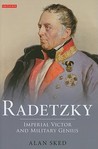
Radetzky: Imperial Victor and Military Genius by Alan Sked
My rating: 3 of 5 stars
This book fails for trying too hard. Sked is so busy insisting on Radetzky’s genius without always providing sufficient proof that the reader becomes suspicious. Sked always takes the Austrian side, and among Austrians always that of Radetzky.
There is no doubt that Radetzky was a very brave and capable officer, and his early career provides numerous examples in various theatres and roles. In the wake of the defeat at Wagram, the 42 year old general was appointed as chief of the general staff. In the following years he would be instrumental in rebuilding the Austrian army from scarce means and leading it to victory and the occupation of Paris in 1814.
He would remain active as a commander, thinker and organiser in the following 35 years. But his finest hour would be his victory at old age in 1848 and 1849 against Italian revolutionaries and nationalist led by the king of Sardinia-Piedmont. Clearly, Sked is most at home in the crisis of revolutionary Italy in 1848-9 (on which he has published before). This is where he uses primary sources at great length to support his narrative.
But his account of the Napoleonic Wars is based on secondary sources. Surprisingly, Radetzky sometimes doesn’t actively contribute for several pages, as if he’s not the driving force that Sked maintains he is. I would have been curious to know how Schwarzenberg, commander of the allied army, and Radetzky interacted: was Schwarzenberg the guy who sold Radetzky’s plans to the monarchs or did he add his own ideas? When Schwarzenberg is said to have made a decision, was it really his? Radetzky’s strategic principles are set out clearly, but what was his day to day role in the army? This lack of added detail means that his description of the 1813 and 1814 campaign adds very little to other accounts.
View all my reviews
Thursday, 12 September 2013
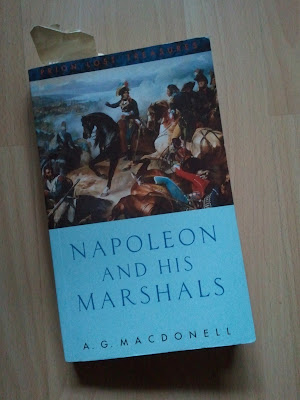
Napoleon and his Marshals by Macdonell
This book is very well written: the story flows, with anecdotes sprinkled liberally but always in the service of the characterisation of the marshals. Those characterisations are masterful and bring to life men from two centuries ago, although maybe not always free from Macdonells preconceptions.
We follow the story ofFrance
But to Macdonell, that lack of moderation was not what brought down the Empire. He paints the decline after 1807 in gloomy colours as talented young commanders like Lasalle, Montbrun and Lannes die fighting for it. The opposition to Napoleon’s attack onRussia
Then again, this book was written eighty years ago and it shows in many other ways. For example when Macdonell reassures us that although there is no bibliography, the reader should trust that every detail is backed up by a source. But it is hard to find a better book to read by the fireside and imagine yourself just for a second next to Ney as he guards the rear of the Grande Armée, musket in hand, against the swarming cossacks in the cold and snow.

We follow the story of
Macdonell makes two more exceptions from the description of military campaigns. The first is the story of the coup of Brumaire1799 and the second of the failed 1804 coup against Napoleon and his creation of the marshalate. To Macdonell these events were closely related.
The French revolutionary army was highly politicised, and republican and Jacobin factions competed with those that put more emphasis on return to order. This power struggle was behind the coups, and Napoleon’s creation of the marshalate was an attempt to reconcile those factions and bind them to his regime. The 1804 coup provided him with the opportunity to found a monarchy and dynasty but also removed credible alternatives for the opposition to rally around, like Moreau and Bernadotte.
In that way the list of marshals reflects Napoleon’s desire: old revolutionary heroes like Kellermann and Sérurier, Jacobins from the Army of the Rhine like Jourdan and Augereau, and his own supporters from Egypt (Davout), Italy
As a whole the marshals performed their task loyally and dutifully, but their loyalty was to Napoleon, or France Russia
 |
| Year of birth of the marshals, most were older than Napoleon |
But to Macdonell, that lack of moderation was not what brought down the Empire. He paints the decline after 1807 in gloomy colours as talented young commanders like Lasalle, Montbrun and Lannes die fighting for it. The opposition to Napoleon’s attack on
By 1813, the lust for glory and belief in the genius of the chief was no longer driving the marshals, but rather duty and loyalty. And in the end their lack of faith in the military and political judgement of the emperor led to his downfall a year later.
Even some of his oldest friends, like Marmont, switched their allegiance to the Bourbons. Others watched from the fence as he returned from Elba, professing their allegiance to France command at Waterloo
With so few loyal supporters left, Napoleon was forced to place his best commanders, Davout and Soult, in Paris
A lesser book would have spent more pages on Napoleon, but Macdonell resists that temptation and focuses on the motivations and interrelations of the marshals. Their many feuds and occasional friendships. Of course, there is more to say about the marshalate as the apex of a new military aristocracy, and its diplomatic and political role. A present day researcher might take a more systematic approach to this subject.
Then again, this book was written eighty years ago and it shows in many other ways. For example when Macdonell reassures us that although there is no bibliography, the reader should trust that every detail is backed up by a source. But it is hard to find a better book to read by the fireside and imagine yourself just for a second next to Ney as he guards the rear of the Grande Armée, musket in hand, against the swarming cossacks in the cold and snow.
Sunday, 1 September 2013
The Siege of Hamburg, Sideshow of the Fall of Napoleon
Die Eisfestung by Gabriele Hoffmann is a nice
piece of history writing in accessible German. It fits in well with the other very
readable history books that German publisher Piper provides to a broad audience. As far as I can see with few concessions to
the thoroughness of the research involved. Sadly the only illustrations in the
book are two very informative maps.

Hoffmann first
sketches the revolt in Hamburg
The book paints a reasonably positive picture of Davout. His devotion to his wife and
children is only matched by that to Napoleon. The marshal puts his talents and
iron will at the service of the Emperor and everything in its path, including
his family, is shoved aside. “Die
Geschichte seiner grossen Militärkarriere is auch die Geschichte ihrer Geburten”,
Hoffmann writes pointedly.
Similarly,
any obstacle to the execution of his orders is overcome. In 1813 Davout is more determined than ever, trying to regain the favour of Napoleon after his fall from grace in the wake of the Russian debâcle. The only reason the marshal sees for leniency in dealing with the rebellious Hamburgers is that it will
induce some of them to return to the city and increase their contribution to
the overall goal. But as the allied troops under Benningsen close the ring
around Hamburg
For the
inhabitants the last year under French rule is tough. The embargo with England
Many
Hamburgers therefore experience the siege from outside the walls of their
hometown. Soldiers from the Hanseatic League and
rebel leaders that have retreated with the Russians in Spring 1813, wives and
children of rich Hamburgers that were sent out of town during the Autumn. They
all depend on networks of kinship and trade relations for housing and
nourishment in Danish Holstein, liberated Mecklenburg or far off London
 |
| Map of the defenses of Hamburg in 1813/14 |
The siege
itself is not particularly exciting. The freezing cold poses problems for the
defenders as the main defense work, water, loses its function as an obstacle. Nevertheless,
Davout´s engineers come up with creative solutions, using horse dung and ice to
create new defences. Although Benningsen executes a number of attacks, he seems
content to keep Europe's most talented tactician inside Hamburg
This is
apparently also how Napoleon saw the situation. A letter that never reached
Davout the Emperor lambasts him for his inactivity against a weaker enemy. Together
with similar complaints of several senior officers of Davout´s corps during the
Autumn campaign, this paints an interesting contrast to the marshal´s martial
prowess in the previous years. Although nobody could question his continued devotion
to duty and skill as an organiser of troops, it is remarkable that after
returning from Russia
Despite the ever worsening news from France - first invasion, then defeat and abdication - Davout is determined to hold out for his master. The loyal commander will not depend on the rumours spread by his enemies for his decisions and awaits official instructions, which don't arrive until late April. It then also becomes apparent that the Bourbons and the allies have come to a peaceful agreement and the French can leave Hamburg undefeated.
Hamburg quickly returns to its former self as inhabitants come home and merchant ships arrive from all over the world. Some refugees have even
found
their new partner in exile. For many, this also signals the end of their correspondence or private notes as they turn to rebuilding their lives.
Despite his successful defense, Davout returns to France in disgrace, amid recriminations over his treatment of the population and the requisition of all bullion in the Hamburg bank. Although he now at last has time to devote to his family it is too late to see his son Jules, who was born and died during the siege. A year later the marshal will take centre stage for one final act in his tragic relationship with the man he has devoted his life to.
Friday, 23 August 2013
German bookshops, not like those at home
I went to Hamburg last week and was well intentioned to drop money on some books on the Befreiungskriege in 1813 as a context for the Waterloo campaign, the Prussian army of 1815 and how the remembrance of the Befreiungskriege and Leipzig in particular compare to that of Waterloo and the 100 Days Campaign. This is all the more interesting because Prussia (and some other German states) were the only ones involved in both battles.
The German brick & mortar book retail trade is dominated by the Thalia chain, which offers nice spacious stores with a reasonable general audience stock, including sizeable foreign language sections, and some local variance. However, their English language history section is as big as the German one.
The history sections of the independent book sellers I visited were comparable in size and scope, with the exception of the Heinrich Heine bookshop near Hamburg University, which was sadly renovating so it had only a small but interesting history selection on display.
While the two big tomes are serious books for a broad audience, they differ in scope. Platthaus' a lively record of the actual battle, Krause's looking at the whole era of Prussian reform and ousting of French influence. Gabriele Hoffmann's book on the fate of Hamburg in 1813 and 1814 under the heel of Marshal Davout offers warm portraits of leading and not so leading participants through their private correspondence. Especially the contrast of Davout's harsh official commitment to the Napoleonic cause and his devoted but also business like relationship with his wife has struck me.
The two smaller books offer shorter introductions on the battle of Leipzig and Freiherr vom Stein. Von Stein was not only the reformer of Prussia after the 1806 defeat, but also the administrator of the areas 'liberated' by the allies in 1813. As such he had enormous influence on events behind the front in Germany, and the perspective of his regime will ahve influenced the choice of Dutch rebels against Napoleon in late 1813.
As a secondary objective, I was looking for books on WWI which, although in torpor, is still a topic a fancy taking on at some point in the future. But even a year before the commemoration starts, bookshops are eerily silent. Yes, lots of stuff on WWII, the Holocaust. Also lots of stuff on Prussia (general history) and Frederick the Great in particular. But the 1800-1923 period almost seems not to have happened.
Guido Knopp's history of Germany's overseas empire gives an interesting and well illustrated overview of Germany's 'Places in the Sun' in Africa and the Pacific, while also venturing into those promoting colonial expansion in Germany. The small Reclam series of cheap editions of classic books offers a bargain, which I could not resist an in depth history of the ill-fated Weimar Republic, which combined chronologic with thematic chapters. Lastly, Lutz Raphael's book looks at the social and political consequences of national mobilisation in Europe in both world wars and in between. Refreshing to have such a broad spectrum book from a non-Anglo-Saxon perspective.

I finally picked up a nice essay on the nature of war by French philosopher Myriam Reveault d'Allonnes and an intreaguing book on the Art of Capitulation. It looks at the structure of society and war aims and how they determine the ending of wars. Could prove an interesting counterpoint to James Whitman's The Verdict of Battle and Russell Weigly's The Age of Battles. I have my problems with the concept of decisive battles, and these books give me some perspective.
And finally a recommendation if you get to Hamburg and you're a military history buff and like in depth stuff on German (WW2) tanks, aircraft and ships. At the Bernhardt second hand book store you should have a field day. There´s much more than just WW2, but you catch my drift.
It´s at Johanniswall 3, within 5-10 minutes walk from the Hauptbahnhof.
Sadly not enough time and not on my subjects so I left empty handed.
So I was a bit disappointed with what I could pick up on my preferred subjects, but I ended up with a nice stack anyway.
 |
| Okay, five books on the Befreiungskriege is not all bad, but the quality is mixed |
The German brick & mortar book retail trade is dominated by the Thalia chain, which offers nice spacious stores with a reasonable general audience stock, including sizeable foreign language sections, and some local variance. However, their English language history section is as big as the German one.
The history sections of the independent book sellers I visited were comparable in size and scope, with the exception of the Heinrich Heine bookshop near Hamburg University, which was sadly renovating so it had only a small but interesting history selection on display.
While the two big tomes are serious books for a broad audience, they differ in scope. Platthaus' a lively record of the actual battle, Krause's looking at the whole era of Prussian reform and ousting of French influence. Gabriele Hoffmann's book on the fate of Hamburg in 1813 and 1814 under the heel of Marshal Davout offers warm portraits of leading and not so leading participants through their private correspondence. Especially the contrast of Davout's harsh official commitment to the Napoleonic cause and his devoted but also business like relationship with his wife has struck me.
The two smaller books offer shorter introductions on the battle of Leipzig and Freiherr vom Stein. Von Stein was not only the reformer of Prussia after the 1806 defeat, but also the administrator of the areas 'liberated' by the allies in 1813. As such he had enormous influence on events behind the front in Germany, and the perspective of his regime will ahve influenced the choice of Dutch rebels against Napoleon in late 1813.
 |
| Colonial, Weimar and the mobilised nation |
As a secondary objective, I was looking for books on WWI which, although in torpor, is still a topic a fancy taking on at some point in the future. But even a year before the commemoration starts, bookshops are eerily silent. Yes, lots of stuff on WWII, the Holocaust. Also lots of stuff on Prussia (general history) and Frederick the Great in particular. But the 1800-1923 period almost seems not to have happened.
Guido Knopp's history of Germany's overseas empire gives an interesting and well illustrated overview of Germany's 'Places in the Sun' in Africa and the Pacific, while also venturing into those promoting colonial expansion in Germany. The small Reclam series of cheap editions of classic books offers a bargain, which I could not resist an in depth history of the ill-fated Weimar Republic, which combined chronologic with thematic chapters. Lastly, Lutz Raphael's book looks at the social and political consequences of national mobilisation in Europe in both world wars and in between. Refreshing to have such a broad spectrum book from a non-Anglo-Saxon perspective.
I finally picked up a nice essay on the nature of war by French philosopher Myriam Reveault d'Allonnes and an intreaguing book on the Art of Capitulation. It looks at the structure of society and war aims and how they determine the ending of wars. Could prove an interesting counterpoint to James Whitman's The Verdict of Battle and Russell Weigly's The Age of Battles. I have my problems with the concept of decisive battles, and these books give me some perspective.
 |
| Sadly, too little time |
So I was a bit disappointed with what I could pick up on my preferred subjects, but I ended up with a nice stack anyway.
Friday, 9 August 2013
What Abba says about the memory of Waterloo
"My, my, at Waterloo Napoleon did surrender
Oh yeah, and I have met my destiny in quite a similar way
The history book on the shelf
Is always repeating itself"
Okay, apart from the slight historical inaccuracy in the above lyrics, even in 1974 Waterloo was still very much in the public mind. Enough at least to help win a Eurovision song contest. Not only did Abba gain the coveted prize, it also became a hit record for them and the start of their international breakthrough.
 |
| Napoleon, as ever taking the credit for the work of others |
However, we have some information on the chart success of the song. According to wikipedia the record went to number 1 in Belgium, Great-Britain, Eire and (West)-Germany, but only reached number 2 in the Netherlands and 3 in France. While a certain restraint was to be expected from France, not exactly the star of the song, Dutch lukewarm reception is suspect. Especially as the song reached #1 in Denmark, the country whose contingent arrived to late in the Low Countries to take part in the campaign.
The song was originally called Honey Pie, but I can't imagine it winning the contest with that title. Bennie and Björn also showed good sense of the musical mood as they moved the musical arrangement closer to disco and of the fashion trends as they latched on to glitter. Sadly, the Eurovision song contest never moved on in both the fields.
But the real question is: why didn't Abba sing about the battle of Leipzig, a battle that they at least participated in?
Friday, 7 June 2013
Maps for Master of Europe
Jim gave me a set of maps to take with me to the Netherlands: player and umpire maps for Master of Europe. The game is on for June 22nd in Nijmegen. Casting is done and handbooks and invitations will go out later this week.
 |
| Note the larger scale umpire map! |
Monday, 13 May 2013
Playtests for megagame Master of Europe on May 18th and 19th
Calling you all to join in the playtest of megagame Master of Europe.

In the weekend of Easter/Whitsunday (Pinksteren), Jim Wallman will be in the Netherlands to test the new combat system. These playtests will be organised with gaming club Murphy's Heroes in Delftstede (Phoenixstraat 66 Delft), on the 18th of May, 12.00-17.00, and with gaming club Casus Belli in Cafe de Verdieping (Platenmakerstraat 3 Nijmegen), on the 19th of May from 14.00-18.00.
The playtest will cover the operational part of the game, the movement and combat of troops on the map. For those of you participating in the game on June 22nd, this may be a good way to get a feel for the system. For those of you unable to join in on the 22nd this may be a good opportunity to get an impression of what it will be like!
Please notify Marc Seutter by mail at marcs@cs.ru.nl if you plan to join in (also for questions)
I also want to urge those of you who plan to come to the megagame on June 22 but haven't registered yet, to do so RIGHT NOW! We will be doint the casting not long after the playtest, and after that your chances at your favourite spot are much lower.
The game will take place Saturday 22nd of June at Activiteitencentrum Doddendaal in Nijmegen, The Netherlands. This is the same place as last year’s Barbarossa game.
Costs to participate in the game are 25€ for players and 12,50€ for umpires. You can enlist individually or as a group. You can register by following this link:

In the weekend of Easter/Whitsunday (Pinksteren), Jim Wallman will be in the Netherlands to test the new combat system. These playtests will be organised with gaming club Murphy's Heroes in Delftstede (Phoenixstraat 66 Delft), on the 18th of May, 12.00-17.00, and with gaming club Casus Belli in Cafe de Verdieping (Platenmakerstraat 3 Nijmegen), on the 19th of May from 14.00-18.00.
The playtest will cover the operational part of the game, the movement and combat of troops on the map. For those of you participating in the game on June 22nd, this may be a good way to get a feel for the system. For those of you unable to join in on the 22nd this may be a good opportunity to get an impression of what it will be like!
Please notify Marc Seutter by mail at marcs@cs.ru.nl if you plan to join in (also for questions)
I also want to urge those of you who plan to come to the megagame on June 22 but haven't registered yet, to do so RIGHT NOW! We will be doint the casting not long after the playtest, and after that your chances at your favourite spot are much lower.
The game will take place Saturday 22nd of June at Activiteitencentrum Doddendaal in Nijmegen, The Netherlands. This is the same place as last year’s Barbarossa game.
Costs to participate in the game are 25€ for players and 12,50€ for umpires. You can enlist individually or as a group. You can register by following this link:
Sunday, 17 February 2013
Master of Europe - Megagame of the Leipzig campaign
Given the 200 year anniversary of the Battle of Leipzig Megagames Nederland will be running Master of Europe, a megagame designed by Brian Cameron and Jim Wallman that brings you all the drama of the autumn campaign of 1813.

On the one hand the military campaign throwing the Russian, Prussian, Swedish and Austrian armies against the rebuilt Grande Armée in a struggle for the control of Germany. On the other hand the political manoeuvring between the four allied monarchs and their ministers and Napoleon and his German underlings. Can the allies force Napoleon back and will they be able to wrestle away his control over a continent?
This game was designed by Brian Cameron and Jim Wallman and played before on several occasions in the United Kingdom. Brian and Jim have been so kind to allow us to use their design.
When & Where
The game will take place Saturday 22nd of June at Activiteitencentrum Doddendaal in Nijmegen, The Netherlands. This is the same place as last year’s Barbarossa game.
Costs to participate in the game are 25€ for players and 12,50€ for umpires. You can enlist individually or as a group. To register, follow this link to our website. We will try to fit players to their preferences where possible.
Have a look at our website for the roles and nations involved
and register for the game!
For more information see our website, or contact megagamesnl@gmail.com
I’ll be bringing you updates in the coming months.
You can also follow us on Twitter @megagamesnl
and on Facebook at the Megagamesnl page.
Apart from upcoming games we also bring you a lot of stuff about military history and innovative ways of gaming
Hope to see you in June!
This game was designed by Brian Cameron and Jim Wallman and played before on several occasions in the United Kingdom. Brian and Jim have been so kind to allow us to use their design.
When & Where
The game will take place Saturday 22nd of June at Activiteitencentrum Doddendaal in Nijmegen, The Netherlands. This is the same place as last year’s Barbarossa game.
Costs to participate in the game are 25€ for players and 12,50€ for umpires. You can enlist individually or as a group. To register, follow this link to our website. We will try to fit players to their preferences where possible.
Have a look at our website for the roles and nations involved
and register for the game!
For more information see our website, or contact megagamesnl@gmail.com
I’ll be bringing you updates in the coming months.
You can also follow us on Twitter @megagamesnl
and on Facebook at the Megagamesnl page.
Apart from upcoming games we also bring you a lot of stuff about military history and innovative ways of gaming
Hope to see you in June!
Subscribe to:
Posts (Atom)