Showing posts with label WWI. Show all posts

Sunday, 26 February 2017

Another forgotten colonial war

Got a bit frustrated with my lack of reading lately and so decided to take on some lighter stuff, and Ospreys have proven excellent in that regard. Easy to pick up and lay down on the commute.


First off was King’s African Rifles vs Schutztruppe, continuing the theme of forgotten colonial wars. Not a middle of the military history road subject. First of all it deals with an African side show in World War I, when troops from British colonies tried to conquer the German colonies. And secondly, it prominently features the African soldiers fighting the war.

And compared to most Osprey books, there is more information on the non-western protagonists. It is made clear that in the British units, with fewer white NCOs, more responsibility devolved on the black NCOs especially when the (always white) officers became casualties.

And the author very cautiously treads the subject whether having more European NCOs was better for battlefield performance. There are even a few passages from the memoires of black participants.

On the other hand, in the operational narrative, the perspective of the black soldiers fades into the background. The prime actors there are the natural environment dictating the tactical and strategic decisions made by white officers. And you can still wonder how the askaris felt about fighting a colonial war.

On all the other elements the book score above average. It does a good job of explaining the challenges of bush warfare in southeastern Africa and the differences in British and German policies towards war in Africa. Also, the operational narrative is clear and highlights the most important factors which are brought together in the final analysis. Special kudos for the illustrations, which are very well integrated into the narrative, reinforcing it with examples.

Tuesday, 24 January 2017

Lovely sculptures

Went to a great exhibition on sculpture this Saturday, charting its development from the mid 19th century till today. The main theme was how sculpture broke free from copying classical and renaissance artists, to new forms and themes. Very well done.


Ecce Puer (See the child) by Medardo Rosso, 1906.


Lee Bontecou, Untitled, 1937. Wonderfully 3D effect done with canvas


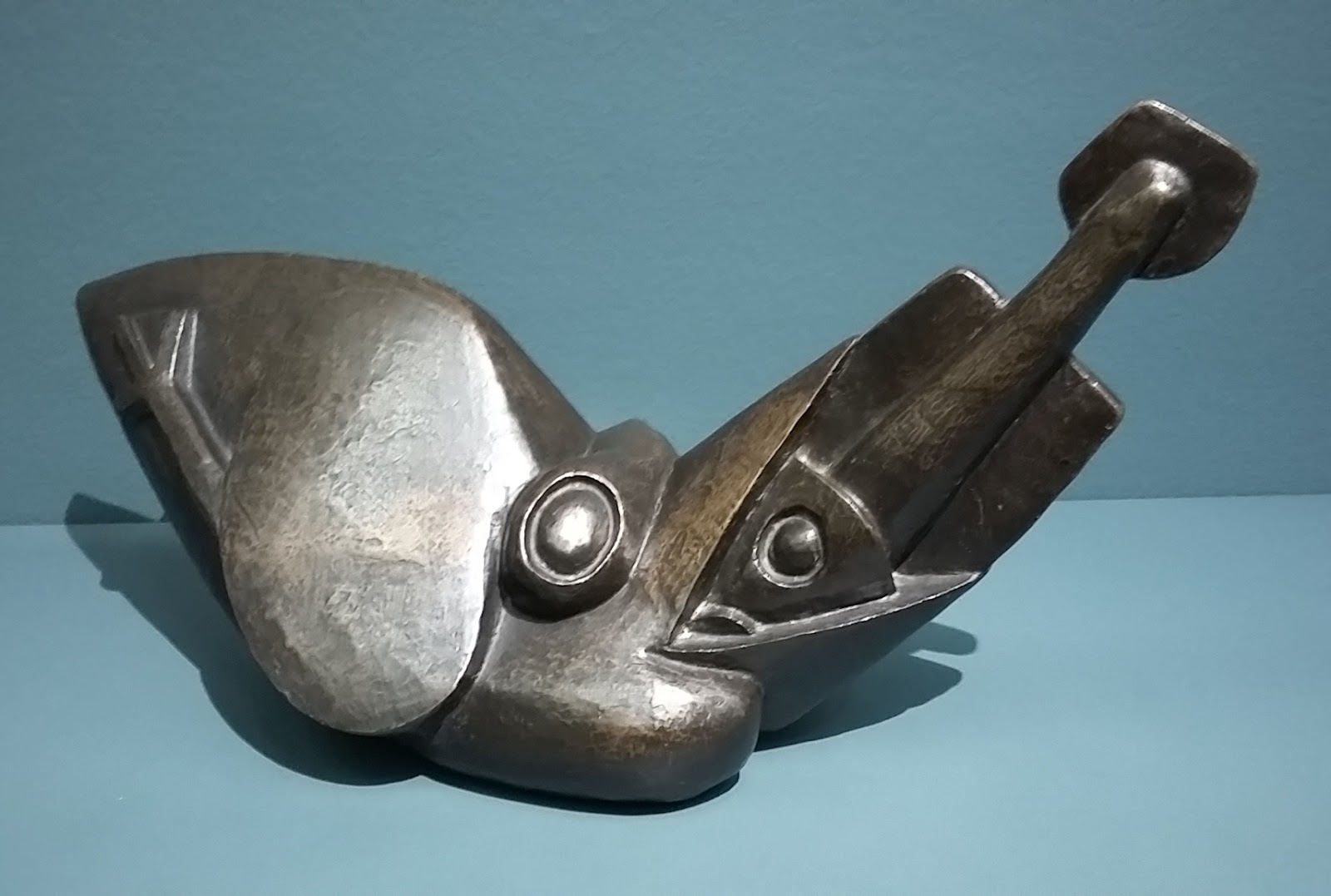
Beatifully stylised Bird Swallowing A Fish by Henri Gaudier-Brzeska, 1914.


This piece, Der Rächer by Ernst Barlach from October 1914 is a good reminder that Germans at that time didn't see themselves as evil invaders but as righteous avengers. The avenger is holding a saex, an ancient Germanic sword type. I feel there's an uncanny resemblance between the face and that of then Emperor Wilhelm II.


Barlach's enthusiasm for the war quickly wore off on the front and he returned as a pacifist. His post war work includes many commemorative signs at war cemeteries. His work was later labeled as Entartete Kunst by the Nazis. Just like Käthe Kollwitz, who lost her son in the Great War. This is her Turm der Mutter from 1937.


Friday, 23 August 2013

German bookshops, not like those at home

I went to Hamburg last week and was well intentioned to drop money on some books on the Befreiungskriege in 1813 as a context for the Waterloo campaign, the Prussian army of 1815 and how the remembrance of the Befreiungskriege and Leipzig in particular compare to that of Waterloo and the 100 Days Campaign. This is all the more interesting because Prussia (and some other German states) were the only ones involved in both battles.

Okay, five books on the Befreiungskriege is not all bad,
but the quality is mixed


The German brick & mortar book retail trade is dominated by the Thalia chain, which offers nice spacious stores with a reasonable general audience stock, including sizeable foreign language sections, and some local variance. However, their English language history section is as big as the German one.

The history sections of the independent book sellers I visited were comparable in size and scope, with the exception of the Heinrich Heine bookshop near Hamburg University, which was sadly renovating so it had only a small but interesting history selection on display. 

While the two big tomes are serious books for a broad audience, they differ in scope. Platthaus' a lively record of the actual battle, Krause's looking at the whole era of Prussian reform and ousting of French influence. Gabriele Hoffmann's book on the fate of Hamburg in 1813 and 1814 under the heel of Marshal Davout offers warm portraits of leading and not so leading participants through their private correspondence. Especially the contrast of Davout's harsh official commitment to the Napoleonic cause and his devoted but also business like relationship with his wife has struck me.

The two smaller books offer shorter introductions on the battle of Leipzig and Freiherr vom Stein. Von Stein was not only the reformer of Prussia after the 1806 defeat, but also the administrator of the areas 'liberated' by the allies in 1813. As such he had enormous influence on events behind the front in Germany, and the perspective of his regime will ahve influenced the choice of Dutch rebels against Napoleon in late 1813.

Colonial, Weimar and the mobilised nation


As a secondary objective, I was looking for books on WWI which, although in torpor, is still a topic a fancy taking on at some point in the future. But even a year before the commemoration starts, bookshops are eerily silent. Yes, lots of stuff on WWII, the Holocaust. Also lots of stuff on Prussia (general history) and Frederick the Great in particular. But the 1800-1923 period almost seems not to have happened.


Guido Knopp's history of Germany's overseas empire gives an interesting and well illustrated overview of Germany's 'Places in the Sun' in Africa and the Pacific, while also venturing into those promoting colonial expansion in Germany. The small Reclam series of cheap editions of classic books offers a bargain, which I could not resist an in depth history of the ill-fated Weimar Republic, which combined chronologic with thematic chapters. Lastly, Lutz Raphael's book looks at the social and political consequences of national mobilisation in Europe in both world wars and in between. Refreshing to have such a broad spectrum book from a non-Anglo-Saxon perspective.


I finally picked up a nice essay on the nature of war by French  philosopher Myriam Reveault d'Allonnes and an intreaguing book on the Art of Capitulation. It looks at the structure of society and war aims and how they determine the ending of wars. Could prove an interesting counterpoint to James Whitman's The Verdict of Battle and Russell Weigly's The Age of Battles. I have my problems with the concept of decisive battles, and these books give me some perspective.

Sadly, too little time
And finally a recommendation if you get to Hamburg and you're a military history buff and like in depth stuff on German (WW2) tanks, aircraft and ships. At the Bernhardt second hand book store you should have a field day. There´s much more than just WW2, but you catch my drift. It´s at Johanniswall 3, within 5-10 minutes walk from the Hauptbahnhof. Sadly not enough time and not on my subjects so I left empty handed.

So I was a bit disappointed with what I could pick up on my preferred subjects, but I ended up with a nice stack anyway.

Wednesday, 21 August 2013

John Terraine goes myth busting WWI

The Smoke and the Fire is a well witten and entertaining read with a clear intent. Terraine has no time for studies critical of British commander in chief Douglas Haig and other WWI generals such as The Donkeys by Alan Clark and Haig’s Command by Denis Winter. In that sense the book feels a lot like Corrigan’s later Mud, Blood and Poppycock that also sets out to bust the myths of incompetence and mass slaughter.


This means Terraine also has little sympathy for Lidell Hart and Fuller, the earliest criticasters of WWI generalship. One chapter dismisses Lidell Hart as a man traumatised by his battlefield experience and suggests that Fuller later rescinded on his earlier views. Of course, to Lidell Hart and Fuller, their criticism was not just a matter of history but also a way to advance their ideas of the future of the British army in the Interbellum.

Terraine defends the military leadership by arguing that contrary to the 'donkeys' caricature they did see the potential of modern weapons and quickly adopted many innovations like machine guns and tanks, but that the delays were in development and production. So the civilians were to blame, really.

Likewise, the maintenance of a sizeable cavalry force was not the result of pigheaded cavalry generals clinging to an outdated arm, but to the fact that cavalry was the only means of operational exploitation of a breakthrough. The technical limits of tanks meant that even by 1918 deep and sustained penetration was impossible. In the spring of 1918 the Germans sorely felt the lack of cavalry to achieve the final breakthrough.

While he acknowledges the cock up that the first day on the Somme was, Terraine argues that this was due to inexperience and too much faith in the effect of artillery. He points out that losses quickly fell and success increased in the following months. And it was the German insistence on counterattack that lent the battle its gruesome human toll. But according to Terraine, that is why it achieved its objective of distracting the Germans from Verdun and wearing the German army out.

Sadly, my copy of The Donkeys seems to have gone AWOL

The best point that Terraine makes is that you have to see WWI in the perspective of the American Civil War and WWII. These are wars in which the challenge was not just military but more so in mobilising a complex whole of economy and society towards victory on many battlefields. That also means the war won’t be won in a single battle. Attrition is part and parcel.

As such the war was a huge challenge to the generals involved: training, organising, supplying and leading mass armies in an environment of solidified defensive lines and a mass of new, unproven technology. But those technological advantages are few and short-lived as the enemy catches up.

This applies to WWII as well. Although the Germans can win early on against opponents that haven’t acquired an answer to their operational innovations, this then turns for the worse. Even the string of unprecedented victories in Russia in 1941 cost them more casualties than the battle of Verdun.

Which ties in with Terraine’s firm stance that the object of war is the defeat of the enemy main army. As long as that is in the field, any diversion only means dispersal of force. On this point he criticises both politicians like Lloyd George and Churchill who pursued campaigns in minor theatres as well as theorists like Lidell Hart who advocated an indirect approach.

Dispersal of British Imperial forces according to Terraine p 57
For Terraine there is no way around it and evasion of the showdown on the Western Front was just a lack of moral courage to face up to the truth and its ugly consequences.  Modern warfare, with its mass armies, will result in mass casualties. The search for a bloodless solution only lengthened the war and caused more casualties.

I think that whoever reads Terraine, like Corrigan, has to readjust their visor from the Lions Led By Donkeys school. But not all the way. Although Terraine often uses statistics and source material to support his point, he rarely goes into great depth, weighing both sides of the argument. It´s hard to find a point where Haig doesn´t come out clean and his detractors come out looking like fools.

Because of that, on a different level this book gave me the indefinable feeling that the lines on these issues in the first post war decades were linked to what faction of British history writers you belonged to. And that was probably related to which school you´d been to, the party you voted for and who published your books. This social dimension gave these discussions a shrill tone that also for example also pervades the post war discussion of generals like Montgomery. I can´t lay my finger on what the factions were though.

Thanks to Nick for giving me this books as a birthday present. The other was Tilt by Nicolas Shrady on the history of Pisa and its tower.

Tuesday, 23 July 2013

Armies of the Balkan Wars

With my interest piqued in the Balkan Wars because of their effect on the outbreak of WWI, chance has it that I had just received my copy of Armies of the Balkan Wars 1912-13 from Osprey's Men At Arms series. It's written by Philip Jowett, who's written a dozen Ospreys on first half of the 20th century subjects and illustrated by Stephen Walsh who has done over 30 books for Osprey now.


Armies of the Balkan Wars follows the standard MAA format: it starts out with a short introduction and chronology of the two wars. I hadn't realised the wars were so close after each other and that the second war had been so bloody, despite lasting only a month. Another factor I'd not taken into account was that the war against Italy (in Libya and the Aegean) was only ended in October 1912.

Reading other stuff about the road towards WWI makes me also see how much of the politics is left out (eg the Russian involvement in creating the anti-Ottoman coalition). I understand why MAA leaves it out, but the complicated politics of the region deserve more. Especially as the book's subtitle claims this was the 'priming charge for the Great War' but nevere really explains how.

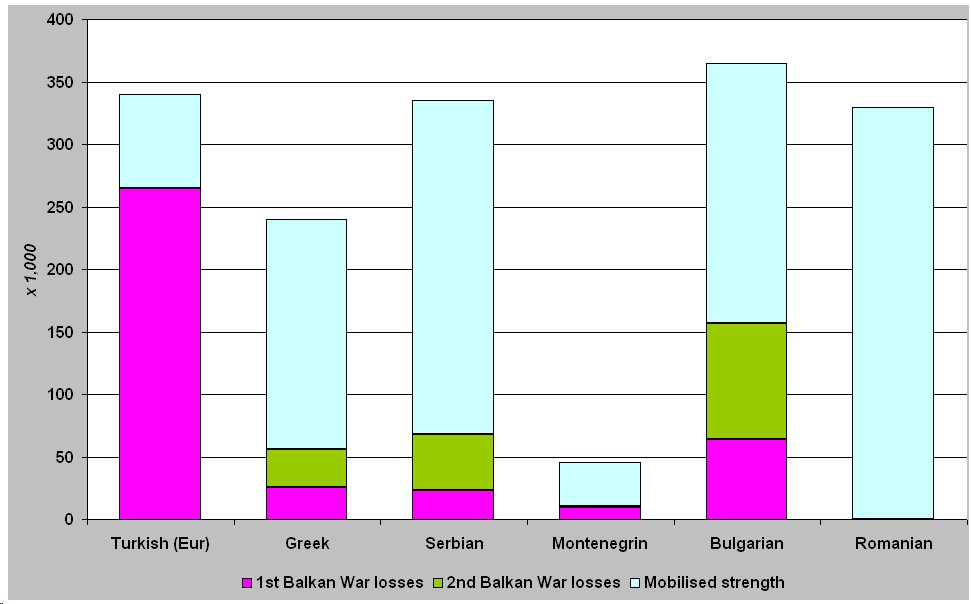
Then follows the major section on all the belligerents. Most armies used an age-based system of conscription, allowing them to raise considerable reserves. Also there was a small additional reservoir of irregulars in the Ottoman territories and foreign volunteers that fought on the side of the ant-Ottoman coalition. However, that also meant that the quality of the majority of troops was low. Especially the Turkish army in Macedonia was hampered by being composed mostly of local reserve troops.

The most remarkable effort was made by Montenegro, a microstate of only 250,000 inhabitants that raised an army of 40,000 by conscription all men between ages 17 and 62. The fact that it lost over 10,000 men during the war was not only a high price to pay for the army, but for the country as well.

The strength and losses of the belligerent states. No records
of Romanian or Turkish losses in the 2nd Balkan War

The graph shows that losses in the two war, although short, were heavy. This had to do with the backward logistics and medical arrangements, amplified by the stationary nature of the war (sieges). Of the 265,000 losses in the Turkish army in the First Balkan War, 75,000 resulted from disease and 115,000 were taken prisoner. I assume these numbers include deserters as well.

From the section on weaponry and other equipment we can conclude that most armies were in short supply to fully equip their war time armies. Although the anti-Ottoman coalition managed to plug most of these gaps with remaindered equipment of more advanced armies, the result was an even greater lack of standardisation and more logistical problems. That leads to the same conclusion as the small section on uniforms, which is that it all wasn't very uniform.

All in all the book is not special. The Men At Arms formula remains very general and I tend to prefer the campaign series for detail. I was impressed by the photographs and illustrations though.

Monday, 10 June 2013

Chemin des Dames books

Last week I brought Some books for Michiel, since he's going to camp around Compiegne in France this summer. Right in the middle of a number of WWI battlefields.


For a number of years I used to go to the nearby Champagne Ardennes region for a weekend in summer with a bunch of friends. On a few occassions we visited the Chemin des Dames battlefields, and I picked up the books in the picture.

One local guide, with a cover by Tardi, the French comic artist who has had a great impact on the way we see WWI. And another a more extensive account of the many battles fought on the Chemin des Dames, starting with the 1814 battle of Craonne (Napoleon's Last Victory), the 1914 battles, the disastrous 1917 offensive and the German offensive of 1918.

Added are two monographies: Pyrrhic Victory by Robert Doughty on the French Army in WWI and Pierre Miquel's book on the Chemin des Dames. And finally an issue of the French WWI magazine Tranchées, dealing with the offensive with limited objectives, among which the capture of Fort Malmaison on the Chemin des Dames in October 1917.

So Michiel is well prepared for his holiday.

Michiel bought me a Dutch translation of Albert Nofi's book on Waterloo for my birthday. An interesting take, you can spot the wargamer from miles away.

Wednesday, 5 June 2013

Books bought in London (and Leiden)

For those of you who wondered whether I'd bought any books this weekend, the answer is yes. Of course.


Friday's reluctant loot: in the end I didn't do too much book shopping and my heart wasn't in it, I guess. Nevertheless, I picked up a book on the end of the Russian Empire because it had lots of social economic stuff linked in to the politics. Then 1815 The Road To Waterloo by Gregor Dallas as an old school introduction to the politics behind the peace process of 1814-1815. And finally The Verdict of Battle, a correction copy. I read a review of it recently and the book argues that battles became accepted as a legitimate way to solve political differences. And in this way, they could become decisive.

On Monday I picked up the catalogue to the exhibition on George Catlin's portraits of North American Indians

Last minute buys at the airport: Nate Silver's The Signal and the Noise and Kahneman's Thinking Fast and Slow. The first on scientific approaches to prediction, and why we are still so crap about it. By one of the smarter guys in electoral predictions. The second decision making and why it is often not economically rational (as economists expect us to do) but rational from the perspective of time and experience. By one of the leading economists.

Also one book I bought in Leiden just before I left for London. It's the travel account of a Dutch reporter in the wake of WWI to revolutions and internal conflicts all over Europe between 1919 and 1923. Should be an inspiration on the postwar situation from the view of a non-participating nation.

Sunday, 2 June 2013

How I love going to Chestnut Lodge

Sunday I joined a meeting of Chestnut Lodge Wargames Group, a rare pleasure because megagames and CLWG don't often coincide.
We had 3 great sessions, the first set in the A Very British Civil War alternate universe where Britain descends into vivi war after Edward decides to ascend the throne with Wallis Simpson as queen.
It was a tactical scenario by John Seaton on attempts by fascists and worker militias to capture the neutral borough of Croydon, including the important airport.
Next was a session discussing Muku Patel's design for an army group level game on the opening stages of WWI on the eastern front.
We discussed some design parameters (which period, what area, at what level of resolution, the character of combat on the eastern front (and how it differed from the west) and some mechanics (trading speed for combat effectiveness, effect of terrain, intensity).
Last was a meeting of the board of a large multinational discussing how it would make the best use of revolutionary new technology.
We faced several fundamental decisions. Given its cooperation with a superpower, how would that affect it's ability to trade with others? What was our window in which we were the sole owners of this technology, and how could we leverage this towards customers and competition?
A busy day with some fascinating insights, good discussion and inspiration

Saturday, 1 June 2013

Edith Cavell, a 1915 PR disaster

Ok, ok. So she was guilty of helping allied soldiers getting back to their own lines. But just because she is a spy doesn't mean you should shoot her.!?

Oh well. This is the stuff you run in to on your way to the bookshops at Charing Cross Road

Sunday, 19 May 2013

Birthday suggestions

One of the boons of publishing my birthday list is that I have gotten a few suggestions, so thanks Raymond and Mats, they are much appreciated and added to the list!


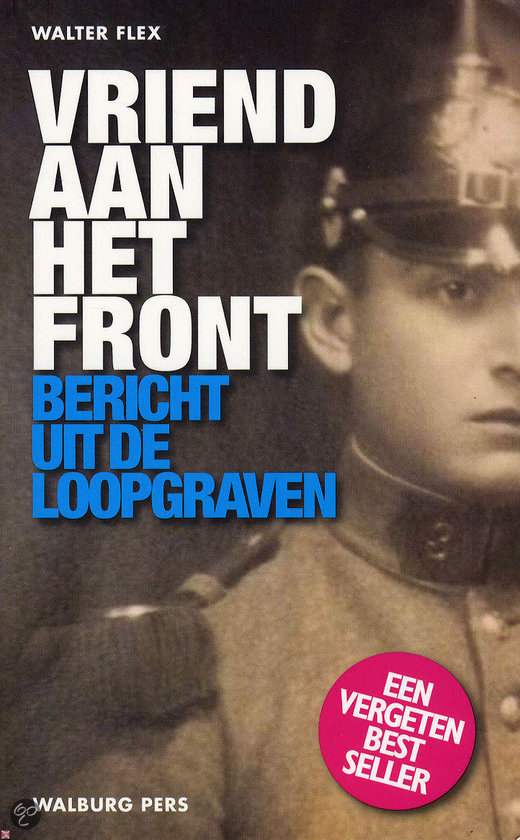
Walter Flex,  Vriend aan het front -  Bericht uit de loopgraven.
A translation of the 1916 original Der Wanderer Zwischen Beiden Welten.


Ammianus Marcellinus, Julianus, de laatste heidense keizer. Nadagen van een wereldrijk
Res Gestae, in de vertaling van Daan den Hengst. For Anglophones, that means that the Res Gestae by Ammianus Marcellinus have been translated into Dutch.


Bernard Cornwell - Sharpe's Waterloo
and another one I thought of myself. Not so much for historical input, but to get a view of how misinformed British readers can be about the battle

Wednesday, 19 December 2012

Memorial at the Chemin des Dames

For several years I visited the Champagne-Ardennes in France with a bunch of friends for a weekend in summer. We'd travel to nearby sights, and occassionally some battlefield trips. These are pictures of a trip to a French war cemetary and memorial at Cerny-en-Laonnois on the Chemin des Dames battlefields near Laon in 2007. The places on the plaques still resound: Craonne, Hurtebise, Cerny...

The chapel

The  Chemin de Dames offensive in the spring of 1917 was so mismanaged my French commander in chief, Nivelles, that mutinees broke out. Nivelles was replaced by Petain, who then proceeded to rebuild the army.


The cemetary outside

Tuesday, 11 December 2012

Something for the weekend, Sir?


This is what I hope to do this coming weekend. French WWI colonial troops (tirailleurs Senegalais) in 10mm for Through The Mud and the Blood by Too Fat Lardies. Spent tonight preparing.

Finally fell for the lure of speed and ease that Army Painter promises. Not sure, it'll be the be all and end all, but at least I can give it a try.

And if it works, I have another project up my sleeve for army painter.

Tuesday, 4 December 2012

Megagames in 2013

Megagame Makers have set their programme for 2013. If you haven't played in a megagame yet, you should definitely try it. These are all exciting subjects and will deliver a momentous experience of time pressure, meticulous planning, courageous leadership and wheeling and dealing.


ENDGAME - The culmination in North Africa 1943. The follow-up to last year´s anniversary game of the Battle of El Alamein now sees the Axis troops defending their last foothold on the African continent. An operational game that will see you lead the remnants of the Afrika Korps, the Eight Army and motley reinforcements of Italians, Americans and French.
London - Saturday 2 March 2013 


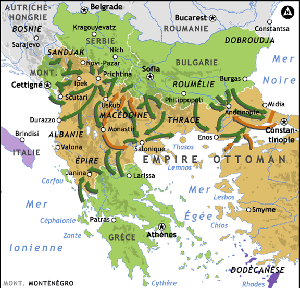
Rehearsal For Armageddon - The Balkan Wars 1912-13. A hundred years ago the powder keg of Europe exploded as the Balkan states turned first on the ailing Ottoman Empire and then on each other. Taste the challenge of marshaling a third rate army to battle or cleaning up the mess at the negotiating table.
London - Saturday 1 June 2013  


Master of Europe 1813 - Napoleon's campaign in Germany: Two centuries ago the three emperors of France, Russia and Austria-Hungary (and the kings of Sweden and Prussia, not to mention a host of minor German princes) slugged it out on the fields around Leipzig to determine the fate of Europe. Tough operational choices for leaders of multinational armies and tough diplomatic shenanigans for diplomats of competing powers.
London - Saturday 21 September 2013 


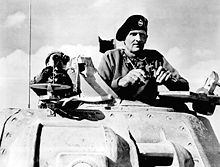
End of the Beginning: The Battle of El Alamein:  Can the Eight Army emulate its historical success (or avoid Monty's historical blunders, depending on which interpretation you hold)?  
Leeds - date to be announced, October 2013


ALEA IACTA EST ITERUM - Crisis in Rome 60 BC: As the Roman Republic enters its death throes, abundantly talented and abundantly ambitious men like Pompeius, Crassus and Caesar make their bid for the remains against defenders of the corrupted senator class like Cato and Cicero. Epic campaigns across the stormy Mediterranean, through the riotous streets of Rome and the across the clamorous Senate floor.
London -  date to be announced, November 2013


To get into the mood, read this great report of last month´s Urban Nightmare game, which pitted an urban administration against a zombie outbreak.

You can also join Megagame Makers facebook page, and see how the development of these games is progressing or read player´s experiences.

Wednesday, 3 October 2012

Tannenberg, a no hope battle for the Russians

On my visit to London two weeks ago I was privileged to play with a group of veteran wargamers that Nick occassionally hangs out with. I got to play in a combination of a map campaign/miniatures tabletop battle devised by Ian Drury, who had interposed the scenario of the battle of Tannenberg in September 1914 over a set of early WWI miniature rules designed by Richard Brooks.

Some of you might be familiar with the (2nd) battle of Tannenberg in 1914. The 1st battle of Tannenberg was an ignominous defeat of the Teutonic Order at the hands of the Polish and Lithuanian nobility in 1410. In 1914 the Germans beat an invading Russian army in the same general area, but the mention of Tannenberg therefor had a much wider cultural significance for them. They had defeated the barbarian invaders.

As all corps were some distance apart at the outset and their positions not exactly known, we played the first few turns on the strategic map. When enemy troops were spotted, the action moved to the tables.

A Russian strategic map, 2 km to each square.
The white flags are corps HQs, green: infantry brigades
yellow and red: artillery, blue: spotted enemy formations
One of the excellent elements of the scenario was the flawless connection between map game and tabletop. Since the grids on the map were the same as on the table, there was no discussion about off map movement rates and appearances on table. This is certainly something I will remember for future map games.

The map game was played with OP14, an abstracted miniatures rule set, designed by Richard Brooks. Command was based on army corps, with brigades as the smallest units. A brigade effectively had four formation options, akin to Volley & Bayonet: march, deployed, defensive and basic field works. Basic field works had a chance of transforming into primitive trenches overnight.

Turns consituted one and a half ours of times and squares a square km. With a movement rate of 1 square per turn for deployed brigades and 2 squares for march formations. Units in deployed formation had an added chance of delay.

Our corps moving into a defensive position on day 1. 
Germans already dug in north of Tannenberg 

This was a tricky bit. Corps initiative was determined by a deck of cards. Low number had higher initiative, but the colour was important as well. All Russian corps were immobilised on spades, while brigades outside command radius were immobilised on diamonds. Any troops in rough terrain or crossing obstacles were delayed on clubs.

You can imagine the hardships Russian troops would suffer outside command range and in rough terrain. I never dared to try.

In combat the formation determined the amount of dice rolled by defenders, while the to hit level was determined by the amount of figures (4 per brigade, 2 or more for artillery). To make things interesting, troop quality determined what kind of dice you rolled, with elite troops rolling D6 and Landwehr rolling D10.

The abstractions worked really well at this level of command. There might even have been less, because matters of flanks in this historical period and tactical level might be ignored.


Now the Tannenberg scenario is obviously heavily skewed to the Germans. Not only do they have the knowledge of the terrain with added intelligence from airplanes and dirigibles, they also held the initiative and choice of the Schwerpunkt against a scattered opposition. Add to this the Russian immobilisation and lack of centralised command and the Russians were up for a serious thrashing.

Only thanks to hindsight the Russian commanders were able to limit the scale of disaster. Because we knew what was coming, we didn't attack deeper into the trap like the Russians did historically.


Alan and me had joint command of a Russian corps near the village of Tannenberg, with Alan doing communications and overall control and me doing the map dispositions. By the end of day one we had managed to put ourselves in a strong position, with dug in infantry supported by artillery and flanks based upon natural obstacles.

But there is a psychological difficulty to the defense that we could not surmount. As the Germans advanced on us on the second day, Alan decided that we should pull back in the light of overwhelming forces. While I agreed on the latter point, I was more worried about being outflanked, because I felt we could do a lot of damage in our defensive positions.

 
Our corps by the end of day 2, having got away from the Landwehr
This proved correct in hindsight as we were able to beat of a lot of German attacks when we pulled back from our position (there was a small amount of luck involved as well, but Napoleon nailed the point about lucky generals). Nevertheless we lost about half our command due to delayed movement and bottlenecks. Staying put might have ruined our corps, but done much more damage to our opponnents.


Anyway, falling back is a very difficult manoeuvre, especially when you have delays at crucial moments and rescuing half our corps was better than I had expected.

Overview of the battlefield by the end of day 2

There was also a nice system for combat exhaustion of corps. Once a unit received 25% losses, it drew a card from the deck. Any losses afterward required the draw of another card. If the value of this card was higher than those already drawn, the corps would be exhausted and unfit for offensive actions.

What I especially liked was to play two days of action in an afternoon with a good strategic feel. The only problem with the limited information was that as soon as units were put on the table, the were visible also for units far away. It might be advisable to have each corps fight its own battle on its own table, oblivious of what happened elsewhere.

Ian explaining afterwards what had happened off map. More bad news

Many thanks to Ian for putting this game on and to Richard for the ruleset. Ian's exlanation of what happened off map was very good in reminding us that even had we beaten off the Germans on our flank, other troops would have gotten into our rear and our fate was pretty much sealed. Made me feel much better about my crappy handling of the troops.

Wednesday, 12 September 2012

Some WWI and plans for the weekend

I've finished my review of Tom Behan's The Resistible Rise of Benito Mussolini. so have a look there.


Furthermore I've booked tickets for two exhibitions this weekend, Bronze in the Royal Academy and the one on war p¨hotographer Cecil Beaton in the Imperial War Museum.

Reading for Lost Youth continues. I´ve tried to get a view from the (North) Vietnamese side. Bergerud's Dynamics of Defeat has a good insight into the tactics and strategy of the National Liberation Front/Viet Cong and one that challenges Nagl's views.

And yeah, a bit of fun. Not a terribly innovative design, I know.


Friday, 31 August 2012

Why Italy came to dinner with only a plate and no cuttlery

I've posted the first 'review' in my Italian trilogy, John Whittam's The Politics of the Italian Army 1861-1918.

Find it her on the Maximum Effort blog


Next week I hope to offer a review of Thompson's White War, followed by Behan's The Resistable Rise of Benito Mussolini. I think I might need a post after that to address certain contentious issues.

Wednesday, 29 August 2012

quick update

Won't finish my Italian review tonight so just a quick update of what's going on in various projects.

WWI

In the works are three reviews of books on Italy around WWI, spanning the period from 1815 to 1922. I will publish them at the Maximum Effort blog.

Dark Ages

I also have a review of a book on the Low Countries in the Roman age in preparation which also gives pointers to the Dark Ages, with interesting implications for Post-Roman Britain.


I've found somebody to paint my Dux Britanniarum troops, and they are under way as we speak. The first game of Dux was played last Saturday at my club, Murphy's Heroes in Delft, and the impressions were favourable. I'm anxious to join in. By the way, there's a few nice new early Saxon models coming out through Musketeer miniatures. Especially Hengist and Horsa look awesome.

Vietnam

I've now shifted to reading stuff for the upcoming megagame Lost Youth on operations in Vietnam (London, September 15th). The stack of books waiting is higher than I can take on in the three weeks left, so I will pick and choose. Started out in Michael Herr's Dispatches and it's cracking. Halucinatory. I'll definitely be in the mood for that game.

Essen 2012

Also coming closer is Spiel in Essen, late October. Probably won't manage to play all the stuff I picked up last year (that lesson has been taken on board), but I've already made a first pick of games I will be checking out. See my geeklist on boardgamegeek. It's a work in progress, as the list of releases for Essen is not complete yet. More suggestions are welcome, of course.

Waterloo

I've talked to my friend who's writing the biography of the Prince of Orange and we're concocting a devious plan, which might alter my future. I'm very excited about it and I hope everything will come up sixes. So far I'm mostly collecting books, but in 2013 I aim to start reading them.

Friday, 17 August 2012

The opening of the Memorial for le Mille on May 9th 1915

On May 9th 1915, the monument was christened for the 1,000 redshirts that accompanied Garibaldi on his trip to Sicily in 1860, beginning the 'liberation' of Southern Italy.

I put liberation in quotations because it soon became clear that the replacement of the Bourbon dynasty with that of Savoy didn't make that much of a difference to the Apulians, Sicilians and Calabrians. For decades the new Italian army was involved in putting down the ongoing revolt in the south, and banditism continued well into the 20th century.

The opening ceremony stood in the light of the Italian intervention in WWI at the side of the Entente. Italy had been allied to Germany and Austria-Hungary since 1882 but now opportunistically threw its weight on the other side, claiming not only the Trentino, Friuli and Triëste, but large parts of the Dalmatian coast in the secret treaty with Great Britain and France.

Gabriele d'Annunzio, Italy's most famous poet was recalled from Paris to whip up public fervour for war. France paid off his debts so he wouldn't be arrested.

On May 9th he promised, demanded bloody sacrifice: 'Blessed are the merciful, for they shall have splendid blood to wipe away, radiant pain to bind up'.

I'd think d'Annunzio got what he wanted. By 1918 over 670,000 Italians had lost their lives.

Wednesday, 15 August 2012

L'Armee de l'Orient

Picked this one up in Levanto on Saturday in a huge stack of second hand books. Interesting to kniw how it ended up there.

This is the account of Sarrail's command of the Armee de l'Orient in Macedonia from late 1915 to spring 1918. Published in 1920.

Sarrail was reluctant to go there, as he had been relieved of his army command on the west front and this was obviously a side show. He demanded and got an army command, more troops and independence from the Brits.

Tuesday, 24 July 2012

Control panel from German cruiser Lützow

Apparently a panel controlling emergency pumps on the German cruiser Lützow which was sunk during the Battle of Jutland in 1916.

Picture taken in the Wrakkenmuseum on Terschelling. Probably ended up there because of the diving club going abroad, as I don't think the panel would have been found near the island.