Showing posts with label Prussia. Show all posts

Tuesday, 13 December 2016

The most thankless job in war

I wrote this short introduction for a presentation I will be making at the Poldercon convention on February 12th. They asked for a presentation on the 1815 campaign, and the theme of the convention seems to be the rear guard action, so I decided to combine them. 
---

"The rear guard: the most thankless job in war. Risking your life to save that of others. Not seldom it ends in total disaster, without a Chanson de Roland to make you immortal. The best you can hope for is to be forgotten.

On the other hand there are many more rear guard actions than pitched battles. It’s the small clashes that determine who has the most advantageous position during the big battle. And it’s the rear guard actions that determine whether a defeat is decisive, or the loser can salvage his force.

Time for some more love for the rear guard action!

I will be taking you through the Napoleonic Wars and in particular the campaign of 1815 using these small but important combats. From the Prussian rear guard at Charleroi on the morning of June 15 to the retreat of general Rapp. What are the secrets of a successful rear guard action and how to bring them to the wargaming table?"

---

For the presentation itself, I'm thinking of 
  • a short introduction on what the role of a rear guard is
  • followed by a number of examples from the Napoleonic wars (eg 1806 post Jena/Auerstädt, 1812 Russian retreat, 1813 and 1814)
  • Then delve into the 1815 campaign: Charleroi/Gilly, Frasnes, Gembloux, Namur, Oise crossings, Rapp's retreat
  • Try to derive some factors for success and failure
  • Translating it into wargames in the form of scenario's or campaigns

Since this is a 90 minute presentation I'm still thinking hard how to make this an interactive experience.

Anybody got further suggestions for this presentation?

Sunday, 11 October 2015

From The Vault Of History

Yesterday I had my first public talk as a result of the Waterloo book. I’d done a sort of interview for a historical society in September, but this was my first one that I needed to prepare for. I had decided that I wouldn’t summarise the book as everyone should read it, and that the talk needed a different approach, giving added value.


I had been invited to cover for my friend and co-author at a famous Rotterdam book store, where I often used to go in my school days. So that was an added bonus. The location was really interesting, in the vault of an old bank building where the book shop is housed temporarily. It really added to the historic atmosphere.


There were about thirty people in the audience, mostly above retirement age. The atmosphere was pleasant from the start and I got off to a good start by introducing a picture of a group of youngsters from Rotterdam, recreating the battle in uniform for the jubilee in 1865. That was my handle for explaining that the memory of Waterloo was alive in the Netherlands long after the battle. In fact, Waterloo day was commemorated up to the Second World War. I then elaborated on commemoration in other countries and up to 2015.

I then used Prussia as the story to explain the wider context of the battle. The picture below of king Friedrich Wilhelm III shows how deeply the confidence of even the most powerful monarchs in Europe was shaken by Napoleon, and therefore why they were determined never to let him be that kind of threat again. Then the reforms, 1813 and finishing of with Blücher in 1815.


Blücher was also the introduction to the challenge of being in command of an army (see my original blog post). Of course everybody was interesting in what sex had to do with it. Napoleon’s  troubles with his marshals and what that meant for him politically and militarily rounded off my talk.

I spoke longer than I had intended (an important lesson), but the crowd joined in early on and the questions were very good, ranging from those who definitely knew their Napoleon from their Napoleon III and those who only had their history lessons to fall back on. 


Considering that about a third of the audience then came up with a book to sign or ask further questions, I guess the talk was reasonably successful, also for the book shop. Now hopefully this will result more invitations.

Friday, 26 June 2015

Shape of things to come

I'm sure you're all waiting for news on how the book has been received etc. This is coming soon but it has been bussyish. However, I managed to buy a spray can and apply some paint.

Yes those are 28mm Prussian Landwehr. And a few Musketeers. Summer project.

Sunday, 25 May 2014

Review: Blücher: Scourge of Napoleon


Blücher: Scourge of Napoleon
Blücher: Scourge of Napoleon by Michael V. Leggiere

My rating: 5 of 5 stars


Probably now the best account of Blücher's life as a commander in English. It didn't shock my view of Blücher after reading Henderson and some other stuff. Blücher was not the charging madman he has sometimes been made to be, but a rational and aggressive commander. Although his great strength lay in the maintenance of the ultimate objective (defeating Napoleon decisively on the battlefield) and inspiration of the men under his command he was clearly more involved in the running of the army than his detractors have suggested.

Driven by his sense of personal pride and urge to show that he loved the Prussian king more than the Prussians he was often more hurt by suggestions of disloyalty on his side or royal disfavour than loss on the battlefield. However, it seems he sought death on the battlefield at Vauchamps at the end of the disastrous week when Napoleon beat his dispersed corps 4 times in 6 days.

Strategically he showed his best during the fall campaign of 1813, when he managed to occupy Napoleon by keeping in close touch and reading his opponents actions well. His pursuit of MacDonald after the Katzbach forced Napoleon to break off the pursuit of the Army of Bohemia and prevented the emperor from moving against Berlin. His move to unite with Bernadotte´s Army of the North was the decisive move of the campaign, but his choice to evade Napoleon by crossing the Saale was of similar brilliance.

In all these cases the question is of course whether the genius was his or Gneisenau´s. To me it appears that Blücher's letters show enough comprehension of the siutation to suggest that he was heavily involved in the decisions. As his moves during 1814 and 1815 show, he was not afraid to try the unconventional, and this seems to have confounded Napoleon.

As one of the few allied commanders not afraid to take on the French emperor himself and because of his ability to draw others along he is probably the single most important military commander on the allied side in the defeat of Napoleon after 1812.

In his personal life he showed many traits of the 'hussar' lifestyle, but he was also a committed husband and father. Leggiere stressed that he also wasn't an uneducated boor, but that the connections made during his period outside the army and especially with the Freemasons, made him socially flexible.

Hats of to Leggiere for this great work, but I think I would have preferred if he had finished his account of the 1814 campaign first.


View all my reviews

Friday, 4 April 2014

NYR update March: books I read


Bought no new books, while awaiting some of the stuff that I had ordered in February. Managed to read a dozen. So still slightly behind the curve toward 150, but that should not be hard to regain when I have more time on my hand from September.


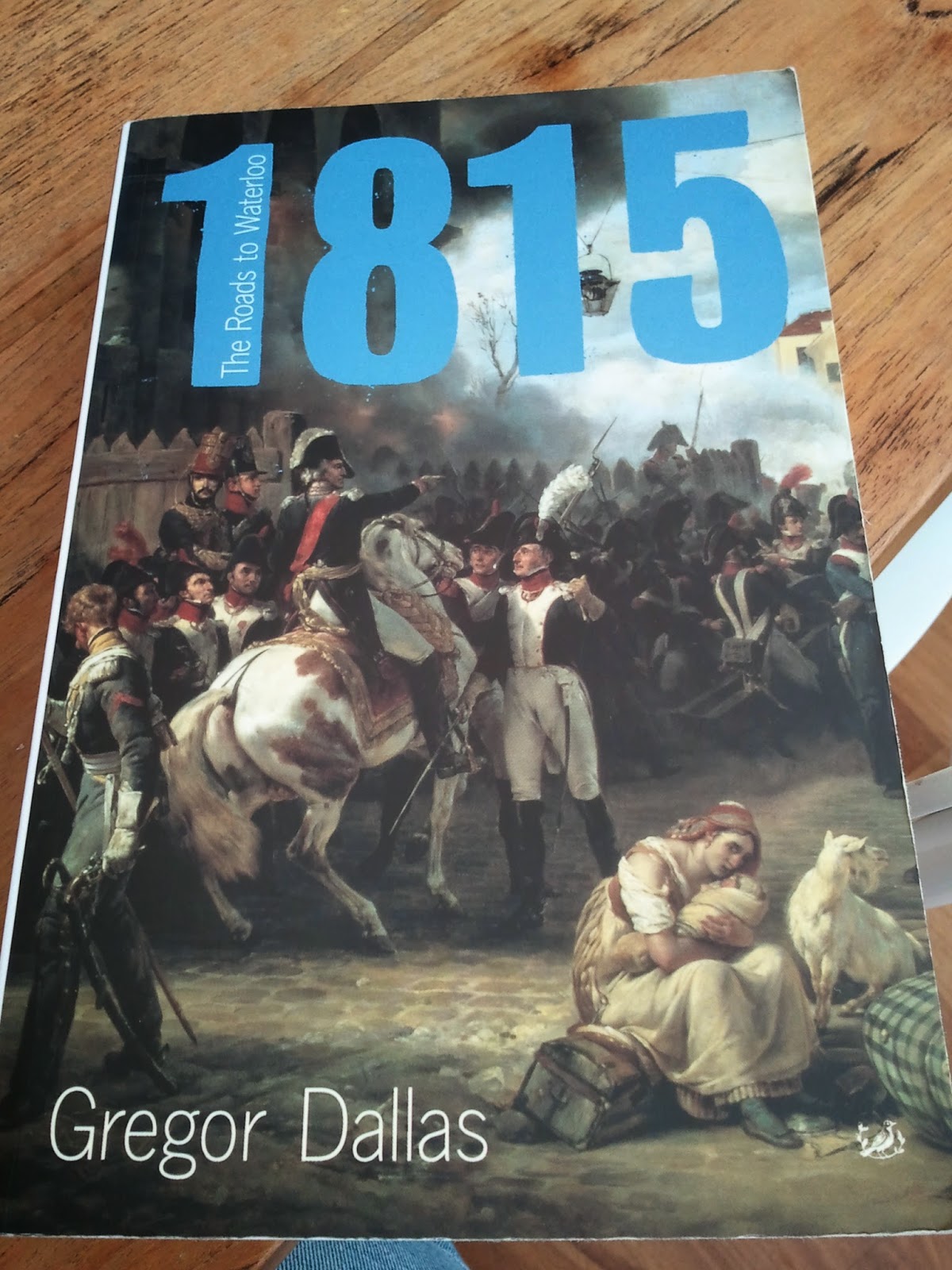
Two tougher books to get through was me finally finishing Lieven's Russia Against Napoleon, a great work which shows how the Russian army managed to get from Moscow to Paris in less than 18 months. The other was Gregor Dallas' 1815 The Roads To Waterloo, which is more about the reordering of Europe than about the campaign. A book which in content and approach is a clear precursor to Zamoyski's The Fall of Napoleon.


With my modelling efforts came three Osprey's on the M3 Halftrack, Stuart and Panther.

One small subject was the smaller German contingents, from Bavaria to Schwarzburg-Sonderhausen. I enjoyed John Gill's With Eagles to Glory on the 1809 campaign, and his article on the German troops in Spain. To this I added the book on the Poles and Saxons of the Napoleonic Wars by Nafzinger. Great research but I’d wish that man could write better and get an editor.


The last week has seen me racing through some books on the Prussian Army: Classics by Craig, Goerlitz, Demeter and Paret. All together throwing a much more nuanced light on the reform period. Paret's book towers above the others as far as I'm concerned.

And a quick Suske & Wiske as well. This one is about WWI and much darker than any S&W I’ve read.


Monday, 31 March 2014

Review: Yorck and the Era of Prussian Reform, 1807-1815


Yorck and the Era of Prussian Reform, 1807-1815 by Peter Paret

My rating: 5 of 5 stars


Great book on the Prussian reforms before and after Jena-Auerstädt. Shows that it was not just a case of noble and visionary reformers vs dumb reactionaries, but a struggle in which military theories and practice were linked to but also conflicted with legal privileges, social attitudes and personal rivalries.

Considering the opposition it is amazing how much was achieved and one wonders what might have happened if Scharnhorst hadn´t died so young and peace hadn´t come so soon. In any case, the reforms turned the Prussian army from a laggard into a front runner, despite the rough edges.

Yorck´s role in all of this is much more interesting than many historians have it (and that includes recent historians who have simply repeated the myths of the past). Yorck was in many ways closer to the reformers than most, looking at his practice as a commander of the Jäger and the infantry regulations and training programmes he helped to write. On the other hand, he was quite aware that the consequences of the social change not only undermined his status and legitimacy as a noble, but thereby also that of other institutions. And he was a pain in the arse to work with.

All this lovingly analysed and extensively researched by the author.


View all my reviews

Monday, 6 January 2014

Reading priorities for January

There's a bunch of books I hope to be reading this month in five groups:

 
  • The biographies of Willem I and Willem II regarding their activities up to 1815
  • 1814 Campaign. For lessons to Napoleon and general strategical dilemma of defense of France, as well as performance of French and allied armies. Already did Uffindel, next Leggiere's Fall of Napoleon, Petre's Napoleon at Bay and Bamford's Bold and Ambitious Enterprise
  • Dutch Army 1780-1815. Showing experience, organisation, mobilisation post 1813 etc. Whole bunch of books & articles
  • Dutch economy 1780-1815: De Vries & Van der Woude, as well as Van Zanden & Van Riel
  • Economics and mobilisation of other main powers. Bunch of books, but hardly complete.