Saturday, 13 October 2012

Edge of Empire review


De Rand van het Rijk. De Romeinen en de Lage Landen by  Jona Lendering and Arjen Bosman
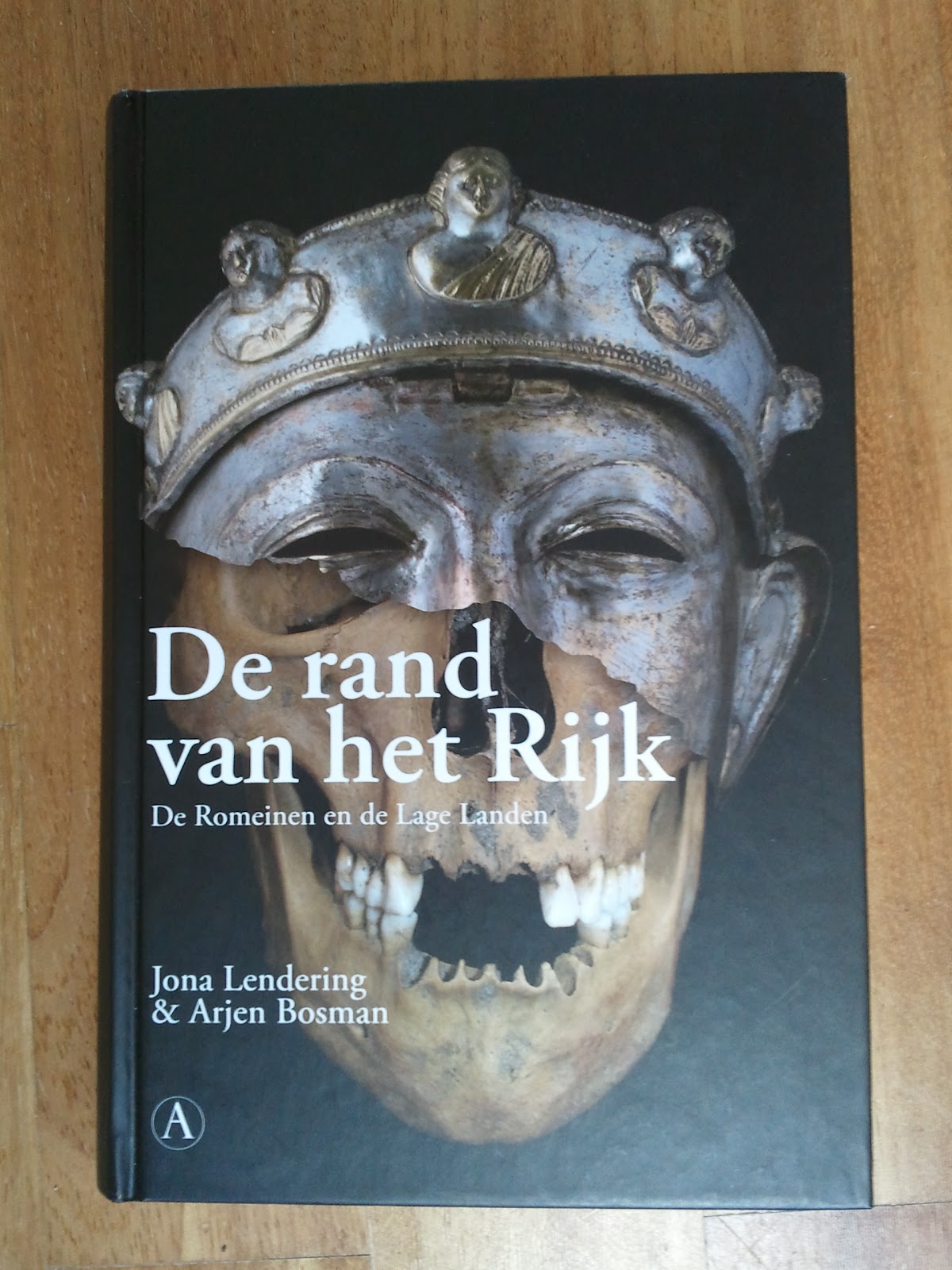
Dutch 2010 edition

Edge of Empire, as it will be released in English, is in fact more of a military than a general history of the area between the Somme and the Weser in the Roman era. This is of course due to the remaining evidence, which mostly focuses on warfare.

The book starts off in earnest with the campaigns of Caesar in northern Gaul. The authors argue that the distinction between Gauls and Germans was not as strong as Caesar suggested (he had his own agenda to emphasize it). This remains a problem throughout this era of shifting tribal allegiances and confusion of ethnicity brought about by the fact that we mostly know these people through the heavily coloured writings of the Romans. Although the areas in the outer ring and even in Germania were Romanised over time, the clichés of the barbarians kept being used until the fall of empire.

In the 1st century AD the Rhine border was consolidated, while there were attempts at expansion across the Rhine. Although colonisation beyond the great river proved unsustainable, Roman influence extended across the Rhine through alliances and divide and rule politics.

Under Roman rule, the difference in economic development between the southern area and the Rhine frontier became more pronounced. This difference is a recurring theme throughout the book. The province of Lower Germania was part of the outer crust of the Roman Empire and the garrisons were an economic stimulus. Belgica, on the other hand, was part of the core, and a net tax exporter. This meant that after Roman power diminished, the outer ring declined, while Belgica could hold out on its own.

This was most pronounced during crises, for example in the 3rd century when internal conflict opened opportunities for external attacks. The new German alliances were more aggressive and more dangerous and mounted major incursions in 240 and 256-260.

The Gallic Empire under Postumus from 260-274 was a local response to the crisis in the absence of central aid. German troops were incorporated as foederati and more troops were stationed in the interior. However, in 274 the central authority was reasserted and troops were sent elsewhere at the expense of local garrisons. This in turn led to renewed incursions.

Although Belgica seems to have recovered well from the crisis, Lower Germany entered a long period of decline. The area north of the line Doornik, Bavay, Tongeren, Maastricht, Cologne was effectively given up as no mans land inhabited by German farmers. There is evidence that the language border shifted in this period as a result. The Frisians disappeared as a separate people and reappear as Saxons in present day Friesland. This was combined with ecological crises, like floods due to intensive salt pans.

Relative peace returned until troops from the west were called east in the crisis of 405-6, never to return. The abandonment of Britannia also meant the end of grain exports and maintaining the Rhine fortresses became unsustainable. Rome now effectively gave up the west.

Northern France and Belgium now became the power base for the Frankish kings. It remained a wealthy and self-supporting area and relatively stable as compared to the decline in the Mediterranean.

After the Frankish takeover a process of creeping Germanisation set in. Chlovis was still a Roman in name, but later Merovingians dropped all pretense. There is a tendency to paint the Germanisation as bringing along decline, but Lendering and Bosman argue that institutions like serfdom and feudalism not imported by Germans but already introduced by the Romans.

The book is well written in a clear style, much like its Roman examples. It´s richly illustrated with maps, portraits and photographs of archeological finds and reconstructions.

Lendering and Bosman emphasize the dearth of evidence and the extent of their conjecture. In many cases the archeological evidence points to different conclusions than the historical sources or contradictory historical sources must both be discounted.
  

The book is now reprinted in English as Edge of Empire - Rome's Frontier on the Lower Rhine and of course I heartily recommend it.


There's a few interesting tidbits relating to Britain at this time as well, which I will post later.

Friday, 12 October 2012

What I've Been Reading Online

Thursday, 11 October 2012

Dux Britanniarum characters

I've done the character generation for my Dux Britanniarum warband. The rules have a simple and reasonably fast method of generating characters through a few dice rolls. This results in characters with enough debth to add atmosphere to the game.

Lord Wilmar, the Tony Montana of the Dark Ages
My lord is Wilmar, born on this side (ie the British) of the waters from noble stock. All his life his desire has been to advance his status among his people and his actions tell the tale. This has gained him a reputation for ruthless ambition. While this makes him useful to a king, it is of course also a risk. And Wilmar would be wiser than to covet the wives of his master and peers.

Apart from your lord, there's two nobles and a champion. Wilmar's two nobles are Sasbout and Osmond.

Sasbout, the miser

Sasbout is Wilmar's elder cousin and likewise strong and tall. But he lacks his cousin's burning ambition and is instead thrifty and conscientious. Those people who have an interest in Wilmar´s carreer quietly hope that Sasbout proves a tempering influence on his lust for glory and carnal gratification.

Osmond, the flatulent

Osmond is younger than Wilmar and more slender. He is of low ancestry but his devotion to the gods makes him a dependable lieutenant. His gastric troubles, which no prayer or gift to the gods will drive away, make him the butt of many a joke.

Swidbert killed that wolf with his bare hands

Swidbert is Wilmar's champion, a distant relative from across the sea. The men are only separated by a moon in age, but the difference in appearance is striking. While Wilmar sticks out in a crowd himself, Swidbert towers even over him, bulky and bristling with muscles. Many times has he crushed his opponents by sheer strength.

As a Saxon noble, you don´t live in a political vacuum. Your ambitions are curtailed by your king. In Dux Britanniarum, the characteristics of the king are generated much like those of your nobles.  

Wilmar's king is called Markwart, an upstart bastard of peasant stock who has risen through the ranks through his skill at arms. Though pretty secure in his position, he´s just turned fifty-four and may soon meet his ancestors.

Now it's just waiting for a Romano-British opponent and an area for a campaign. Luckily, Derk has almost finished his army.

Wednesday, 10 October 2012

New books on the history of wargaming and roleplaying

There's a few books come out lately on the history of wargaming, roleplaying and simulation.


War Games and their History
by C G Lewin. This book charts the development of (map and board) wargames from the Renaissance to the 1950s.


Innovations in wargaming. Developments in professional and hobby wargames vol 1
By John Curry. This book is in fact a collection of games in all kinds of unconventional forms by Paddy Griffiths and Terry Wise (mostly). There's an introduction and discussion of the design of these games by Paddy Griffith at the end.


Jon Peterson’s Playing at the World: A History of Simulating Wars, People and Fantastic Adventures from Chess to Role-Playing Games.
This is big book about the development of roleplaying up to the 1980s, based on meticulous research of game fora and fanzines as well as interviews with some of the key players. Check out this interview with Jon Peterson and a review by John Curry.


Fantasy Freaks and Gaming Geeks. An Epic Quest for Reality Among Role Players, Online Gamers, and Other Dwellers of Imaginary Realms.
By Ethan Gilsdorf. This also a book about the fantasy and roleplaying but focusses on the community, rather than the development of the games.

It inspired me yesterday to post my review of Achtung Schweinhund by Harry Pearson which I did a few years ago .

This is an interesting development. I remember there were a few books on wargaming around in the mid-1980s, but they didn't have that retrospective look. They were gamut's of what was around at the time.

My guess is that with the end of the first generation of postwar wargamers, some of their younger members and pupils now feel the need to pass on something that they consider special, and possibly disappearing. What do you guys think? Are these guys documenting a hobby in decline?

Tuesday, 9 October 2012

How boys become wargamers

Not quite a review of Achtung Schweinehund by Harry Pearson.


In the end my parents only have themselves to blame. I guess I had just turned 12 years old when we visited the Museum of Amsterdam History where I walked into an exhibition of flat toy soldiers. This was way more interesting than the plastic soldiers that went AWOL at alarming rates in our back garden!

My father traced the source of the miniatures back to a shop in The Hague, the Boutique de la Grande Armée, named after Napoleon's awesome instrument of power. We went there a few weeks later and I found not just flat tin soldiers, but also the round Hinchliffe Napoleonic ranges, which I liked even more. After a short while I spent most of my Saturdays going to the shop, buying an occasional miniature and watching the older men play and discussing military history.

The Boutique was no Friendly Local Gamestore, but a store with a club room attached and only open on Saturday. This was a collection of odd middle aged men, with a leaning to right wing politics that I only grasped later. I remember my embarrassment when I saw one of the members of the club appearing on television representing a neo-nazi organisation and I could only hope my parents wouldn't recognise him.

Due to this and the limited room for gaming at the store, a group of younger players started their own club. In a few years the Boutique's owner would decide to close and emigrate to sunny France. Our club still exists twenty years later.

My experience may have been like that of many other wargamers. It certainly is close to that of Harry Pearson, who grew from playing with Action Man to plastic soldiers to metal miniatures. The first part his book is actually not so much about wargaming but about growing up in 1960s England. Apparently it was very boring and narrow, but ‘the war' was around all the time in family stories and popular culture. Fathers, uncles and grandfathers had all served and fought in the army or navy and the threat of the Cold War was very real.

For (war)gamers the book often comes frighteningly close to our own experiences. Upon reading I noted some uncanny resemblances between Pearson's youth and mine. Like him, I remember almost drowning in a pond and the long afternoons wandering about the neighbourhood with my schoolmate Gijsbert, playing cowboys and Indians while we eluded the other boys to sneak to the enemy base.

Pearson further describes his large collection of toy guns. It brought back to me the wonders of the jigsaw, which provided us with wooden toy guns, painted by my brother. My brother was always the more talented of the two of us when it came down to handicrafts. He built the tanks and weapons for our Playmobil armies.

And a few weeks ago I had that moment of instant recognition, stepping into a room in Tate Modern to see the Andy Warhol painting my brother had painted on his 1/20 model plane. Later he built a model of a Fokker DXXI after his own design.

Although I never could match my brother's skill, like Pearson I proved more apt at handling the brush. I never became more than an average painter, but it will do on a wargaming table.

This part of Pearson's account will be very familiar to English wargamers. There are the pioneers of the hobby, like Don Featherstone and Charles Grant. The shows he lists (including Crisis in Antwerp!) are shows me and many of my friends have attended. This means it may have less to say to American readers, who presumably have a different experience.

The latter part is more universally recognisable. You can read Pearson for the interesting trivia on wargames through the ages, its take off in the 1960s and 1970s and the peculiar characters involved in it. There is ample discussion of the way in which wargames have been featured in popular media.

But this also the weakest part of the book, as it moves from Pearson's personal experiences to a more general overview and the omissions stand out. It doesn't touch on developments in the 1990s, when technological advances vastly improved the quality of miniature castings. Peter Gilder miniatures were already much better than the later Hinchliffes, but Wargames Foundry's Franco-Prussian range was really a leap in quality of design and casting. Not surprisingly, those designers came from Citadel, the fantasy miniatures company that later merged into Games Workshop. Fantasy wargaming (and GW) is also sorely lacking from Pearson's account, due to his professed distaste.

Pearson did a short bit of research on board games, quoting a member of boardgamegeek.com. But looking at his activities, this was solely as research for the book and he hasn't returned to the site in ages. Its summary treatment makes you wonder why it was included at all.

Yet, there are positives here as well. When Pearson writes about people he is at his funniest but also at his most perceptive. The discussion by two wargamers of how women ‘ just don't get it' is hilarious. And so is the way in which wargamers try to distance themselves from related hobbies, such as fantasy and live role playing, re-enactment and collecting. I can only confirm Pearson's many stories of long standing feuds and disagreements in the wargaming scene, and at some times I felt I knew who was hidden behind the nicknames.

By the end of the book, at last, the stream of loosely connected anecdotes, stories, trivia and observations get tied up. Pearson makes fun of wargamers, their mushy clothing, their weird lingo, their obsessive collecting, their feuds and petty disagreements. And yet, he loves them. Whatever you may think of the style and content of Pearson's book, it is the first venture into what wargaming actually means to those that play it.

"In the end, every man needs a place unto himself, to escape from the dreariness of daily life." Or so Pearson thinks. But is it really just escapism? Is there no fundamental difference between wargamers and stamp collectors, flower decorators and plaid makers?

In that sense the book is confronting to everyone of us. Many of us feel at least slightly uncomfortable at the geekiness of our hobby and the company we engage in. To most wargamers, it is a hobby. A consuming hobby, but also one that isn't very harmful, although in pacifist circles it was long seen as suspect. Wargamers may not always be the most socially apt, they may have weird laughs, lax standards of hygiene (we all have stories), bad taste in clothing and a limited range of topics for discussion, but they are generally kind and responsible.

I myself haven't been positive always about my gamer friends, but I've come to realise that there is a part of our lives that we share, rather than just a hobby. And unlike Harry Pearson, I do know of many of them whether they have a family and what job they do. This is in the end my problem with Pearson's take on wargamers. To him they seem to be people sharing the same hobby but little else. Something to be embarrassed by and to hide from your ‘cooler' friends.

But the horrible truth for those that are uncomfortable with this company is that they themselves share at least a number of those traits, and that condescension for fellow players also reflects on themselves. And in all these respect the difference between wargamers and boardgamers is very small.

When Pearson expresses his unease about being a wargamer, his friend TK retorts: "We work hard, we don't smoke, we don't gamble, we don't go down to the pub, we don't chase after women and we don't sit in front of the telly all night moaning there's nothing on. We have a hobby that's given us decades of fun, helped us make hundreds of friends all over the world and we don't do a drop of harm to anybody. What's sad about that?"

And damn right he is.


This post was published earlier on Fortress Ameritrash

Monday, 8 October 2012

The Long Road to Civilization

I'm not a fast learner. I've played enough games of Civilization by now to know that the technology victory is the hardest one to achieve.

Bit cramped at the start
Collecting 15 coins is relatively straightforward and can be achieved in fewer than 10 turns. You need to focus on developing the tech cards which allow you to gain coins in the city management phase and then pile on the resources. It helps to play the Romans, who start with Code of Laws, so you first victories over villages also count towards your end goal.

Reaching the end of the culture track is also achievable in this time frame, once you see the consequences of the strategy, ie forget about technology (you need the trade points to advance) and use the culture cards to delay predators from conquering your capital.

There's always a chance of capturing a capital, but if your opponents are awake, they'll see you coming and prepare. It then becomes a war of attrition, burning through your victim's deck of units, something that other players might profit from.

So to actually attempt to win through technology, which means you need to collect another 14 technology cards, in a hierarchical order, is taking the hard road. There's not many ways to develop more than one technology each turn. Even the Russian spies are limited in usefulness, although the odd gifted technology from a culture event card or village (from the expansion) and winning the race to Atlantis (also in the expansion) may help a little.

Since the table seating is relevant in Civ, I'll start showing that last Friday night, in clockwise order, we were: Spaniards (Andries), Arabs (Rob), Germans (Paul) and Greeks (me). This meant that Andries and Paul and Rob and I were natural allies against our neighbours.

There's the Germans in blue, with the Spaniards in green closing in as well

The Spaniards and Arabs both set out on a culture victory strategy, but Paul, as first time player, decided to go for the military route. So why I persevered in my attempts to win through technology  I cannot tell. It was foolish and with a highly aggressive Teutonic neighbour, I was inviting disaster.

Soon the Prussian army was knocking on my door, destroying a scout and threatening a city. Of course I was glad to be rid of these uncouth advances when the Arabs (Rob) started to draw his attention. I also cannot explain Rob's brawn here, because he'd just received a bloody nose from the Spaniards (Andries). There really wasn't much for him to defend with.

And there the Germans have done their evil deeds, and turn northwards

Paul quickly defeated two of Rob's armies and killed one unit after another. This left the Arab capital almost defenseless and when Andries drew the extra move culture event from his magician's hat, he could walk in with the result never being in doubt.

It was a rather sudden end, but a fairly predictable one. Andries fully benefitted from Paul's aggression, while Rob and I were distracted. Not sure how you can handle this, other than by the players themselves.

I was very happy to see how well Paul picked up the rules. There's quite a lot of them, especially considering that he's had to digest the basic game and expansion at the same time. He quickly made the leap from rules to strategy and played a solid game, whipping Rob's and my asses.

It was the first time for Rob and Andries, and Paul of course, to play with the Fame and Fortune expansion. And although I'd tried some bits, I hadn't experienced it all at the same time.

I like how the generals have been toned down a bit, the metropolis is an interesting addition, as are the three 'lost civilisations' and the new civilizations add diversity. The best is probably the addition of a 5th player. However, the investment cards haven't delivered for me yet.

Sunday, 7 October 2012

Saxons bring up reinforcements

 As if the Romano-British haven't enough to worry about, this is a bunch of Gripping Beast Franks I  received in the mail this weekend.

Army in a box


Bought from Marktplaats/eBay with some unpainted stuff, including a box of Gripping Beast Anglo-Saxon thegn for the SAGA period. It was reasonable value for money. The painting is okay (although not as good as René). This means I now also have ample cavalry and skirmishers.

Considering I also have some great minis from Musketeer coming in, that about settles my army for this period.

And then I find out they do prepainted dark ages buildings from Gripping Beast and Warlord. That'll be my next objective then.

Thursday, 4 October 2012

More pics of my Saxons

Some more pictures of my Saxons. As said, they were painted excellently by René van den Assem. Check out his other work at his Paint_in weblog. Click on the images for close up.

A German warband

The gedrith or hearthguard, the close retainers of the lord
More gedrith


These will probably provide some of my named characters. You've got to love the dog minder and the shaman.


This is a warband of veteran warriors (duguth) in a linear formation with a fair bit of aggression


And finally a warband of duguth at ease


Now looking forward to my first game of Dux Britanniarum! I've been working on my main characters, who I will introduce to you soon.

Wednesday, 3 October 2012

Tannenberg, a no hope battle for the Russians

On my visit to London two weeks ago I was privileged to play with a group of veteran wargamers that Nick occassionally hangs out with. I got to play in a combination of a map campaign/miniatures tabletop battle devised by Ian Drury, who had interposed the scenario of the battle of Tannenberg in September 1914 over a set of early WWI miniature rules designed by Richard Brooks.

Some of you might be familiar with the (2nd) battle of Tannenberg in 1914. The 1st battle of Tannenberg was an ignominous defeat of the Teutonic Order at the hands of the Polish and Lithuanian nobility in 1410. In 1914 the Germans beat an invading Russian army in the same general area, but the mention of Tannenberg therefor had a much wider cultural significance for them. They had defeated the barbarian invaders.

As all corps were some distance apart at the outset and their positions not exactly known, we played the first few turns on the strategic map. When enemy troops were spotted, the action moved to the tables.

A Russian strategic map, 2 km to each square.
The white flags are corps HQs, green: infantry brigades
yellow and red: artillery, blue: spotted enemy formations
One of the excellent elements of the scenario was the flawless connection between map game and tabletop. Since the grids on the map were the same as on the table, there was no discussion about off map movement rates and appearances on table. This is certainly something I will remember for future map games.

The map game was played with OP14, an abstracted miniatures rule set, designed by Richard Brooks. Command was based on army corps, with brigades as the smallest units. A brigade effectively had four formation options, akin to Volley & Bayonet: march, deployed, defensive and basic field works. Basic field works had a chance of transforming into primitive trenches overnight.

Turns consituted one and a half ours of times and squares a square km. With a movement rate of 1 square per turn for deployed brigades and 2 squares for march formations. Units in deployed formation had an added chance of delay.

Our corps moving into a defensive position on day 1. 
Germans already dug in north of Tannenberg 

This was a tricky bit. Corps initiative was determined by a deck of cards. Low number had higher initiative, but the colour was important as well. All Russian corps were immobilised on spades, while brigades outside command radius were immobilised on diamonds. Any troops in rough terrain or crossing obstacles were delayed on clubs.

You can imagine the hardships Russian troops would suffer outside command range and in rough terrain. I never dared to try.

In combat the formation determined the amount of dice rolled by defenders, while the to hit level was determined by the amount of figures (4 per brigade, 2 or more for artillery). To make things interesting, troop quality determined what kind of dice you rolled, with elite troops rolling D6 and Landwehr rolling D10.

The abstractions worked really well at this level of command. There might even have been less, because matters of flanks in this historical period and tactical level might be ignored.


Now the Tannenberg scenario is obviously heavily skewed to the Germans. Not only do they have the knowledge of the terrain with added intelligence from airplanes and dirigibles, they also held the initiative and choice of the Schwerpunkt against a scattered opposition. Add to this the Russian immobilisation and lack of centralised command and the Russians were up for a serious thrashing.

Only thanks to hindsight the Russian commanders were able to limit the scale of disaster. Because we knew what was coming, we didn't attack deeper into the trap like the Russians did historically.


Alan and me had joint command of a Russian corps near the village of Tannenberg, with Alan doing communications and overall control and me doing the map dispositions. By the end of day one we had managed to put ourselves in a strong position, with dug in infantry supported by artillery and flanks based upon natural obstacles.

But there is a psychological difficulty to the defense that we could not surmount. As the Germans advanced on us on the second day, Alan decided that we should pull back in the light of overwhelming forces. While I agreed on the latter point, I was more worried about being outflanked, because I felt we could do a lot of damage in our defensive positions.

 
Our corps by the end of day 2, having got away from the Landwehr
This proved correct in hindsight as we were able to beat of a lot of German attacks when we pulled back from our position (there was a small amount of luck involved as well, but Napoleon nailed the point about lucky generals). Nevertheless we lost about half our command due to delayed movement and bottlenecks. Staying put might have ruined our corps, but done much more damage to our opponnents.


Anyway, falling back is a very difficult manoeuvre, especially when you have delays at crucial moments and rescuing half our corps was better than I had expected.

Overview of the battlefield by the end of day 2

There was also a nice system for combat exhaustion of corps. Once a unit received 25% losses, it drew a card from the deck. Any losses afterward required the draw of another card. If the value of this card was higher than those already drawn, the corps would be exhausted and unfit for offensive actions.

What I especially liked was to play two days of action in an afternoon with a good strategic feel. The only problem with the limited information was that as soon as units were put on the table, the were visible also for units far away. It might be advisable to have each corps fight its own battle on its own table, oblivious of what happened elsewhere.

Ian explaining afterwards what had happened off map. More bad news

Many thanks to Ian for putting this game on and to Richard for the ruleset. Ian's exlanation of what happened off map was very good in reminding us that even had we beaten off the Germans on our flank, other troops would have gotten into our rear and our fate was pretty much sealed. Made me feel much better about my crappy handling of the troops.

Tuesday, 2 October 2012

Making room on the shelves

I'm cleaning out my bookshelves. Does anybody want to save these books from the trash heap? 


West Point Military History Series: The Wars of Napoleon
A band of old issues of Uniformes, the French modelling and militaria magazine
Peaceful Action, a book of photographs from liberated Europe where western and Soviet troops met along what would later be known as the Iron Curtain.
The Armies of Britain 1485-1980, a long history of the British Army published by the Army Museum
Sociale Verdediging. Een kritische literatuurbeschouwing by Koen Koch


Drop a note in the comments and we'll arrange delivery. International is fine.
First come, first served.