Sunday, 6 September 2015

Miniature painting projects for last part of 2015

I promised myself two small painting projects for the 2nd half of 2015. I had already compiled a short list of possible projects in the early part of the year.


And then by chance I started off on the 1815 Prussians for the Battle of Waterloo, a game that was put on for the end of August. Somebody put a few batallions up for sale in May and I decided to buy them, including some unpainted stuff, adding up to two batallions of Landwehr. It was a pretty tough job finishing in time for that, but as always a deadline helps.

I've managed to resist the temptation of buying more unpainted lead/plastic, because once this deadline's gone, there's not much chance of me painting it. I bought a bunch of painted limbers and guns and staff officers was offered by someone at the club. Good buy, but it also included a bag of unpainted cuirassiers...


The good thing is that I felt so happy about painting that I picked up another tiny project last Monday, spraying a base coat and putting on three colours on a set of six medieval monks useful for either Dux Brittanniarum or SAGA. And then some more work this weekend! Pretty easy to paint and limited detail, which is good to keep momentum going!


So what after this short project? This is what I'm thinking off:
  • Finish the vehicles for my American WWII Chain of Command force. It will be a bit of glueing, and not too much painting. Mostly spray painting and finishing. It's good to finish a project!
  • Scenery for Dark Ages which will be useful for either Dux Brittanniarum or SAGA

More distant and ambitious projects:

  • Muskets and Tomahawks. I've got Indians, French and Americans, so I can try both French & Indian Wars and American War of Independence. M&T doesn't require many troops, so doable. With an added Maroon project stemming from my interest in slavery in the West Indies. There's also this big project a number of people are starting for a big AWI battle day...
  • I've got loads of Fantasy stuff lying around for some vague project. goblins, skaven, an unfinished batch of bats, and loads more. Tempting. I might also join in the Frostgrave fun, which doesn't require a lot of figures, but with the risk of buying their plastic soldiers set, which will make excellent adventurers...
  • Normans. I bought a good sized army but half of it only in base coating. It's already enough for what I intended with them (SAGA), but finishing the force would give a feeling of completion. It does however pose questions about matching the quality and style of the miniatures already finished. That will be very hard
  • Vikings and Late Saxons. I've got two Gripping Beast boxes of plastics which with some army painter treatment might finish in good time.
  • Welsh. I've got this Welsh starter army for SAGA which can also be used against the Saxons. And Picts. And Normans. And Vikings. And Late Saxons.
  • Samurai and fantasy Japanese. Some lovely stuff from the Indiegogo, and some buildings. It's just that my painting technique is not good enough to do it justice


Oh well... I can still try to get somebody else to paint some of this stuff, which is what I decided on two years ago.

Wednesday, 2 September 2015

Big Battles, Big Challenges

So last Saturday I could reap the fruits of my hard work on a Landwehr battallion! A very well organised day, with a lavish lunch, good company and a feast for the eyes. It was clear that more talented painters than I had spent more time on building their armies. Mine were swamped a bit, but at least gave a good account of themselves, especially the Jäger.


My Landwehr joining the fray, but outpaced by cavalry

I am very grateful to the guys who made it possible: Patrick for organising, Erwin for writing the scenarios (with a little help), Jelle for selling his troops to me and Peter for lending part of his troops to me for the day.

Black Powder didn't disappoint. After 8 turns, which took us close to 6 hours to play, the Prussian troops had hardly entered Plancenoit. So instead of sweeping changes in the tide of battle, as in 1815, is was now a overloaded table with troops queuing whilst those at the front waited for the dice to roll their way. It made me wonder whether the BP guys that wrote the scenario actually playtested it.


Turn 2: You are almost in Plancenoit!

It's good to have some disorganisation, but you can just expect a 2D6 command roll to fail 4 out of 10 rolls if you rating is 8 and you need to roll that or lower. Which hamstrings most of your commands needlessly and raises frustration similarly. If that happens a couple of times of your 8 turns you play, well...

"This is why I don't play toy soldier games any more" a wise man once said...

Beautiful La Haye Sainte Model

On the other three tables they were able to (just about) finish their scenarios in time, but I have no idea whether those games felt historical. Then again, that was not the issue of the day. It was an excuse to paint miniatures and have a nice chat. Both those aims were achieved. I might be tempted to join the project next year if it helps me engage my American War of Independence miniatures. I might even pretend to play Black Powder.

Hougoumont holds out

Some day I will write the ultimate book on how Big Battles should be fought in miniature, but I'll just start with a few rules I've picked up over the years:


  • Rules. Most commercial rules are too complex for big battles. Too many exceptions, too much waiting for other players. But you don't need complex rules with lots of chance (i.e. dice rolls): the decisions of generals should play the main role. So use only the barest minimum of rules
  • Amount of troops. Limit this to about 7 units per player. More than that will mean they have to resolve combat with more than one player which slows resolution down. It also puts a lot of pressure on one player while others sit idly waiting for their troops to enter the table.
  • Time pressure. The big battles I have participated in which gave the most excitement and sense of fulfilment were those with a pretty sharp turn sequence mercilessly enforced by the umpires.
  • Hierarchy. Have commanders and sub commanders. In a tightly run battle, the challenge of command and control is at least as interesting as that of shoving units and rolling dice. It also gives the players the sense of being part of a bigger event.
  • Umpires. Last Saturday was a very pleasant occasion, and rules arguments were few and readily solved. But be prepared for rules lawyers and have umpires to decide calls quickly. The game needs to move on. Also, make sure the umpires have the same interpretation or else the space between them will be exploited by competitive players. Umpires are also very useful in keeping the game moving


Friday, 28 August 2015

The Phases of a Miniature Painting Project

Tomorrow I will be participating in one of four simultaneous battles from the Waterloo campaign. Slight problem is that the rules will be Black Powder for which I have little love, or any ruleset of its ilk. I go there to meet some really nice people. And because I bought a bunch of figures. Which has become a bit of a circular argument.


As I progressed with the painting last weekend, I started to recognise a number of phases in my painting. Whilst I have enjoyed preparing the miniatures and spray painting them, the painting itself became increasingly discouraging. Trying to follow the Army Painter philosophy you should refrain as much as possible from highlighting. I did a few highlights in blue, put a layer of light gray under the white trousers. Once I got to the white leatherwork, the many mistakes started to get me down. Although I persevered in the belief that Army Painter dip would solve all my problems, my religion was sorely tested when a came to the piping of the Landwehr field caps.


My hand may have been less steady, or I was starting to get irritated by not being able to reach the miniatures as easily when individually mounted. I was disappointed in the result and I resolved to go over all the caps again to redress the mistakes. I went over most colours. That made me feel better, but it also required extra time.


But what a difference the army painter dip made. It is very forgiving! By this time I was pretty happy with the look of the miniatures. The hardest part still had to come: basing them. I got a lot of useful suggestions from my facebook friend at Dutch Miniature Wargames, but I was being stupid and didn't have the right tools to hand for applying the plaster, but when I improved a sort of plastic spatula my aggression levels dropped off a bit.


I still believe that basing is the worst kind of job and psychologically at the toughest time in the process as you try to finish the project in time. I also am happy to go on record to say that re-basing miniatures is of the devil and a clean waste of time. No ruleset is worth that kind of shit.

Thursday, 27 August 2015

Finding Arthur

Somehow, what started out as an anything-but-Waterloo summer has turned in to a medieval reading tournament. After the wonderful Quest for El-Cid, I turned to Guy Halsall’s Worlds of Arthur. And of course it’s hard not to compare the books.


Essentially the books have a similar approach: to use the story of one semi-mythical character to gain a wider understanding of the time and place they lived in. And they face similar challenges: a flood of artistically and ideologically embellished literature obscuring a dearth of dependable sources.

Rodrigo was retroactively incorporated into the Reconquista propaganda and 19th and 20th century Spanish-Castilian nationalism. Much of the popular image of Arthur is based on 12th century romantic literature, which by the way has strong ideological or at least moralistic overtones, as Halsall points out. This has not been improved by 20th century fantasts who have claimed to have proven certain myths based on very crude and fanciful interpretation of isolated snippets of evidence.

There are differences too: while Rodrigo can be proven to have lived and the main occurrences in his life are beyond doubt, Arthur’s best bet is that it cannot be disproven that he has existed, but that it is unclear when exactly and where. But the fundamental challenge remains to construct a narrative from very slim and unreliable evidence.

"Indeed, whether or not one of the post-imperial British kings was called Arthur is probably the least interesting question that one can ask about this important period."

Like Fletcher, Halsall is less interested in the main character than in the society that he (supposedly) lived in. Halsall effectively dismantles the 'barbarian invasion' interpretation of British medieval history. But the historical discourse which has replaced it (well presented by Robin Fleming in Britain after Rome), and focusses more on non-violent and cultural domination by relatively small groups of immigrants, also doesn't satisfy him entirely.

First of all, Halsall more strongly emphasises that Britain was not an island but part of a North Sea cultural zone where migration, like trade, was not a one-way phenomenon. This means that cultural change was not the result of conquest, but of interaction and shows parallels on the continent.

Halsall agrees with the new historiography of British decline even before the end of Roman presence and that for a long time the population of Britain saw the removal of Roman forces to the continent as temporary. Also the coming of the Saxons started as allies to the local population some time before the Roman departure. This may have been part of a civil war(s) between Roman competitors.

Finally, post-Roman Britain probably had larger political units than long assumed. Even if not strongly unified, patterns of overlordship by weak states existed, in connection to mainland Europe.

Reading Halsall it is clear that he has a very deep and keen insight into the different material available. His scientific criticism of the written sources is unparalleled and his points out many logical pitfalls in the interpretation of archeological findings. It is clear that what we can infer from them is very limited. So when he keeps open the possibility that Arthur may have really existed this is more from the viewpoint that there is no evidence to disprove his existence, just as there is no proof that he actually did. I think the book is a must read for any serious student of ancient and medieval for its state of the approach and methods.

But in the end, it's the organisation of the book where Fletcher prevails. Halsall's convoluted break up of the development of the 'historiography' of Arthur makes the book tough to finish and the part that is most interesting, Halsall's alternative view of post-Roman Britain, suffers from the reader's desire just to be done with it. Which is a shame.

Sunday, 23 August 2015

Zieten's Landwehr To Reach Waterloo In Time

Hurrah for deadlines! Significant strides were made painting my Landwehr. Now preparing to base the minis and allocating magnabase. I might not have to do frantic last minute work on Friday evening...


I've been able to do some painting the last two weekends, so that I got it almost done tonight. All that remains to be done is the drum and the drummer's shoulder wings. I also need to do the shoulder straps of the soldiers. I only decided today what unit they were going to be. I wanted them to be from Zieten's Corps at Waterloo because then they can fight at Ligny as well as Waterloo. Which basically leaves you with Westphalian Landwehr. Not the best of troops, but probably more fun and challenging than the French Guard. I've picked the 4th Westphalian regiment because I like light blue. 

It's not high quality painting of course. But it's fit for purpose and so far within the project constraints. There is still one issue outstanding, though. I still haven't got the materials to base my troops on. I also haven't prepared anything for basing: no flock no other stuff. I might just leave them as they are and just stick em on.

Monday, 10 August 2015

More on the Waterloo front

Although it's gone rather quiet with regards to the battle, it hasn't completely died down. Last week saw the publication of my article in Mars Et Historia, a Dutch magazine on military history.


My bit delves on the loyalty of the Dutch and Belgian troops in the wider context of sweeping political and territorial change in the 25 years before it. In that light it was no wonder that people questioned the allegiance of people living the areas affected. In fact, the armies in which no conflicts of loyalty played a part were the exception!

This Waterloo special also includes articles on the Dutch general staff, Dutch flags during the campaign and a discussion of the role of General Chassé's troops in repulsing the attack of the Old Guard. The outcome might surprise Dutch as well as non-Dutch readers!

The good news is that you can now buy this volume separately online!

In the autumn we hope to fan the flames with a re run of a documentary series on the first three Dutch kings (Williams I, II and III) which also includes the battle. Narrator my friend Jeroen.

Then a documentary on the battle itself based on the recollections of one of the Dutch soldiers involved. Co-narrator my friend Ben.

And also my appearance in the Hoe Heurt 't Eigenlijk? series for which we filmed in June.

Tuesday, 7 July 2015

Finding El Cid

What a joy!


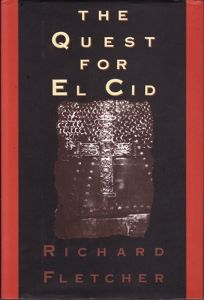
After a year of almost exclusive focus on Napoleonics I am now returning to the promiscuous reading selection of old. One of the books I had been saving up for this moment was Richard Fletcher's The Quest For El Cid. My interest in The Leader was aroused by my visit to Spain two years ago.

The beauty of the book is that it not only describes the life of The Cid, about whom there is only a limited amount of hard evidence, but also the Spain that he lived in, and also the Spain that turned him in to a crusader saint later on.

The age of El Cid was a fluid one, with disintegration of the old Muslim Caliphate into successor states that were unable to maintain themselves against Castilian expansion. So many of them became dependents, riven apart by internal struggle to be exploited by rising Christian states in the north. However, those fought amongst themselves as well.

Christians, Jews and Muslims lived among each other, just like Spanish born were mixed with Arab and Berber immigrants and descendants. Not that it was a multicultural paradise, but at least a period of relative tolerance (see my discussion of that topic earlier on this blog).


Spain in 1086, just before the coming of the Almoravids

But that was about to change during The Cid's lifetime. On the one hand hard line Christians were starting to build a vision of reconquest, while from the North and South of the Sahara the strict Almoravid sect made rapid progress toward the Mediterranean.

The Cid was always more his own man than a courtly insider after he lost his royal patron early in life. He wasn't particularly liked and easily made enemies, but his skill at leading troops made him very useful to the leaders of his age. He served the king of Castile but also the Muslim leader of Zaragoza. And late in life he primarily served his own interest, capturing Valencia to rule himself.

In the last chapter Fletcher shows how the legend was built on this, partly from a need to attract pilgrims in monasteries and later from a need to build a reconquista ideology, and finally in the modern ago, the need to create a unifying myth for Spain.

Highly recommended, therefor

And yes, this is a perfect setting for a megagame.

Tuesday, 30 June 2015

It's My Party...


This is my blog and I brag if I want to


Evert Pater shot this brilliant picture, passing by
The last couple of weeks have been very nice. It all started with the presentation of the book in the Rijksmuseum, together with an exhibition on the battle. I had so many friends and family around it was amazing and I lacked the time to talk to anyone for a sensible time. Not the least because Isabelle was tugging my arm constantly to catch the autographs of my co-authors. But for me it was wonderful to be in the centre of attention. Read a report by Dutch national broadcaster NOS and view the pictures taken by newspaper Parool.

The book has been well received with very favourable reviews in Dutch newspapers NRC (free but registration required) and Trouw (free but registration required) and some historical magazines, such as Historiek, and information vault Kennislink.

Co-author Jeroen van Zanten was interviewed in the Flemish magazine Knack (May 22nd).
Co-author Ben Schoenmaker was interviewed for the Defensiekrant

There have been a number of appearances on Dutch radio and TV:
Ben on Nieuwsuur (June 18th, after 17 minutes)
Me on OVT history programme (June 14th)
Jeroen on TROS nieuwsshow (June 6th) and on Een Vandaag (May 25th)

And we ain't done yet

An article by my hand will appear in the next issue of Mars et Historia, a Dutch magazine on military history, somewhere next month. And I went out on June 19th with a camera crew for the Dutch ironic society programme Hoe Heurt 't Eigenlijk? with dandy presenter Jort Kelder, who proved to be a bit of a history buff. I was bombarded with questions for almost 6 hours straight (except when they were interviewing the Prince of Orange and a few others in the Waterloo bivouac), even when the camera was off. Due to be broadcast somewhere this autumn.

There will also be a number of public lectures, with me appearing at Donner book shop in Rotterdam in October.

Friday, 26 June 2015

Shape of things to come

I'm sure you're all waiting for news on how the book has been received etc. This is coming soon but it has been bussyish. However, I managed to buy a spray can and apply some paint.

Yes those are 28mm Prussian Landwehr. And a few Musketeers. Summer project.

Friday, 5 June 2015

A Heartfelt Thanks To You All

I try not to pat myself on the back here too much, but today was a day that brought me enormous satisfaction: I received the first hard copy of the Waterloo book.

Just holding it sends a pleasant chill down my spine and brings a big smile to my face. It feels good, it smells pleasantly and the quality of the illustrations is really good. Even the flat water colours come off admirably.


The past months have not really been frantic, and I've been through tougher publishing processes, but this is much more *mine* than anything previously. Even if I did it with two other guys, who were very good to have around. Co-operating with Ben and Jeroen has been a real pleasure. Their experience saved me loads of time and took away a lot of potential worries.

And somehow it all fell into place. Our chapters linked up with hardly any overlap, our writing styles meshed and the structure afforded by taking a time and place as the starting point of sections of our chapters worked out as well as might be hoped. It is one book, not three parts.

This also a good time to thank a number of people who provided help during the production of this book: Paul Lindsay Dawson and Stephen Summerfield who gave me access to cutting edge literature and together with Erwin Muilwijk and a number of other regulars on internet fora gave me a good idea of where to find the best current research. Jenny Gierveld, Herman van der Haegen, Michiel Schwartzenberg, Arjan de Jong, Barbara Mounier and Jan Kees Mol gave very useful feedback on the text at several stages. Egon Dietz, Mieke Mateboer and Lona Verkooijen made it possible for me to take four months of leave from work. And last, but certainly not least, Kaj Wijmans should be thanked for turning a switch in my head.

And I want to thank all of you: facebook commenters that sharpened my arguments, colleagues that kept asking when the book would be finished, friends that forgave me when I cancelled appointments, family that had to cope with me staring at a screen late at night, and all of you for showing interest and providing encouragement. It meant and means a lot to me.