Saturday, 15 June 2013

Crisis in Binni - Operation Succesful, Patient Deceased

Two weeks ago I joined in for Crisis in Binni, the megagame about humanitarian intervention in a failing African state (think of Somalia in the early 1990s) as the commander of the US contingent to the international force. I was going to write peacekeeping force, but then realised that was not our mission. Remember this, because it is important.


When the UN decided to intervene in Binni, there had been low level conflict in the country for some years, with the autocratic government of President Ancongo having suppressed rebellions in the north of the country. The direct occasion for action was a famine developing in the northern region.

While the security council (formed for this game of the US, Britain, France and Italy) worked out our exact mission, the commanders of the military contingents planned for their role, in coordination with the UN refugee commissariat and World Food Programme.

As US commander my aims were to keep the commitment of ground troops to a minimum, but to still be seen as the leading nation. I managed to circumvent this seeming paradox by providing the expensive HQ, airbase and transport and attack helicopters for the mission. A few marines were used for protecting the force HQ, airbase and UN depots in Binni’s capital, out of harm's way. And as the Security Council resolution that formed the basis for our deployment implicitly put the US in command, I just treated that as a fait accompli which nobody questioned.

My briefing material for the game, with extensive historical information

The UN military force got a very limited brief: to protect the aid workers and refugees under their care. This also meant very restricted Rules of Engagement, effectively to only shoot when shot at.

My next priorities were to establish a unified command structure and get men on the ground as soon as possible to get a feel for the developing situation. The first French troops were on the ground in a month, with other contingents following two weeks later.

By that time the north of the country had seen extensive ethnic cleansing, with several thousand refugees shot to encourage others to make a move. The smart warlords then corralled the refugees in their area into large camps and waited for UN officials to turn up.
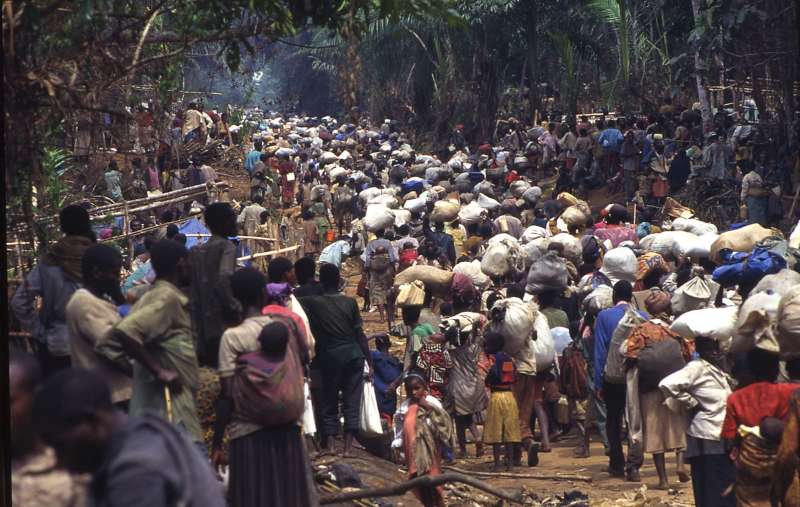


This actually helped the UN aid operation a lot, because it allowed them to concentrate on a few locations. That also made the military mission easier. Part of the aid flowed through Binni’s northern neighbouring country, which was expensive, but saved us the costs and risks of a very long line of communications. We also established on refugee operation in the north based only on air transport to which the same applies.

As expected, the government tried to squeeze us for money, but I was determined to prevent outright bribes as much as possible. So when president Ancongo demanded money to supply his troops, I agreed to a convention that only committed us to paying government troops that would be used solely to protect our refugee camps. In that way I hoped to limit the amount of units we had to support and also gain some leverage over them should push come to shove.

This deal may however been the reason for government troops to try to forcibly take over protection of the refugee camp at Cleopatra from the local warlord. This resulted in a three week battle over the town which gave us some headaches. Mostly because our forces in the area were split: a single British company guarding the camp to the north of the town and a slightly bigger garrison of the UN depots to the south.

We were afraid some of the indigenous force would find the 90,000 lightly protected refugees as a far more alluring target than the opposition and turn on the camp. We solved this by having our Black Hawks flying constantly over the refugee camp to discourage such thoughts. The commander of the British contingent remained anxious and enquired when and how he would be allowed to pull out. Of course I wasn´t keen on UN troops running off from their primary mission when put to the test, but I also understood that a company would not be enough to hold against a determined attack. So I put a number of transport helicopters on call to extract his force when attacked in force and this seems to have been enough to assure him. Anyway we were lucky we weren´t attacked.

UN military personnel at the gate of Cleopatra Refugee Camp

But apart from this and a few pot shots taken at a convoy the game was rather quiet for the UN military. In this we were really helped by the ´constructive´ stance taken by the warlords and the government. As long as they could make some money from us, they had no incentive to create trouble for us. In all I think that the level of bribing in this game was probably lower than in reality, and it was definitely only a small part of our total expenses.

Meanwhile, another neighbouring country had decided to take advantage of the internal turmoil in Binni to invade a disputed region. The Ancongo government therefore kept holding its hand up for money, but the US Ambassador was eventually able to wrench a promise of elections from the president for it.

The Battle of Cleopatra also proved an incentive for the US president to take an interest in the operation, and the US ambassador managed to broker a ceasefire and peace talks. This resulted in a government of national unity and a photo opportunity for the US ambassador.

Of course these peace talks were mainly meant to allow the government to turn on the invaders, which they had duly expelled by the end of the game. On the other hand, the power sharing didn’t fare well with Ancongo’s other clan leaders and rumours were rife of a coup by that time.

Nothing of the sort happened

The generally cooperative behaviour of the warlords and Ancongo government gave the UN a relatively easy game. Those refugees that we got to in time were saved and the concentration worked to our benefit. However, outside UN reach the world was less safe. The Security Council whisked away independent reports on human rights violations by the Ancongo government and evidence of ethnic cleansing and death marches in the north in order to maintain a working relationship. Of course, that didn’t mean that by the end of the game Binni was in a better position for the future.

I think that the UN could have had a lot more criticism in how it dealt with the crisis: the limited brief, the bribes, the support for an autocratic government, no attempts to create peace or safety for ethnic minorities. From all sides there was a lot of Realpolitik and very little principled behaviour. I guess that is due to a general disillusionment with human intervention and what it can achieve in the long run. As far as I understand, UN forces in earlier games were more ambitious and ready to get stuck in. So after six runs of Crisis in Binni, maybe it’s time to shift the situation in Binni by 20 years as well.

... and I approve of this message


Friday, 14 June 2013

Go There Rather Than Here

After yesterday´s general dissing of blogs, I´d like to counter by pointing you to one of the best wargaming blog posts ever: Sidney Roundwood´s ideas on creating a game that feels like being there. Very much enhanced by excellent pictures and illustrations.


Thursday, 13 June 2013

Wargames magazines vs blogs

Let me draw your attention to a very good post by Keith Flint on wargames magazines. I think Keith is entirely correct when he writes

"there are far too many trivial posts and comments out there that contribute very little to our hobby, and which fail to communicate very much in terms of ideas or inspiration. Indeed, some forum posters seem to have quite a lot of trouble spelling words properly and grasping the basics of punctuation, let alone having anything worth saying. Far too many blogs make do with battle reports featuring no maps or scenario outlines, thus giving no idea of what's going on, and support this thin fare with a series of badly lit and/or out of focus photos."

There is a lot of low quality stuff out here (including mine) that is only relevant to a few people that know me well. On the other hand, that's the essence of a blog. It's a trade of between personal and immediate and objective standards of quality. That is also the reason why there will always be room for magazines (in paper or digital form).

On the other hand, it was a long time ago that I was subscribed to one of the glossies and I frankly lost interest because of the indifferent quality of the articles. I'm glad that the both revamped Wargames, Soldiers and Strategy and Miniature Wargames seem to be improving on that.

For me Keith's crie de coeur is a good reason to think about what I can do to improve my blog, without it becoming an online magazine.

The front of Keith's own blog

Keith's criticism is not limited to the blogs however. He is also critical of the 'rather bland and forgettable' contributions of 'prominents figure in the hobby' like Rick Priestly and Richard Clarke. And he engages the debate about the quality of painting shown in magazines and
"articles that purport to pass on their 'secret' of producing wonderful figures in record time. [...] Unfortunately, amongst all the tips and wrinkles, one does not have to read between the lines of such articles very much to discover that the real 'secret' is to spend every waking hour painting figures, often with as much shading and general fiddling about as possible."
 Also Keith argues that
"The emphasis on painting creates a distraction from the task in hand, which is of course to get some wargaming in."
 So by all means, read Keith's blog and take up his recommendations to read the magazines involved.

Wednesday, 12 June 2013

All Shill For Quatre Bras book by Erwin Muilwijk

Also in the mail last week: Erwin Muilwijk's second volume in his history of the Dutch army during the Waterloo campaign: Perponcher's Gamble. This concerns the Battle at Quatre Bras, where a Dutch vanguard managed to hold out long enough for the rest of the Allied army to come up and hold the cross roads at the village.

The black & white and the colour version

Erwin's book fills some gaps that English (and other) writers have neglected to lack of Dutch language skills or the fact that Wellington was having a chat with Blücher somewhere else at the time. For them the battle only starts when Wellington returns.

The maps and illustrations add a lot to the story, because some episodes were confusing even to the participants. It helps to figure out what was going on and where. I heartily recommend the colour version to take full advantage of them, but for the cheapskates (and all others) there is a downloadable version of the maps.

The two extra contributions by Ab Küchler on the Quatre Bras painting by Pieneman and Marco Bijl on the Bois de Bossu also provide added value.

I did have a small role in getting this book to the printer, although I still think a native speaker would have done much better.

Next up is the book on the Battle of Waterloo itself, to be published in about a year from now. Must read for anyone that is interested in the Waterloo campaign or the Dutch army of the Napoleonic and restauration period

Tuesday, 11 June 2013

Fitter, healthier...and more productive - A Year Of Blogging


I started this blog a year ago. Officially it kicked off on June 4th with an obligatory introduction, explaining who I am and why I returned to blogging.


"So think of this blog as a rearguard action. An attempt to retain some of the ground lost to age and commitment (and lose some of the weight I've gained). Think of it as a means of putting dots on the horizon and enlisting the help of others to stay on course."


Me with a WWI A7V tank on display at the Tank Museum in Munster, Germany

But my first real post was on June 10th. On June 14th I set out the projects I had in mind. It may be useful to review to what extent I have persevered with these projects, given that this blog was partially meant to provide focus on a few projects that I could see through to completion.

Grand Projects


Maximum Effort, World War I Megagame. Shelved to focus on another grand project, but I still have it in the back of my head and keep buying books. Reviewed a few on Italy after my holiday there,  the Battle of Adua, then Why Italy came to dinner with only a plate and no cuttlery and Arditi del Popolo. The Maximum Effort blog is now in torpor.

Waterloo, books. Is now a Grand Project. Bought many books in the past year.
Hero of Waterloo? and  Hero of Waterloo II onto 1813-5 battle casualty rates
All is fair in love and war and history and Prussian Infantry Tactics

First Dutchman to lounge in the chair of the First Sea Lord
Admiralty Board Room, London


Minor projects


Mother Russia, the political economy game for WWI. Shelved with the megagame.

Ypres, books. Shelved after reading half to move on to other projects. I reviewed Belgian Patrouilleurs. Unfinished, but drawn the line.

Through the Mud and the Blood, WWI miniatures. Although delayed many times, I have actually started on them recently. However, this is all prototype and no production line. I'll get back to this soon.

Barbarossa, books for the megagame. I did review one of the books I'd read, but not all. Unfinished, but drawn the line.

Dux Britanniarum, Dark Age skirmishing. Bought minis, had them painted (also here), generated my characters, bought more and had them painted too, played a battle. Read a few books but did not review all of them. Here´s Britain After Rome. Even played Struggle for Rome. On slow burn now.

King John, books and possible megagame. One of my first posts. Bought more books, read none. Founded the King John Appreciation Society in response to the resurgence of love for Richard III. On slow burn.

Essen 2011, boardgames. I did play most of the stuff bought in 2011. Like Guards! Guards! Unfinished, but drawn the line.

Leipzig, books and megagame. Now a sub project for Waterloo. Been doing my reading, but not much reviewing. Game is played in two weeks so maybe I can do some more reviews afterwards.

Playtest for Master of Europe and Maps for Master of Europe

Me posing with a T-33 trainer on Vancouver Island

Projects started later


Vietnam, megagame Lost Youth. Read about counterinsurgency, played the megagame. Finished.
 
Essen 2012, boardgames. Started October 2012. I have played most of the games I bought at least once, but still some work to do in the coming four months, like Signum Mortis. And there's reports of games played as planned, games played unplanned, games unplayed and Metro 2033. Ongoing

Al-Andalus, books. Reading up for my holiday in Andalusia last May. Read the books, but only finished my review of the big one. Others to follow.


Humanitarian intervention in the 1990s. Preparation for Crisis in Binni megagame. Read the books. Finished and reviewed. But I need to get the report on the game itself on screen from my notes. Soon! Posts: Zero Dark Thirty, Lessons of Humanitarian Intervention, Crisis Caravan, Black Hawk Down, Crisis in Binni Game Materials 


Me in 2008: fitter, healthier, but not as productive


Conclusions

I still get distracted too easily. A megagame or a holiday is enough to get me sidetracked for a few weeks. And that´s only the projects. I also lost weeks on analysing what makes a real wargamer, reports on boardgames such as Civilization (the game I have played the most over the last two years), bookshops and general musings about the state of the hobby.

For the coming weeks I plan to close off the humanitarian intervention and Al-Andalus projects, then in the following months I should try to focus on Waterloo and Essen 2012. I hope to play some Dux Britanniarum. WWI and King John will be on hold until better days.

The temptations of Essen
Weight loss. On aggregate, I have lost no weight. It was no official project, so I'll make it official now. Let's get it structurally to under 90 kgs by next blog birthday.

Closing remarks

Although I have been graced by many viewers over the year (not all of it referrer spam), the best experiences for me have been to get comments from you. The blog soapbox is nice, but I actually prefer discussion and exchange. Thanks to all of you who have honoured me by entering the conversation.

Monday, 10 June 2013

Chemin des Dames books

Last week I brought Some books for Michiel, since he's going to camp around Compiegne in France this summer. Right in the middle of a number of WWI battlefields.


For a number of years I used to go to the nearby Champagne Ardennes region for a weekend in summer with a bunch of friends. On a few occassions we visited the Chemin des Dames battlefields, and I picked up the books in the picture.

One local guide, with a cover by Tardi, the French comic artist who has had a great impact on the way we see WWI. And another a more extensive account of the many battles fought on the Chemin des Dames, starting with the 1814 battle of Craonne (Napoleon's Last Victory), the 1914 battles, the disastrous 1917 offensive and the German offensive of 1918.

Added are two monographies: Pyrrhic Victory by Robert Doughty on the French Army in WWI and Pierre Miquel's book on the Chemin des Dames. And finally an issue of the French WWI magazine Tranchées, dealing with the offensive with limited objectives, among which the capture of Fort Malmaison on the Chemin des Dames in October 1917.

So Michiel is well prepared for his holiday.

Michiel bought me a Dutch translation of Albert Nofi's book on Waterloo for my birthday. An interesting take, you can spot the wargamer from miles away.

Sunday, 9 June 2013

Flat Earth News - The Dumbing Down of Journalism

Hopelessly late in reading this, but Nick Davies´ Flat Earth News is probably more true now than it was when published first in 2008, before the great culmination of scandals that brought down the Sun and threatened the Murdoch media empire.


Davies argues that by the establishment of media empires in the 1980 and 1990s there started a trend towards rationalisation of news production. Budgets were lowered, fewer journalists were required to produce more news. This has led to a decline in the quality of journalism as there is not enough time to check facts and dig beyond what is delivered to them.

News is now delivered by press agencies with similarly reduced staff, but increasingly directly by PR organisations from the government, interest organisations, companies and intelligence agencies. Davies notes that the time is fast approaching where PR personnel outnumbers the journalists.

PR people have become much better at offering journalists ready-made news items. Political press officers provide Sound bites, arrange exclusive interviews and plant scoops. Interest groups selectively quote-mine scientific reports to support their arguments. Businesses subsidise related research that draws headlines, so that their message gets across. This is just what allows journalist, short of time, to meet their expected levels of productivity.

How journalism is squashed between rationalisation 
on the one hand and expanding PR on the other

The lack of time available has led to several sub-trends, picking stories which:
  • Are easy to process. So only give the facts, not the context
  • Carry low risk. They come from 'trusted' sources like the government, don't offend those powerful/wealthy enough to sue you or block your access to new stories, present both sides of the story as is they are equal. It also means that news media tend to hunt in packs, because a story published elsewhere is a safe source. Esepecially when there's a moral panic.
  • Are guaranteed to sell. So no news from far off places that nobody cares about, but endless celebrity gossip. And nothing that challenges the preconceptions of your audience.
The most interesting development is the support of astro-turf organisations, that is (fake) grassroots organisations supported by companies or intelligence agencies. Look for instance at the many patients representation groups supported by the pharmaceutical industry and non-representative expatriate organisations like the Iraqi National Council.  Or the dubious think tanks and research establishments used by the oil industry to sow doubt about climate change.

Most worrying is that the intelligence agencies have found their way to the newsrooms as well. It is not entirely new, as Cold War agencies also had their journalistic ´assets´, conduits through which they could convey their message. Or undermine the credibility of someone who lifted the lid on them. But since the 1990s they have used their information monopoly to steer reporters in their desired directions.  Their power is as big as those of the independent press agencies. The War in Iraq being a case in point.


Davies´ chapter on The Observer shows how the CIA led reporters astray by misinforming them (through the Iraqi National Council) while the political editor was bagged by Downing Street. But the chapters on other newspapers are as chilling and depressing, especially the collusion with private investigators and policemen that bug phones, gather private information from protected databases and harrass victims to get their side of the story even when all they want is to be left alone.

Tragically, it seems that this book has not been able to change much, although I can see an undercurrent of journalists trying to wrest away from Big Media. And judging by the results of the Leveson Inquiry and the opposition from the media to its conclusions, I have no confidence that it will prove more than a dint in the trend, let alone a break.

Even though this book isn't directly about gaming and history, I think it holds very important lessons when it comes to current military subjects. We cannot assume that information on opponents of the intelligence agencies is truthful. Information is leaked, planted through 'assets' and distorted. It also hold important lessons about the role of the press and the way in which it can be used to keep the truth from the public. We should be thinking hard about how we integrate these lessons into our game design.

It would be nice to say that this trend is only confined to the UK or the anglo-saxon media, but there's enough signs that it also applies to the Netherlands. Joris Luyendijk, writing about the same time, showed the weakness of foreign correspondents in the Middle East. He argued that in countries with hardly any room for independent public opinion, lacking social scientific research or even opinion polls, if not controlled by security services, how could the foreign correspondent really know what people felt?

And when you cover such a large and diverse region, you end up doing a standup from your hotel roof 30 minutes after you'd flown in based on nothing more than what you got from the newsroom and a quick chat with your taxi driver on the way in from the airport. But his criticism of the work of foreign correspondents was met as much by indignant replies from his colleagues as by others commending him for his bravery to be open about the limitations of his job.


Friday, 7 June 2013

Maps for Master of Europe

Jim gave me a set of maps to take with me to the Netherlands: player and umpire maps for Master of Europe. The game is on for June 22nd in Nijmegen. Casting is done and handbooks and invitations will go out later this week.

Note the larger scale umpire map!

Thursday, 6 June 2013

Movie education

Saturday my host Richard delighted me with two excellent low budget movies. They prove that a good story and creative use of limitations can beat million dollar budgets.


The first was The Call of Cthulhu by the Lovecraft historical society. Although fairly recent it was shot in black and white and in a 1920s silent movie style. This worked excellently.

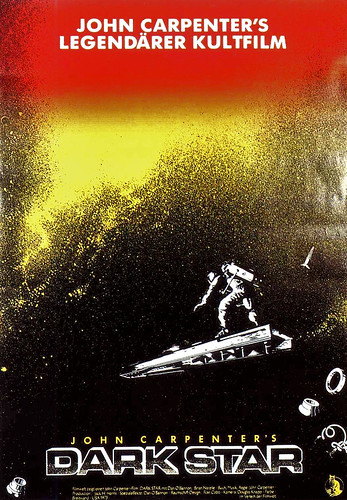
The second was Dark Star by John Carpenter (who went on to make other great movies). It is the story of group of astronauts after 20 years of their scouting mission, charting the stars and blowing up instable planets.


You could see how it had influenced later sci fi movies. But it has more merrit than that. There's great dialogue (especially with the intelligent bombs) and monologue, hilarious chase of the pet alien and like in The Call of Cthulhu , creative use of materials to create props. And it's given me a few interesting quotes to throw at people.

Both movies come highly recommended.

Richard and Jim also educated me on sci fi novels. I'll see if I can fit that hobby in somewhere.