It's that time of the year again!
This may take a while....
Saturday, 6 January 2018
Monday, 4 December 2017
An introduction to Angkor
Angkor is one of the
world's biggest archeological treasures. The site contains hundreds
of structures, many of which have not been recovered yet. They were
built between 800 and 1300 AD and are of impressive size and
artistry.
Part of the mythical
aura that surrounds Angkor stems from its recovery from the jungle.
The city was abandoned in the 15th century after the
capital had been sacked by a Thai army. Although people used to live
there for a long time after and foreigners visited the site in the
16th and 17th century, much of the city was
overgrown after centuries.
| Ta Keo, rebuilt with Chinese help |
From the 1920s French
archeologists (Cambodia was a French colony at the time) have started
to recover and restore the temples. After the peace process in the
1990s and a listing as a UNESCO world heritage site these works,
supported by archeologists from all over the world, have sped up.
| The top structure of Pre Rup. An early temple, with lots of bricks |
What makes Angkor interesting is that there are structures built over a period of 500
years, and you can see different styles interacting. Those style
changes also reflect changes in religion, for example the shift in
focus between Hindu gods Shiva and Vishnu and later to Buddhism.
![]() |
| Stone surrounded by jungle |
On the other hand, all
that remains now is stone, surrounded by jungle. That makes it very
hard to imagine the living city of a millenium hence, with the stone
plastered, painted and covered in copper or gold, the wooden
buildings and the surrounding countryside cut by rice paddies and
irrigation canals.
And of course the
people of the city are missing. Angkor must have had tens if not a
hundred thousand inhabitants. Officials and traders from the
provinces under Angkorian control must have visited, as well as
foreigners. A late 13th century Chinese diplomat has left
an account that adds a lot of colour to our understanding of daily
life, but it is hard to envision in the present environment.
One touch of nuance
however. Apart from the temples there remains another element in the
landscape: the baray, or water storages. The two largest of them, to
the west and east of the city, measure several square kilometers. It
is still discussed whether they were built to supply water to the
inhabitants and/or irrigation system, or for purely symbolic reasons,
but they are still visible and in some cases partially filled to this
day.
Sunday, 3 December 2017
Back from South East Asia
It's been two and a half fascinating weeks. First ten days travelling through western Thailand in the footsteps of the 100.000 POWs who contributed to the construction of the infamous Burma railway (together with thousands of Japanese and perhaps 200.000 South East Asians). Then five days in Cambodia around the fabled temples of Angkor.
It's been a lot of information to take in, even though much of that was self-inflicted. And as always while travelling, full of impressions that go beyond the immediate subjects of the trip. You can't help to notice that both Thailand and Cambodia have shed much of the essence of democracy despite still maintaining the trappings. Thailand is ruled by a military junta (that isn't very good at listening to the people) and the Cambodian government has just had the major opposition party banned.
Yet life seems to be going on anyway. Military and police presence are light. In Bangkok and Siem Reap the Christmas season has started. Around the royal palace in downtown Bangkok we experienced the perfect storm of tourists, graduation day at university and the last opportunity to visit the ashes of revered former king Bhumibol (the exhibition has since been extended).
The poverty gap in these countries is still huge between those in the airconditioned zone (including us tourists) and those outside. Yes, I caught a cold.
And Bangkok is a powerhouse, ever expanding its network of flyover roads and sky trains. I remember that the first skytrain rode between my first two trips in Thailand in 1999 and 2000. Now there are several lines and an underground. Then there were 6.3 million inhabitants, now 9.6 million.
It was also intense to make this trip. I'm not a group travel person and when you are around 35-40 co travellers, that takes some energy out of me. Most of these people had a direct personal relation to the railway, which for them made it an emotional experience that I could only relate to from a distance. I wouldn't have survived if it had not been for my travel companion Michael. We never ran out of topics to discuss and events to comment on, however silly.
I will be posting a few bits from the Angkor part over the next week, but the Thailand-Burma railway story will arrive after that and in a different format as I have a distant personal stake in it.
![]() |
| The party of premier Hun Sen, a former Khmer Rouge cadre, has effectively ruled Cambodia since 1979 |
It's been a lot of information to take in, even though much of that was self-inflicted. And as always while travelling, full of impressions that go beyond the immediate subjects of the trip. You can't help to notice that both Thailand and Cambodia have shed much of the essence of democracy despite still maintaining the trappings. Thailand is ruled by a military junta (that isn't very good at listening to the people) and the Cambodian government has just had the major opposition party banned.
![]() |
| Police booth in Kanchanaburi, Thailand |
Yet life seems to be going on anyway. Military and police presence are light. In Bangkok and Siem Reap the Christmas season has started. Around the royal palace in downtown Bangkok we experienced the perfect storm of tourists, graduation day at university and the last opportunity to visit the ashes of revered former king Bhumibol (the exhibition has since been extended).
| Tourist entrance to the inner sanctum of the royal palace, Bangkok |
The poverty gap in these countries is still huge between those in the airconditioned zone (including us tourists) and those outside. Yes, I caught a cold.
![]() |
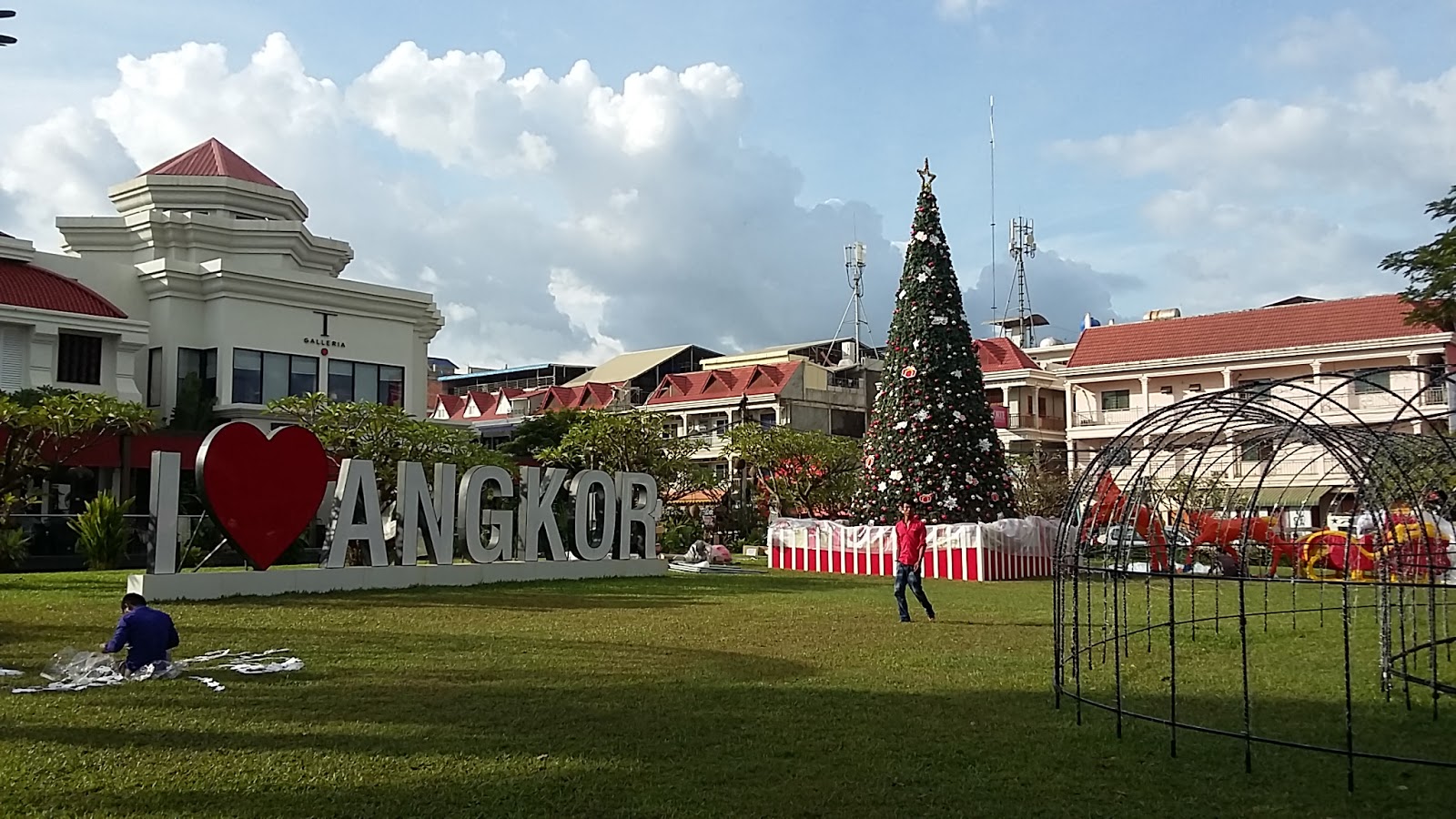
| Christmas decorations are prepared before the luxury mall in Siem Reap (opened in 2016) |
| Flyover roads under construction, Bangkok |
It was also intense to make this trip. I'm not a group travel person and when you are around 35-40 co travellers, that takes some energy out of me. Most of these people had a direct personal relation to the railway, which for them made it an emotional experience that I could only relate to from a distance. I wouldn't have survived if it had not been for my travel companion Michael. We never ran out of topics to discuss and events to comment on, however silly.
I will be posting a few bits from the Angkor part over the next week, but the Thailand-Burma railway story will arrive after that and in a different format as I have a distant personal stake in it.
Tuesday, 14 November 2017
Pink Panzer
This is a small side project I did for a friend of mine who recently became a father and called his daughter Mathilda. "Not after the tank, of course," he said. Because he's a tank hugger and we do exchange tank trivia. The mother of his child didn't seem pleased with that, so an evil plan hatched in me...
A few day ago, I giftwrapped it and handed it over to the young father...
And apparently, it's been appproved.
For those interested, this is a 1/100 Zvezda model of the British A12 Matilda tank.
Of course, my inspiration comes from the legendary Girls und Panzer anime series.
Sunday, 12 November 2017
Forgotten colonial war revisited
Ok, just a small step back to one of the books about colonial wars I posted on some time ago. I follow the excellent podcast series New Books in Military History, which has an interesting selection of new material. Some time ago I listened to a comparison of genocide and conquest on the Eastern Front in WWII and the the American West.
What I found interesting is that the author, Westermann, took up this project based on discussions in his classes, where he found the students would naturally compare different forms of genocide. When it comes to genocide, Nazi Germany remains the archetype/Idealtype, although the last decades our historical knowledge of other genocides has widened.
Of course looking at genocide involves a discussion of the definition, but most definitions go farther than just the mass murder of a particular group with the intent of total destruction. Some include the destruction of culture and separate identity.
While it easy to dismiss referring to the Holocaust as a Godwin, in this vase it is actually helpful.
Westermann notes that what happens 'at the sharp end' of policy doesn't necessarily align with what happens at the centre. And while what happens at the sharp end may seem very similar in both cases, Westermann argues that the main difference between the American and the German case is that in the former, the authorities were not bent on genocide and in the latter they were.
It's worth listening to his argument in full.
What I found interesting is that the author, Westermann, took up this project based on discussions in his classes, where he found the students would naturally compare different forms of genocide. When it comes to genocide, Nazi Germany remains the archetype/Idealtype, although the last decades our historical knowledge of other genocides has widened.
Of course looking at genocide involves a discussion of the definition, but most definitions go farther than just the mass murder of a particular group with the intent of total destruction. Some include the destruction of culture and separate identity.
While it easy to dismiss referring to the Holocaust as a Godwin, in this vase it is actually helpful.
Westermann notes that what happens 'at the sharp end' of policy doesn't necessarily align with what happens at the centre. And while what happens at the sharp end may seem very similar in both cases, Westermann argues that the main difference between the American and the German case is that in the former, the authorities were not bent on genocide and in the latter they were.
It's worth listening to his argument in full.
Thursday, 9 November 2017
Summer painting seamlesly devolving into beer and games
This is what I did for our club's Summer Painting Challenge (inspired by Curt's). Ran from late June till halfway September. I set myself 400 points to paint, although I felt 200 would have been more realistic. In the end I ended up somewhere above 300 points, so setting the goal probably made me more productive than I'd otherwise been. That's a good thing I guess.
This was the main bit: a bunch of 18th century civilians, some scenery and goodies for scenarios and Frostgrave. And a bunch of farm and pack animals for the same purpose.
But I also finished a unit of British light infantry for AWI. This is them still glossy because I didn't get them sprayed with matt varnish before the received their baptism of fire.
Ten wargamers got together in September for a Wargame Beer and Game session, with me hosting Rens and Henny for a practice game of Sharp Practice 2, and seven other guys doing a Big Chain of Command game. Beautiful table!
And a very good dinner was had afterwards.
This was the main bit: a bunch of 18th century civilians, some scenery and goodies for scenarios and Frostgrave. And a bunch of farm and pack animals for the same purpose.
But I also finished a unit of British light infantry for AWI. This is them still glossy because I didn't get them sprayed with matt varnish before the received their baptism of fire.
Ten wargamers got together in September for a Wargame Beer and Game session, with me hosting Rens and Henny for a practice game of Sharp Practice 2, and seven other guys doing a Big Chain of Command game. Beautiful table!
And a very good dinner was had afterwards.
Monday, 6 November 2017
Return from Crisis II
Apart from the paper, I also brought home some wargaming terrain: I had been looking out for a game mat that I could use for both Frostgrave and Sci Fi (of course I had originally started out for two). I ended up buying a 4'x4' mat from Kraken. I was swayed by the guy from Kraken showing a WH 40K battle report video which used this mat and it looked dead on.
Last year I bought quite a lot of styrofoam stuff to build large stone buildings for Frostgrave. But as I've got two left hands, I have never actually dared building anything without adult supervision. So this year I decided to just buy a bunch of ready made ruins which I can quickly assemble and actually use.
Finally, I also got some Footsore miniatures to round off my Anglo-Saxon army for Hastings. That's part of the annual project from the Dutch Miniature Wargames facebook group, this year themed for the high and late Middle Ages. More about that later.
Ooh! And the guinea pigs!
Last year I bought quite a lot of styrofoam stuff to build large stone buildings for Frostgrave. But as I've got two left hands, I have never actually dared building anything without adult supervision. So this year I decided to just buy a bunch of ready made ruins which I can quickly assemble and actually use.
Finally, I also got some Footsore miniatures to round off my Anglo-Saxon army for Hastings. That's part of the annual project from the Dutch Miniature Wargames facebook group, this year themed for the high and late Middle Ages. More about that later.
Ooh! And the guinea pigs!
Sunday, 5 November 2017
Return from Crisis I
Yesterday visited the Crisis wargames show in Antwerp. Others have made more extensive reports on the show, so I'll not try to compete. But for me mostly it was a pleasure talking to so many people about their day and future plans.
I had planned to buy the latest edition of the Volley & Bayonet rules set to go with my Napoleonic French and Austrians for the 1809 campaign. Picked up the Marechal d' Empire /General de Division rules from Baccus as well. Now have to decide quickly which one I want to use for a participation game at PolderCon.
The books I bought just show that I can't be trusted to stick to one period. The book on the Iberian theatre of the War of Spanish Succession I bought because I met Nick Dorrell a decade ago in Eastern Europe. We then discussed the WSS (which I have this fascination for) and I sent him some stuff from Dutch sources.
The other WSS book I bought because I'm a sucker for logistics and systems of command and control. And I was intreagued to find that this author had at least read a few Dutch sources. I believe this was the first time Helion & Company visited Crisis. I was glad to shake the hand of Andrew Bamford, whose A Bold and Ambitious Enterprise (and follow up sourcebook) on the British campaign in the Low Countries in 1814 I used when writing on Waterloo. Consider that a recommendation.
And 10th century warfare in Germany just taps into my new found interest in that period. I hope to blog about how that came about.
Note: Yup, it's been too quiet up here. And I stand reprimanded for that. As last year, I will try to do better. However, I haven't figured out how to do that, yet, without spending a lot of time. Which has been the reason why I dropped out before. It's okay to spend half an hour once every few days, but I have found that blogging takes more time if you want to do it well. But let's give it a shot.
I had planned to buy the latest edition of the Volley & Bayonet rules set to go with my Napoleonic French and Austrians for the 1809 campaign. Picked up the Marechal d' Empire /General de Division rules from Baccus as well. Now have to decide quickly which one I want to use for a participation game at PolderCon.
The books I bought just show that I can't be trusted to stick to one period. The book on the Iberian theatre of the War of Spanish Succession I bought because I met Nick Dorrell a decade ago in Eastern Europe. We then discussed the WSS (which I have this fascination for) and I sent him some stuff from Dutch sources.
The other WSS book I bought because I'm a sucker for logistics and systems of command and control. And I was intreagued to find that this author had at least read a few Dutch sources. I believe this was the first time Helion & Company visited Crisis. I was glad to shake the hand of Andrew Bamford, whose A Bold and Ambitious Enterprise (and follow up sourcebook) on the British campaign in the Low Countries in 1814 I used when writing on Waterloo. Consider that a recommendation.
And 10th century warfare in Germany just taps into my new found interest in that period. I hope to blog about how that came about.
Note: Yup, it's been too quiet up here. And I stand reprimanded for that. As last year, I will try to do better. However, I haven't figured out how to do that, yet, without spending a lot of time. Which has been the reason why I dropped out before. It's okay to spend half an hour once every few days, but I have found that blogging takes more time if you want to do it well. But let's give it a shot.
Sunday, 5 March 2017
Symmetry on the western front in WWII
The
bazooka vs panzer book whetted my
appetite for some more WWII western front stuff (I still have that 20mm US army
miniatures hanging around), so I picked up this new Osprey pitting German and
US armoured infantry against each other.
Looking back it wasn’t
written in the stars that the last four books I read would all be from the Combat and similar Duel series,
but that’s how it played out. I’ve warmed to these series but my impression has
been confirmed that the best of these are the ones that pit different styles of
warfare against each other. With the armoured infantrymen and the World War I askaris,
there is a less interesting dynamic than between Apache vs US cavalry and bazooka vs tank.
There didn’t seem to be much difference between the Panzergrenadier and armoured infantryman when it comes to equipment
and armoured fighting vehicle. There were some differences in replacement
policy but those went for the armies as a whole and didn’t affect tactical and
operational employment. Zaloga refers to a German preference for attacking mounted
in their AFVs, but that is not what happens in the examples, so we don’t have
any idea how that plays out.
Armoured divisions
on both sides suffered when defending because they had a smaller infantry
complement than an infantry division. And while the Americans had the luxury of
being on the strategic offensive and thus only having to defend occasionally,
the German army by the end of the war had to plug gaps with whatever came to
hand, thus putting the armoured divisions at a disadvantage.
Apart from
an offensive or defensive stance the determining factor in the outcome of this
match up was that the Americans had much more stuff and were better at
coordinating them. So while the Germans even struggled to get artillery support
for their attacks, the Americans could pour artillery on enemy attacks,
supplemented with air attacks when the weather was good.
My main
problem with the book is that the combat narratives, and especially the last
one, are not that clear and are badly supported by the maps. Especially in the
last case it is hard to figure where the combat is taking place to St Vith and
other places which are constantly referred to in the text. To sum up: I lost
interest at some point.
Friday, 3 March 2017
Asymmetry on the western front in WWII
After a
couple of colonial contests, I was happy to shift to World War Two. I had been
intreagued by the match up between the bazooka and German close defense systems
for tanks.
Steven
Zaloga is an authority on tank warfare, and his knowledge on this subject does
not disappoint. The dynamic interaction between antitank tactics and close
defense is explained well, debunking some myths on German mesh side armour. And
there were some weirdly interesting solutions suggested, like the Vorsatz P.
It was all
rather marginal though, as infantry weapons were responsible for only a small
amount of tank losses, with tanks, aircraft and artillery doing the most
damage. The main impact may have rather been to give infantry the idea that
they wouldn’t have to face tanks empty handed. Also the bazooka was used far
more often to take out enemy strong points than to fight tanks.
Zaloga then
delves into one example where tanks and infantry were pretty evenly matched, during
the Ardennes offensive in December 1944. As
this fight took place in favourable circumstances for the infantry, with
limited vision due to fog and houses, the infantry was able to get close to the
tanks and on their weak side and rear armour.
Sadly,
lacking in the account is the perspective of the German tankers and their attempts
at close defense here. All in all the technical/tactical account of the start
didn’t mesh too well with the combat narrative.
Subscribe to:
Posts (Atom)