Monday, 31 March 2014
Review: Yorck and the Era of Prussian Reform, 1807-1815
Yorck and the Era of Prussian Reform, 1807-1815 by Peter Paret
My rating: 5 of 5 stars

Great book on the Prussian reforms before and after Jena-Auerstädt. Shows that it was not just a case of noble and visionary reformers vs dumb reactionaries, but a struggle in which military theories and practice were linked to but also conflicted with legal privileges, social attitudes and personal rivalries.
Considering the opposition it is amazing how much was achieved and one wonders what might have happened if Scharnhorst hadn´t died so young and peace hadn´t come so soon. In any case, the reforms turned the Prussian army from a laggard into a front runner, despite the rough edges.
Yorck´s role in all of this is much more interesting than many historians have it (and that includes recent historians who have simply repeated the myths of the past). Yorck was in many ways closer to the reformers than most, looking at his practice as a commander of the Jäger and the infantry regulations and training programmes he helped to write. On the other hand, he was quite aware that the consequences of the social change not only undermined his status and legitimacy as a noble, but thereby also that of other institutions. And he was a pain in the arse to work with.
All this lovingly analysed and extensively researched by the author.
View all my reviews


Saturday, 29 March 2014
I actually did some more modelling and painting!
Yes, it gets more unbelievable...
When I spray painted the Panther tank, I also went over two 1:72 Shermans I had assembled earlier for my US Army force for Chain of Command (look for a teaser at René's Paint-In blog, he's doing a great job again).

And three newly assembled M3 halftracks in different versions. I gotta admit I love those Plastic Soldier kits for ease and speed of assembly.
You won't believe it, but I also have three Stuart M5A1 sprues here that I just might assemble sometime soon. And a bunch of jeeps and a Buffalo.
Not making any promises though....
When I spray painted the Panther tank, I also went over two 1:72 Shermans I had assembled earlier for my US Army force for Chain of Command (look for a teaser at René's Paint-In blog, he's doing a great job again).
And three newly assembled M3 halftracks in different versions. I gotta admit I love those Plastic Soldier kits for ease and speed of assembly.
You won't believe it, but I also have three Stuart M5A1 sprues here that I just might assemble sometime soon. And a bunch of jeeps and a Buffalo.
Not making any promises though....
Friday, 28 March 2014
I actually did some modelling and painting
My appearance at Murphy's Heroes yesterday was a bit of a shocker. Not so much the fact that I was present, but the fact that I was carrying an assembled and painted 1:72 Airfix model of Panther tank.

This goes contrary to club myth that I don't ever paint any miniatures and as we all know you shouldn't let the facts come between a good story.
The tank is actually not for myself, but a proxy gift to my great chum Michiel, a tank hugger if there ever was one.

I had to assemble quickly to present the unpainted model at his birthday bash last Friday.

And this weekend I quickly snatched the opportunity to airbrush it. Yes, desert yellow is a cop out. But it's the thought that counts.

I even spray painted the tracks

Did some dark wash on the rear grids. And a highlight. Which makes it look presentable, doesn't it?

Oh yes! Almost forgot the decals...
This goes contrary to club myth that I don't ever paint any miniatures and as we all know you shouldn't let the facts come between a good story.
The tank is actually not for myself, but a proxy gift to my great chum Michiel, a tank hugger if there ever was one.
I had to assemble quickly to present the unpainted model at his birthday bash last Friday.
And this weekend I quickly snatched the opportunity to airbrush it. Yes, desert yellow is a cop out. But it's the thought that counts.
I even spray painted the tracks
Did some dark wash on the rear grids. And a highlight. Which makes it look presentable, doesn't it?
Oh yes! Almost forgot the decals...
Friday, 21 March 2014
It's Official: I'm not a Witch!
Had a nice trip cycling from Woerden via Oudewater and Montfoort to Vleuten. Not only was it a beautiful sunny day, but this is classic polder country.

In Oudewater we visited De Waag, where goods were traditionally weighed before sale, but it is better known for its weighing of witches. The first recorded witch trials in the northern Netherlands stem from the 1540s, and de Waag probably acquired the privilege to weigh witches sometime after that. However, since you have to pay for weighing, this was only of use to the wealthy.
Although the coming of Protestantism helped in driving out the belief in witchcraft the last trial in the northern Netherlands was in 1614. But in the year before several dozens of people had been killed during a trial in Roermond. The last official weighing was in 1729 but it is still done for visitors. The museum has a small but engaging exhibition on witchcraft and trials.

From there on to Montfoort where with some luck we ran into the gate of the former castle of Montfoort. The castle was destroyed by the French during one of their attempts to break into the Water Line (oude Hollandse Waterlinie) in 1672.
In Oudewater we visited De Waag, where goods were traditionally weighed before sale, but it is better known for its weighing of witches. The first recorded witch trials in the northern Netherlands stem from the 1540s, and de Waag probably acquired the privilege to weigh witches sometime after that. However, since you have to pay for weighing, this was only of use to the wealthy.
 |
| Unsurprisingly, my 190 pounds proved I am not a witch |
Although the coming of Protestantism helped in driving out the belief in witchcraft the last trial in the northern Netherlands was in 1614. But in the year before several dozens of people had been killed during a trial in Roermond. The last official weighing was in 1729 but it is still done for visitors. The museum has a small but engaging exhibition on witchcraft and trials.
From there on to Montfoort where with some luck we ran into the gate of the former castle of Montfoort. The castle was destroyed by the French during one of their attempts to break into the Water Line (oude Hollandse Waterlinie) in 1672.
 |
| A sign showing the castle in the mid 17th century |
Tuesday, 18 March 2014
I sacrificed 3 months of virtue for 8 minutes of pleasure
It had been a long time since I went to the club in Delft and a long time since a went to the FLGS there. So I hopped in, saw some interesting stuff but remembered my pledge not to buy new games. That made it easy to resist the temptation of new games like Warhammer DiskWars and Relic, about which I want to know more before I consider buying.
But I did pick up Eight Minute Empire. There´s been some real enthusiasm for this game and it will not be hard to get to the table given its short playing time (not exactly 8 minutes though). The rules are really minimal, but that also works for Love Letters.
Breaking my resolution within 3 months, but I don't feel bad about it and I'll leave the resolution standing.
 |
|
Notice that the name of the game was left untranslated in the Dutch edition |
But I did pick up Eight Minute Empire. There´s been some real enthusiasm for this game and it will not be hard to get to the table given its short playing time (not exactly 8 minutes though). The rules are really minimal, but that also works for Love Letters.
Breaking my resolution within 3 months, but I don't feel bad about it and I'll leave the resolution standing.
Sunday, 9 March 2014
The Social in analogue games
I'd like to point you to this thought provoking post on social gaming on designer site Gamesbrief. It is about computer games, but I think the golden question is: can miniature and board game companies use these same techniques? I think they can, and they should. The technology is there.
It seems analogue game designers are too busy designing mechanisms rather than building a product to make money. And apparently, analogue publishers are still behind the video game, movie and music businesses.
Obviously the technologies involved have to be different than for video games, but it shouldn´t be too hard to develop a multimedia strategy to promote a game. Fans have shown themselves to be only too happy to contribute.
So if you design miniatures, why not set up a Pinterest or Instagram page where people can post their efforts? Why not reward them? Why not bring them together? Why not offer them workshops?
Or if you design games, use your fans to test play. Challenge them to 'break' the game. Invite them to promote your game (like Too Fat Lardies does). Incorporate their story lines in a universe of stories around your game.
Of course, that means you delegate some of the control over your creation to others. That's nothing new in RPGs, so why not do it? Games Workshop could have had all that, but they left that huge social gap up for grabs. Who is going to jump in it?
 |
| From Gamesbrief |
It seems analogue game designers are too busy designing mechanisms rather than building a product to make money. And apparently, analogue publishers are still behind the video game, movie and music businesses.
Obviously the technologies involved have to be different than for video games, but it shouldn´t be too hard to develop a multimedia strategy to promote a game. Fans have shown themselves to be only too happy to contribute.
So if you design miniatures, why not set up a Pinterest or Instagram page where people can post their efforts? Why not reward them? Why not bring them together? Why not offer them workshops?
Or if you design games, use your fans to test play. Challenge them to 'break' the game. Invite them to promote your game (like Too Fat Lardies does). Incorporate their story lines in a universe of stories around your game.
Of course, that means you delegate some of the control over your creation to others. That's nothing new in RPGs, so why not do it? Games Workshop could have had all that, but they left that huge social gap up for grabs. Who is going to jump in it?
Friday, 7 March 2014
Wexy comes out of the depot
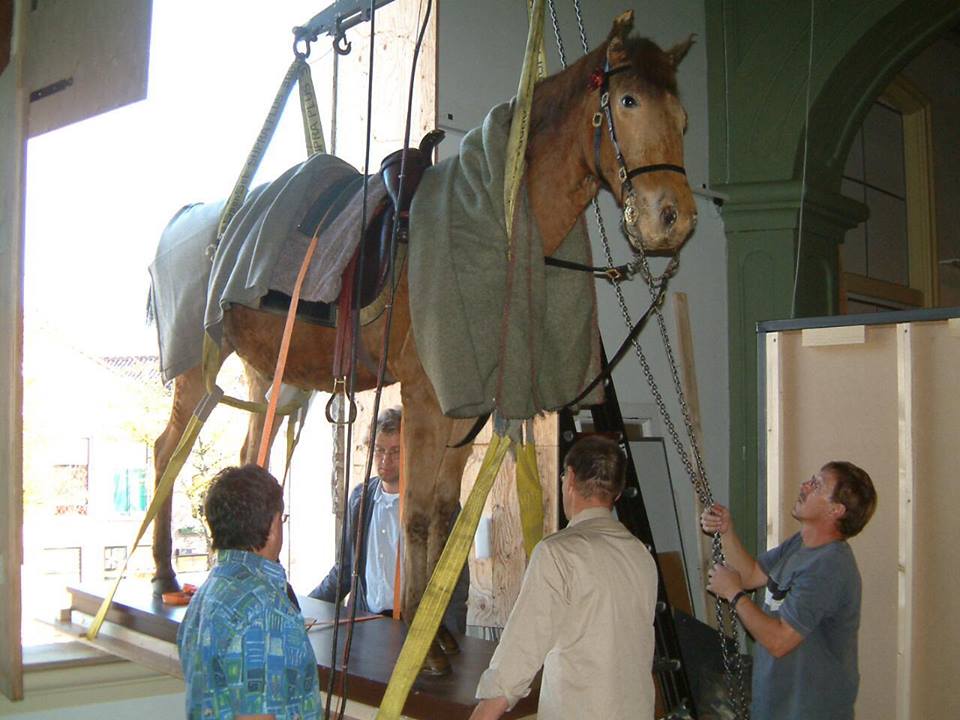
If you have any interest in Waterloo the one thing you have to do in the next few months is go to Dordrecht and visit the exhibition on the art collection of king Willem II. Willem was an avid collector and connaisseur, but after his sudden death in 1849 the collection was sold to cover his debts. It has been partly reconstructed for this exhibition.
The special guest in the exhibition is Wexy, Willem's longtime favourite horse. He rode it at Waterloo where Wexy was wounded. The horse lived on to ripe age, but even then Willem couldn't part. Wexy's body was preserved and remained in Willem's collection, but was also dragged around Ghent after Belgium split from the United Kingdom of the Netherlands to garner support for the Orange family.
These days it is mostly locked away so this is a unique opportunity to see Willem's faithful charger.
 |
| From the Dordrecht Museum website |
These days it is mostly locked away so this is a unique opportunity to see Willem's faithful charger.
Sunday, 2 March 2014
NYR update February
The book: again a considerable amount of reading, which is encouraging. I started the month with a big splash of online orders, which have almost all arrived by now. Some of these I have read immediately, like Officieren Aan Het Woord, The Unwanted Revolution, In the Wake of Napoleon, Hell Upon Water and Napoleon and Berlin.
I also picked up two Ospreys on Napoleon´s headquarters and general staff. There was the odd non-Napoleonic book bought, mostly second hand as promised: one on El Cid, three on WWI and French WWII aces from the translated Osprey series.
February was meager in terms of gaming. I missed two sessions (one of A Study in Emerald and one of Civilization), so I’m not happy with that at all. But at least I got some nice stuff played: Tales of the Arabian Nights, Concordia, In the Name of the Rose and Set. None of my new acquisitions, though. No games bought. Not tempted.

No minis bought, although I ordered bases for the American WWII infantry that René is painting for me.
I did 10 blog posts, mainly book reviews, but also a fairly popular one on why it matters to wargamers what happens to Games Workshop. I still have to finish one on the differences and similarities between Napoleon’s 1814 and 1815 campaigns. After finishing Leggiere’s The Fall of Napoleon, I’m sure there is something in there.
The Cid book rekindled the smouldering interest I picked up last year in Spain for the Reconquista period (which is about Christians fighting Christians and Muslims fighting Muslims as much as fighting each other). So I’ve added it to the shortlist of projects I might pick up after Waterloo.
All in all again quite a good month from the perspective of my resolutions.
As far as non-gaming NYR: I got a new bike. Spring has officially started!

 |
| Two books picked up cheaply at a second hand stall |
February was meager in terms of gaming. I missed two sessions (one of A Study in Emerald and one of Civilization), so I’m not happy with that at all. But at least I got some nice stuff played: Tales of the Arabian Nights, Concordia, In the Name of the Rose and Set. None of my new acquisitions, though. No games bought. Not tempted.
No minis bought, although I ordered bases for the American WWII infantry that René is painting for me.
I did 10 blog posts, mainly book reviews, but also a fairly popular one on why it matters to wargamers what happens to Games Workshop. I still have to finish one on the differences and similarities between Napoleon’s 1814 and 1815 campaigns. After finishing Leggiere’s The Fall of Napoleon, I’m sure there is something in there.
The Cid book rekindled the smouldering interest I picked up last year in Spain for the Reconquista period (which is about Christians fighting Christians and Muslims fighting Muslims as much as fighting each other). So I’ve added it to the shortlist of projects I might pick up after Waterloo.
All in all again quite a good month from the perspective of my resolutions.
As far as non-gaming NYR: I got a new bike. Spring has officially started!
Thursday, 27 February 2014
Review: Napoleon and Berlin: The Franco-Prussian War in North Germany, 1813

Napoleon and Berlin: The Franco-Prussian War in North Germany, 1813 by Michael V. Leggiere
My rating: 5 of 5 stars
Fine account of the 1813 campaigns in Saxony with a focus on the role of Prussian general Von Bülow. This is an interesting perspective as Bülow’s career in 1813 touches on several crucial episodes in the Prussian revival of that year.
He first played an important role during the three months between the return of Napoleon’s shattered army from Russia in December 1812 and the Prussian shift of alliance from France to Russia in March 1813. It shows that apart from walking a tight political rope between French demands for action, insubordination to his own king and challenges from Russian frienemies and Prussian revivalists, he maintained his freedom of action while building up his own untrained force. Leggiere holds that the Prussian army was the prime mover driving king Friedrich Wilhelm into the alliance and that it remained the driving force behind the campaigns against Napoleon in the next two years.
Next, Bülow was tasked with the defence of Berlin during the spring campaign. This gives a nice assessment of the Prussian ability to defend the capital and the amount of prestige invested in holding it. Elaborate plans for a system of inundations around the town were marred by lack of water and offered no help in practice. It also shows the central place Berlin held in Napoleon’s long term plans. On the other hand, the fact that he never led a force to occupy it in person and the resources he put at the disposal of his underlings suggests that it wasn’t a primary goal. A feeble attempt by Oudinot in May was stopped by Bülow at Luckau.
During the armistice Bülow took the responsibility for the reorganisation and final completion of the Kurmark Landwehr. The armistice provided a crucial breathing space that ensured the Landwehr was an effective combat force in the autumn. This is a very interesting episode illustrating the high water mark of the reform movement in Prussian military and political affairs and the challenges of building up an army in an impoverished state. Although the Landwehr had been envisaged by the reformers as a separate institution to the regular army, the generals’ involvement in its organisation and training ensured that the two forces merged and that the ideals of a people’s army and a nationalist force were subjected to conservative and monarchical considerations.
With the resumption of hostilities Bülow was again tasked with the defence of Berlin but now in a multinational army under the orders of Crown Prince John Charles of Sweden, formerly known as Marshal Bernadotte. Bülow, not an easy man to work with himself, suffered from Bernadotte’s single minded pursuit of Swedish and private objectives at the cost of allied cooperation and success. At the battles of Gross Beeren and Dennewitz the Prussians essentially fought the French thrusts towards the capital by themselves with the Swedish and Russian elements of the army watching from a distance.
Towards the end of the book the focus of action shifts away from Berlin but Bülow once again plays an important part in the final day’s fighting at the battle of Leipzig. Meanwhile, the fraught relationship with Bernadotte reaches new lows, and it is easy to see that this would affect Bülow´s operations in the Low Countries in late 1813 and 1814.
Bülow’s difficult relationships with about every other allied commander show that personality played as much of a role in generalship on the allied side as between Napoleon’s marshals. It also affected his performance in 1815. On the other hand, Leggiere shows that the general was not a conservative doctrinarian but an intelligent man of experience with a principal distrust of the reform faction in the army, who developed as good a working relationship with his reformist chief of staff Boyen as Blücher reached with Scharnhorst and Gneisenau.
Leggiere’s great achievement is to weave all these elements into an engaging narrative that adds much to the classic accounts of the 1813 campaign.
View all my reviews
Sunday, 23 February 2014
Review: Hell Upon Water

Hell Upon Water by Paul Chamberlain
My rating: 4 of 5 stars
Well written and well researched book about the prisoners of war kept in Great Britain during the Napoleonic Wars. Most of these were French, but also included French allies, Americans (from 1812) and even British soldiers who had misbehaved.
Although life in the prisons was no pleasure, Chamberlain makes every effort to show that it wasn't too bad and most British officials earnestly tried to provide for the men in their care.
Part of the problem was the breakdown in Anglo-French agreements over care and exchange of civilians captured at the recommencement of hostilities in 1803. This meant that the French refused to pay for the food and lodging, but also that there were hardly any exchanges. French soldiers therefore knew they were in it for a long time and this created further problems for discipline.
However, the vast majority of prisoners seems to have behaved as well as might be expected in confinement. Escapes and mutinies were rare and even officers rarely broke their parole to escape.
The best bits of the book are where Chamberlain describes the social stratification of the prisoners, but Chamberlain also extensively describes how they occupied themselves with crafts like carving, straw work and forgery.
The officers on parole and the craftsmen through their sale on markets became a part of the local communities, even resulting in a few marriages and permanent settlement. Another nice feature of the book is the many examples of remaining signs of the POWs in artifacts, graves and geographical names like Frenchmen's Road.
View all my reviews
Subscribe to:
Posts (Atom)