Saturday, 20 October 2012

Spiel Essen 2012 - day 2

Day 2 was much better, started out well with King of Tokyo and Elder Sign. Roamed around halls 4, 5 and 6 with the small new designers and saw some promising stuff, like Democracy. Majority Rules.
Dominare, part of AEG's Tempest setting for a range of euros, was surprisingly sophisticated and thematic. I hope we can give it a full try today.
I didn't buy a lot of stuff. I will pick up Kemet later and couldn't find an English version of Risk Legacy. But I'm quite happy with what I bought and have a good feeling that they will be played.
Now off to Hünxe Raststätte for some more gaming


Friday, 19 October 2012

Spiel 2012 - day 1

Pffff, so what to say about the first day? It was relatively quiet, so I decided to finish my business in the busiest halls first, because Friday is bound to be more crowded.
Not overly enthused so far. Played a few games, like City of Horror, World Conquerors, Aztlan and Moongha Invaders. Had a few explained, like 1984: Animal Farm, Vlad Prince of Wallachia and Oh no! Invasion.
But my eyes only started to shine when I got hold of Kolejka (=queu). A lot of love went into that game and it shows.
The only bit of news I got is that people are working on a fantasy multiplayer version of A Few Acres of Snow. I look forward to that and trust there won't be a Halifax Hammer.
So back to the show and all the weird eastern European stuff.


Wednesday, 17 October 2012

A Quick One (before I'm away)

As I finish packing my stuff for Spiel in Essen.

The boardgamegeek page with Essen freebies and specials

And the plans for all the halls with the stands in detail. In case you can't aready find your way around blindly.

I'm a loser, baby...

This is also the moment to acknowledge failure. I didn't make my stated goal to play all Essen 2011 games before Essen 2012.

There are of course reasons enough, but our gaming appetite is always greater than the time available to play. Which has caused me to write this anguished post. Which, in turn, has not yet brought on a change of behaviour, and I dread the amount of stuff I´ll be bringing home this time.

But this year I did  manage around a dozen games of Civilization, as well as half a dozen games of Eclipse. So there´s a tendency as well to master one great game rather than discover as many new ones as possible. Not sure this is a long term shift or just a mood swing which will turn back in a couple of years time.

So I´m not much further than I was early September. Yes, René, it sounded really easy then. And I´ve been carrying Apokalypse around in my bag for 6 weeks, but I just couldn´t finish the rules in German. I will download them in English.

The structural boon has been to buy more shelf space, which was not immediately taken up by stuff stacked up in corners. I am still trying to clear away a few books, so let me know if you would like to send one to you for free.

The only thing I can do now is to set myself the goal to have played all games I am bringing home from Essen within one year from now. Let's call that minor project Essen 2012. That should make me think harder the next two days to set a realistic target. Obviously, just stating the plan hasn't worked to full satisfaction. Anyone have a suitable punishment if I don't make it next time?

Tuesday, 16 October 2012

Essen 2012 interest list: Ameritrash and wargames

This post follows on my post from earlier today, where I looked at games with cool, fresh themes, euros and expansions. Today we will look at Ameritrash and a group of undefined games.

Me and my mates trying out Conan at Essen 2009

Old Skool AT, Dudes on a map

Moongha Invaders: Mad Scientists and Atomic Monsters Attack the Earth!
Martin Wallace's take on 1950s monster C-movies. This has been a long time coming, and is supposed to be great fun!

Might be an old fashioned dudes on a map game, it might have a twist. It's about the Mediterranean in the 7th-11th centuries. Let's give these Greeks a try, they should have a different perspective on this.

Pretty good as a theme. The board looks very chess like, but there's some intreaguing dashboards with dials to keep track of stuff. I'm going check this one out.

I played the demo last year at Essen and I hope it has been improved on it since then. Should be easier to attack now, because there were too many -no results- and it became a grind, rather than the highly exciting, over the top wargame it should be to match the movie. 

From the guys that made Cyclades. The game pieces are truly stunning, as is the artwork. Hope the game is as good.

Need to check out the base game first, but it has a good press, so very interested. Monsters battling across Tokyo is not a sparkling new theme, but rolling dice, now this is supposed to be fun, says Jazzbeaux.

I saw a test version of this last year and was pretty taken with the art work and theme, so surely I will have a look at this one! Not much idea of the rules yet, though.

Hey, it's finished! Cool! I playtested this. Can't wait to see how it's turned out in the end. Here's what I wrote 2 years ago after playtesting. WARNING: Those remarks may no longer apply.

This one escaped my attention last year. Will check out. Luckily they have a better price now (although at the loss of the metal miniatures, but I think I should be able to make up for that with others)

This could be awesome, this could be trouble. The possibilities are endless, but it is easy to do wrong, because a rampaging Balrog is presumably a game changer. Also it is an expansion to WOTR 2nd edition, which I don't have (nor covet).

Teutons
This is a game on four battles involving the Teutonic order, like Lake Peipus and Grunwald/Tannenberg. In fact, it's more of a wargame, with card driven mechanics. It is only the prototype, but there's nothing like giving a prototype a try.

Mythic Battles
Supposedly a innovative new battle mechanism including influences from miniatures, board and card games. Terrific artwork. Worth a look.


Not Sure whether these are really AT but they have OK themes
Maybe special agents are the theme for 2012? Counterterror actions, played in scenarios with the promise of campaigns and leveling up characters. Euro cooperative game mechanics.   

Gauntlet of Fools
Certain death sounds good. I am intreagued how the boasting thing works out.

Maybe special agents are the theme for 2012? Counterterror actions, played in scenarios.  Euro cooperative game mechanics.

Space, cooperative... this could just be the umptieth cooperative space game, but at least you'll be doing some fighting. All will depend on the player interaction

Cool theme: managing your orc tribe. Competition, backstabbing sounds good, but it's also worker placement... let’s try

Rerelease, but artwork looks good. Bit meh on second look.

Ninja's, dinosaurs, pirates, and more all in one deck building game! Here's what Matt Drake and Michael Barnes think about it.

Winter Tales
I have a fascination for storytelling games, but they are incredibly difficult to pull off. Given the amount of stuff in the box there might be a lot of game in there as well.

Essen 2012 interest list: Fresh themes, euros and expansions


As in the last few years I'll be going to Essen with a list of things to watch out for. I have based it on Eric Martin's preview list on boardgamegeek. It is not necessary that they are releases on the show, just that I haven't tried them yet.

Phil Eklund explaining High Frontier to my friends at Essen 2010

In some cases I'm adding opinions and reviews.

I will be tweeting from the show as @jurdj on the Thursday and Friday (which also appear at my Facebook) and post a few pics here if time allows. And Saturday we will play a few of the games we bought before heading home.

Have a look at last year's list and my experiences last year. And here's my 2010 list as well with the report. And for the sentimalists, here's my report on Essen 2009.

I've arranged the games in a couple of categories:
  • Really cool, fresh themes: I don't really care (yet) what the mechanisms are.
  • Ameritrash: Old Skool, dudes on a map, hybrids
  • Euros
  • An undefined group with reasonable themes and perhaps some Ameritrash mechanisms
  • Expansions: there´s a number of expansions coming out to games I like. These are easy pick ups.
Today I will look at the fresh themes, Euros and expansions, later today at the Ameritrash and undefined games.

Cool theme

1984: Animal Farm
The theme is brilliant of course, and a negotiation game with a 'forced cooperation' idea could be a great game

Always felt that this was an epic contest at high stakes. It now comes as a dice game with a push-your-luck mechanism.

A game on music festivals. Awesome theme! Seems like the rules are simple. Well, I just need to check that out

I like the card driven, high interaction idea in the game and the use of four different factions. I understand from some comments that the game is not fully 'historical' but that's a minor gripe to me if the gameplay is fun

Kolejka
A game about queuing in late communist eastern Europe is about the best theme I can think of. Although it may prove to be a dry hand management and worker placement euro derivant, laying your hands on some socialist nostalgia products from the 1980s makes up for a lot.

The Pioneer Card Game: Chapter resources
19th Century pioneering, cool! Apparently you draw up your cards in a row, and they will then be resolved, maybe a bit like Galaxy Trucker?

Euro

I love the Neuroshima world, but was badly disappointed by 51st State. This, however, looks like one-on-one combat! But it might actually belong in the euro section.

Looks beautiful, and is a straight up euro. But at least it's about fighting.

Apparently, the Winter expansion to 51st State will finally make it the game it was supposed to be all along. Instead of scoring VP, this will result in an end battle and includes some nice dice.  Let's see. Would be nice to give a 2nd life to my copy of New Era.

Pix
Try to describe a phenomenon (on your mission card) in as few pixels as possible. Not a new release (although from this year), but I played this with lots of fun.

Expansions

Of course, the next set of Dixit cards is on the shopping list. If you don't know Dixit yet, this is me shilling for Dixit. But there's also Nate Owens and Matt Drake giving this game the thumbs up.

Evolution is a fun game, with real good evolution mechanics. Think Ursuppe/Primordial Soup. Might be nice to get the expansion (I will need to convince Rob, who owns the basic game).

I like Lupin, so let's get this expansion. More scenario's, equipment, character cards.

Bang! is a fun game and with a Samurai theme, it may be even more fun. According to the blurp, it's faster than the original. Good! 

Sunday, 14 October 2012

Notes on Britannia in the Roman Age


A few notes from Edge of Empire of interest to the situation in Britannia. See my review yesterday for more on the Low Countries.

Milestone commemorating the edge of the Roman Empire in Utrecht
Britannia was a grain exporting region, and also delivered to the garrisons on the lower Rhine. This testifies to the fertility of the land. After the Romans left, grain exports ceased, probably as much because of the lack of social organisation, as from the fall of population. 

I wonder whether and when the country became a grain exporting country again. As said, the loss of Britannia also effectively made the Rhine frontier undefendable. Even though grain might have been provided from further away, this would have been too expensive. 

Like Belgica, you could argue that considering its economic role and the relative peace, Britannia was part of the core of the Roman Empire rather than the outer ring. I would like to see whether Britannia was a net tax exporting region. This would give some indication whether it would be able to maintain the required defenses by itself (if politically united).

The North Sea in this period was more alive than I’d have thought. Considering that the large raids by Chauki pirates on the coast of Flanders in 47 and 172 AD were recorded, suggests that they were also active at other times. They probably also were part of the threat that led to the establishment of the Saxon Shore fortresses. Lendering and Bosman suggest that the Saxons took over the role of pirates. 

I'm now firmly in the camp that thinks that Saxon was a generic name for Germans from the continent in the 5th and 6th centuries..

Dutch 2010 edition
Also, with the establishment of Saxon settlements in Britannia, the North Sea effectively became an Saxon inland sea in the 5th and 6th centuries. This reminds me of discussions about the North Sea as an economic and cultural community in later periods, much like Braudel described for the Mediterranean. This means that the North Sea was a conduit of interaction (economic, cultural, social) rather than a barrier.


Saturday, 13 October 2012

Edge of Empire review


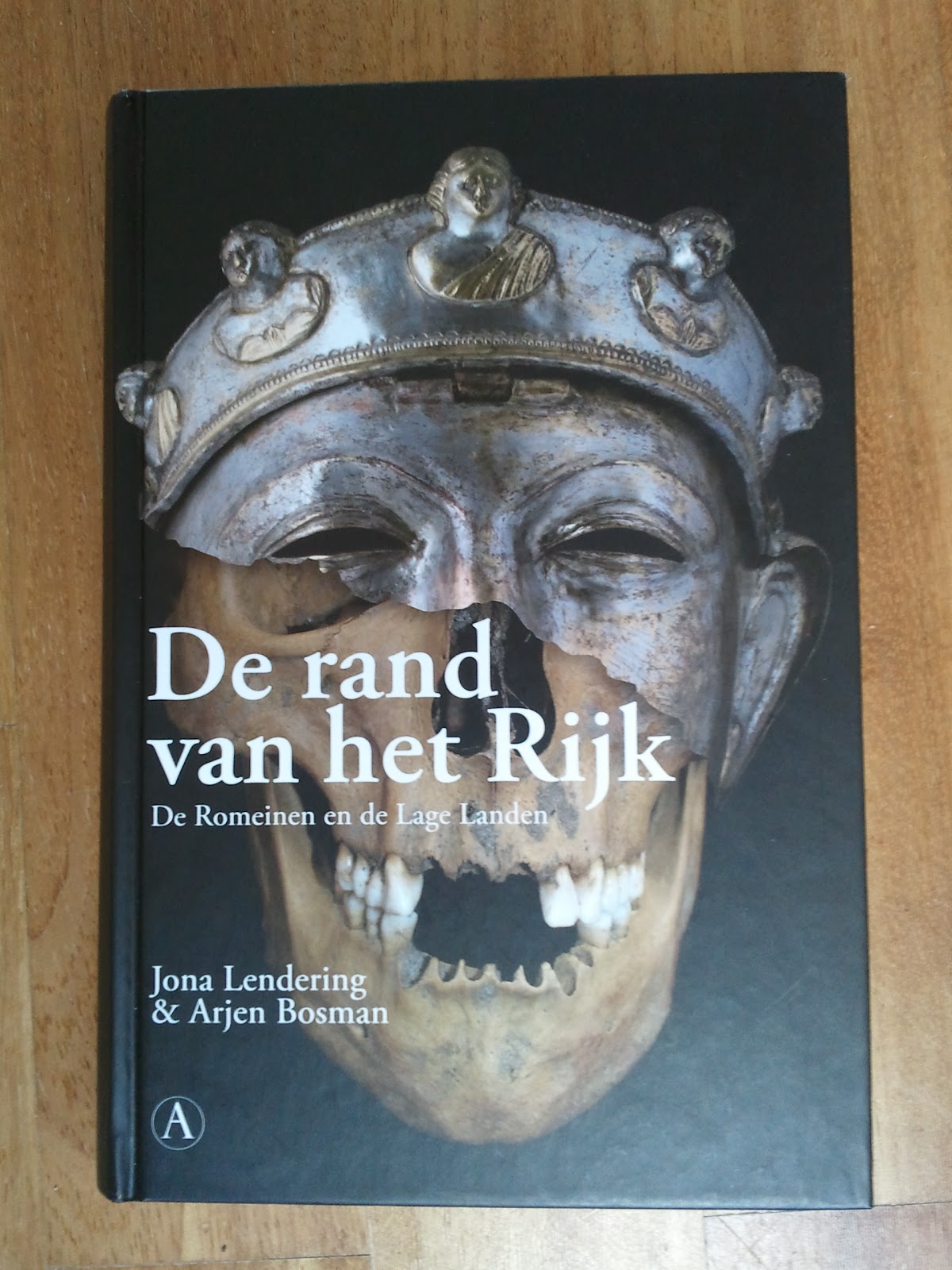
De Rand van het Rijk. De Romeinen en de Lage Landen by  Jona Lendering and Arjen Bosman

Dutch 2010 edition

Edge of Empire, as it will be released in English, is in fact more of a military than a general history of the area between the Somme and the Weser in the Roman era. This is of course due to the remaining evidence, which mostly focuses on warfare.

The book starts off in earnest with the campaigns of Caesar in northern Gaul. The authors argue that the distinction between Gauls and Germans was not as strong as Caesar suggested (he had his own agenda to emphasize it). This remains a problem throughout this era of shifting tribal allegiances and confusion of ethnicity brought about by the fact that we mostly know these people through the heavily coloured writings of the Romans. Although the areas in the outer ring and even in Germania were Romanised over time, the clichés of the barbarians kept being used until the fall of empire.

In the 1st century AD the Rhine border was consolidated, while there were attempts at expansion across the Rhine. Although colonisation beyond the great river proved unsustainable, Roman influence extended across the Rhine through alliances and divide and rule politics.

Under Roman rule, the difference in economic development between the southern area and the Rhine frontier became more pronounced. This difference is a recurring theme throughout the book. The province of Lower Germania was part of the outer crust of the Roman Empire and the garrisons were an economic stimulus. Belgica, on the other hand, was part of the core, and a net tax exporter. This meant that after Roman power diminished, the outer ring declined, while Belgica could hold out on its own.

This was most pronounced during crises, for example in the 3rd century when internal conflict opened opportunities for external attacks. The new German alliances were more aggressive and more dangerous and mounted major incursions in 240 and 256-260.

The Gallic Empire under Postumus from 260-274 was a local response to the crisis in the absence of central aid. German troops were incorporated as foederati and more troops were stationed in the interior. However, in 274 the central authority was reasserted and troops were sent elsewhere at the expense of local garrisons. This in turn led to renewed incursions.

Although Belgica seems to have recovered well from the crisis, Lower Germany entered a long period of decline. The area north of the line Doornik, Bavay, Tongeren, Maastricht, Cologne was effectively given up as no mans land inhabited by German farmers. There is evidence that the language border shifted in this period as a result. The Frisians disappeared as a separate people and reappear as Saxons in present day Friesland. This was combined with ecological crises, like floods due to intensive salt pans.

Relative peace returned until troops from the west were called east in the crisis of 405-6, never to return. The abandonment of Britannia also meant the end of grain exports and maintaining the Rhine fortresses became unsustainable. Rome now effectively gave up the west.

Northern France and Belgium now became the power base for the Frankish kings. It remained a wealthy and self-supporting area and relatively stable as compared to the decline in the Mediterranean.

After the Frankish takeover a process of creeping Germanisation set in. Chlovis was still a Roman in name, but later Merovingians dropped all pretense. There is a tendency to paint the Germanisation as bringing along decline, but Lendering and Bosman argue that institutions like serfdom and feudalism not imported by Germans but already introduced by the Romans.

The book is well written in a clear style, much like its Roman examples. It´s richly illustrated with maps, portraits and photographs of archeological finds and reconstructions.

Lendering and Bosman emphasize the dearth of evidence and the extent of their conjecture. In many cases the archeological evidence points to different conclusions than the historical sources or contradictory historical sources must both be discounted.
  

The book is now reprinted in English as Edge of Empire - Rome's Frontier on the Lower Rhine and of course I heartily recommend it.


There's a few interesting tidbits relating to Britain at this time as well, which I will post later.

Friday, 12 October 2012

What I've Been Reading Online

Thursday, 11 October 2012

Dux Britanniarum characters

I've done the character generation for my Dux Britanniarum warband. The rules have a simple and reasonably fast method of generating characters through a few dice rolls. This results in characters with enough debth to add atmosphere to the game.

Lord Wilmar, the Tony Montana of the Dark Ages
My lord is Wilmar, born on this side (ie the British) of the waters from noble stock. All his life his desire has been to advance his status among his people and his actions tell the tale. This has gained him a reputation for ruthless ambition. While this makes him useful to a king, it is of course also a risk. And Wilmar would be wiser than to covet the wives of his master and peers.

Apart from your lord, there's two nobles and a champion. Wilmar's two nobles are Sasbout and Osmond.

Sasbout, the miser

Sasbout is Wilmar's elder cousin and likewise strong and tall. But he lacks his cousin's burning ambition and is instead thrifty and conscientious. Those people who have an interest in Wilmar´s carreer quietly hope that Sasbout proves a tempering influence on his lust for glory and carnal gratification.

Osmond, the flatulent

Osmond is younger than Wilmar and more slender. He is of low ancestry but his devotion to the gods makes him a dependable lieutenant. His gastric troubles, which no prayer or gift to the gods will drive away, make him the butt of many a joke.

Swidbert killed that wolf with his bare hands

Swidbert is Wilmar's champion, a distant relative from across the sea. The men are only separated by a moon in age, but the difference in appearance is striking. While Wilmar sticks out in a crowd himself, Swidbert towers even over him, bulky and bristling with muscles. Many times has he crushed his opponents by sheer strength.

As a Saxon noble, you don´t live in a political vacuum. Your ambitions are curtailed by your king. In Dux Britanniarum, the characteristics of the king are generated much like those of your nobles.  

Wilmar's king is called Markwart, an upstart bastard of peasant stock who has risen through the ranks through his skill at arms. Though pretty secure in his position, he´s just turned fifty-four and may soon meet his ancestors.

Now it's just waiting for a Romano-British opponent and an area for a campaign. Luckily, Derk has almost finished his army.

Wednesday, 10 October 2012

New books on the history of wargaming and roleplaying

There's a few books come out lately on the history of wargaming, roleplaying and simulation.


War Games and their History
by C G Lewin. This book charts the development of (map and board) wargames from the Renaissance to the 1950s.


Innovations in wargaming. Developments in professional and hobby wargames vol 1
By John Curry. This book is in fact a collection of games in all kinds of unconventional forms by Paddy Griffiths and Terry Wise (mostly). There's an introduction and discussion of the design of these games by Paddy Griffith at the end.


Jon Peterson’s Playing at the World: A History of Simulating Wars, People and Fantastic Adventures from Chess to Role-Playing Games.
This is big book about the development of roleplaying up to the 1980s, based on meticulous research of game fora and fanzines as well as interviews with some of the key players. Check out this interview with Jon Peterson and a review by John Curry.


Fantasy Freaks and Gaming Geeks. An Epic Quest for Reality Among Role Players, Online Gamers, and Other Dwellers of Imaginary Realms.
By Ethan Gilsdorf. This also a book about the fantasy and roleplaying but focusses on the community, rather than the development of the games.

It inspired me yesterday to post my review of Achtung Schweinhund by Harry Pearson which I did a few years ago .

This is an interesting development. I remember there were a few books on wargaming around in the mid-1980s, but they didn't have that retrospective look. They were gamut's of what was around at the time.

My guess is that with the end of the first generation of postwar wargamers, some of their younger members and pupils now feel the need to pass on something that they consider special, and possibly disappearing. What do you guys think? Are these guys documenting a hobby in decline?