Showing posts with label 1806. Show all posts
Showing posts with label 1806. Show all posts
Monday, 31 March 2014
Review: Yorck and the Era of Prussian Reform, 1807-1815
Yorck and the Era of Prussian Reform, 1807-1815 by Peter Paret
My rating: 5 of 5 stars

Great book on the Prussian reforms before and after Jena-Auerstädt. Shows that it was not just a case of noble and visionary reformers vs dumb reactionaries, but a struggle in which military theories and practice were linked to but also conflicted with legal privileges, social attitudes and personal rivalries.
Considering the opposition it is amazing how much was achieved and one wonders what might have happened if Scharnhorst hadn´t died so young and peace hadn´t come so soon. In any case, the reforms turned the Prussian army from a laggard into a front runner, despite the rough edges.
Yorck´s role in all of this is much more interesting than many historians have it (and that includes recent historians who have simply repeated the myths of the past). Yorck was in many ways closer to the reformers than most, looking at his practice as a commander of the Jäger and the infantry regulations and training programmes he helped to write. On the other hand, he was quite aware that the consequences of the social change not only undermined his status and legitimacy as a noble, but thereby also that of other institutions. And he was a pain in the arse to work with.
All this lovingly analysed and extensively researched by the author.
View all my reviews


Tuesday, 5 November 2013
Blücher at the Burgtor
It is time to set the spotlights on Gebhard Leberecht von Blücher, the charging Hussar general who once believed he was pregnant with an elephant (true story!). That didn't stop him from some prodigious feats on the battlefield
while in his seventies
and of giving Napoleon and his marshals a few bloody noses.
This is the site from where he made the leap to national hero. On holiday in Hamburg last summer, we made a day trip to Lübeck and the nearby beach at Travemünde. When you enter the town from the east, you do so through the Burgtor.
In the autumn of 1806, with the Prussian army in flight from its humiliating defeats at Jena and Auerstädt, Blücher was one of the few that kept ahead of the furious French pursuit. On November 5th his troops reached Lübeck and he set out to prepare the city for defence.*
Next day the French attacked the city and managed to enter through the Burgtor, which was defended with little competence. Desperate counterattacks failed to throw the invaders back and Blücher's chief of staff, Scharnhorst was taken captive. The general himself managed to fight his way out of the city with the remnants of his force. However, on 7th November his men and ammunition were exhausted and there was nowhere left to run as they had entered Danish territory. The general realised that further resistance was futile and accepted a French demand for surrender.
* Some of you will know that Lübeck was then still an independent city. Blücher demanded access to the city from the city council. The French sacked Lübeck as they would have any defended city, not knowing that it had been against the wishes of the population.
 |
| The Burgtor, or Castle Gate |
This is the site from where he made the leap to national hero. On holiday in Hamburg last summer, we made a day trip to Lübeck and the nearby beach at Travemünde. When you enter the town from the east, you do so through the Burgtor.
 |
| Commemorative plaque on the wall of the gate |
In the autumn of 1806, with the Prussian army in flight from its humiliating defeats at Jena and Auerstädt, Blücher was one of the few that kept ahead of the furious French pursuit. On November 5th his troops reached Lübeck and he set out to prepare the city for defence.*
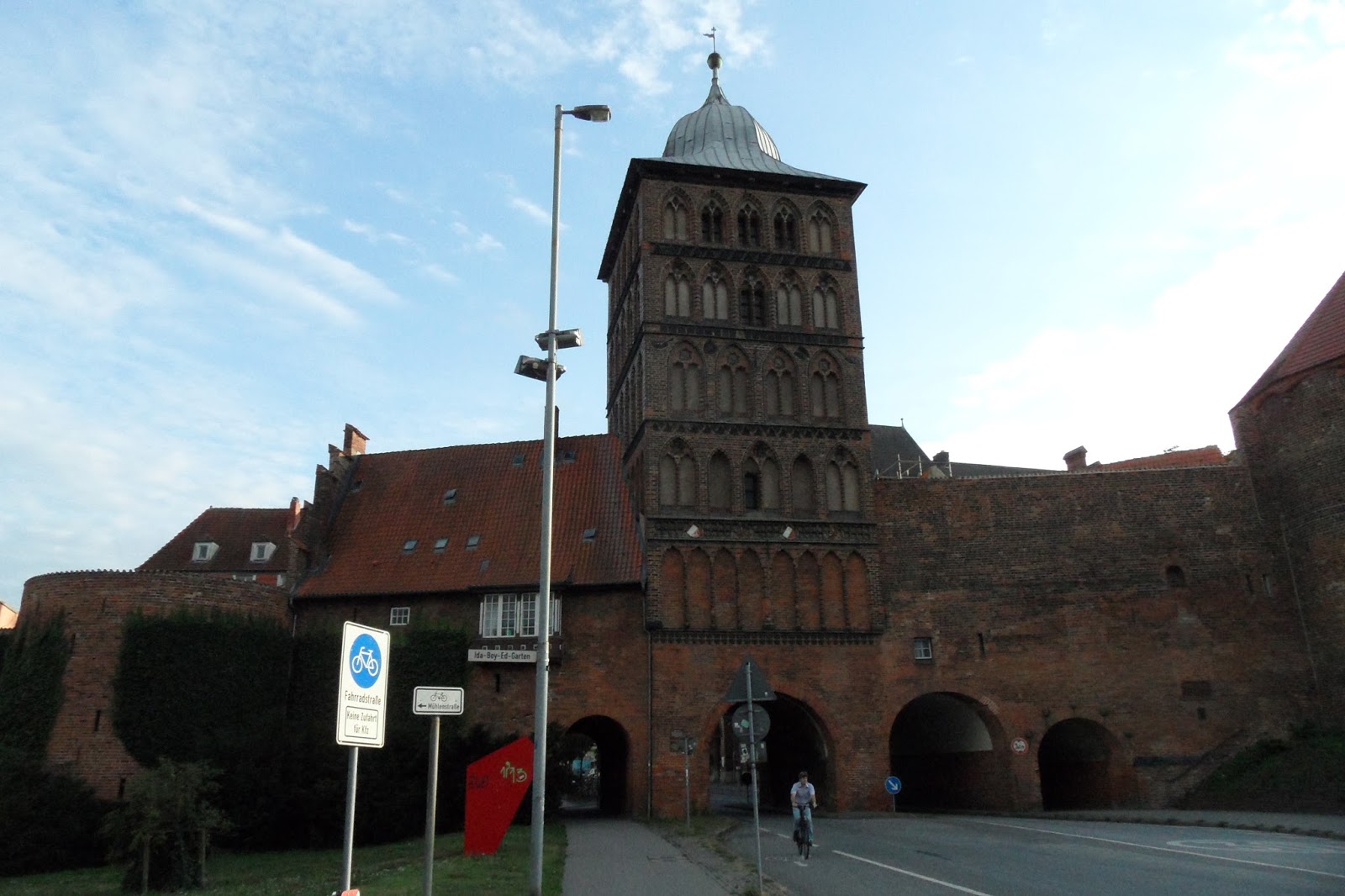 |
| The Burgtor from a slightly different angle |
Next day the French attacked the city and managed to enter through the Burgtor, which was defended with little competence. Desperate counterattacks failed to throw the invaders back and Blücher's chief of staff, Scharnhorst was taken captive. The general himself managed to fight his way out of the city with the remnants of his force. However, on 7th November his men and ammunition were exhausted and there was nowhere left to run as they had entered Danish territory. The general realised that further resistance was futile and accepted a French demand for surrender.
 |
| The fight for the Castle Gate from a contemporary print (wiki commons) |

Subscribe to:
Comments (Atom)