Showing posts with label boardgame. Show all posts

Wednesday, 1 May 2019

Gaming goals - April update


Been working hard this month, doing a presentation at the Citadel of Namur on the Wellington Barrier.


Painting

None. Literally.


Playing


No minis, but I got around to a first game of Secret Weapons of the Third Reich.  There seems to be an interesting game hidden beneath a badly written ruleset. I spent quite a lot of time going through the rules before I dared to bring it to the table and I still missed essential bits tucked away in paragraphs. Which is a shame because the theme is awesome and some of the elements included, like Himmler's pet projects, really speak to the theme. Although I have a better grasp of the game now after filling in the gaps by rereading the rules after playing, I'm not sure I can get the players to play it again.


The other game struck off the list is Gothic Invasion. More meat to it than I expected. The game was tighter than it seemed, but the Goths needed a lot of time running around the empire to get to their targets. But Romans have a thankless task, and their best strategy is not clear to me yet.

Plus a couple of games of Blood Rage, Puerto Rico, Love Letter and Eight Minute Empire. So that week in Denmark was good in that sense (and the weather, and Dybbol).

Dybbol with redoubts V and VI on the left and VIII in the middle, visitor centre on the right

Not forgetting two games of Power Grid: First Sparks later in the month.


Decluttering

None.


Projects

None.

I may recover some breath in June. But May's going to be BUSY.

Sunday, 22 January 2017

Wow. Just wow

I told you two weeks ago, that my Secret Satan had been very kind and scarily knowledgeable about my wishes. The third package arrived a week ago, but since I wasn't home I had to pick it up at a post office. To which I only came around yesterday.


After all the goodness that had been my share already, I was surprised at the size of the package, although the weight was bearable.Arriving home I left it to unpack my groceries and the set upon the box with a knife.

The packing foam was familiar, but what it uncovered was frankly breathtaking. First, up popped an expansion for Blood Rage, so my thought was that the all-knowing Satan had picked up my interest in the game and wanted to tease me. Colour my surprise as more expansions followed, and finally, the basic game.


That had me stunned, because this was shaping up as no ordinary gift and I had no clue why Satan would have reason to reward me so richly.

Still unbelieving I tried to make sure that there was nothing else hidden in the box before I stashed it away. And colour my surprise several shades deeper as another package turned up, carrying Dungeon Crawl Classic RPG plus an extra adventure, as well as the rule book for Congo, a miniatures game by the same people that brought us Muskets & Tomahawks and Saga.


Satan is keenly aware of my interest in slavery and will have noticed when I expressed my doubts about playing a game with slave traders and which depicts the opening up of the Congo to the merciless exploitation of its people by the Belgian king Leopold as described in Heart of Darkness by Joseph Conrad. I read the book last summer on the train to London, as Satan seems to recollect.

Also, I have recently been gifted with a copy from a German geographical magazine from 1872, with an account of Livingstone's research into the origins of the Nile. It has me salivating. Satan must be roaring with laughter putting this ethical dilemma before me.


And I hadn't even reach the bottom yet. Satan's final revenge. After all he goodness, there was this...


Yes, that is Knizia's Modern Art. A game which I revile and abhor. So much so that I had given it away having never played it. Okay, so I won a game recently; that doesn't make me like it! Apparently there's no getting rid of this steaming turd of a game. Perhaps giving it away is being too nice. Maybe stronger measures are called for...

There are no words to express my appreciation to Satan for going the length he did to spy on me to bring me such a generous package. I am absolutely overwhelmed by it.

Monday, 5 October 2015

Essen 2015 - What I Will Be Checking Out

Okay people,

I got my BoardgameGeeklist of interesting games ready for Spiel this year.


There's a couple of games with interesting (historical) themes: 1714: Case of the Catalans, Apollo XIII, Bloody Inn, Churchill, DRCongo, Foreign King, Germania Magna, Lembitu, Manifest, Nippon,  Race to Berlin, SchinderhannesTesla vs EdisonThunderbirds, Trenches of Hell, Triumph & Tragedy, Waterloo: Enemy Mistakes, €uro Crisis,


A few from designers that I keep an eye on: RaptorPax Pamir, Ships,


Some expansions for games I already have (or other guys in my game group): Age of Conan, Concordia: Salsa, Metro 2033,


Some games which I have heard positive things about and wish to check: Agents of SMERSH, Arctic Scavengers, Battle at Kemble's Cascade, Luchador, Space Cadets,


Stuff that the kids might like (and me!), or some friends: Celestia, Flock, Tank Hunter, Tiger Leader,


Games that attracted my attention for no clear reason: Bad Medicine, Dogs of War, La Glace et le Ciel, Haspelknecht, Predator deck builder, Raid & Trade, Sapiens, Scythe, Shakespeare.

Not all of my interest is serious, and quite a few of them could easily be rubbish or good but not brilliant. However, at least some of this should appeal. Especially not too sure about the games on display for crowdfunding, but I think it is a great development that people can actually try out these games. Too many kickstarters have been sold on theme and juicy bits alone. I'm not sure that many of them have actually made much of an impression in terms of gameplay.


Last year there were a couple of games that were cheap and I bought on a hunch. Not too impressed with most of them, so I might not do that again. On the other hand, I like to have a game ready to play on Thursday night. So some simple game will probably be bought, but I hope to have a better idea of what it will be like.

Only three more nights before the fun starts. I just hope I can sleep!

Thursday, 23 October 2014

First Impressions and Final Thoughts on Spiel 2014

There was some stuff that I hardly saw but quickly formed an opinion about:


Good impression: Historia was very much enjoyed by my friends. It offers a two-axis take on civilization with room for conflict.


Undecided:
Battle of the Five Armies: looks great as ever (but many of the miniatures are the same), and similar to Battles of Middle Earth. But maybe we should play those more before buying this one.
Greenland: the premise is great, but it’s three players.


Quartermaster General: this could still be Axis&Allies with less combat
Raid & Trade: didn’t see it played or explained but looked as if it had a lot of numbers on counters and the board. Excellent minis and artwork though.


Lord of the Ice Garden looked great, but the unpainted miniatures expansion adds €40 to €55 for the basic game.


Bad impression: Athlas, Empire Engine (cube producing micro game), Swedish Parliament (although the policy axes were nice), The Walled City (looked like Carcassonne the City and ignored the contentious history of Londonderry), 8 Minute Empire expansion (there is something contradictory to a micro game expansion)

Missed: Night of the Grand Octopus (but it will be in stores at some point), €uro Crisis, Airborne Commander, Fantastiqa, Fief: France 1429, Luchador, Nothing Personal, Pamietne Historie, Patchistory, Pocket Imperium, Samuari Spirit, Shinobi Clans, Stimmvieh, Tiny Epic Kingdoms, Wir Sind Das Volk, Battle at Kemble’s Cascade

It seems like I’ll need to play less to see more. I did that the last few years but I think I prefer playing to running around.


So how did I feel about this Spiel?

Even though I’m no longer excited by this year’s euro offering (Arler Erde looks too much like Agricola and Panamax might be another multiplayer solo hit) and Sci Fi and Fantasy have become mainstream (almost everybody has by now jumped on the zombie bandwagon) there is still room for excitement and surprise.


The Polish publishers have blossomed by adopting euro mechanisms but they keep applying them to historical theme. Now Greek, Romanian, Spanish and even Indonesian publishers are following in their wake. There is still so much unused and unique theme around one might despair of the next generic fantasy game. Wallace still produces interesting games, even if they are occasionally flawed. And there are still publishers wanting to take risks.


It’s been a good year.

Wednesday, 22 October 2014

Mythotopia and Spiel 2014 shopping

Saturday's 'one more for the road' game was Mythotopia, Martin Wallace's new offering. It's a bit of a cop out, really, to apply a mechanism to a fantasy (or sci fi) theme, but it works out well enough. As in A Few Acres of Snow the deck building mechanism is subordinated to the map manouever. You build the deck from 4 basic cards and 6 area cards, which gives every player a unique set of resources (grain, gold, bricks and military goods). You can add to your hand by conquering new areas and buying cards from the market for gold. What cards are for sales changes from game to game.


Another familiar feature of Wallace games is that you can take two actions, chosen from a wide variety of options. Some of the cards in your hand provide extra options (instead of playing them for resources). Most actions require playing resource cards from your hand. When you invade an area, the war is only resolved by a player ending it as the first action of her turn. This can protract wars as players keep adding resources to an area and tipping the balance.

There are challenges to your hand management once your deck grows, but the game offers the opportunity to place cards in a 'reserve' so you can use them for permanent effects or to save them for a better opportunity. But placing cards into the reserve counts as an action. There are also a few cards that help you draw extra cards or search your discard pile. Let's see about killer combo's...


You score victory points for the number of areas you hold and a range of achievements, the standard three being castles, cities and roads, and possible other special conditions: areas conquered, successful defense or dragons killed. However, for every type of achievement, there is a limited amount of times they can be claimed.

Victory is determined by a player claiming victory as the first action of his turn. Any running wars are resolved then, but you can only claim victory if you end up with the most points after resolution. We ended up very close to each other which made it impossible to clinch victory in the end. So we decided on a four way tie. I hope this is a one off bug, and not a feature. Despite the ending a good finish to the gaming side of the weekend! With the varying selection of cards available on the market and the changing set of victory conditions ensures a fair amount of replayability.


So what did I buy?

My buying strategy this year was focused on games I was pretty sure would make it to the table. I think I’ve managed that well. I’ve shied away from the overly complicated, and 2 and 3 player games, leaving micro games and multiplayer. Lost Legacy: Starship, Unicum, Auge um Auge, Mat Goceng and Verone have all been dealt with in the previous posts.


 Lost Legacy: Flying Garden looks very much like the Starship game, but with another ending. The cards of Flying Garden and Starship can be mixed for variation.

I was torn between First to Fight and Race to the Rhine. The latter is a game that is very close in design to what I had in mind myself about the breakout from Normandy to the Rhine in autumn 1944, as a logistic struggle between three allied players, rather than two player campaign. It also looks good, but I didn’t take time to see how it plays because there were always people playing the demo.

First to Fight has all the players controlling Polish forces over the course of WWII. Because the Polish forces were few and widely scattered, I felt it is a great challenge to get all that into one game in a coherent way. In the end the decision was based on Race to the Rhine being three players which made it unlikely to hit the table regularly.


Marchia Orientalis and 15 Dias are both games with a strong historical theme, which I like. Maybe they end up being forgettable additions to the genre of tile laying respectively influence building games, but I’m eager to find out. 

Tuesday, 21 October 2014

Just another day at Spiel 2014

After our pretty successful first day in Essen, we returned still burning with curiosity and enthusiasm.


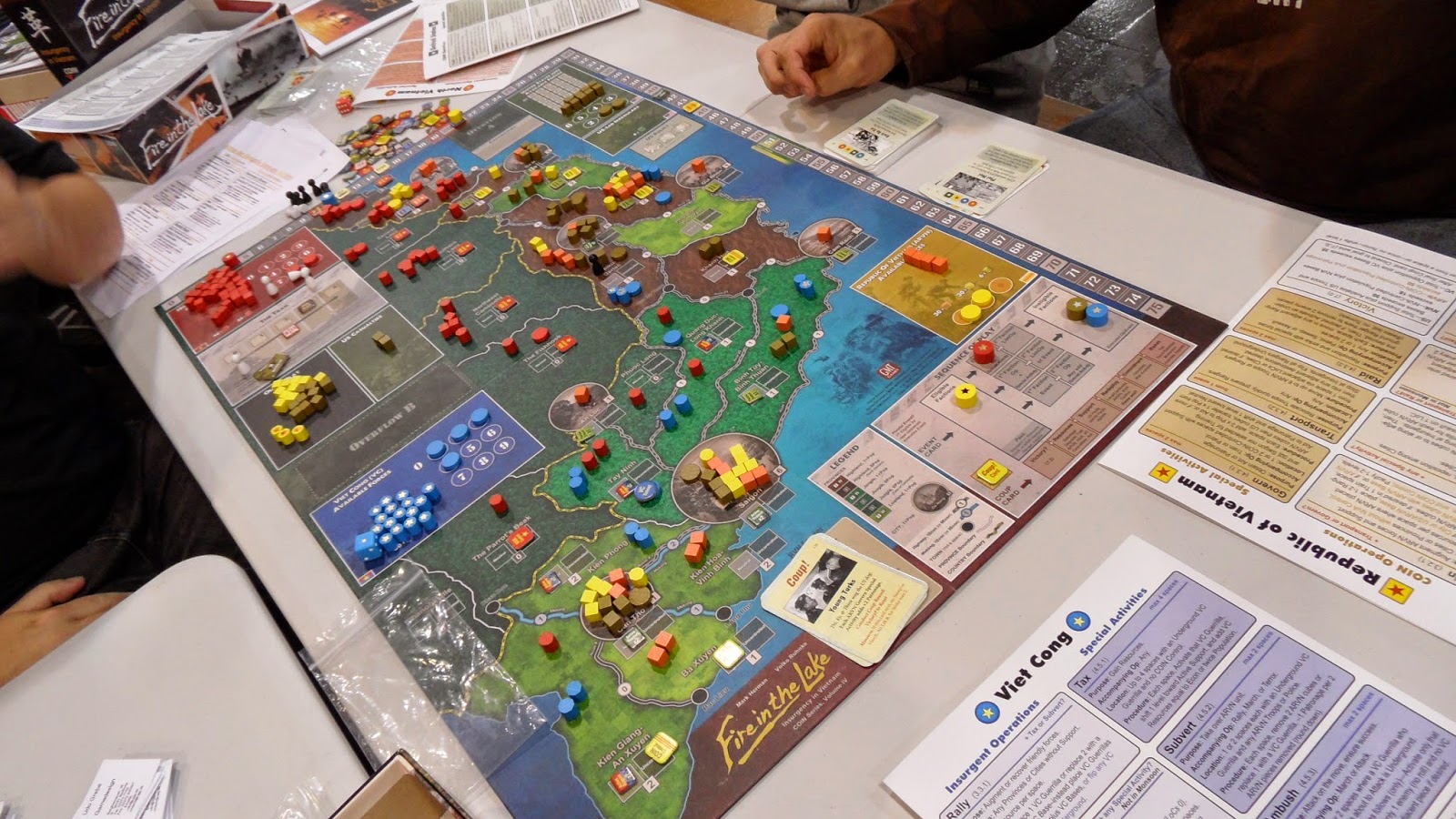
Our first stroke on Friday was to try out Fire in the Lake at the UGG stand. We were quickly into the game as we’ve already played Cuba Libre. But while the mechanics are familiar, FitL is much more complex. There’s more units, more areas and possibly longer scenario’s. So we did a couple of enjoyable rounds, but not really knowing what would be a good strategy for each faction.


We then split up as two of us had arranged to play a prototype of Mahardika. This game about the Indonesian independence struggle has the feel of Pandemic, with a similar engine running ‘the Enemy’ (ie the Dutch colonial state and its allies) as the outbreaks. The main interest is how it ties in the history into the objective cards. You either solve two series of objectives, or you get defeated by the Enemy. It is hopeful to see this game coming from Indonesia.

Mahardika will not be published until later this year, but the publisher had Mat Goceng available, a simple card game where you duel your opponents with hidden identity and hidden objectives as the catch. I hope to play it soon.


We then reconvened to play Euphoria, a worker placement game that owes most of its appeal to the brilliant application of the theme to the board and game pieces. Brilliant green and orange, suitably dystopic locations such as the Incinerator of Historical Accuracy (it sounds even better in German).. It is also neat that the workers are dice and you roll for their value every time they are taken off the board. Some of mechanisms neatly tied into the theme such as the risk of too much knowledge leading to workers escaping, but the layer of theme remains thin overall. So if you like worker placement games, this might actually be one of the more fun to have around.

Then Tragedy Looper. One that has good reviews from folks at Fortress Ameritrash so I wanted to try it out. I was cast as the MasterMind, ie the bad guy/gm. I think it is a wise move that Z-Man have included a introductory guide for the Mastermind in the first game because it really is tough to play it straight off the bat. I still made a clumsy mistake on the second day of the second loop which cost me the game. The players did well in deducting several of the character roles but not all.


As a treat we got to play the prototype of Conan Hyborian Quests, which will Kickstarter in January. The mechanism seem fine for a skirmish game, with the players spending energy and deciding whether they recover fast or slow. As all the scenarios have a time limit these are important decisions. The Bad Guy/Mastermind has a similar mechanic, and he uses energy to activate units or to roll emergency defense.


The evening was started with a quick game of Lost Legacy: Starship. It is strongly modeled on Love Letters with a slightly different ending (players having the opportunity to guess who has the ‘starship’). Nice, but I’m not sure that it will be worth it having several of these.

The main feature was Onward to Venus, a solid Martin Wallace steam punk fiction design. Ranging between Venus and the Kuiper Belt, the great European nations of the early 20th century take to the exploitation of these planets’ mineral resources, and some occasional big game hunting. The joy is in the possible crises on the planets (eg Martian attacks) and the bonus cards. After a tight finale we retired to bed well satisfied with another long and hard day’s work.

Monday, 20 October 2014

Spiel 2014 day one

I went to Essen with a rather long list of games I looked out for but it always proves hard to check everything you want and luckily you also run into happy accidents


Hyperborea was a great start to the show. It allows for different strategies, offers some interesting events and sets up for conflict. It’s rightly been likened to Eclipse. We went through a few rounds and then decided it was a winner.


Run, Fight or Die is the umptiest zombie game and I realized I was suffering from zombie fatigue after a decade of exposure. And although there is some kind of a challenge in there, it is mostly multiplayer solo.


Spartacus is one of the first games by Gale Force Nine and although it probably isn’t the edgiest design, the intrigue is fun. Trash talk flows naturally and you find yourself booing gladiators that don’t try hard enough.


Theme and the fact that it is published by a Greek company drew me to Gothic Invasion. How can you not get excited for the war that inflicted one of the heaviest defeats on the Roman Empire and saw the death of an Emperor? The designer gave us an overview. Play is card driven with 2 or 3 options per card. Forces and objectives are asymmetric, so there is a lot of maneuver on the map. You can see there is a lot of promise in there. Although it can be played with more than two, there is no rivalry or separate objective. It just didn’t do it for my friends so I was faced with buying a game that wouldn’t get played.


Time Masters tries a new approach to deck building by making time the key unit. It works, because the game speeds up and slows down. But I didn’t feel like I was achieving anything worthwhile by building the deck. Somehow I couldn't find a way to hold the cards due to the horizontal design. And who asks €35 for a card game these days? [edit: apparently I was misinformed at the booth or I misunderstood the price: the publisher has informed me the price in stores should be €30 and would have been €25 in Essen] 


The evening in the bar and restaurant was spent with Unicum, Verone/Council of Verona and Auge um Auge. All three are excellent for beer and pretzels. Unicum offers a small box for a short game with a neat betting war hidden in it. This is fun, but I just wish the ‘uniqueness’ argument mattered a bit more. If you can get into the spirit of bogus arguments that helps.


I think that Verone is a truly great microgame, with all trying to influence the outcome of the feud between the Montagues and Capulets. It is worthwhile getting the French edition because I like the art better (and it automatically includes the Poison expansion, which is a neat addition). Pic above is the English version.


I’m not sure about Auge um Auge though. It is mostly a dice rolling fest with an alliance system. There are some abilities that help you create series, which you need to inflict black eyes on your opponents. But the alliance system is what makes the game interesting, because ganging up and keeping the front runner out of fist fights is the key. It may be a bit long for the amount of fun it holds. Art work nice, as always with Sphinx games.

Monday, 13 October 2014

Spiel 2014 longlist

Having browsed the lists of games coming out at Spiel this week, and with some suggestions from others, I have come to this list of games I will be looking for. It's adding up to about fifty, so I've narrowed it down to over a dozen games that I really would like to know more about and the rest would be nice. Of course I've now got an idea what they are about.


Stuff that gives me a good feeling

  • 15 Dias. My old time friend: el Conde-Duque de Olivares
  • 1944: Race to the Rhine. Always been fascinated by the logistics of this campaign. Check out Matt Thrower's review
  • Coup: Reformation. I just loved Coup.
  • First to Fight. will be interesting to see what they can make out of this
  • Gothic Invasion. great subject, plus multiplayer. And good to see Greek publishers attending!
  • Luchador! Mexican Wrestling Dice. Dice rolling, and looks good.
  • Battle of the Five Armies. The guys from War of the Ring at it again. Not an Essen release but who cares?
  • Mahardika. Fascinating to find a game about the Indonesian War of Liberation. As a Dutchman I'm used to watch it from the other perspective so I should learn a lot from this (maybe more about current perceptions of the war in Indonesia than what actually happened). But I'll be curious about their handling of British troops, Dutch internees in camps, Dutch atrocities, Moloccans etc
  • Marchia Orientalis. As a fan of the Holy Roman Empire (although I do not seek a return to it), this could be right up my alley
  • Mat Goceng. Interesting piece of Dutch/Indonesian colonial history from the Indonesian viewpoint.And good to see Indonesian publishers attending!
  • Mythotopia. Wallace's multiplayer version of A Few Acres of Snow
  • Raid and Trade. theme and minis promising
  • Samurai Spirit. The 7 samurai in game form, with a very postive review from SU&SD
  • Tragedy Looper. See Charlie Theel's review on 2D6
  • Wir sind das Volk! Interesting to see that somebody thinks East Germany could have beaten West.


Check out my list on boardgamegeek if you want to have a closer look at the games. 
And the Spielbox overview of all the games released at Spiel. So you can figure out stand numbers if you intend to visit yourself.


I will be tweeting @jurdj as always.


Stuff that might be good, but perhaps not

I might pick up one the cheaper ones

  • €uro Crisis
  • Abraca... what?
  • Abyss
  • Airborne Commander
  • Athlas: Duel for Divinity
  • Conan: Hyborian Quests
  • Corto: The Secrets of Venice
  • Cyclades: Titans
  • Dixit: Daydreams
  • Empire Engine
  • Fantastiqa
  • Fief: France 1429
  • Fresh Fish
  • Greenland
  • Guatemala 1954
  • Hyperborea
  • Illegal
  • Lost Legacy
  • Memorable Stories
  • New Dawn
  • Night of the Grand Octopus
  • Onward to Venus
  • Patchistory
  • Pocket Imperium
  • Quartermaster General
  • Romans Go Home!
  • Stimmvieh
  • Swedish Parliament 2014
  • The Walled City: Londonderry & Borderlands
  • Tiny Epic Kingdoms
  • Unicum
  • Uruk II: Die Entwicklung Geht Weiter
  • Vérone

Thursday, 2 October 2014

Won by the Sword and more

So after my last lament at getting so little gaming in, this has been a good catch up. Managed to play Won By The Sword. As a recent arrival with limited length of rules I decided it was best to get it to the table instead of something else.


It took us an evening to get through the first month (ie 5 activations of 5 armies each) of the 1632 scenario including a major battle and a small siege. The manoeuvring was a lot more hectic than I'd thought it would be. By the end we felt reasonably comfortable with the rules (there's not a lot of them but some of it is complex).

What I liked about Won by the Sword was that it promoted historical strategies, like laying waste an area so you make it more difficult for your opponent to attack you; and splitting off a separate cavalry column to forage.


Although it is a main part of the game, the foraging feels clunky, mostly because you make about 30 dice rolls in a turn just for that (no kidding). Too much looking up. I understand the wish to randomise but with this many rolls, the results tend to the average. 

Oh well, no judgement till I've played a bit more


Yesterday we were supposed to play a game of Civilization but changed our minds. We had a very tight game of In The Name Of The Rose, where Diederick scraped a just few points less than Michiel and me, even though I saw through his little trick!

Then continued with Love Letters. Michiel finally got most letters through. Love Letters was perceived as okay but not as cool as King of Tokyo which we played next. And again. And again. Absolute hit I guess!


Brutal as always I think we all won one of the games, and I won the last, very unlikely, with one health left. Epic, n'est-ce pas?

And in terms of New Years Resolutions this means one more unplayed game scratched off!

Thursday, 25 September 2014

Essen 2013 Challenge Completed

With Essen 2014 fast approaching, I can draw up the result of my self imposed Essen 2013 challenge. What games did I manage to play that I bought there?


Rats in the Walls (at Essen 2013)
Strajk (Christmas Offensive 2013)
Concept (January 2014)
Sigismundis Augustus (19 september 2014)

Which means I have actually managed to play all four games I bought, but only just in time. These weren't the toughest games to learn, so you can see how hard it is for me now to make the effort. But I can go to Essen knowing my hands are free to buy games.

But the sad story is that the past few months, I haven't played many games. Only 5 since the end of June. Apart from Sigismundis Augustus there were the familiar Civilization and Battlestar Galactica. I learned the Game of Thrones card game I had bought for Died's birthday. Newly bought Pathfinder was also good, but doesn't really count towards my NYR because it wasn't my copy.

In terms of getting 13 unplayed games from my collection to the table this year, I'm now at 7, so behind schedule.The sterner among you (and who can remember the New Years' Resolution) will note that I also played Eight Minute Empire, which although I didn't buy it at Essen was also mandatory to play before the deadline.


Monday, 22 September 2014

Sigismundus Augustus

Managed to play a new game last Saturday! I bought Sigismundus Augustus last Essen from Polish publisher Fabryka Gier Historycznych Fundacja Niepodległości.


King Sigismund of Poland was best known for his acquisition of Lithuania by the end of his reign, while Poland itself in the early modern periode is best known for its chaotic politics. It is exactly the latter part of history that this game focusses on. Players are powerful families within the Polish Diet (Sejm), vying for the most profitable offices (governors, ministers, clergy).

The game is won on victory points, for the most part derived from holding offices or from diplomatic relations with neighbouring states like Moscovia, Lithuania and Austria. There's three important phases in the game: the policy, the action and the Sejm phase.

In the policy phase, players can play one policy card. The cards allow you to attack another player,
Perhaps the most important action is to activate a neighbouring state so that it will be scored at the end of the turn. In the foreign policy phase each player can at least place one token on a neighbouring state. The VP are scored by the player with the most and the second most tokens on this state.


The action phase is based on worker placement. Each player has at least 3 clients to take actions like taxing, diplomacy in a neighbouring state, gain influence among the nobles or magnates or make an office available to bid upon in the Sejm phase.

There is another randomising element to the game in one of these actions: the deck of Polish characters from the age. These can be enlisted by the players for their direct advantage or victory point bonus at the end of the game. Since the deck is much larger than the amount of cards drawn in a game, this helps increasing replayability.


The Sejm phase is the heart of the game, although it doesn't hand out any victory points. It starts with collecting the votes you can cast from your position on the noble, magnate and royal support tracks. Some ministerial offices and discarded internal policy cards offer extra votes. Next, players can blindly bid money for votes, and then blindly bid votes to sell. The highest bid of money is exchanged for the highest offer of votes and so on. A neat mechanism.

Players first vote on each office that has become available. Next, the Sejm commits itself to fulfilling the royal demand. The king desires money, troops or just votes. Again all players bid blind. This determines the amount of royal favour (ie votes) for the next turn, with the player spending the most resources becoming the king's favourite which gives you the valuable right to decide on all ties.

Finally, each turn after the first, the players also vote on a piece of legislation, which changes the game rules, for example restricting the number of offices that can be held. All votes here are open and players just indicate whether they agree or disagree with the proposal.

The turn the ends with the scoring phase and the upkeep of the troops.

First impressions a largely positive. In one game, we found it hard to figure out clear strategies. There's so much happening that it seems hard to focus on one aspect. But the mechanisms feel to have been integrated well.

One odd thing is that in the last turn several parts of the game lose their meaning. There is no reason to worry about the upkeep of your troops, or even to fulfil the king's demand, as the result has no effect on the game.

It is not an easy game to learn. The rules are written pretty densely, there are a lot of mechanisms that tie into each other and how this works out only really become clear by playing. But it is worthwhile. Leave it to Polish designers to integrate euro mechanisms with historical themes. I'm pretty sure we will have another go at this one.