Showing posts with label Dutch. Show all posts

Sunday, 18 March 2018

Some of my recent reading: dark ages Frisia

Another couple of books I read the past moths were triggered by plans for some medieval wargaming. Somebody suggested that we should try the Battle of Vlaardingen in 1018, a smallish affair by today's standards. It was pretty momentous however, as it established the independence of the counts of Frisia against the Holy Roman Emperor.


Sadly the execution wasn't compatible with stuff I already had lying, waiting to be used, so my project will deal with the Battle of Hastings. But I read the stuff on Frisia anyway...


And the most amazing I learned is that the Dutch coast was mostly deserted in the 3rd and 4th centuries AD. Apparently rising water levels, combined with moving sand dunes made life extremely hard so it essentially depopulated. The people that came to inhabit the area afterwards were not the original Frisians of Roman times, but migrants from present day Northern Germany and Scandinavia, with a different material culture and different language. However, they were named after the area and for a long time people assumed there was a continuous link of Frisian inhabitation.

Sunday, 19 February 2017

Forgotten colonial wars don't go away

This is a very nice book on a forgotten colonial war that the Netherlands started without good reason and only ended with the arrival of a new colonial power, Japan, in 1942.*


From the first unsuccessful invasion in 1873, through the bitter decades of guerilla warfare to the anticlimax in 1942, Dutch colonial administrators and military struggled to bring an end to the costly occupation of a region that just would not submit, even when all hope seemed gone.

As the Dutch brought more power to bear, the resistance dwindled from a full fledged army defending the sultanate to desperate attacks on individual soldiers and bureaucrats. And as the Dutch sent their columns deeper into the hinterland, all of Aceh was marked with destroyed villages and hasty graves for freedom fighters and their pursuers.

The coming of the Japanese didn’t improve the lives of the inhabitants of Aceh, nor did their struggle end with Indonesian independence. And even though peace has reigned since almost a decade, Aceh is still a poor and neglected part of Indonesia.

Stolwijk, who lived in Aceh for 18 months between 2009 and 2015, gives a sympathetic view of a society trying to overcome the painful present, while keeping alive the ghosts from the past. His anecdotes of interactions with former guerillas and collaborators, students and officials (who seem genuinely pleased that somebody takes an interest in the history of their building or train line) both provide comic relief and perspective.

*full disclosure: I’ve played a few games of football with the author and I think he’s a nice guy.


Sunday, 29 January 2017

British Invasion

A colleague of mine gave me this interesting little book. When he read my Waterloo book he revealed that he’d done a documentary in 2011 on the recovery of the bones of a British soldier in the Dutch dunes near Groote Keeten.


The soldier had died on the 27th of August 1799, during the landing of a British invasion force on the Dutch coast. The intention was to raise the Dutch  against their French allies and for the previous sovereign, Stadtholder William V of Orange. When the French had conquered the Dutch Republic in 1795 they installed a satellite government of Dutch revolutionaries.

Although the British invasion force managed to gain the Dutch fleet base (and fleet) at Den Helder and the city of Alkmaar, they were unable to make more headway towards Amsterdam, even after being reinforced by a Russian expeditionary force. Neither had Orangist sympathisers made much of a showing. Late in the year, the British and Russians reembarked, leaving little trace.

The discovery of the remains of the British soldier lead to an archeological dig at the site. The book describes the research, based on the finds at the site linked to historical evidence.

There’s the estimates of length and age based on the skeleton, the analysis of the wood and metals of a musket, some cloth and buttons which all go some way to identifying it as the remains of a soldier of the Coldstream Guards.

A more precise identification was not possible, although based on letters and official records, the search could be narrowed down to a handful of individuals who had died on the 27th of August.


In 2012 the remains were returned to the Coldstream Guards for interment in Britain.

Sunday, 15 January 2017

Dutch Democracy Is Not In Crisis.

First a note to my English readers: by exception this post is partly in Dutch. A translation is provided below.


Niet vaak dat je zo enthousiast wordt van een boek over politiek. Misschien komt dat vooral omdat het boek nauw aansluit bij wat ik zelf al dacht (goh!?), maar omdat auteur Tom van der Meer ook hoogleraar politicologie is, heeft dat wat meer gewicht.

In Niet De Kiezer Is Gek betoogt hij dat de kiezer sinds zij bevrijd is uit de ketenen van de verzuiling niet wispelturig is geworden, maar wel elke verkiezing kiest uit verschillende partijen die dicht bij haar eigen opvattingen staan. En dat levert een Tweede Kamer op die goed in staat is nieuwe politieke stromingen een platform te geven. De democratie functioneert dus eigenlijk prima.

Waar het probleem zit, is bij het landsbestuur. De politiek heeft zich aan de ene kant niet aangepast aan het veranderende politieke landschap, en weerspiegelt aan de andere kant dat veranderde landschap onvoldoende.

De wens om elke regeerperiode te starten met een uit twee of drie partijen bestaande kamermeerderheid met een dichtgetimmerd regeerakkoord wordt steeds lastiger te vervullen. En het verdelen van banen op basis van regeringsdeelname wordt ondermijnd door dalend partijlidmaatschap en een kleiner aandeel van de bestuurspartijen in het totaal.

Alle voorgestelde alternatieven voor veranderingen voor het kiesstelsel zijn voor Van der Meer dus sowieso al niet echt nodig, maar dreigen in veel gevallen zelfs het probleem te verergeren. Kiesdrempels betekenen minder democratie, niet meer. Loterijen vallen ten prooi aan de groep die nu al het meest politiek geëngageerd is. 

De opdracht is dus vooral aan de politici in Den Haag: profileer jezelf weer op de inhoud en accepteer minderheidsregeringen. Dat laatste is de afgelopen vier jaar in zekere zin al aardig gelukt.

Ben ik dan helemaal gelukkig met dit boek? Nee, toch niet. Voor het door Van der Meer geconstateerde probleem van de banenverdeling langs partijpolitieke lijnen heeft hij zelf geen echte oplossing.

En eerlijk gezegd zie ik partijen dat niet zo snel opgeven aangezien dat een belangrijke reden is voor personen is om lid van een politieke partij te worden/blijven. Zolang partijen geen manier weten te vinden om kiezers weer op andere manieren structureel aan zich te binden zie ik dat niet zo snel veranderen.

Ook denk ik dat de Haagse politiek ook de kans moet krijgen om te veranderen en niet door journalisten en publieke opinie moet worden afgestraft als het weigert de waan van de dag te volgen. Van der Meer had die rol best meer mogen benadrukken.

English version

It’s not often that you get excited by a book about politics. This could perhaps be a result of the book aligning closely with my own views on the subject (surprise!), but also because the author is a professor in Political Studies, which carries a bit more weight than my opinion.

In It’s Not The Voter That Is Mad, Tom van der Meer argues that the voter, since she became unshackeled from pillarisation*, hasn’t become more fickle, but now chooses from a number of political parties to which she feels close. That results in a parliament that is very apt at including new political movements. Democracy, therefore,  is functioning quite well.

The problem on the other hand, lies with government. Dutch governmental politics hasn’t adapted to the changing political landscape and doesn’t reflect those changes enough.

The ideal of starting each cabinet with a parliamentary majority in two or three political parties with a fixed policy programme (called the Regeerakkoord) has become harder to achieve with the shrinking of the main parties. And the division of jobs in strategic positions between the major parties is undermined by falling party membership and the shrinking  share of the old main parties in the total vote.

The suggested alternatives for changes in the electoral system are not really necessary according to Van der Meer, but also run a high risk of only making the problem worse. Electoral barriers make the system less democratic, not more. And systems based on lotteries tend to fall in the hands of those that are already most politically engaged.

So the message of this book is mostly addressed to the national politicians: bring ideology back again. Also accept minority governments, like the Netherlands have effectively had in the last couple of years.

So am I completely happy with this book? No. Van der Meer doesn’t really offer an alternative to the practice of dividing key jobs among members of the ruling parties.


And to be honest, I don’t see that happening too soon. It is a major reason for people to become and remain a member. Certainly won’t happen as long as parties haven’t figured out how to structurally attract people by other means.

Press and public opinion will also have to give politicians the opportunity to break away from the news cycle. As far as I am concerned Van der Meer could have stressed those roles more.

* Pillarisation is the typically 19th/20th century Dutch practice of social, economical and political organisation along religious and ideological lines: ie separate football clubs, unions and parties for Catholics, Protestant sect #1 through #X, Liberals, Social Democrats. This social organisation was broken up in the 1970s and 1980s though some of it remains to this day.

Thursday, 5 January 2017

Integration through military service

First book read this year! Chance encounter in 2nd hand. Very readable military autobiography of early 19th century.

Koch was born in the small German principality of Waldeck before the French Revolution and joined a Waldeck regiment in Dutch service in 1803. This took him into Austria in 1805, Eastern Germany in 1806, Spain in 1808.

As the Waldeckers were corporated into Dutch and later French regiments, Koch doesn't seem to have been troubled too much. However, he requested to be released from French service in 1814 and returned to the Netherlands in 1814.

He remained in Dutch service during the Waterloo campaign and the war against Belgium in the 1830s, ending his rise through the ranks as commander of the veterans in Leiden in the 1840s.

In all this time he only saw his family three times, and he settled and died in the Netherlands, where his autobiography was taken down by one of his sons.

Tuesday, 6 December 2016

The Dutch army under Napoleon

Also in, this great book on the Dutch army under the Kingdom of Holland. This period was the last step between the foundation of a Batavian revolutionary republic under French protection in 1795 and full incorporation into the French empire in 1810.


With Napoleon's brother Louis put on the throne in 1806, the country seemed already well under French control. But Louis' genuine considerations for the interests of the Dutch people ensured that neither Napoleon was satisfied nor the Dutch.

Given Napoleon's focus on the military contribution of the Dutch to his overall war effort, the army was always going to be a breaking point. Louis' four years in charge failed to bring a balance between Napoleon's demands for a bigger army and the Dutch ability to pay for expansion and provide the necessary recruits.

Which is why Napoleon finally decided to be done with and independent state.

Christiaan van der Spek looks at the Dutch room for manoeuvre in military policy during independence, and also to which extent the Dutch maintained a separate identity, first within the French sphere of influence and later within the empire.

Will be an interesting read.

Monday, 16 March 2015

The Story of a Map

One of those instances where work and hobby coincide! A few weeks ago I considered doing a tweet with a thematic map to commemorate the birth of the Kingdom of the Netherlands on March 16th 1815. It is an interesting episode because it happened in the pressure cooker days after Napoleon had returned from Elba and it included at that time most of the area we now recognise as Belgium.


My take was to create a map of the Low Countries in 1815 and link it to data from our historical collection on the 1815 census. I though that sending out a tweet with the map would be a nice gesture and likely to get picked up by the media.

I set out searching for a shapefile (a file that holds the spatial information of the map, like borders of provinces) of the Low Countries in 1815 at the time but found none. Then I thought it might be possible to stick together maps of the north and the south into one map, which is what we ended up doing in two stages. I managed to find a shapefile of the north for 1815, and on the assumption that the current Belgian provinces were much like those in 1815 my colleague in the mapping department stuck  the two together. I was SO thrilled with the result.

And so were some of my colleagues, who suggested not just a tweet but a short article, using more data and adding more maps. I set to work on that, despite the fact that I would also have to hand in my two chapters for the Waterloo book this week. That was pretty stupid.


In my enthusiasm I showed the maps to my Belgian stepfather who immediately spotted some necessary changes: in 1962 a number of municipalities was exchanged between Flanders and Wallonia to conform to the language divide, and in 1920 the Belgian took an area on their eastern border including Eupen and Malmedy from the Germans as a compensation for damages in the First World War. And a few minor others.

Just as I was contemplating defeat, another Belgian connection, a very kind historical geographer from the University of Ghent, stepped in and offered the right historical shapefiles for Belgian provinces in 1815. The colleagues at the mapping department stuck those to the north (and a current shape of Luxembourg) and voilá!

The colleagues also suggested doing a storymap application which has turned out pretty awesome as well.

I struggled through the week, working on the article, the map and the book at the same time. Occasionally it looked like it would fail, but on Friday it all came together in the end: chapters went to the publisher, article was finalised and approved and the storymap finished. Much relieved and tired.

So on Monday: cake for the great people that did the mapping. They are awesome!

Saturday, 25 October 2014

Review: De Adelaar En Het Lam: Onrust, Opruiing En Onwilligheid In Nederland Ten Tijde Van Het Koninkrijk Holland En De Inlijving Bij Het Franse Keizerrijk


De Adelaar En Het Lam: Onrust, Opruiing En Onwilligheid In Nederland Ten Tijde Van Het Koninkrijk Holland En De Inlijving Bij Het Franse Keizerrijk by Johan Joor

My rating: 5 of 5 stars


Joor looks at the level of civil unrest in the Kingdom of Holland (1806-10) and the 'Dutch' departments of the French Empire (1810-13). He shows that it was pretty high by European standards (despite never reaching full scale armed revolt such as in Spain or Southern Italy) and by Dutch standards of the 17th and 18th centuries. This contradicts earlier books that assumed resistance to French and French backed authority was low.

The highest levels were recorded in 1809 and 1813, with higher levels from 1810-13 than before. Most important source of unrest was military service, followed by tax and smuggling and general opposition to French or French-backed authority. Religious and civilian disputes were rarely behind large scale unrest.

In terms of participants and modes of protest, there is strong continuity with 18th century forms of unrest. Mostly lower middle class craftsmen and farmers (rather than urban and rural poor), a high participation of women and mostly very local and disciplined. Where the protest were non-traditional was in their opposition to expanding role and power of the state (conscription, taxation).

Excellent, based on extensive research of primary sources. Includes lots of case studies, background information on policies, and on the means at the disposal of the authorities to deal with unrest.


View all my reviews

Thursday, 24 April 2014

Across Two Lines of Fortifications

Last Saturday by some coincidence I biked all the way from Leiden to Houten, a distance of some 73 km. It was a pretty epic endeavour from my perspective as it has been some time since I spent 3 hours in the saddle and because I needed to be on time for another three and a half hours of frying fries and cleaning up afterwards. It left me pretty much broken at the end of the day.

Entrance to fort Wierickerschans along the Oude Rijn
between Bodegraven and Woerden

I also ran a flat tire, but luckily this was only 100 meters from my destination.

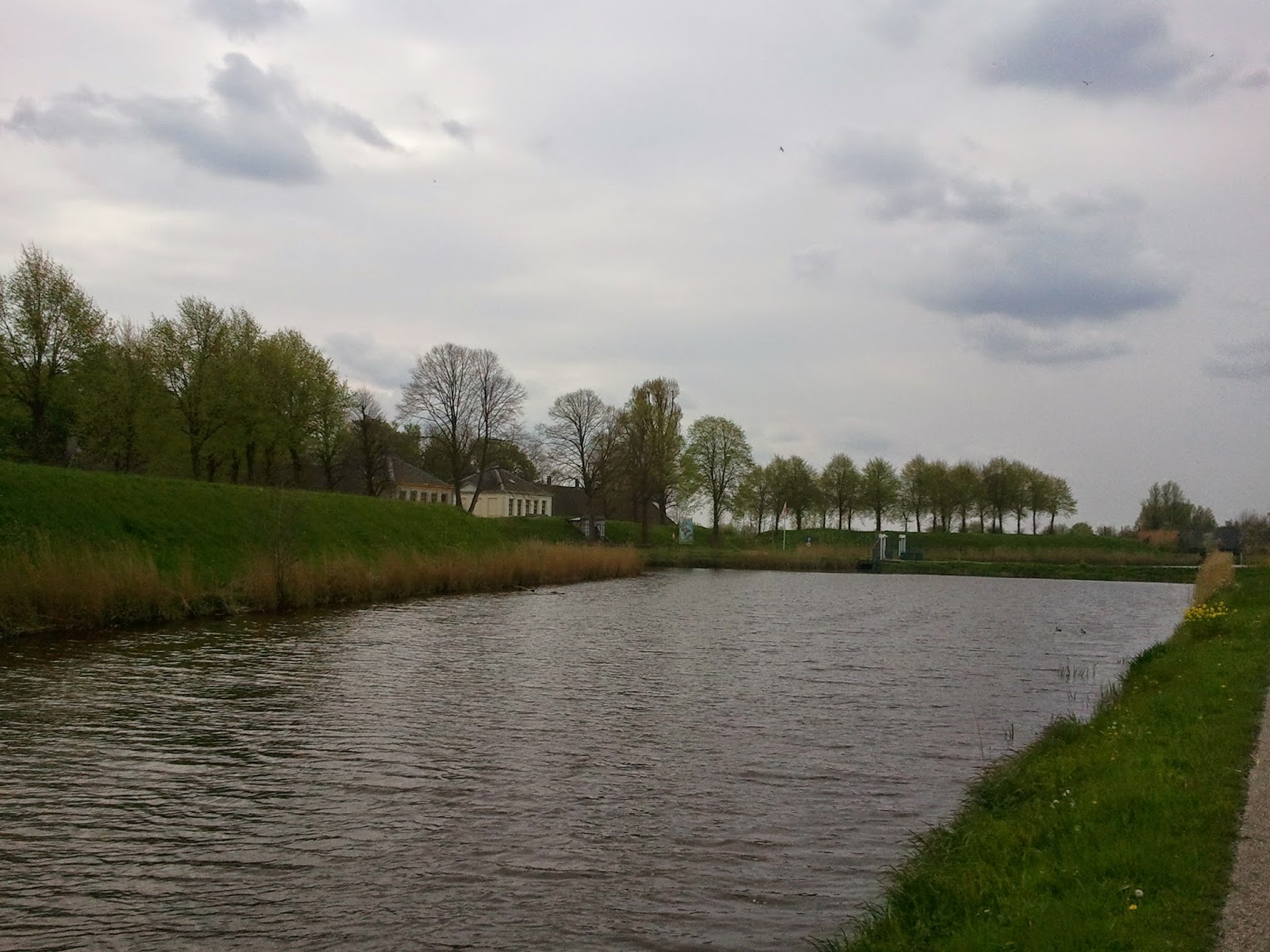
However, it took me through the two most heralded Dutch lines of fortifications: the Old and New Water Line. While the 17th century line runs from north to south (the IJsselmeer to the main rivers) to the west of Utrecht, the 19th century line runs to the east of the city.


The old line had it's day in the sun in 1672/3 when it stopped the best army and generals of its time. The later line was saved the embarrassment, although Dutch troops fell back in good order on the line during the night of May 13th and 14th 1940 after the breaching of the Grebbe Linie.

Fort Jutphaas in Nieuwegein now shelters a wine shop

Although in this case I didn't have enough time to make a relaxed visit, fort Jutphaas (and several others of the New Water Line) are within easy cycling distance of Houten, where my iron horse has now been parked. Once I get my tube fixed, I'll start exploring them.

Friday, 7 March 2014

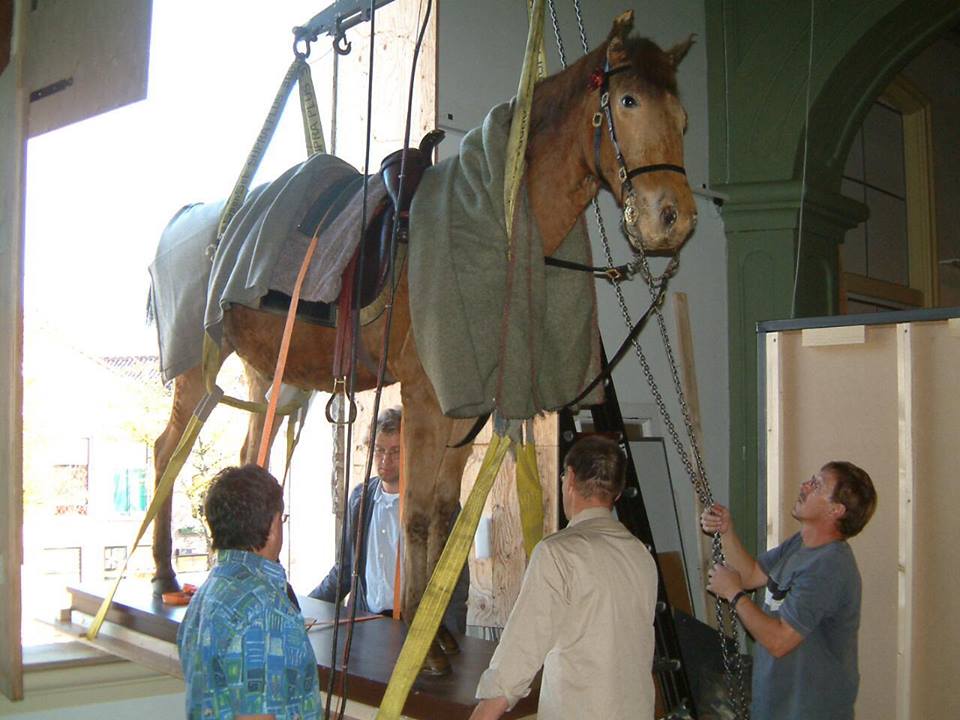
Wexy comes out of the depot

If you have any interest in Waterloo the one thing you have to do in the next few months is go to Dordrecht and visit the exhibition on the art collection of king Willem II. Willem was an avid collector and connaisseur, but after his sudden death in 1849 the collection was sold to cover his debts. It has been partly reconstructed for this exhibition.

From the Dordrecht Museum website
The special guest in the exhibition is Wexy, Willem's longtime favourite horse. He rode it at Waterloo where Wexy was wounded. The horse lived on to ripe age, but even then Willem couldn't part. Wexy's body  was preserved and remained in Willem's collection, but was also dragged around Ghent after Belgium split from the United Kingdom of the Netherlands to garner support for the Orange family.

These days it is mostly locked away so this is a unique opportunity to see Willem's faithful charger.

Friday, 21 February 2014

Review: In the Wake of Napoleon: The Dutch in Time of War 1792-1815


In the Wake of Napoleon: The Dutch in Time of War 1792-1815 by Mark van Hatten

My rating: 3 of 5 stars


Book written around items from the Napoleonic collection of the Dutch army museum. The main part consists of short biographies of individuals illustrated with their personal belongings or uniforms. This ranges from the princes of Orange, king Louis Napoleon, and several officers from different units to Wexy, the favourite horse of Willem, prince of Orange, which was killed at the battle of Waterloo.

As such, the book offers no synthesis and is rather anecdotal. But the illustrations are special.


View all my reviews

Review: Ongewilde revolutie. Limburgs Maasland onder Frankrijk


Ongewilde revolutie. Limburgs Maasland onder Frankrijk by Ubachs, P.J.H.

My rating: 4 of 5 stars


A case study of the Nedermaas department under French administration. With the French conquest of the Southern Netherlands in 1794 the whole area was placed under French administration, but it would take a decade before it was fully integrated in the French empire. The area had been a patchwork of states so that the new department included parts of the Dutch Republic, the Austrian Netherlands, the Duchy of Gulik, the Prince Bishopric of Liège and some others.

Very interesting to read this just after Woolf's Napoleon's Integration of Europe, which touches on many similar subjects: the long and winding road of incorporating territories outside France into France (or the Empire), administrative reform and creation of a modern bureaucracy, conscription, the struggle with the catholic church, regional cultures and attempts to integrate elites by setting up societies and through masonic lodges. And of course forms of resistance or at least maintaining distance from the regime.


View all my reviews

Sunday, 16 February 2014

Review: Officieren aan het woord. De geschiedenis van de Militaire Spectator 1832-2007


Officieren aan het woord. De geschiedenis van de Militaire Spectator 1832-2007 by Ben Schoenmaker

My rating: 3 of 5 stars


Precursor of Schoenmakers' more detailed Burgerzin en Soldatengeest. While the latter is a detailed discussion of several Dutch military periodicals in the 19th century and the debates about the place of the military in a changing society, this book focuses on the history of the first and most popular magazine.

It is more institutional: the editors and appearance are as important as the content. It charts the change from a conservative to a professional magazine, although the road takes some twists.

Written as well as might be hoped


View all my reviews

Wednesday, 5 February 2014

Weather Vanes: the Art of Changing Sides

Mattijs Lok: Windvanen. Napoleontische Bestuurders in de Nederlandse en Franse Restauratie (1813-1820)

A study of the political survival of Dutch and French members of the Napoleonic regime during the Restoration. This book draws its strength from the comparison between the two countries, the analysis of the rite de passage that was inherent in crossing the political lines and the description of the popular press criticising the ´weather vanes´.


Despite the political revolution of 1813/1815 many bureaucrats, officers and senior politicians remained in office. How did they manage? Over the course of the regime change, the senior politicians were able to shape the events by shifting their loyalty. They did not all do so at the same time and not always out of conviction. But by their conversion in a period when the new regime had not settled they moved the scales in the right direction, thus ingratiating themselves with the new rulers.

The new regimes needed experience bureaucrats and, being still weak, had no ambition to create an internal opposition from the start. Also, both Willem Frederik and Louis XVIII had previously sought Napoleon’s favour themselves so they could not claim the moral high ground.

There was also a striking continuity in the institutions of the old regime, despite public displays of the restoration of the ancient regime. The Napoleonic legacy was not only popular enough that a real return to the old institutions would have created such unrest as to unbalance the fledgling monarchies, the bureaucracy was also very useful to the Louis and William. The imperial system of government was a top down authoritarian administration subjected to the needs of the emperor and the military. It gave the restored monarchs more power than their ancestors had had before the revolution.

But there was such a broad sense of unease that much of the Napoleonic bureaucracy remained that this continuity was downplayed as much as possible while stressing the need for unity and reconciliation. This narrative was enforced so strongly in the Netherlands that opposition to King William was stifled for years.

But discontent could not be suppressed entirely. The most committed supporters of the returned Houses of Bourbon and Orange could not hide their disappointment. Not only did they resent that former opponents went unpunished and were even rewarded, but more so they lamented that their suffering for the cause had gone unnoticed. They had sacrificed their careers for their convictions and now felt insufficiently compensated. They took out their revenge on the weather vanes by publicly holding them to account for their lack of conviction.

A successful conversion went to several phases. The first (optional) step was a request to the old ruler to be relieved from the oath of loyalty. Next a letter was written proclaiming adhesion to the new rulers. This was often a convoluted document defending the choices for former regimes in the past. Most times this was followed by an invitation from the new prince to enter his service. This later involved swearing a new oath. The monarch later confirmed the union by continuing the noble titles from the Napoleonic regime or awarding new. Knightly orders were also instituted so the king could express his gratitude.

The move from regime to regime was by no means an easy one. In the Netherlands it took several weeks before it became clear that the rising against French rule would succeed, and many preferred to bide their time before committing themselves. In France the dismantling of Napoleon’s rule in April 1814 was more rapid, but complications erupted as the emperor returned. It forced politicians, bureaucrats and officers to make difficult choices twice in three months.

And so it went wrong occasionally, as in the cases of Dutch admiral Ver Huell and bureaucrat/general Dirk van Hogendorp. Ver Huell eventually ended up in the French Chamber of Peers, but Van Hogendorp met a tragic death in Brazil. In France marshal Ney was the prime example of failure to choose wisely. He died in front of a fire squad.

The second restoration of the Bourbons was in any way more traumatic than the first and the Dutch. To the reactionary ultra monarchists the reversal of many bureaucrats to the returned emperor was a betrayal of the magnanimous treatment they had been offered in 1814. This inspired the ultras to sweeping purges of a quarter to a third of all French bureaucrats. In some parts of the country this even escalated into mass arrests, and occasional murder and lynching. Although Louis and his government discouraged these excesses, they were nevertheless tainted by them and their legitimacy of their regime was weakened as a result.

Although this book focuses almost exclusively on the civilian side of the bureaucracy, there are some interesting bits on the military and the rite de passage analogy is readily applicable to army officers. Maybe I can use it to analyse letters by Dutch officers in the National Archives in The Hague.

Thursday, 16 January 2014

A Bold and Ambitious Enterprise by Andrew Bamford

In December 1813 the British cabinet decided to create a force to operate in the Low Countries to assure that the area came under friendly rule, for which a suitable dynasty was quickly found in the House of Orange. Task of the force was to ensure the security of the new regime, then the expansion of that regime in to present day Belgium and the destruction of the French fleet in Antwerp if not the capture of the town. This book relates the story of that ‘bold and ambitious enterprise’.


I found the book interesting for three reasons:

A Bold and Ambitious Enterprise tells the story of a significant part of the army that would fight Napoleon at Quatre Bras and Waterloo a year later. It was led by the aged but capable general Graham, who had served with Wellington in the Peninsula. Its origins were not very fateful, cobbled together from units recovering and rebuilding from service elsewhere. Many of the men were only partially trained or otherwise unfit for service. It took time to gather enough strength to take aggressive action, but in reality was unable to do so without support from allied troops.

Although the troops performed as well as might be expected in two small scale attacks against the defences of Antwerp, the force failed its toughest test: the storming of Bergen op Zoom. This weak and isolated French garrison was a thorn in the flesh of the allies, occupying troops that Graham wished to employ against his main objective. The failure of the attack resulted mostly from insufficient troops employed and failure of leadership by senior commanders. Some went off on their own, thus leaving troops leaderless, other showed a lack of initiative. It all ended in half of the forces killed, wounded or captured. All this bodes ill for the performance a year later.

De Gevangenpoort or Prisoners Gate between the town centre and harbour
A British section held out here until forced away in the morning

The book also provides a counterpoint to the better known developments in France. Although this is just a sideshow, it shows the ways in which the area might have been more important had Napoleon successfully held off the Schlesische Armee and the Hauptarmee. It is interesting to see how the course of the war in France progressively allows or demands more troops to be shifted south.

Finally, it has more consideration for the position of Britain´s allies, ie the Dutch and Prussians, than most British authors. This prevents the book from the all too familiar blame game. Although Graham kept trying to get his allies to cooperate in a move against Antwerp (his main objective), it was understandable that their efforts were limited by overriding considerations elsewhere. The book also shows that quite a few people in prominent places during the Waterloo campaign had already acquainted themselves with their allies and struck up a workable relationship (eg Cooke, Bülow and Van Gorkum). That would prove useful.

The book is well written and makes good use of personal accounts. Although I didn’t care much for the details of British involvement, it was nice to read about the attack on Bergen op Zoom, having visited the town in September. Too bad not much of the fortress has remained.

Monday, 6 January 2014

Reading priorities for January

There's a bunch of books I hope to be reading this month in five groups:

 
  • The biographies of Willem I and Willem II regarding their activities up to 1815
  • 1814 Campaign. For lessons to Napoleon and general strategical dilemma of defense of France, as well as performance of French and allied armies. Already did Uffindel, next Leggiere's Fall of Napoleon, Petre's Napoleon at Bay and Bamford's Bold and Ambitious Enterprise
  • Dutch Army 1780-1815. Showing experience, organisation, mobilisation post 1813 etc. Whole bunch of books & articles
  • Dutch economy 1780-1815: De Vries & Van der Woude, as well as Van Zanden & Van Riel
  • Economics and mobilisation of other main powers. Bunch of books, but hardly complete.


Friday, 3 January 2014

Review: Napoleon's Overseas Army


Napoleon's Overseas Army
Napoleon's Overseas Army by René Chartrand

My rating: 3 of 5 stars


Broad description of the dress and actions of French colonial units during the revolutionary and Napoleonic wars. With the 20 year struggle between France and Great Britain, it is not surprising that fighting also reached France's and the Dutch colonial possessions, as the Britons steadily gobbled up the French empire overseas, with only a short intermission after the Peace of Amiens in 1802.

This book focuses mainly on the Americas, rather than Asia and Africa. The war of independence of the former slave population of Saint Domingue, present day Haïti, features prominently. There's even a short section on the Dutch colonial troops in the West Indies.


View all my reviews

Review: Kopstukken uit de krijgsmacht. Nederlandse vlag- en opperofficieren 1815-1955


Kopstukken uit de krijgsmacht. Nederlandse vlag- en opperofficieren 1815-1955
Kopstukken uit de krijgsmacht. Nederlandse vlag- en opperofficieren 1815-1955 by Teitler, G.

My rating: 2 of 5 stars


Collection of short biographies of general officers in in Dutch army and navy in the 19th and early 20th century. The collection lacks any sort of integrative force. No comparison, not even a concluding chapter trying to draw it together. There's no idea of whether these men are representative of the army and navy. It seems certain well known general officers have not been included on purposes, so that this volume covers the gaps.

The text is rather dry in many cases, but research seems generally quite well done. For people with interest in Napoleonic warfare only the article on d'Aubremé is really interesting.


View all my reviews

Thursday, 2 January 2014

Review: Met man en macht. De militaire geschiedenis van Nederland 1550-2000


Met man en macht. De militaire geschiedenis van Nederland 1550-2000
Met man en macht. De militaire geschiedenis van Nederland 1550-2000 by Jaap Bruijn

My rating: 3 of 5 stars


Handbook, good scientific introduction to Dutch military history, written by people who mostly know their subject. High text to image ratio. Not the smoothest of reads. Combines naval, land and colonial (naval) warfare, which is a huge plus.


View all my reviews

Wednesday, 1 January 2014

Review: Wisselend lot in een woelige tijd; van Hogendorp, Krayenhoff, Chasse en Kanssens, generaals in Bataafs-Franse dienst


Wisselend lot in een woelige tijd; van Hogendorp, Krayenhoff, Chasse en Kanssens, generaals in Bataafs-Franse dienst
Wisselend lot in een woelige tijd; van Hogendorp, Krayenhoff, Chasse en Kanssens, generaals in Bataafs-Franse dienst by Leo Turksma

My rating: 3 of 5 stars


Highly readable multibiography of Dutch soldier-statesmen in the Batavian and French era, yet only based on secondary sources. Turksma describes Dirk van Hogendorp, Krayenhoff, Chassé, Janssens, Daendels and Ver Huell in short biographical sketches and ties them together at the end of the book. Which is what provides the added value of this book.

Not much time for family life and culture. Only in the case of Krayenhoff is there room for other than military and political activities. This shows that only Krayenhoff is able to combine them with scientific endeavours, but also that military and political rolls are tightly intertwined in this period.

The men navigate the revolutions of the period between 1780 and 1815 with more or less success. From the failed revolution of the Patriots in 1787, to the French invasion and establishment of the Batavian Republic in 1795, the Kingdom of Holland in 1806, the annexation by the French Empire in 1810 and finally the return of the house of Orange and the foundation of the United Kingdom in 1813-15.

They all face tough choices between political principles, personal reputation and practical necessities. Most don’t have independent means to maintain their status and are therefor dependent on employment by the state. Considerations of personal reputation are also important to officers: Krayenhoff cannot accept Russian offers in 1811 and 1812 because Napoleon will not release him of his oath.

Most of these six only make the transition to the new Orange regime only in 1814 or even 1815. Only Krayenhoff makes the move in 1813 without waiting for permission. Janssens awaits Napoleon’s abdication and then also manages to bring Chassé, an old Patriot, into a good position. Even Daendels, also not a friend of the house of Orange, eventually manages to obtain a lowly post. But Ver Huell fails to make the transition as his personal relationship with new king Willem is bad and because he is replaceable. Van Hogendorp is hindered by the estrangement of his brother and Willem and has to look outside Europe for better perspectives.

Turksma emphasises that the men don´t fit with the Second World War distinctions of right and wrong of collaboration. In most cases the loyalty of these men lay with their homeland and career decisions slowly drew them closer into the French orbit. You also need to consider that the patriots and the Batavian regime had more than sufficient support among the population to fend of challenges of the Orange party in 1799. Even King Louis Napoleon tried as much as possible to retain Dutch independence. After the annexation by France, most of these men kept their distance from Napoleon.

Collaboration was therefor, especially before 1810, not a matter of treason. Even prince Willem (the later king Willem I) at times sought Napoleon’s favour, even to the point of begging. This meant that at his return he wasn’t able to take the moral high ground, which provided opportunities for the Dutch elite under Batavian and French rule to continue their carreers.

The question of loyalty to the new regime is therefor a complex one. Not everybody who joined the Orange regime did this on grounds of principle, but they were often as closely tied to its destiny by practical necessity and honour as the convinced Orangists. And there may not have been too many of the latter in 1815 anyway.


View all my reviews