Yesterday visited the Crisis wargames show in Antwerp. Others have made more extensive reports on the show, so I'll not try to compete. But for me mostly it was a pleasure talking to so many people about their day and future plans.
I had planned to buy the latest edition of the Volley & Bayonet rules set to go with my Napoleonic French and Austrians for the 1809 campaign. Picked up the Marechal d' Empire /General de Division rules from Baccus as well. Now have to decide quickly which one I want to use for a participation game at PolderCon.
The books I bought just show that I can't be trusted to stick to one period. The book on the Iberian theatre of the War of Spanish Succession I bought because I met Nick Dorrell a decade ago in Eastern Europe. We then discussed the WSS (which I have this fascination for) and I sent him some stuff from Dutch sources.
The other WSS book I bought because I'm a sucker for logistics and systems of command and control. And I was intreagued to find that this author had at least read a few Dutch sources. I believe this was the first time Helion & Company visited Crisis. I was glad to shake the hand of Andrew Bamford, whose A Bold and Ambitious Enterprise (and follow up sourcebook) on the British campaign in the Low Countries in 1814 I used when writing on Waterloo. Consider that a recommendation.
And 10th century warfare in Germany just taps into my new found interest in that period. I hope to blog about how that came about.
Note: Yup, it's been too quiet up here. And I stand reprimanded for that. As last year, I will try to do better. However, I haven't figured out how to do that, yet, without spending a lot of time. Which has been the reason why I dropped out before. It's okay to spend half an hour once every few days, but I have found that blogging takes more time if you want to do it well. But let's give it a shot.
Showing posts with label rules. Show all posts
Sunday, 5 November 2017
Wednesday, 23 November 2016
Another bunch of books
Having been gifted a few book coupons, I ordered a few books off my wishlist. The book on the Grande Armée in Germany has been on the list for over a year. Based on numerous first hand accounts and archives I'm interested in the way the French behaved as an occupation force, but also on it's relations with the population.
And with the coming of Project 217 (the as yet still mysterious project about ancient warfare around 217 BC), I decided to finally order the 3rd edition of the De Bellis Antiquitatis rules for ancient warfare. I still think that it is a very innovative rule set that regretfully developed in the wrong direction.
If I return to ancients wargaming, it will be in 6mm using DBA. I just don't have the time for painting another large army and learning a complicated tactical rule set that feels more like recreating Napoleonic warfare than ancient.
And it was just a bit to easy to just add the newest edition of Hordes of the Things, the fantasy version of DBA. By the way check out this fantastic blog that shows how incredibly creative people can be in designing their HotT armies. Or have a look at the HotT facebook group. Pure joy.
I had also ordered a book on maroons in North America, after reading a very interesting article on the maroons in the Great Dismal Swamp in Virginia.
And as I went to pick that up, I just happened to look at the new Ospreys just in and I was kind of spineless.The campaign book on the Battle of the Thames is a kind of a no-brainer since it covers the Indian part of the War of 1812.
I am also quite fond of the work of Sean McLachlan, who does thorough historical research and occasionally combines it with interesting fiction. I was happy to pick up his combat series instalment on the Apache warrior vs US cavalryman. An interesting contest and it seems McLachlan has done a good job on both sides.
That said, the third booklet will be the proof on how the combat series is doing because King's African Rifles vs Schutztruppe Soldier might expose the weaknesses of the series by pitting two similar troop types against each other, but might also show interesting differences in their deployment by their colonial masters. Anyway, a much understudied topic in itself.
And with the coming of Project 217 (the as yet still mysterious project about ancient warfare around 217 BC), I decided to finally order the 3rd edition of the De Bellis Antiquitatis rules for ancient warfare. I still think that it is a very innovative rule set that regretfully developed in the wrong direction.
If I return to ancients wargaming, it will be in 6mm using DBA. I just don't have the time for painting another large army and learning a complicated tactical rule set that feels more like recreating Napoleonic warfare than ancient.
And it was just a bit to easy to just add the newest edition of Hordes of the Things, the fantasy version of DBA. By the way check out this fantastic blog that shows how incredibly creative people can be in designing their HotT armies. Or have a look at the HotT facebook group. Pure joy.
I had also ordered a book on maroons in North America, after reading a very interesting article on the maroons in the Great Dismal Swamp in Virginia.
And as I went to pick that up, I just happened to look at the new Ospreys just in and I was kind of spineless.The campaign book on the Battle of the Thames is a kind of a no-brainer since it covers the Indian part of the War of 1812.
I am also quite fond of the work of Sean McLachlan, who does thorough historical research and occasionally combines it with interesting fiction. I was happy to pick up his combat series instalment on the Apache warrior vs US cavalryman. An interesting contest and it seems McLachlan has done a good job on both sides.
That said, the third booklet will be the proof on how the combat series is doing because King's African Rifles vs Schutztruppe Soldier might expose the weaknesses of the series by pitting two similar troop types against each other, but might also show interesting differences in their deployment by their colonial masters. Anyway, a much understudied topic in itself.
Friday, 18 November 2016
Seeing the elephant
(AWI project retrospective, part 8)
The painting progress was quite satisfactory in May and June. I finished a small group of Stockbridge Indians (which were allied to the rebels) and a large group of Woodland Indians. I also managed to construct a few wooden cabins and a load of wicket fences.
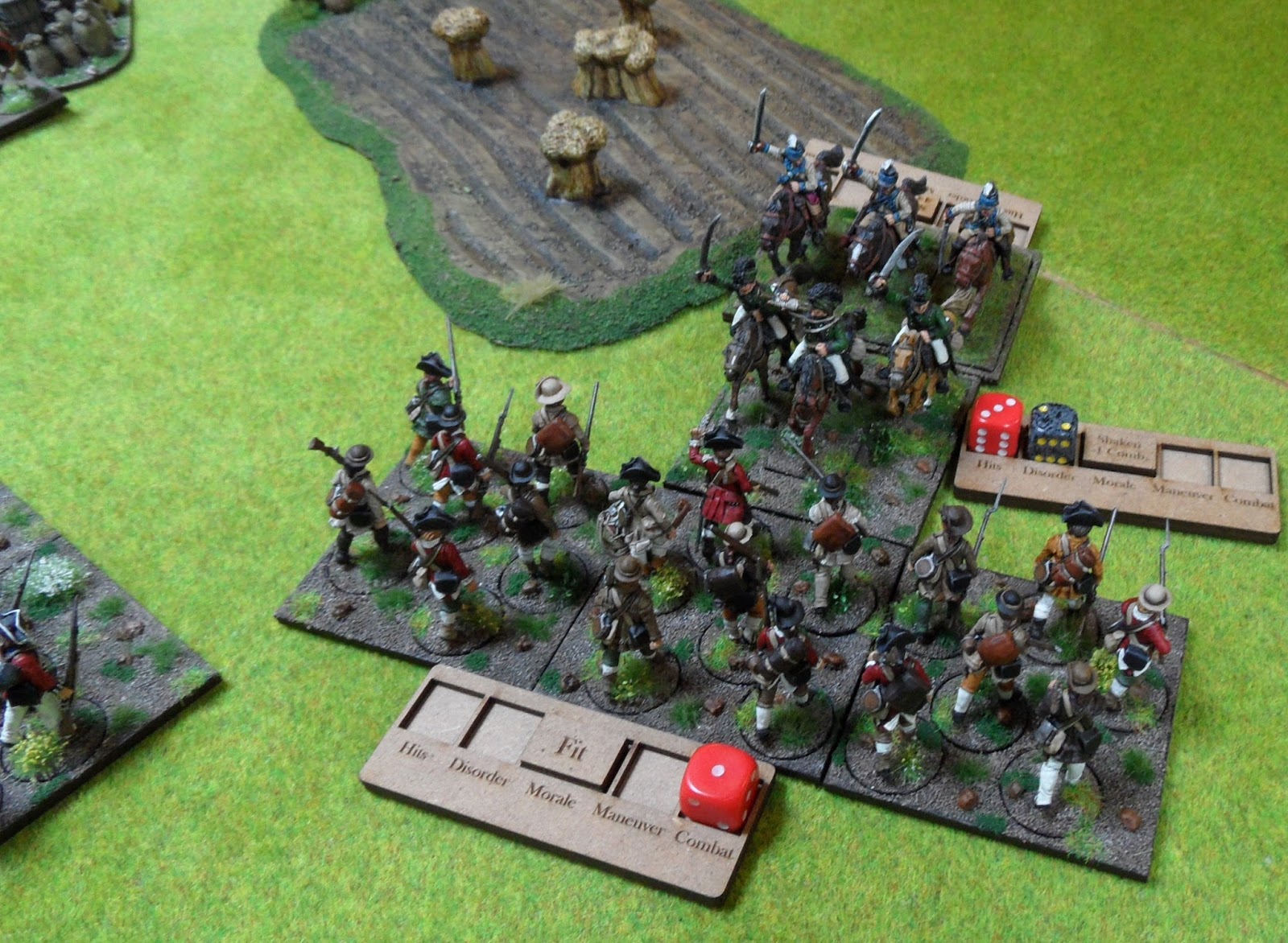
This happily coincided with an occasion for all my painted units to see the elephant. In May we played a game of Land of the Free with some of the participants in the AWI project. As we were all novices to the set, Jasper gave us an introduction to the rules. That helped a lot; I now at least had a basic grasp of the mechanics.
There is ample appreciation in LotF for the problems of command and control, and I think the activation system works fine. Movement and fire are pretty standard. The charge mechanism, in combination with the morale rules, as so often seems to be the Achilles heel and it will take some effort to master. We didn’t the advanced rules at the time, so that Indians operated the same as light infantry. No need to say that I was happy to move on to advanced rules as soon as possible!
The game itself turned out in our favour, largely due good initial positioning, good use of cavalry and some lucky dice rolls. I was able to concentrate my regulars and militia before the enemy regulars could reach the battlefield. The cavalry was used a bit as a Napoleonic shock force, which seems anachronistic, but worked because it operated on the flanks. And lucky dice rolls… well, Napoleon had something to say about that.
My troops generally acquitted themselves well. The Continentals, positioned at the anchor of my line, took a serious pounding but stayed in the field and dealt out in equal measure. The militia was tentative but provided valuable support. The delicate Stockbridge group got severely punished for its small but crucial contribution, and the Indians didn’t get into the fight.
All in all a good first impression, that would need a few more test games to play smoothly in August. There was still the uniformed militia and some officers to finish before then as well, but was getting confident that these would be ready well in time. Something I hadn’t expected to say when I started out in December!
This blog was first published on the Wargames, Soldiers & Strategy blog on June 16th 2016
The painting progress was quite satisfactory in May and June. I finished a small group of Stockbridge Indians (which were allied to the rebels) and a large group of Woodland Indians. I also managed to construct a few wooden cabins and a load of wicket fences.
This happily coincided with an occasion for all my painted units to see the elephant. In May we played a game of Land of the Free with some of the participants in the AWI project. As we were all novices to the set, Jasper gave us an introduction to the rules. That helped a lot; I now at least had a basic grasp of the mechanics.
There is ample appreciation in LotF for the problems of command and control, and I think the activation system works fine. Movement and fire are pretty standard. The charge mechanism, in combination with the morale rules, as so often seems to be the Achilles heel and it will take some effort to master. We didn’t the advanced rules at the time, so that Indians operated the same as light infantry. No need to say that I was happy to move on to advanced rules as soon as possible!
The game itself turned out in our favour, largely due good initial positioning, good use of cavalry and some lucky dice rolls. I was able to concentrate my regulars and militia before the enemy regulars could reach the battlefield. The cavalry was used a bit as a Napoleonic shock force, which seems anachronistic, but worked because it operated on the flanks. And lucky dice rolls… well, Napoleon had something to say about that.
My troops generally acquitted themselves well. The Continentals, positioned at the anchor of my line, took a serious pounding but stayed in the field and dealt out in equal measure. The militia was tentative but provided valuable support. The delicate Stockbridge group got severely punished for its small but crucial contribution, and the Indians didn’t get into the fight.
All in all a good first impression, that would need a few more test games to play smoothly in August. There was still the uniformed militia and some officers to finish before then as well, but was getting confident that these would be ready well in time. Something I hadn’t expected to say when I started out in December!
This blog was first published on the Wargames, Soldiers & Strategy blog on June 16th 2016
Friday, 11 April 2014
The Mechanics of Violence
Interesting outcome. New research links aggression after video games to the mechanisms rather than violent content. So it´s the designers fault?
Could this also be true for analogue games? Are wargamers happier after a bout of crisp Black Powder and aggravated after a spell of Barkerese?
Do people feel less aggressive after playing an 'elegant' Knizia design and driven to rage by the disorganised, misspelled and obtuse collection of half sentences that the publisher of Luna Llena calls the rulebook?
I wouldn't be surprised.
Could this also be true for analogue games? Are wargamers happier after a bout of crisp Black Powder and aggravated after a spell of Barkerese?
Do people feel less aggressive after playing an 'elegant' Knizia design and driven to rage by the disorganised, misspelled and obtuse collection of half sentences that the publisher of Luna Llena calls the rulebook?
I wouldn't be surprised.
Labels:
boardgames,
design,
rules,
video games,
wargame,
Wargames
Tuesday, 27 August 2013
More thoughts on miniatures rules and the future
Yesterday´s post was about some favourite miniature rule sets, but later that night I also had a discussion about rule sets at the birthday of Michel with Hans and Ed.
Hans is working on a fantasy rule set (For Reign or Ruin, see him testing it here) and very interested in what happens before the battle and how that affects the battle. Delays in the arrival of troops or in their deployment would offer their enemies opportunities for pre-emptive attacks or send an battle plan into disarray. Pre-battle speeches could lift the hearts of the troops.
Ed is thinking not so much of a rule set, but more a scenario generator because he feels that in many rule sets there is no context to the battle and organising and above all keeping campaigns going is hard work.
![]() |
| Maurice, by Sam Mustafa |
Another example of a new direction in wargaming is Dux Britanniarum, another Too Fat Lardies set about the struggle between Arthurian British and Anglo-Saxon invaders. The rules focus on the main characters in the war band as it raids or defends the frontier over several years. With rudimentary character generation like in an RPG and with opportunities to rise through the hierarchy and expand your force, the simple campaign rules offer a structure to each battle.
![]() |
| Dux Britanniarum by Too Fat Lardies |
What I like about the rules is that they are aimed on a small period of time (you know, just a century or two) and move away from the generic setting so common in ancient and medieval wargaming (why is there no rule set just for the Pelopponesian War?). The other side of the coin is that it offers only a relatively small sales volume at reasonably low costs for the designer.
I think there are opportunities for new products by combining card decks a la Maurice with limited ancients/medieval settings like Dux Britanniarum. The card sets build a mini campaign or act as a scenario builder, compatible with whatever rules people use to fight their battles. You could link it to new miniatures ranges, but I think there are also advantages in offering players new ways to use armies that they already have.
The upside is that creating a deck is not expensive. You can sell the decks themselves or offer them via print on demand services. It requires some research to include the kind of events and characters and the dynamics of a particular conflict or campaign. There are a lot of ancient and medieval wars and campaigns so this adds up.
A possible solution to that challenge is to provide a much larger set of cards that players can use to build decks for particular campaigns or wars themselves. It is a good way to engage players with the product. If you allow them to publish their decks on a forum it will build a community or when they publish in magazines they advertise for you.
What do you think? Is this something you are looking for? Do you think it is viable?
Labels:
Ancient,
design,
history,
medieval,
miniatures,
rules,
Too Fat Lardies,
wargame,
Wargames
Monday, 26 August 2013
The best miniature wargame rules (according to a non-representative selection of wargamers)
A couple of weeks ago I met Jasper and Jan-Willem and we discussed our favourite and not-so favourite miniature rule sets. This set me thinking.
Jan-Willems favourite ruleset is G.A.S.L.I.G.H.T. It is straightforward and fast. The game allows for storytelling and is easily adaptable for different settings, something Jan-Willem has done for several participation games.
But he really dislikes De Bellis Multitudinis, often known as DBM. It was a totally regressive development of the ancients ruleset De Bellis Antiquitatis, which was quite innovative. It introduced the now widely accepted PIPs and defined only a dozen troop types based on their role on the battlefield, assuming that weaponry and armour were less important. DBM however, recomplicated the game and reintroduced differences in armour etc, thus negating much that was good about DBA. It also did so in an excruciatingly bad writing style but most of all it was a bad ruleset and no fun.
Note; also check out the excellent fantasy rules Hordes of the Things, which keeps the spirit of DBA and in my humble opinion, makes it even better!
The newish Black Powder ruleset is Jasper´s favourite. It fast and simple. Rather than focussed on tournament battles it aims at scenarios. Jasper likes that it works well as a toolbox for more specific supplements, thus reflecting the character of the period.
My favourite is Stonewall Jackson's Shenandoah Valley Campaign. The rules for battles are really simple but try to reflect the main elements of American Civil War combat. But the brilliance of this set is the campaign system in which all players are Union commanders fighting againt the brilliant Jackson. In fact their main objective is not to win battles but to gain the most political capital out of the campaign which can be done by sending off troops to other armies, politicking in Washington and and avoiding being attacked by Jackson. Just reading the rules brings a smile to your face.
Another favourite ruleset of mine is Bag the Hun / Algernon Pulls It Off, Too Fat Lardies' WW2 and WW1 Staffel level air combat rules. Lots of focus on experience of pilots, maneouvres and formations, not so much on the technical aspects of the planes. As you play with named pilots, seeing them shot down doesn't feel well. Too bad they added more rules in later editions.
Jasper and I are also impressed with Muskets & Tomahawks. These are 18th century skirmish rules for North America with the emphasis on scenarios and storytelling. The rules are fast and simple (yes, you're spotting a pattern here).
We all agreed that we liked rule sets which paid more attention to the game and historical feel than historical detail and complexity. Easy to pick up and hard to master, but more importantly: fun and with room for story. There are of course people with other preferences, like tournament players and historical buffs who would probably come up with other favourites.
So what are your favourites? And why? Did we miss something? Or do you think these rules actually suck?
![]() |
| G.A.S.L.I.G.H.T. by Buck Surdu and De Bellis Multitudinis by Wargames Research Group |
Jan-Willems favourite ruleset is G.A.S.L.I.G.H.T. It is straightforward and fast. The game allows for storytelling and is easily adaptable for different settings, something Jan-Willem has done for several participation games.
But he really dislikes De Bellis Multitudinis, often known as DBM. It was a totally regressive development of the ancients ruleset De Bellis Antiquitatis, which was quite innovative. It introduced the now widely accepted PIPs and defined only a dozen troop types based on their role on the battlefield, assuming that weaponry and armour were less important. DBM however, recomplicated the game and reintroduced differences in armour etc, thus negating much that was good about DBA. It also did so in an excruciatingly bad writing style but most of all it was a bad ruleset and no fun.
Note; also check out the excellent fantasy rules Hordes of the Things, which keeps the spirit of DBA and in my humble opinion, makes it even better!
![]() |
| Black Powder by Warlord Games |
The newish Black Powder ruleset is Jasper´s favourite. It fast and simple. Rather than focussed on tournament battles it aims at scenarios. Jasper likes that it works well as a toolbox for more specific supplements, thus reflecting the character of the period.
![]() |
| Stonewall Jackson's Shenandoah Valley Campaign by Real Time Wargames |
My favourite is Stonewall Jackson's Shenandoah Valley Campaign. The rules for battles are really simple but try to reflect the main elements of American Civil War combat. But the brilliance of this set is the campaign system in which all players are Union commanders fighting againt the brilliant Jackson. In fact their main objective is not to win battles but to gain the most political capital out of the campaign which can be done by sending off troops to other armies, politicking in Washington and and avoiding being attacked by Jackson. Just reading the rules brings a smile to your face.
![]() |
| Bag the Hun and Algernon Pulls it Off by Too Fat Lardies |
Another favourite ruleset of mine is Bag the Hun / Algernon Pulls It Off, Too Fat Lardies' WW2 and WW1 Staffel level air combat rules. Lots of focus on experience of pilots, maneouvres and formations, not so much on the technical aspects of the planes. As you play with named pilots, seeing them shot down doesn't feel well. Too bad they added more rules in later editions.
![]() |
| Muskets & Tomahawks by Studio Tomahawk |
Jasper and I are also impressed with Muskets & Tomahawks. These are 18th century skirmish rules for North America with the emphasis on scenarios and storytelling. The rules are fast and simple (yes, you're spotting a pattern here).
We all agreed that we liked rule sets which paid more attention to the game and historical feel than historical detail and complexity. Easy to pick up and hard to master, but more importantly: fun and with room for story. There are of course people with other preferences, like tournament players and historical buffs who would probably come up with other favourites.
So what are your favourites? And why? Did we miss something? Or do you think these rules actually suck?
Labels:
books,
design,
history,
miniatures,
rules,
Too Fat Lardies,
wargame,
Wargames
Thursday, 18 July 2013
Muskets & Tomahawks (and More) in the Mail
In the mail the long awaited:
Some nice French & Indian Wars minis as well:
Maroons, revolting slaves, slave hunting dogs
and a few French Revolutionary.
And I couldn't resist Sam Mustafa's Maurice.
None of this will see immediate action, but I hope to get at least the F&IW ready for a battle this year.
Some nice French & Indian Wars minis as well:
![]() |
| Coureurs du Bois and Indians |
and a few French Revolutionary.
![]() |
| To fight the revolting slaves |
And I couldn't resist Sam Mustafa's Maurice.
None of this will see immediate action, but I hope to get at least the F&IW ready for a battle this year.
Labels:
18th century,
Caribbean,
miniatures,
rules,
slavery
Sunday, 16 June 2013
Maroons and slave revolts
When my interest was raised in slavery at university, I also learned about the maroons (called bosnegers
in Dutch controlled Surinam). These escaped slaves formed communities in hard to reach areas of British Jamaica, Surinam, French Saint-Domingue (present day Haiti). I assume there were also maroon communities in North and Latin America.
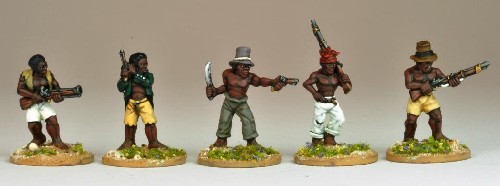
The subject has not left me since but was rekindled with the 150th anniversary of abolition of slavery in the Dutch West-Indian colonies coming up on July 1st (more on this later). It made me wonder why there have been no wargame rules that included maroons or slave revolts in their rules, at least none that I know of. But there's references in a few Ospreys (shown above) and at least I've found a miniature manufacture, Trent Miniatures, that offers maroons, Haitian rebels and regulars.
For the rules, I've been looking at Muskets and Tomahawks, as it also focuses on 18th century skirmish wargaming in the North American colonies. I think it can be easily adapted to include actions in the Caribbean. As it uses card driven scenarios, it could be well suited for the raiding, tracking and harassing expeditions of slave societies.
It could also include scenario's based on the larger slave rebellions, like the one on Saint-Domingue in 1792 that led to its independence. With British, Spanish and French attempts to (re)gain control, there's all kinds of interesting angles to take.
So I've done myself a big favour by getting a few relevant Ospreys and ordering Muskets & Tomahawks, and the Trent minis (as well as some French and Indians for the French & Indian wars). This isn't a project yet, and will have to wait a while, but I'm looking forward to working on it. René, are you reading this?
![]() |
| These include the French, Haitian, British and even Dutch units involved in the Napoleonic Wars in the Caribbean, in my possession since last Friday |
For the rules, I've been looking at Muskets and Tomahawks, as it also focuses on 18th century skirmish wargaming in the North American colonies. I think it can be easily adapted to include actions in the Caribbean. As it uses card driven scenarios, it could be well suited for the raiding, tracking and harassing expeditions of slave societies.
![]() |
| Revolting slaves by Trent Miniatures, from NorthStar website |
So I've done myself a big favour by getting a few relevant Ospreys and ordering Muskets & Tomahawks, and the Trent minis (as well as some French and Indians for the French & Indian wars). This isn't a project yet, and will have to wait a while, but I'm looking forward to working on it. René, are you reading this?
Wednesday, 22 August 2012
"Western" boardgaming and egalitarianism
Sagrilarius put some interesting questions in his blog " The Culture of Gaming, and Vice Versa". I was struck especially by one point he made, in that "western" society doesn't accept hierarchical games.
Sagrilarius wrote: "Games with binding contracts or hierarchical player roles are simply unheard of in the genre, not because they aren't fundamentally sound, but because they simply don't occur to the usual suspects that drive boardgaming's technological progress. Not just a eurogame thing, this a western game thing." Not to leave my thoughts in the comments section, I put them up here.

The comment may strike true for boardgames (although the Great Dalmuti springs to mind as the obvious exception) but is patently untrue if you look at other forms of gaming. In games with many players there is the opportunity for both hierarchical and 'contractual' relationships.
If you look at the mass player games occuring online, the hierarchical (and diplomatic) aspects are very clear, with structures like guilds, corporations, alliances and clans. In these structures some players take leading roles, whether formally or informally. Another aspect is specialisation of character types and team balance.
Another form of gaming which is inherently hierarchical is megagaming , games which involved 25 players and more. Player are grouped in hierarchies of teams, which in turn are hierarchical. In "The Last War ", a two day game about the latter half of WWII, about 150 players were grouped into 35 political or military teams , ranging for example from Roosevelt's cabinet through the Joint Chiefs of Staff to theater headquarters.
In both types of games players seem to happily accept the different roles, some relishing in the opportunity to exert leadership, others preferring to stay out of the limelight. Some people take pride in the team effort.
Of course, problems do occur when arguments start. Because this is only a game, and not real life, the extent to which players accept formal authority is limited. And even though there are limits to formal authority in real life (think of Guderian pushing on to the Channel Coast in May 1940, despite orders to halt), the options to punish players for disloyalty and insubordination in games are much less. On the other hand there is greater opportunity for players to excel on merrit, charisma, setting the example or by taking the lead.
I think the lack of hierarchy in boardgames has more to do with the format of a small group of players that need about an even chance of winning, than with cultural traits. Interestingly, informal hierarchy also works with semi-cooperative boardgames, especially if connected to special powers connected to certain offices, like in Republic of Rome and Battlestar Galactica.

So while there is a cultural propensity in the west for egalitarianism, it is not absolute, and it would be very interesting to see comparative studies of gaming culture, just like is being done for business culture (where for example the German business culture is more hierarchical than the Dutch). Do Chinese MMRPG player groups have different forms of organisations than Americans, or British?
There is an academic literature building up that looks at these kinds of dynamic in computer games, but I'm not sure it's as easy to do the same for boardgames.
An earlier version of this post was published on Fortress Ameritrash
Sagrilarius wrote: "Games with binding contracts or hierarchical player roles are simply unheard of in the genre, not because they aren't fundamentally sound, but because they simply don't occur to the usual suspects that drive boardgaming's technological progress. Not just a eurogame thing, this a western game thing." Not to leave my thoughts in the comments section, I put them up here.

The comment may strike true for boardgames (although the Great Dalmuti springs to mind as the obvious exception) but is patently untrue if you look at other forms of gaming. In games with many players there is the opportunity for both hierarchical and 'contractual' relationships.
If you look at the mass player games occuring online, the hierarchical (and diplomatic) aspects are very clear, with structures like guilds, corporations, alliances and clans. In these structures some players take leading roles, whether formally or informally. Another aspect is specialisation of character types and team balance.
Another form of gaming which is inherently hierarchical is megagaming , games which involved 25 players and more. Player are grouped in hierarchies of teams, which in turn are hierarchical. In "The Last War ", a two day game about the latter half of WWII, about 150 players were grouped into 35 political or military teams , ranging for example from Roosevelt's cabinet through the Joint Chiefs of Staff to theater headquarters.
In both types of games players seem to happily accept the different roles, some relishing in the opportunity to exert leadership, others preferring to stay out of the limelight. Some people take pride in the team effort.
Of course, problems do occur when arguments start. Because this is only a game, and not real life, the extent to which players accept formal authority is limited. And even though there are limits to formal authority in real life (think of Guderian pushing on to the Channel Coast in May 1940, despite orders to halt), the options to punish players for disloyalty and insubordination in games are much less. On the other hand there is greater opportunity for players to excel on merrit, charisma, setting the example or by taking the lead.
I think the lack of hierarchy in boardgames has more to do with the format of a small group of players that need about an even chance of winning, than with cultural traits. Interestingly, informal hierarchy also works with semi-cooperative boardgames, especially if connected to special powers connected to certain offices, like in Republic of Rome and Battlestar Galactica.

So while there is a cultural propensity in the west for egalitarianism, it is not absolute, and it would be very interesting to see comparative studies of gaming culture, just like is being done for business culture (where for example the German business culture is more hierarchical than the Dutch). Do Chinese MMRPG player groups have different forms of organisations than Americans, or British?
There is an academic literature building up that looks at these kinds of dynamic in computer games, but I'm not sure it's as easy to do the same for boardgames.
An earlier version of this post was published on Fortress Ameritrash
Saturday, 7 July 2012
Jim Wallman, my favourite game designer
My game designing hero is Jim Wallman, a friendly guy from South London with a warped mind and the English sense of humour. He has a good grasp of (military) technology and history, of popular culture and of gaming. One of my fondest memories of him is sitting together on the ground in a wargames convention hall and trying to design a game on global crime networks.
Jim started out playing ith the likes of miniature wargaming icons Paddy Griffith and Donald Featherstone, then became involved in Wargame Developments, an innovative English game design group. Their foremost inspirations were miniature wargames and Kriegsspiel and the games mostly assumed pretty good knowledge of the subject to play. The club was a fertile ground for aspiring game designers and has done a lot in the development of matrix games for example.

Jim was one of the founding members of Chestnut Lodge Wargames Group in South London, which over the years has dedicated itself to the design of new games. I find it a very inspiring club of people that are supportive and critical of game design and I’ve played some of the most fun games ever there.
The range of game formats and mechanisms Jim has used is just astounding and he really uses the form he thinks fits the theme and approach best. They range from WWII company actions and samurai skirmish to 18th century English colonels leading their regiments and large scale space battles. Jim has put most of his game designs online for everyone to benefit and has been glad to assist and discuss with aspiring game designers and players like me. It's even led to a translation by an Italian group.
His designs assume that players don´t try to bend the rules and play ´historically´, mostly assisted by umpires. Also he doesn´t believe in complex rules, because player interaction is more important to him. A lot of effort is taken to give perspective through player briefings. Of course, the use of umpires allows rules to be kept to covering only the most likely events, and let wizard wheezes and exceptions be handled separately. As a result, Jim hasn´t designed many board games as he finds the medium too restrictive, but I´ve got a fine example below.

In the early 80s Jim also started doing megagames and over the years has designed and organised dozens of them. After a couple of years he and a couple of friends/designers set up Megagame Makers. In 2005 the organised their ‘hundredth’ megagame, The Last War, with about 150 players and umpires fighting WWII from January 1942 to the bitter end in two days. Search out their archive of megagames and stand in awe of the number of games they actually put on over the years, especially if you consider what a shitload of work these games take to organise. I’ll go deeper into megagames elsewhere.
And these are my favourite (non-mega)game designs of his:

Tank duel: a double blind tank dog fight. The teams are on opposite sides of a curtain with the terrain duplicated. They only see their own tank until the enemy gets into the line of sight. Both teams consist of commander, gunner, loader and driver (depending on tank type of course). The commander has to order each of the other crew members on direction, type of ammo use, firing etc etc. By keeping the pace of the game up it becomes extremely tense and fast, with most games done in under 15 minutes.
My worst session was against an experienced team that used an antitank gun. All the time I was wondering why they hardly gave any orders. Until they hit me while turning the corner.
Decapitation: a boardgame of the ‘Freedonian attempts’ to take out an ‘Evil Dictator’ before they invade his country to bring peace, democracy and prosperity. The Freedonians have intelligence teams on the ground and radio listening to pinpoint the dictator’s whereabouts, but the latter has a few stand ins to deceive them. Of course, bombing and cruise missiles can have collateral damage that will lower public support for the war. This game shows what is possible in designing and producing a game as it was ready before the Iraq war was over. The map is here.

The Universe: the Universe is actually a living background to a whole range of games, including a strategic campaign Humanity will Prevail (running for over 10 years now), pirates (erm… independent traders), space marines and ships’ crew role playing campaigns, large space battles, and sports.
The major polities in the campaign have gained an eerie level of realness over the years as players have added their political styles and popular cultures. Political summits are hosted, battles fought, propaganda wars waged and elections rigged.

I used to sort of rule the government of the postcommunist Sirian Socialist Republic, an egalitarian bureaucracy that has greatly expanded its robot workforce to lessen the burden of human labour. When not in a meeting, the SSR leads the opposition to the Evil Empire of Sol, unless distracted by piracy, terrorism, natural disasters, alien invasions or out of control AIs.
Do have a look. And enjoy!
This was posted earlier to Fortress Ameritrash
Jim started out playing ith the likes of miniature wargaming icons Paddy Griffith and Donald Featherstone, then became involved in Wargame Developments, an innovative English game design group. Their foremost inspirations were miniature wargames and Kriegsspiel and the games mostly assumed pretty good knowledge of the subject to play. The club was a fertile ground for aspiring game designers and has done a lot in the development of matrix games for example.

Jim was one of the founding members of Chestnut Lodge Wargames Group in South London, which over the years has dedicated itself to the design of new games. I find it a very inspiring club of people that are supportive and critical of game design and I’ve played some of the most fun games ever there.
The range of game formats and mechanisms Jim has used is just astounding and he really uses the form he thinks fits the theme and approach best. They range from WWII company actions and samurai skirmish to 18th century English colonels leading their regiments and large scale space battles. Jim has put most of his game designs online for everyone to benefit and has been glad to assist and discuss with aspiring game designers and players like me. It's even led to a translation by an Italian group.
His designs assume that players don´t try to bend the rules and play ´historically´, mostly assisted by umpires. Also he doesn´t believe in complex rules, because player interaction is more important to him. A lot of effort is taken to give perspective through player briefings. Of course, the use of umpires allows rules to be kept to covering only the most likely events, and let wizard wheezes and exceptions be handled separately. As a result, Jim hasn´t designed many board games as he finds the medium too restrictive, but I´ve got a fine example below.

In the early 80s Jim also started doing megagames and over the years has designed and organised dozens of them. After a couple of years he and a couple of friends/designers set up Megagame Makers. In 2005 the organised their ‘hundredth’ megagame, The Last War, with about 150 players and umpires fighting WWII from January 1942 to the bitter end in two days. Search out their archive of megagames and stand in awe of the number of games they actually put on over the years, especially if you consider what a shitload of work these games take to organise. I’ll go deeper into megagames elsewhere.
And these are my favourite (non-mega)game designs of his:

Tank duel: a double blind tank dog fight. The teams are on opposite sides of a curtain with the terrain duplicated. They only see their own tank until the enemy gets into the line of sight. Both teams consist of commander, gunner, loader and driver (depending on tank type of course). The commander has to order each of the other crew members on direction, type of ammo use, firing etc etc. By keeping the pace of the game up it becomes extremely tense and fast, with most games done in under 15 minutes.
My worst session was against an experienced team that used an antitank gun. All the time I was wondering why they hardly gave any orders. Until they hit me while turning the corner.
Decapitation: a boardgame of the ‘Freedonian attempts’ to take out an ‘Evil Dictator’ before they invade his country to bring peace, democracy and prosperity. The Freedonians have intelligence teams on the ground and radio listening to pinpoint the dictator’s whereabouts, but the latter has a few stand ins to deceive them. Of course, bombing and cruise missiles can have collateral damage that will lower public support for the war. This game shows what is possible in designing and producing a game as it was ready before the Iraq war was over. The map is here.

The Universe: the Universe is actually a living background to a whole range of games, including a strategic campaign Humanity will Prevail (running for over 10 years now), pirates (erm… independent traders), space marines and ships’ crew role playing campaigns, large space battles, and sports.
The major polities in the campaign have gained an eerie level of realness over the years as players have added their political styles and popular cultures. Political summits are hosted, battles fought, propaganda wars waged and elections rigged.

I used to sort of rule the government of the postcommunist Sirian Socialist Republic, an egalitarian bureaucracy that has greatly expanded its robot workforce to lessen the burden of human labour. When not in a meeting, the SSR leads the opposition to the Evil Empire of Sol, unless distracted by piracy, terrorism, natural disasters, alien invasions or out of control AIs.
Do have a look. And enjoy!
This was posted earlier to Fortress Ameritrash
Labels:
CLWG,
design,
Jim Wallman,
Megagame Makers,
megagames,
rules,
wargame
Subscribe to:
Comments (Atom)