Showing posts with label books. Show all posts

Sunday, 18 March 2018

Some of my recent reading: dark ages Frisia

Another couple of books I read the past moths were triggered by plans for some medieval wargaming. Somebody suggested that we should try the Battle of Vlaardingen in 1018, a smallish affair by today's standards. It was pretty momentous however, as it established the independence of the counts of Frisia against the Holy Roman Emperor.


Sadly the execution wasn't compatible with stuff I already had lying, waiting to be used, so my project will deal with the Battle of Hastings. But I read the stuff on Frisia anyway...


And the most amazing I learned is that the Dutch coast was mostly deserted in the 3rd and 4th centuries AD. Apparently rising water levels, combined with moving sand dunes made life extremely hard so it essentially depopulated. The people that came to inhabit the area afterwards were not the original Frisians of Roman times, but migrants from present day Northern Germany and Scandinavia, with a different material culture and different language. However, they were named after the area and for a long time people assumed there was a continuous link of Frisian inhabitation.

Sunday, 11 March 2018

Some of my recent reading: military innovation

So I'm on for a new adventure, starting in October. I'll be cooperating on a part of a larger series of handbooks about Dutch military history. Personally, it looks like I will mostly be writing on the 1813-1870 period.


Of course there'll be several themes discussed in this book, but I have taken a special interest in the development of technology and how it's integrated into military practice. It's become an interesting field in this century, since the military revolutions / revolutions in military affairs discussion blossomed up. Mostly this is a discussion about how you can foster innovation and draw the right lessons from the past to guide technological development towards succes while avoiding the pitfalls.


Part of that discussion focusses on where in the military organisation this innovation takes place? Is it top down (reforms of Prince Maurice or Gustavus Adolphus), is it bottom up (battlefield adaptation in WWI)? Or is it perhaps a complex interaction of military entrepreneurs in the military hierarchy that may or may not succeed in catching the ear of those with decision making power. And perhaps, I add as an historian, this changes based on social structures over time and space?


So I'm diving into some old and new literature...


Mostly on the 19th century, but if a valid theoretical point seems to be made, I'm happy to look beyond.


Let's say I'm pretty psyched about this project


Sunday, 12 November 2017

Forgotten colonial war revisited

Ok, just a small step back to one of the books about colonial wars I posted on some time ago. I follow the excellent podcast series New Books in Military History, which has an interesting selection of new material. Some time ago I listened to a comparison of genocide and conquest on the Eastern Front in WWII and the the American West.


What I found interesting is that the author, Westermann, took up this project based on discussions in his classes, where he found the students would naturally compare different forms of genocide. When it comes to genocide, Nazi Germany remains the archetype/Idealtype, although the last decades our historical knowledge of other genocides has widened.

Of course looking at genocide involves a discussion of the definition, but most definitions go farther than just the mass murder of a particular group with the intent of total destruction. Some include the destruction of culture and separate identity.

While it easy to dismiss referring to the Holocaust as a Godwin, in this vase it is actually helpful.

Westermann notes that what happens 'at the sharp end' of policy doesn't necessarily align with what happens at the centre. And while what happens at the sharp end may seem very similar in both cases, Westermann argues that the main difference between the American and the German case is that in the former, the authorities were not bent on genocide and in the latter they were.

It's worth listening to his argument in full.


Sunday, 5 November 2017

Return from Crisis I

Yesterday visited the Crisis wargames show in Antwerp. Others have made more extensive reports on the show, so I'll not try to compete. But for me mostly it was a pleasure talking to so many people about their day and future plans.


I had planned to buy the latest edition of the Volley & Bayonet rules set to go with my Napoleonic French and Austrians for the 1809 campaign. Picked up the Marechal d' Empire /General de Division rules from Baccus as well. Now have to decide quickly which one I want to use for a participation game at PolderCon.

The books I bought just show that I can't be trusted to stick to one period. The book on the Iberian theatre of the War of Spanish Succession I bought because I met Nick Dorrell a decade ago in Eastern Europe. We then discussed the WSS (which I have this fascination for) and I sent him some stuff from Dutch sources.

The other WSS book I bought because I'm a sucker for logistics and systems of command and control. And I was intreagued to find that this author had at least read a few Dutch sources. I believe this was the first time Helion & Company visited Crisis. I was glad to shake the hand of Andrew Bamford, whose A Bold and Ambitious Enterprise (and follow up sourcebook) on the British campaign in the Low Countries in 1814 I used when writing on Waterloo. Consider that a recommendation.

And 10th century warfare in Germany just taps into my new found interest in that period. I hope to blog about how that came about. 


Note: Yup, it's been too quiet up here. And I stand reprimanded for that. As last year, I will try to do better. However, I haven't figured out how to do that, yet, without spending a lot of time. Which has been the reason why I dropped out before. It's okay to spend half an hour once every few days, but I have found that blogging takes more time if you want to do it well. But let's give it a shot.


Sunday, 5 March 2017

Symmetry on the western front in WWII

The bazooka vs panzer book whetted my appetite for some more WWII western front stuff (I still have that 20mm US army miniatures hanging around), so I picked up this new Osprey pitting German and US armoured infantry against each other.


There didn’t seem to be much difference between the Panzergrenadier and armoured infantryman when it comes to equipment and armoured fighting vehicle. There were some differences in replacement policy but those went for the armies as a whole and didn’t affect tactical and operational employment. Zaloga refers to a German preference for attacking mounted in their AFVs, but that is not what happens in the examples, so we don’t have any idea how that plays out.

Armoured divisions on both sides suffered when defending because they had a smaller infantry complement than an infantry division. And while the Americans had the luxury of being on the strategic offensive and thus only having to defend occasionally, the German army by the end of the war had to plug gaps with whatever came to hand, thus putting the armoured divisions at a disadvantage.

Apart from an offensive or defensive stance the determining factor in the outcome of this match up was that the Americans had much more stuff and were better at coordinating them. So while the Germans even struggled to get artillery support for their attacks, the Americans could pour artillery on enemy attacks, supplemented with air attacks when the weather was good.

My main problem with the book is that the combat narratives, and especially the last one, are not that clear and are badly supported by the maps. Especially in the last case it is hard to figure where the combat is taking place to St Vith and other places which are constantly referred to in the text. To sum up: I lost interest at some point.

Looking back it wasn’t written in the stars that the last four books I read would all be from the Combat and similar Duel series, but that’s how it played out. I’ve warmed to these series but my impression has been confirmed that the best of these are the ones that pit different styles of warfare against each other. With the armoured infantrymen and the World War I askaris, there is a less interesting dynamic than between Apache vs US cavalry and bazooka vs tank.

Friday, 3 March 2017

Asymmetry on the western front in WWII

After a couple of colonial contests, I was happy to shift to World War Two. I had been intreagued by the match up between the bazooka and German close defense systems for tanks.


Steven Zaloga is an authority on tank warfare, and his knowledge on this subject does not disappoint. The dynamic interaction between antitank tactics and close defense is explained well, debunking some myths on German mesh side armour. And there were some weirdly interesting solutions suggested, like the Vorsatz P.

It was all rather marginal though, as infantry weapons were responsible for only a small amount of tank losses, with tanks, aircraft and artillery doing the most damage. The main impact may have rather been to give infantry the idea that they wouldn’t have to face tanks empty handed. Also the bazooka was used far more often to take out enemy strong points than to fight tanks.

Zaloga then delves into one example where tanks and infantry were pretty evenly matched, during the Ardennes offensive in December 1944. As this fight took place in favourable circumstances for the infantry, with limited vision due to fog and houses, the infantry was able to get close to the tanks and on their weak side and rear armour.


Sadly, lacking in the account is the perspective of the German tankers and their attempts at close defense here. All in all the technical/tactical account of the start didn’t mesh too well with the combat narrative.

Tuesday, 28 February 2017

And yet another forgotten colonial war

Even when I was young, we didn’t play Cowboys & Indians any more and Westerns have declined as a movie theme. But despite the relative neglect, the Indian wars remain a fascinating colonial conflict.


By the time the U.S. army took on the Apache tribes in the middle of the 19th century, the issue was no longer in doubt. The demographic and industrial weight of the US totally overshadowed that of the hunting and farming Apache who number in the tens of thousands.

This was a war of relatively small battles, neither side bringing more than several hundred combatants to the fight. However, each Apache killed had long term consequences for the survival of his tribe, while there was a steady flow of new recruits for the cavalry.  At the same time, expanding settlement reduced the hunting grounds on which the Apache depended, thus forcing them into raiding.

Nevertheless, the struggle was a long and bitter one, which could only be brought to an end by employing Apache versus Apache. This although the cavalry itself made significant strides in its counter guerilla capabilities. Equipment and tactics were adapted to the climate and Apache warrior society.

Likewise the Apache adapted to the western world, improving their weaponry, and finding ways to sabotage telegraph communications. They also used their superior knowledge of the terrain to move and live undetected.

The only way to really get at them was to use scouts from rival tribes. There was little sense of common cause between these tribes and for many warriors the opportunity to stick to their warrior lifestyle, plus a gun and free meals, was too good to be missed.


McLachlan does an excellent job using first hand accounts from both sides to illustrate the challenges that both sides faced and how the social-political dynamics of the Apache and white settler society made conflict inevitable. The narrative flows well, the analysis is crisp and the illustrations fit the narrative. Probably the best Osprey book that I’ve read on ‘non-western‘ armies.

Sunday, 26 February 2017

Another forgotten colonial war

Got a bit frustrated with my lack of reading lately and so decided to take on some lighter stuff, and Ospreys have proven excellent in that regard. Easy to pick up and lay down on the commute.


First off was King’s African Rifles vs Schutztruppe, continuing the theme of forgotten colonial wars. Not a middle of the military history road subject. First of all it deals with an African side show in World War I, when troops from British colonies tried to conquer the German colonies. And secondly, it prominently features the African soldiers fighting the war.

And compared to most Osprey books, there is more information on the non-western protagonists. It is made clear that in the British units, with fewer white NCOs, more responsibility devolved on the black NCOs especially when the (always white) officers became casualties.

And the author very cautiously treads the subject whether having more European NCOs was better for battlefield performance. There are even a few passages from the memoires of black participants.

On the other hand, in the operational narrative, the perspective of the black soldiers fades into the background. The prime actors there are the natural environment dictating the tactical and strategic decisions made by white officers. And you can still wonder how the askaris felt about fighting a colonial war.

On all the other elements the book score above average. It does a good job of explaining the challenges of bush warfare in southeastern Africa and the differences in British and German policies towards war in Africa. Also, the operational narrative is clear and highlights the most important factors which are brought together in the final analysis. Special kudos for the illustrations, which are very well integrated into the narrative, reinforcing it with examples.

Sunday, 19 February 2017

Forgotten colonial wars don't go away

This is a very nice book on a forgotten colonial war that the Netherlands started without good reason and only ended with the arrival of a new colonial power, Japan, in 1942.*


From the first unsuccessful invasion in 1873, through the bitter decades of guerilla warfare to the anticlimax in 1942, Dutch colonial administrators and military struggled to bring an end to the costly occupation of a region that just would not submit, even when all hope seemed gone.

As the Dutch brought more power to bear, the resistance dwindled from a full fledged army defending the sultanate to desperate attacks on individual soldiers and bureaucrats. And as the Dutch sent their columns deeper into the hinterland, all of Aceh was marked with destroyed villages and hasty graves for freedom fighters and their pursuers.

The coming of the Japanese didn’t improve the lives of the inhabitants of Aceh, nor did their struggle end with Indonesian independence. And even though peace has reigned since almost a decade, Aceh is still a poor and neglected part of Indonesia.

Stolwijk, who lived in Aceh for 18 months between 2009 and 2015, gives a sympathetic view of a society trying to overcome the painful present, while keeping alive the ghosts from the past. His anecdotes of interactions with former guerillas and collaborators, students and officials (who seem genuinely pleased that somebody takes an interest in the history of their building or train line) both provide comic relief and perspective.

*full disclosure: I’ve played a few games of football with the author and I think he’s a nice guy.


Sunday, 5 February 2017

Nazi women and Nazi Wives

Fascinating book. Most of the women in this book were highly dedicated to Hitler and his ideas. Magda Goebbels married the 'next best'. They paid a high price for their dedication after the war: destitution, imprisonment, even life.* Yet, several of them defended the Third Reich onto their dying bed.


The book gives a peek behind the scenes of the Nazi party. The stories of Geli Raubal, Hitler's favourite niece, and Carin Göring, the Swedish aristocrat that left her husband for Hermann, provide insight to the workings and social sphere of Hitler's entourage in the Kampfzeit, ie before the Nazis came to power.

It shows that the Nazis were human. Göring was a true romantic, whilst Goebbels was an adulterer with a penchant for adoration and self doubt. Even Hitler felt a moral obligation to take care of Eva Braun after suicide attempts, and although he ordered her to stay out of sight when foreign dignitaries visited the Berghof.

None of these women held any personal power. Women were considered unfit for the political sphere in Nazi ideology. Despite the huge services rendered for the party by benefactresses in the Kampfzeit, their opinions counted for little. Even the staunch Nazi organiser Gertrud Scholtz-Klink, in charge of the party (and later state) women's organisations, never actually got to talk to Hitler.

So all influence these women had was through their men. Whilst Emmy Göring and Henriette von Schirach slowly faded into the background as the influence of their husbands waned, Eva Braun slowly increased her hold on Hitler's private life.

Is there a lesson in these stories?


* That's not saying it wasn't just or deserved or both.

Friday, 27 January 2017

From the Congo to Nova Zembla. A small step

I referred to this beautiful book last Sunday. A year's worth of a German geographical magazine.


Not only is is 145 years old, it has the most beautiful maps. The publisher, Justus Perthes from the German city of Gotha, had a golden reputation for its map making. I also have an atlas of the classical world from these guys. Stunning work.


Not only does it have a piece on Livingstone's research into the origins of the Nile, it also has a lot of stuff on a polar exhibition to Nova Zembla. And this is where a legendary chapter in Dutch history comes to pass. Because what the polar expedition found was an old hut, known in Dutch as Het Behouden Huys, in which a group of Dutch sailors survived an arctic winter.

Here's the 1872 map, showing the location of the hut near the lowest cape on the eastern coast.


In 1596 an expedition led by captains Barentsz (yes, the sea is named after him) and Heemskerck tried to find a way to the East Indies by the north cape. It was hoped that in this way, the Spanish and Portuguese, who claimed the Indian Ocean and the Pacific as their monopolies, could be avoided.


The expedition failed, getting stuck in the polar ice. But the account of their survival during the polar winter, including fights with bears, was widely read and still forms one of the seminal elements of Dutch pride in their Golden Age. The magazine included a couple of classic prints out of the account.


With the north route proven to be unusable, Dutch traders forced more resources into breaking into the Indian Ocean, which lead to the foundation of the Dutch East India Company and a colonial empire that lasted for almost 350 years.

Friday, 20 January 2017

How not to write a history of slavery

Rarely have I been so disappointed in a historian that I held in high regard as by Jeremy Black’s Slavery. A New Global History. There are probably very few untruths in this book, but there is a glaring imbalance.


There are markets and goods, there is military technology and repression. Slavery was more harsh in the Carolinas than in the Chesapeake Bay. But beyond the abstractions that Black uses, you’ll be hard pressed to find out what life would have been like for a slave or a slaver or a freed slave living in a slave society: the daily routines, housing conditions, punishments, or slave markets.

Also the agency of the slaves in ending slavery is dismissed in a few sentences as ‘evidence ... is limited’. But since this is a major theory in the study of slavery, you might expect a serious discussion. As would be warranted by the rest of half century of research and debate on slavery that Black mostly ignores.

The imbalance is especially striking when the book is full of not that relevant detail on imperial and colonial history, and on the abolition debate in Great Britain and its role in the following decades. To the point where becomes self-congratulatory.

Alright, there are some redeeming features. This book has a more global perspective than most, looking beyond the early modern Caribbean. What it basically underwrites is that slavery was part and parcel of most societies up to the 19th century and its sudden retreat in that century is something worth noting.

But essentially this is a White Englishman’s History of Slavers that might have been written in the 1960s. Black should have known his limits and stuck to military history.

Sunday, 15 January 2017

Dutch Democracy Is Not In Crisis.

First a note to my English readers: by exception this post is partly in Dutch. A translation is provided below.


Niet vaak dat je zo enthousiast wordt van een boek over politiek. Misschien komt dat vooral omdat het boek nauw aansluit bij wat ik zelf al dacht (goh!?), maar omdat auteur Tom van der Meer ook hoogleraar politicologie is, heeft dat wat meer gewicht.

In Niet De Kiezer Is Gek betoogt hij dat de kiezer sinds zij bevrijd is uit de ketenen van de verzuiling niet wispelturig is geworden, maar wel elke verkiezing kiest uit verschillende partijen die dicht bij haar eigen opvattingen staan. En dat levert een Tweede Kamer op die goed in staat is nieuwe politieke stromingen een platform te geven. De democratie functioneert dus eigenlijk prima.

Waar het probleem zit, is bij het landsbestuur. De politiek heeft zich aan de ene kant niet aangepast aan het veranderende politieke landschap, en weerspiegelt aan de andere kant dat veranderde landschap onvoldoende.

De wens om elke regeerperiode te starten met een uit twee of drie partijen bestaande kamermeerderheid met een dichtgetimmerd regeerakkoord wordt steeds lastiger te vervullen. En het verdelen van banen op basis van regeringsdeelname wordt ondermijnd door dalend partijlidmaatschap en een kleiner aandeel van de bestuurspartijen in het totaal.

Alle voorgestelde alternatieven voor veranderingen voor het kiesstelsel zijn voor Van der Meer dus sowieso al niet echt nodig, maar dreigen in veel gevallen zelfs het probleem te verergeren. Kiesdrempels betekenen minder democratie, niet meer. Loterijen vallen ten prooi aan de groep die nu al het meest politiek geëngageerd is. 

De opdracht is dus vooral aan de politici in Den Haag: profileer jezelf weer op de inhoud en accepteer minderheidsregeringen. Dat laatste is de afgelopen vier jaar in zekere zin al aardig gelukt.

Ben ik dan helemaal gelukkig met dit boek? Nee, toch niet. Voor het door Van der Meer geconstateerde probleem van de banenverdeling langs partijpolitieke lijnen heeft hij zelf geen echte oplossing.

En eerlijk gezegd zie ik partijen dat niet zo snel opgeven aangezien dat een belangrijke reden is voor personen is om lid van een politieke partij te worden/blijven. Zolang partijen geen manier weten te vinden om kiezers weer op andere manieren structureel aan zich te binden zie ik dat niet zo snel veranderen.

Ook denk ik dat de Haagse politiek ook de kans moet krijgen om te veranderen en niet door journalisten en publieke opinie moet worden afgestraft als het weigert de waan van de dag te volgen. Van der Meer had die rol best meer mogen benadrukken.

English version

It’s not often that you get excited by a book about politics. This could perhaps be a result of the book aligning closely with my own views on the subject (surprise!), but also because the author is a professor in Political Studies, which carries a bit more weight than my opinion.

In It’s Not The Voter That Is Mad, Tom van der Meer argues that the voter, since she became unshackeled from pillarisation*, hasn’t become more fickle, but now chooses from a number of political parties to which she feels close. That results in a parliament that is very apt at including new political movements. Democracy, therefore,  is functioning quite well.

The problem on the other hand, lies with government. Dutch governmental politics hasn’t adapted to the changing political landscape and doesn’t reflect those changes enough.

The ideal of starting each cabinet with a parliamentary majority in two or three political parties with a fixed policy programme (called the Regeerakkoord) has become harder to achieve with the shrinking of the main parties. And the division of jobs in strategic positions between the major parties is undermined by falling party membership and the shrinking  share of the old main parties in the total vote.

The suggested alternatives for changes in the electoral system are not really necessary according to Van der Meer, but also run a high risk of only making the problem worse. Electoral barriers make the system less democratic, not more. And systems based on lotteries tend to fall in the hands of those that are already most politically engaged.

So the message of this book is mostly addressed to the national politicians: bring ideology back again. Also accept minority governments, like the Netherlands have effectively had in the last couple of years.

So am I completely happy with this book? No. Van der Meer doesn’t really offer an alternative to the practice of dividing key jobs among members of the ruling parties.


And to be honest, I don’t see that happening too soon. It is a major reason for people to become and remain a member. Certainly won’t happen as long as parties haven’t figured out how to structurally attract people by other means.

Press and public opinion will also have to give politicians the opportunity to break away from the news cycle. As far as I am concerned Van der Meer could have stressed those roles more.

* Pillarisation is the typically 19th/20th century Dutch practice of social, economical and political organisation along religious and ideological lines: ie separate football clubs, unions and parties for Catholics, Protestant sect #1 through #X, Liberals, Social Democrats. This social organisation was broken up in the 1970s and 1980s though some of it remains to this day.

Sunday, 8 January 2017

Satan's been too good to me

Hard to figure out where to start on this one. Still stuck in a WTF feeling, to be honest. Because Satan has been scary this year. Very scary.


Now, I've been gifted by Satan before and the stuff's been good. Very good at times. But never has the Dark Lord come under my skin. Let's look at the list:

  • I have been wearing my love for Lovecraftian horror on my sleave, so perhaps the Victorian Fantasy link is not the toughest to make.


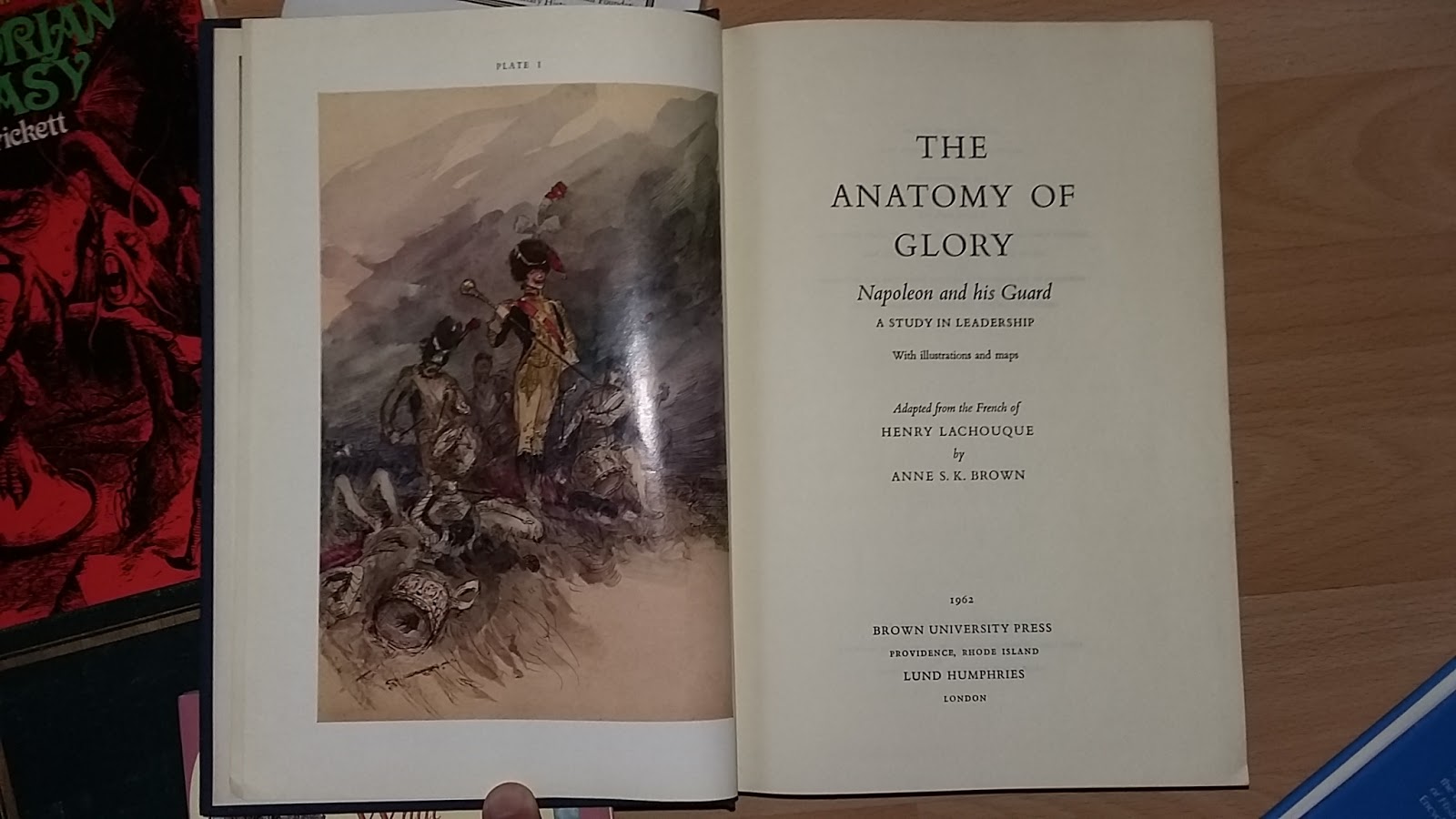
  • Similarly, I have made it very clear that I've written a book on the Waterloo campaign. So gifting me Lachouque's famous Anatomy of Glory looks a safe gift. Beautiful edition. But then again, how did Satan know I didn't have it already?


  • The issue of the Journal of Military History on the War of 1812. If you read this blog, you might have noticed I have an interest in this period. Brilliant find and very useful for my future research on this period.


  • The same with Sinews of War on US army logistics: somehow Satan must know that I have Thompson's Lifeblood of War, van Creveld's Supplying War and Lynn's Feeding Mars on my shelf. 


  • Herre's history of the period 1890-1925 connects to my interest in Germany in the period (stemming from my PhD research), and neatly teases me on my pursuit to find a copy of Pflugk-Harttung's history of the 1815 campaign. Satan knows how to wrap it in gold.
  • What Jane Austen knew and Charles Dickens Ate: well, I have this soft spot for 19th century London, but it needs some digging on this blog. This book gives good background on 19th century British (high) society.


  • A historical atlas of Polish history: obviously Satan knows I like history. To say I have a soft spot for Poland would be driving it too far, but I definitely have a (private) Polish connection. You have to be Satan to know, though. Scary? Yes, deeply so.

  • And to top all this: three series of Ren & Stimpy! That I love them is not a complete secret. But scary? Very much so!


So while these gifts are all beautiful and perfectly chosen, I'm left with that uncomfortable feeling that Satan is, well, all-knowing. And I've got to admit that part of the scary thing is that Satan told me there would be a third package. I must imagine that will contain something related to my childhood, or a lost and forgotten love. I shudder at the thought.

Thursday, 5 January 2017

Integration through military service

First book read this year! Chance encounter in 2nd hand. Very readable military autobiography of early 19th century.

Koch was born in the small German principality of Waldeck before the French Revolution and joined a Waldeck regiment in Dutch service in 1803. This took him into Austria in 1805, Eastern Germany in 1806, Spain in 1808.

As the Waldeckers were corporated into Dutch and later French regiments, Koch doesn't seem to have been troubled too much. However, he requested to be released from French service in 1814 and returned to the Netherlands in 1814.

He remained in Dutch service during the Waterloo campaign and the war against Belgium in the 1830s, ending his rise through the ranks as commander of the veterans in Leiden in the 1840s.

In all this time he only saw his family three times, and he settled and died in the Netherlands, where his autobiography was taken down by one of his sons.

Tuesday, 6 December 2016

The Dutch army under Napoleon

Also in, this great book on the Dutch army under the Kingdom of Holland. This period was the last step between the foundation of a Batavian revolutionary republic under French protection in 1795 and full incorporation into the French empire in 1810.


With Napoleon's brother Louis put on the throne in 1806, the country seemed already well under French control. But Louis' genuine considerations for the interests of the Dutch people ensured that neither Napoleon was satisfied nor the Dutch.

Given Napoleon's focus on the military contribution of the Dutch to his overall war effort, the army was always going to be a breaking point. Louis' four years in charge failed to bring a balance between Napoleon's demands for a bigger army and the Dutch ability to pay for expansion and provide the necessary recruits.

Which is why Napoleon finally decided to be done with and independent state.

Christiaan van der Spek looks at the Dutch room for manoeuvre in military policy during independence, and also to which extent the Dutch maintained a separate identity, first within the French sphere of influence and later within the empire.

Will be an interesting read.

Wednesday, 30 November 2016

The Second Front of the Revolutionary War

If you read military histories of the revolutionary war, the focus tends to be on the campaigns against the British, and you might conclude that most tribes took the British side but that their contribution was limited to the Great Lakes region.


However, Ray Raphael’s The American Revolution. A People’s History opened my eyes to the varied reaction of Native Americans to the war. Difficult choices were made from New England down to Florida. And fundamentally, most tribes were trying to stay out of the war, which they didn’t consider as their own.

Yet, few tribes managed to avoid the conflict. The Abenakis along the border with Canada managed to keep both sides at arms length by taking it slow and occasionally switching allegiance. Although this gave them a reputation for unreliability on both sides of the border, in this way they kept losses low.

Likewise the Chickasaw, although friendly to the British, managed to stay out of the fray because they weren’t in the front line. Only when the Americans built a fortress on their borders did they take action and drove off the garrison.

The fate of the Iroquois, the once mighty confederacy, was possibly the most tragic. Bound to the British after 1763 they accepted an American offer of neutrality in 1775 and avoided conflict until 1777. But then the confederacy fell apart with the Oneidas and Tuscaroras siding with the rebels and the other tribes with the British.

They fought each other as auxiliaries of their allies at the bloody battles of Oriskany and Wyoming. The punitive expedition by general Sullivan’s continentals through the Iroquois heartlands in 1779 destroyed the fabric of the tribes which then became totally dependent on British support. At the end of the war, they retreated to Canada.


The Ohio tribes, such as the Delaware, Mingo and Shawnee, also inexorably got drawn into the conflict. In 1777 violent incidents escalated and by 1778 raiding terrorised the settlements in the region. In 1781 a large punitive expedition laid the Native American towns to waste, bringing the tribes to heel.

The Cherokee honoured their ties to British and attacked in 1776. However, as there was no British threat in the southern states at the time, the militias from four states were available to stage a punitive expedition, destroying many Cherokee towns and crops. Although the majority of the tribe, forced by hunger, accepted a humiliating peace, part of the tribe split off and migrated west.

There were a few tribes that sided with the rebels from the start, most notably the Catawbas in the Carolinas. Their contribution to the cause was fully recognised by the Americans but they became marginalised nevertheless and seem to have disappeared by the middle of the 19th century.


The Seminoles even seem to have prospered as a result of the war. Living in Spanish territory, they were not being targeted directly themselves. But more importantly, they welcomed many new members of the tribe by accepting black runaway slaves.

This gives me the impression that there was in fact an active second front on the western border of the United States, tying up valuable manpower. You might imagine that if the British had been able to coordinate their actions better with those of the Native Americans, it could have had better results than it did now. On the other hand, it is unlikely to have swung the war in British favour, thus leaving the loyal tribes as high and dry after the war as they were historically.

Given the desperate state of the British cause and the long standing distrust between Native Americans and settlers, no tribe in the east could escape from the conflict and although some managed to limit the damage, most lost many warriors and were forced to cede land in the end.

Monday, 28 November 2016

Paint it black

Quite some time since I last picked up the paintbrush, but I cleared up some space on a table so I can leave it where it is and have a good lamp close by.


Started and finished a bunch of riflemen and black militia members. The ones in the long coats would probably end up with northern units. The ones in shirt sleeves in the south.

In the former case they probably fought on the American side, where manpower shortage saw the enlistment of quite a few free blacks and slaves, who did so because this meant a job and a chance to be freed after service. Didn't always work out that way apparently according to Ray Raphael's brilliant The American Revolution. A People's History.

Raphael also shows how in the latter case, tens of thousands of southern slaves escaped from the plantations to the freedom promised them by the British. They joined the British and loyalist units, or accompanied them as servants. Many died of hunger and disease and by the time of the British retreat, they were often left to their own devices.

Jim Piecuch, in his Cavalry of the American Revolution devotes an article to the Black Dragoons, a cavalry unit composed of and led by escaped slaves in South Carolina. They appear to have performed to the satisfaction of the British, but their existence enraged the white planters in the south, making it less likely that they would accept a return of British rule.

As far as  I am concerned, A People's History is an indispensable companion to the military history of the American revolution. Apart from showing how blacks could end up fighting on both sides, there's good stuff on the role of women, native Americans, Loyalists and common American males sympathetic to the revolution. It shows how this war affected them, but also, how they tried to make the best of it, or even turn it to their advantage.

I'll come back to this book, because it was an eye opener for me on the vastly different experiences of native American tribes. But worth every penny and widely available in second hand.

Wednesday, 23 November 2016

Another bunch of books

Having been gifted a few book coupons, I ordered a few books off my wishlist. The book on the Grande Armée in Germany has been on the list for over a year. Based on numerous first hand accounts and archives I'm interested in the way the French behaved as an occupation force, but also on it's relations with the population.


And with the coming of Project 217 (the as yet still mysterious project about ancient warfare around 217 BC), I decided to finally order the 3rd edition of the De Bellis Antiquitatis rules for ancient warfare. I still think that it is a very innovative rule set that regretfully developed in the wrong direction.

If I return to ancients wargaming, it will be in 6mm using DBA. I just don't have the time for painting another large army and learning a complicated tactical rule set that feels more like recreating Napoleonic warfare than ancient.

And it was just a bit to easy to just add the newest edition of Hordes of the Things, the fantasy version of DBA. By the way check out this fantastic blog that shows how incredibly creative people can be in designing their HotT armies. Or have a look at the HotT facebook group. Pure joy.

I had also ordered a book on maroons in North America, after reading a very interesting article on the maroons in the Great Dismal Swamp in Virginia.

And as I went to pick that up, I just happened to look at the new Ospreys just in and I was kind of spineless.The campaign book on the Battle of the Thames is a kind of a no-brainer since it covers the Indian part of the War of 1812.

I am also quite fond of the work of Sean McLachlan, who does thorough historical research and occasionally combines it with interesting fiction. I was happy to pick up his combat series instalment on the Apache warrior vs US cavalryman. An interesting contest and it seems McLachlan has done a good job on both sides.

That said, the third booklet will be the proof on how the combat series is doing because King's African Rifles vs Schutztruppe Soldier might expose the weaknesses of the series by pitting two similar troop types against each other, but might also show interesting differences in their deployment by their colonial masters. Anyway, a much understudied topic in itself.

Monday, 21 November 2016

Last post before the AWI battle

(AWI project retrospective, part 9)

I wrote this post at the end of an evening where I had based my prospective army for the big battle. It’s the worst job I can think of in preparing a wargaming army. I resent it like nothing else. And yet, this meant that I was about to finish the job. There was this relaxed sense that I would make this deadline.


And not just make it. Sunday morning sun rising, I had ready all four regiments of Smallwood’s brigade present at the battle of Camden. And more: woodland Indians, Stockbridge Indians and surplus militia. That was far beyond what I had thought to achieve when starting on this journey almost a year before. I even slipped in painting three Dark Age houses.


That doesn’t mean there wasn’t a pile of pewter and plastic left waiting for me still. Some last Indians and militia, several units of British and loyalist troops and the 2nd South Carolina regiment. But that was all beyond the task I had set myself, so no worries there. I was just proud of my achievement irrespective of the outcome of the game.

In further developments in preparation for the big day, I did manage another test game of Land of the Free. This was very useful. Needless to say I got my behind handed to me by Patrick. SO I decided to read through the rules again and again, because I kept finding rules I’d overlooked or misinterpreted.


Apart from the painting challenge and the rules, and in direct contradiction to my intentions at the start, this has turned into a reading project as well. Over a dozen Ospreys somehow came into my possession, and a further dozen paper and digital books on the AWI. And somehow I managed to read most of them.

I was first infatuated with the militia side of the war; then the Indian conflict grabbed my attention. Four of the books I bought on my summer holiday to the UK dug deeper into the subject. I discovered the Black Dragoons of South Carolina, and how choosing to become a loyalist sometimes depended more on the side that the people you hated chose, than on your ideology.


But the crown on my reading spree has been Barbarians & Brothers by Wayne Lee, a brilliant book weaving together the civil and colonial wars in England, Ireland and North America from the 16th to the 19th century. Lee explains how conflicts between civilians and between cultures turned much more violent than between regulars. This clash of regular soldiers, warriors and citizens in these centuries, and more specifically in the AWI, has proved a fascinating discovery that I had not expected a year ago.

That legacy will endure.

This blog was first published on the Wargames, Soldiers & Strategy blog on August 23rd 2016