In yesterday's post I made a reference to Gary Gygax, major Von Reiswitz and Phil Barker. I'll explain, as promised.
More about this below...
As I discovered megagaming in 1993 I also came into contact with Chestnut Lodge Wargames Group in London and became a loyal but not very active member. But at least I get my copy of the club magazine, Military Muddling with reports on design sessions and I occasionally go to meetings, like the annual picnic or games weekend.
At the games weekend there's two days of game design sessions, with the evenings available for after dinner games. One of the few times I was around (in 1996) it was a good session of Four Men in a Balloon, where all the passengers had to make their case not to be the one thrown out this round. In this case the passengers were Don Featherstone, Gary Gygax, major Von Reiswitz and Phil Barker arguing their value to the wargaming hobby. And I represented the latter.
Phil was the second to be released after the major, but in the end Gary Gygax survived rather than Don Featherstone. It was something to do with polearms, I believe. I think that is a good indication of the mindset at Chestnut Lodge, with a heavy emphasis on role playing even in a miniatures game.
The guys even autographed my copy!
But the best after dinner game was the bard competition we had afterwards. The idea was that we were given an episode of the life of Harald Hardrada and then turn this into Nordic poetry, so with lots of alliteration, reference to mythical animals etc. Jonathan Pickles put up a copy of Snorri Sturluson's King Harald's Saga for the winner and that proved to be me.
I never read the full story, but it is obvious that Harald was a bit of a poser. He traveled around much of the known world, but always seemed to get into trouble and be forced to move on rather in a hurry. In the end he lost the battle of Stamford Bridge against Harold Godwinson a few weeks before the latter was beaten by William of Normandy, later known as the Conqueror, at Hastings.
Harald's predicaments were of course part of the amusement, as the ´bards´ had to gloss over these inconveniences and portray them in a more positive light. In most cases I opted for outright lies rather than spinning the evidence. I suspect that my reward was more out of kindness to the foreigner who had come so far to join in the proceedings than on the basis of my superior poetic skills in a second language.
But coming back to yesterday´s theme it is interesting that although my memory is hazy, these games I remember much better than many regular miniature games. Just like I remember the Peasant´s Crusade game that Graham Hockley put on that weekend, which was a string of grown men weaving around a playground à la Polonaise, with every break in the chain signifying losses to the expedition. You can imagine that once we´d crossed a few obstacles our chances of ever reaching Jerusalem, let alone ´liberating´ it, were null.
It's all very tempting to look back these days. There was 100 years of H.G. Wells' Little Wars, then Willem Schoppen, the ´Dutch Donald Featherstone´ was taken into hospital and then The Donald himself passed away. It feels like the end of an era.
Welsh Guards (Wargaming Miscellany: Bob Cordery)
Given the massive outpooring of reminiscences in the blogosphere, it feels like in a sense we are now paying our last respects to the last wargaming pioneers. Wells who made the transition from an officers' teaching tool to a civilian's game, Featherstone who popularised it in the Anglo-Saxon world, Schoppen who popularised it in the Netherlands.
Look at the sense of novelty and pioneering this old hand describes in his memories of wargaming in the 1950s and 60s. Or read Achtung Schweinhund by Harry Pearson for a more elaborate depiction of those years. There is a recent spate of books on wargaming, boardgaming and roleplaying history. But of course, the pioneering era ended some decades ago already. Don Featherstone has already been 'succeeded' by others.
Okay, no Featherstone, but I do have some gamer cred
I just found out I actually have no book by Featherstone at all! I always took him as an icon whose designs had been surpassed by new generations of writers like Bruce Quarry and Stuart Asquith, of whom I have several books each.
Starting wargaming with Hinchliffe miniatures, I was then totally overwhelmed by Foundry's Franco-Prussian range. Just like Magic: the Gathering was a watershed in terms of visual appeal and gaming tension. I remember coming back from a games show and teaching all my friends how to play the next week and then buying them all starter packs the week after that.
Willem Schoppen and his wife from a Dutch popular science magazine in the early 1980s
To me, Willem Schoppen and his Boutique La Grande Armée are natural points of reference, but they are meaningless to most Dutch gamers of my age and younger. Donald Featherstone means nothing to tens of thousands of kids in GW stores worldwide, and neither does Gary Gygax, Von Reiswitz or Phil Barker (I'll share that story with you tomorrow). And they don't have to. Just like you don't need to have heard the Beatles to appreciate One Direction or to have read Marx to appreciate Lenin's writing.
And now there's discussion of a Golden Age in wargaming and boardgaming and on the other hand one of 'the hobby's dying out'. Lots of new stuff is happening. In terms of boardgaming the mechanical revolution has passed from the German/euro style games to wargames and Ameritrash. In wargaming the revolution is now mostly in highly thematic skirmishing rules after a period of highly formated competition rules. And design and marketing have received a welcome energy by crowdfunding schemes in the middle of a general crisis for gaming companies.
But as ever, there is a process of creative destruction going on. The success of Too Fat Lardies, Bolt Action and Flames of War will mean the quiet disappearance of other rule sets, just as Avalon Hill was eaten up by Hasbro and Wizards of the Coast, Peter Laing and Minifigs have become memories of the past. Hinchliffe was sold to Skytrex and now Skytrex itself has gone into administration. Those that see only growth, just don't notice all that we leave behind.
There are counter movements though, like the one sparked by the Little Wars anniversary. I see a dozen gamers with a sense of nostalgia buying up their 54mm toy soldiers and playing Old Skool on their brittle knees in the garden again. I guess there is an age between 13 and 50 where you feel too serious about this kind of thing, just like you feel to serious to play monsters battles with Play-Doh. Wrong!
Grown Men (Hail! Hail! Freedonia: Jim Wallman)
Maybe we all just got old
And maybe that is what people yearn for the most when they hanker back to the good old days of Wells and Featherstone. A period when they were young, when it seemed the whole world was still there to explore and map and everybody was enjoying it. It all became more complicated with time. Wargaming became work, with lots of accounting and legal prose. Maybe as the world was mapped and better understood, players lost the freshness and joy in arguments over rules, regimental lace and the intricate mechanisms of phalanx combat.
We need to find back, bring back and/or keep alive that sheer fun of the game. I used to get up early to get to the club in time to play four games of Napoleonics for a club competition. I played 24 hour RPGs marathons. It was the best thing I could think of doing then and even though life now gets in the way much of the time, it still is one of the few ways of spending my time now totally engrossed, immersed, occupied and happy.
If you want to honour your heroes, if you want to keep this hobby alive but you worry about the fact that we can't get the youngsters in anymore, or if you just want an opponent for your dust covered Royalists, do it by playing. With anyone, anywhere, in any way possible, because mechanisms and realism and correct painting schemes don't matter. Just play that game with the same intent and joy as you played when you were playing with the Don.
Remember how I got the awesome Colonial Marines badge from my Secret Satan last January? Well, I finally found time to patch it to some sleeve, doing the necessary needlework yesterday at the club.
Wear it with pride, Marine!
And here's a better look at the badge.
If you don't remember this picture, check the link at the top of the page! Secret Satan is a great story
I didn't use to buy much stuff online. I've always liked holding games, books and minis in my hand before buying them. I also like to reward FLGS and producers for their creativity and service rather than webshops. Also, my book and game shelves are full enough as it is. There's stuff from years ago that I haven't looked at. This aspirational side of purchase I've noted before. I don't NEED to buy more stuff. I need TIME to play and read.
Westfalia Kielmansegge Jaeger and Prussian medics
And in some ways, buying online is a pain because package delivery is still a 20th century craft. Postal services always come by when I'm at work. So it always creates a fuss with neighbours instead of delivering at a nearby post office.
What I did do over the last few years, was pre-order board games. I liked supporting games on subjects not so well covered, or designs that seemed novel to me. So I have received maybe a dozen games from MMP and GMT.
However, I shrank from directly ordering stuff online. For the above reasons, but also because I could see the junkie reflected in my monitor. This all went splendid for years, but I've let my guard down. Buying online has become too easy. As easy as buying in shops.
So when I succumbed to Dux Britanniarum and the Gripping Beast miniatures, that set in motion other buys (additional Saxons from Musketeer, a bunch of Welsh, a late Germanic army). My rising interest in Waterloo saw more books coming in and then there were other shiny toys beckoning. The last bits that have come in are the wonderful miniatures from Westfalia and GMT's Great Northern War block game Pax Baltica on pre-order.
Then I was coveting more Napoleonics (Calpe Prussians, the Perry Retreat from Moscow set), steam punk and the entire collection of Plaid Hat games. Saliva was dripping from my mouth. I was going "yeah honey, I'll be along in a minute. Go to bed." Just press this button and it'll be on its way. Easy as pie, just do it. Press that button, pick it up in a few weeks time gaze at it in delight put it in the cupboard forget about it press the button for something else... hey wait!
So I'm putting a stop to it for now. Let's get some stuff painted and played first!
Okay, you might not get what half of these are about, but that doesn't matter: over a dozen entries to my request to use the Pulp-O-Mizer for the greater good of the world! And a few excellent ones I hope to see again in some other place.
Most of these refer to Jim Wallman´s Universe campaigns and should leave innocent bystanders clueless as to the names and places mentioned. Don´t worry about it. If you are intreagued, try the Universe Encyclopedia or the Interstellar News Network for an update of major events that are being allured to. See for example Senator Antoinette Banderas from the Martian Union.
They reflect an ongoing debate in a far flung galaxy some time in the future about the dangers and potential of artificial intelligence, by some messed up with a renunciation by some (obviously less enlightened characters) of entirely harmless forms of AI found in useful applications such as the dombot (domestic robot).
Enjoy (and try for yourself!).
By Jim
, Universe campaign
By Andrew, for political incitement
By Barbara, for the heck of it
By Barbara, for the heck of it
By Jeff, for his movie reviews
By Jim
, Universe campaign
By Tom
, Universe campaign
By me, for an occassional meeting of Dutch wargamers
Went to see Django Unchained last week and enjoyed it a lot. The latest movie by Quentin Tarantino is
again
a masterpiece of imagery and storytelling.
The outstanding points for me were the fantastic story, another great musical score, the performances by Leonardo di Caprio, Samuel Jackson and Christoph Waltz. Especially the first two seem to revel in the opportunity to play a bad guy, while Waltz makes an almost sentimental volte face from his Hans Landa role.
He´s bad and he likes it
There's many other good bits of acting. Don Johnson continues his silent comeback with hilarious redneck cameos (like in Machete). Jamie Foxx is good, but he isn´t allowed much room for manouver as the stoic avenger.
The action scenes are very good and the hyperrealism (splatter) matches the incredible story. Also, Django is less a movie about western movies than Kill Bill was a movie about classic martial arts movies and Inglorious Basterds was a movie about 1960s and 1970s war movies.
Tarantino pulls no punches on Southern slave society. The abominal treatment of blacks is in your face, with the brutal mandingo wrestling not even the worst. The white people in the movie generally have few redeeming qualities, if any. You feel like cheering when they die.
And regarding the supposed controversy of the use of the n-word, why is nobody complaining about this: "killing white people and get paid for it. What's not to like?"?
One of the weaker points, to me, was the ending, with the sale to the mining company and the unlikely escape (and terrible acting by Tarantino!). Jackson's monologue on saving Django's life doesn't come out as good as Christopher Walken's brilliant watch monologue in Pulp Fiction.
There isn't a scene to match the shocking dynamics of the opening of Inglorious Basterds, or the "Dick, dick, dick, dick, dick" discussion from Reservoir Dogs. Nor does it have the one-liners.
Maybe the parts with Di Caprio are a bit too long as compared to the rest of the story. I can see how the excellent acting could tempt Tarantino into giving it as much room as possible, but to me it unbalanced the movie. They could have taken longer to find and deal with the Brittle brothers, as far as I´m concerned.
At times Tarantino even seems pretentious, trying to link it the story to the Siegfried saga, bringing up Mahler and Beethoven and showing his knowledge of European classic culture: "by the way, Alexandre Dumas was black".
It´s a bit of a pity that this isn´t Tarantino´s first movie, because were used to the continuous references to other movies, his choreography of violence and the dialogues. We start nagging about the less delightful bits and lose perspective of the whole.
So, in all this is a great movie, with great acting but with fewer stand out moments than we´re used to with Tarantino.
On a trip to Antwerp over a week ago, we visited a few interesting places, like the excellent MAS (Museum aan de Stroom), with a rich combination of four collections stretching from anthropology (international and local) to local history. And Antwerp has a illustrious history as the greatest and richest port of Europe in the late Middle Ages.
A 17th century interpretation by Antwerp painter David Teniers
You can still find many remains of that golden age around the city, and one of the best places is the Mayer van den Bergh house, which holds a small but excellent collection of medieval and early modern art. The collector after whom the house is named started to buy all these art objects on business trips. He didn't think like a museum director, pursuing a direction and filling in gaps, but bought what was available through local traders and other collectors, all based on his personal preferences.
This means there is stuff from the Low Countries down to France, Germany, Switzerland and Italy and the objects range from religious objects to bourgeois furniture. I stood amazed watching a piece of beautifully crafted ivory from the 10th century, which had been carved in the back of an Byzantine original from a century earlier.
The Dulle Griet
But the top stuff are a couple of paintings by Pieter Bruegel, the most famous being the Dulle Griet, an apocalyptic view with an armed and armoured women carrying her spoils across it. I easily spent a quarter of an hour enjoying this.
But there's another bit that I found interesting, which were a couple of paintings showing the temptation of Anthony the Abbot, one of the founders of the Christian monasterial tradition. It was a theme I hadn't noticed before, but which happens to have been popular in the Middle Ages, but also inspired Dali.
Bruegel's take on the temptations of Anthony the Abbot
The reason why I was so interested is because it shows contemporary views on what monsters and demons would look like and I am fascinated. The monsters are all a bit comical, rather than scary. There´s a brilliant site on Anthony with lots of illustrations of paintings over the ages. Below I post one from 1490 that I actually like best, because it is so different from contemporary paintings. The colours are so bold and the monsters so stylised! It made me think of Indian art.
I was led (I forgot by whom, but thanks) to a really interesting article on Peter Jackson's interpretation of The Hobbit, by Kristin Thompson. I can agree to it in most cases. I urge all fans of Tolkien to read it (after they've seen the movie). There's a few peeks at cut scenes as well.
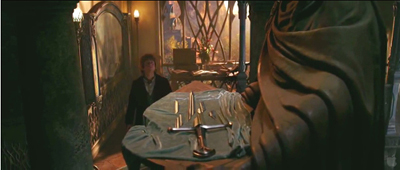
Still from the cut scenes where Bilbo sees broken Narsil in Rivendel
But it also made me think about what will be in part 2 and part 3. From the point where the party is rescued by the great eagles on, the following plot main parts from the book are still to come:
Meeting with Beorn, the forest road, the spiders, the elves, the lake town, entering mount Erebor, talks with Smaug, slaying of Smaug, Battle of the Five Armies and the return home. It is to be expected that the encounter with Smaug and the Battle will be in part 3, so you can see the problem for part 2, because it will be pretty lean on spectacular moments.
Apart from the fight with the spiders and the escape from Lake Town, there isn't much high drama. So it is to be expected that a lot of the stuff from outside the book will be included here.
Most important, I guess will be the attack of the White Council on the Necromancer in Dol Guldur. This can involve some spectacular CGI, even if there isn't a full scale battle with ghouls, skeletons and other undead creatures.
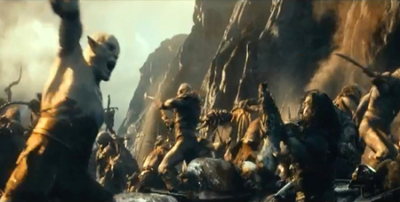
Azog, unwelcome as always
We can also expect Azog to feature at some point, although I don't see an easy point where he can be injected in the story. Maybe as he tries to make his way towards the Lonely Mountain. Or worse, if Jackson has him chasing the dwarves through the forest. As Thompson notes, the creative team around him are very fond of the Defiler and he will probably mess up the whole story more than in part 1.
The only intreaguing thing that he could be involved in are the sparse references to a plot against the dwarves ('who have you told of this?'). It is an interesting take, but I don't see at this point who could have been behind it at this point.
Another thing we might see is Gollum leaving the realm of the Goblin King to find his Precious. In Tolkien's version, this happens later, but I could understand if Jackson advances this point. On the other hand, Gollum has no further use in the plot and no immediate interaction with Gandalf. On the other hand, it could be a way to have Gandalf encounter Aragorn and have him search for Gollum.
But chances are that part two will start slowly with Beorn and the forest road and then see a tumble of action scenes, possibly culminating in the siege of Dol Guldur. That's not a bad thing to look forward to as a fan, but it would probably not be enough if this movie were to stand on it's own.
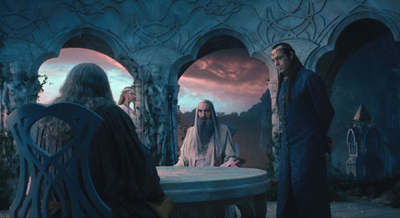
Saruman, victim of hindsight
Also, I still think they've not set up Saruman in the right way. He is depicted as too dodgy, while all he is is extremely arrogant, which he has every right to be, considering that he is the most powerful being in Middle Earth at the time. Why not show Saruman like that? Dismissing Gandalf's evidence of the Necromancer not because he doesn't believe it, but rather because he doesn't like that Gandalf found it rather than him. His pride becomes his folly only after he tries to use the Palantir of Orthanc. I'd preferred if Jackson had kept it that way. Now, because we all know he joins the Dark Side in the end, it is set out too deterministic. Saruman is a lot less interesting that way.
Since Mark
Kurlansky’s Cod: A Biography of the Fish
that Changed the World became a hit book in 1997 many authors have tried to
emulate this concept. Main characters for example have been nutmeg, tea, potatoes and salt and
similarly books have appeared about related goods like indigo or conservation
methods.
The success
of Kurlansky’s book goes further than the popularity of its protagonist. The
book came heavily spiced with anecdotes and historical recipes. The chapter on
the Founding Fathers is hilarious and the Cod Wars between Great Britain and Iceland
challenge our ideas about peaceful diplomacy in post-war Europe.
The great
thing about books on food is that they give a unique platform for storytelling.
Providing almost every possible angle on history and touching on many parts
that fire the imagination and interest.
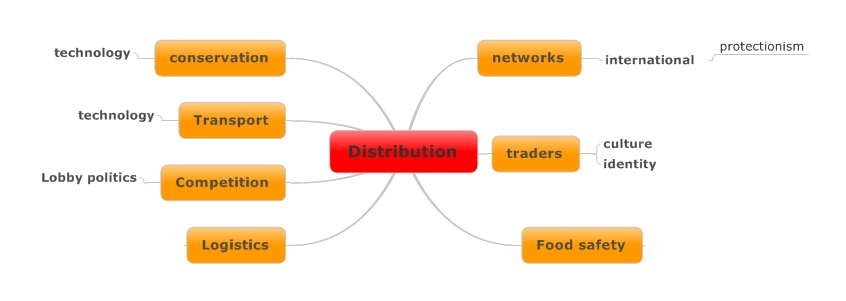
I’ve put a
few of these angles in mind maps arranged about the three stages of the food
chain: production, distribution and consumption.
What is
immediately apparent is that food is closely connected to culture and identity,
from the peasants’ close connection to the soil, to the religious rules on
which products you can eat. In some cases ethnic of social groups were closely
tied to trade of certain products. Think of Jewish in the 19th century
European cattle trade. However, their identity seemed to be more important in
determining their trade than the other way around, as in the case of production
and consumption.
The economy
of food is fundamental to any story. Almost all foods covered in these books are
tied to agriculture or horticulture. Fishing and hunting are less universal in
appeal and perhaps therefore not as popular as subjects (although the craze was
set off by cod). This evolves in first instance about the means of production
such as labour, land and capital.
Production
in certain places becomes based on certain types of labour, with far reaching long
term social consequences. The landed gentry and yeomen farmers of England were a major factor in its political
development, while slavery still casts a shadow over the Caribbean.
The high risks of the local climate and social restrictions prevented South
East Asian peasants from devoting more land to profitable export crops.
Production
was also determined by land ownership and quality of the soil. The shift to cheese
production in medieval Holland
was partially the result of the loss of arable land. The land owning nobility was
the motor behind Romania’s
grain exports in the late 19th century, whereas at the same time Danish
farmers started export cooperatives for bacon, butter and eggs. The Irish
famine could become as devastating as it did because of farming marginal lands and
high rents.
Trade seems
to be less of a subject in these books. Trade ties in to important questions
about international networks, transport and conservation technologies and
access to markets. In the 19th century it becomes linked to
cooperative production and export, chain retail and accessibility of products
to new groups of consumers.
The
specific location of production can determine distribution. The Dutch monopoly
on nutmeg was a vital element in trade and the profitability of the East India
Company, the first modern multinational (semi-)private enterprise.
But social subjects
are also in very much scope. Hunger, obesity and health are intimately related,
while most tropical products have a history of plantations and slavery or migration
and indentured labour. As such they are also related to imperialism.
Women’s and
men’s roles in food production, distribution and consumption are very
different. In some cultures men till the soil, while women focus on the smaller
animals nearer home, cheese production and selling products on the market. Anorexia
nervosa is an almost exclusively female condition, while masculinity is
stressed by eating red meat and spicy food.
A field
that I think is fascinating is the relationship between food and emotion. We
eat different foodstuffs at parties than when we’re in need of comfort. For
many people certain products have become closely identified with liberation
(chewing gum), freedom and progress.
Lately eating
healthy has become a quest for some (eg the boy who is only allowed to eat
uncooked food by his mother) which goes beyond the immediate health issues and
is now part of a broader health culture that takes on obesity, genetically
modified crops and professional health organisation. Is a glass of wine each
day good for longevity or not? What about garlick? And chocolate?
You can
probably come up with things I haven’t even touched on in these mind maps, so
feel free to come up with suggestions. Alternatively, you could help me coming
up with similar mind maps for military history.
It was only to be expected that Peter Jackson would extend the line from the Lord of the Rings trilogy to the Hobbit and the first part of the Hobbit fully meets these expectations. That is probably why reviews are generally quite flat. This movie shows craftsmanship rather than genius. You can admire the skill with which it's been made but you won't be shocked, overwhelmed, surprised or moved.
This is not a problem as long as you liked the Lord of the Rings, book or movie, and all that goes with it. You can then just continue in that cozy, plush rose garden that you've been looking forward to over the last decade. And that feeling will continue for a few more years as parts two and three appear, followed by extended versions. And then the long wait will start anew, for some adaptation of the Silmarillion or whatever Tolkien's legacy has in store that can be adapted with any chance of commercial success.
As a huge fan of Lord of the Rings since I was 17 I'm one of the core audience for this movie, and Jackson delivers first of all to us, staying true to the imagery of the sequels.
The movie has the dark undertones that Tolkien sought to inject into the Hobbit after the LotR had come out. Luckily the book was saved from that treatment and I can appreciate it for what it is. But the movie, as a prequel, is better for adopting that atmosphere. The setting is pretty grim, but not overburdened with the forboding of the later saga.
Of course, I have my minor qualms about changes to the book. Some are unnecessary, in my opinion. Like the way the trolls are handled. As far as I'm concerned the solution in the book is much funnier. But that is peanuts, especially compared to the Arwen fiasco in LotR. The only thing that comes close is the Rhosgobel Rabbit Express, which is totally ridiculous but thankfully not a recurring item.
The movie is certainly not too long for me, but then again I'm the core audience. I could have stayed there all night if Jackson had so willed it, but if this movie wants to make money it needs to draw in a lot of people who will not just lap up anything about Tolkien. They might think this is overwrought and three movies about this short book is a bit much, even when the movie draws in some stuff from other books.
I read The Hobbit in English first time, but later acquired a Dutch translation. Reads very well
But most of all this movie is a reason to experience it all again. We played Middle Earth Quest again. It made me reread the Hobbit, much of the early parts and the appendices of LotR and even bits from the Silmarillion. It's wonderful to step into an entire universe with so much behind it and to look at it like a historian or a game designer would, not just as the reader of a novel.
I spent last week near the Giants' Mountains in the Czech Republic. On account of most people opting for alpine joys, there was little in the way of cultural refinement. The surroundings would have been promising, since our base was near Jicin, the main town in the famous Imperialist condottiere Wallerstein´s domains.
At least I had a closer look at the local brewery on a hike I managed to make. It looked pretty old.
A neat but disused building just outside Nova Paka
There was a hint of the old imperial legacy in this war monument to the fallen in WWI. Not a conflict many Czechs would feel proud of.
And in downtown Nova Paka, the once glorious Hotel Central had now been taken over by a nice Vietnamese textile salesman.
Note the plastic flowers at the entrance
And even though I didn't get to taste the local beer, I tasted another. It still had this pilzner taste, but carried 11% of alcohol.
It's all a blur now
Such time as I could spend, I dug into Britain After Rome, Robin Fleming's account of the years between the Roman 'occupation' and the occupation by the Normans. There's a lot of interesting stuff in there, mostly because it has a firm grounding in archeological evidence. This often trumps the historical 'evidence', as I also noticed earlier in my review of Edge of Empire, which deals with the Roman presence in the Low Countries.
Gamewise, I managed a game of chess and a few games of Dobble (or Spot It) with the kids. But I pride myself on two victories at de Val van Rome (Struggle For Rome) my favourite version of the Settlers line. More about that tomorrow.
Well then, returned home today and lots to tell and so little time to tell it. So let's start with this:
One of the joys of Fortress Ameritrash is the annual Secret Satan ritual performed around Christmas. It's similar to Secret Santa, but instead a great way to get rid of the worthless crap you compile through bad buying decisions and unwanted gifts. If you feel a bit sentimental, you might slip in a few nice bits to soften the impact of your satanic evil.
But you also receive a load of junk yourself. Last year I received a copy of Ascalion, the German version of Borderlands, but also a puzzling cd of country songs performed on a Moog synthesizer. So I was pretty apprehensive of what would befall me this year.
Oh boy, was
I glad my package turned up late for Christmas…
This meant
I would be on holiday when it arrived and I wouldn’t have to touch it for some
time. Who knows what hand Lucifer would’ve dealt me?
So when I
got back today, I picked it up at my neighbour’s. There was a bit of a wait at
the door, but my apprehension was soon soothed when the old men appeared and
happily handed me the package. He seemed in fine feather.
Much
relieved I returned home, but decided to take precautions anyway. The box was
sealed pretty tightly and I consulted a friend of mine who’s in waste disposal
about the best approach. I improvised a hazmat suit.
Better safe than sorry, let´s move this MoFo outdoors
Then on to dissecting
the box of doom.
This time
Satan had not been beating about the bush. The hate was in my face as I stared
at the behind of Reiner Knizia’s Modern Art in a dilapidated version. Many a
time have I lamented my knowledge of this game and Satan throws it right back
at me and my suboptimal talent for In Die
Faust bidding. I left the box there to whither for some time and to let the
foul stench wear off.
OH NO!!! I've been Kniziad!
As I
returned I decided to dig deeper and removed Knizia´s Bane from the box,
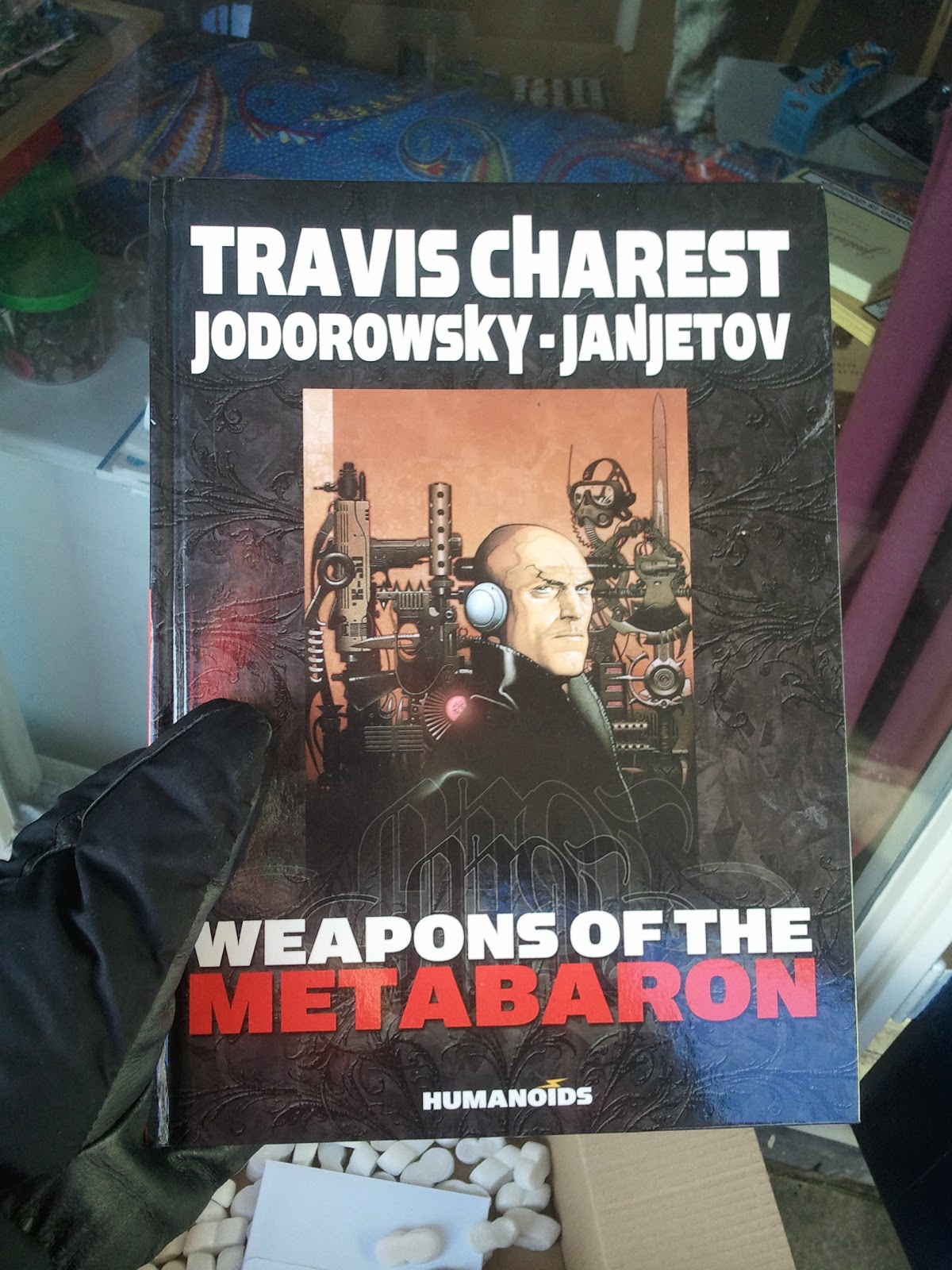
revealing a stunning edition of Jodorowsky’s Weapons of the Metabaron, a
classic French comic. Of course Satan wouldn’t spare me a treacherous trick, as
I lapsed on the series some time ago and have no clue where all this fits in
the greater story line.
Puzzle
And still
deeper down the box, I found this accursed amulet. Taunting me, Satan obviously
despises me for my lack of needling skills. In fact, this proves to be the badge of the Colonial Marines in Aliens! That is awesomely cool! I will become a seamster, no matter how and sew this badge of honour on some fitting sleeve!
Bug Stomper: "We endanger species".
And then to
top it all off: a kick in the shins on what first appears a friendly Christmas
card…
It proves
no such thing
Well, I
guess I had that coming….
But then... much later, when I sat down to write this post, I thought of actually opening that box of Pandora, and found that apart from containing the accoutrements to the accursed Modern Art, it also held Mission; Red Planet! It looks almost complete, only missing the rules. But that can be fixed. That makes this year´s haul actually kind of awesome. And Satan rather like a big ol´ soft puss...
This game has been on my 'this must be really cool' list for a few years now
PS if you want to know what I inflicted on an unsuspecting victim, look here