Showing posts with label art. Show all posts

Tuesday, 24 January 2017

Lovely sculptures

Went to a great exhibition on sculpture this Saturday, charting its development from the mid 19th century till today. The main theme was how sculpture broke free from copying classical and renaissance artists, to new forms and themes. Very well done.


Ecce Puer (See the child) by Medardo Rosso, 1906.


Lee Bontecou, Untitled, 1937. Wonderfully 3D effect done with canvas


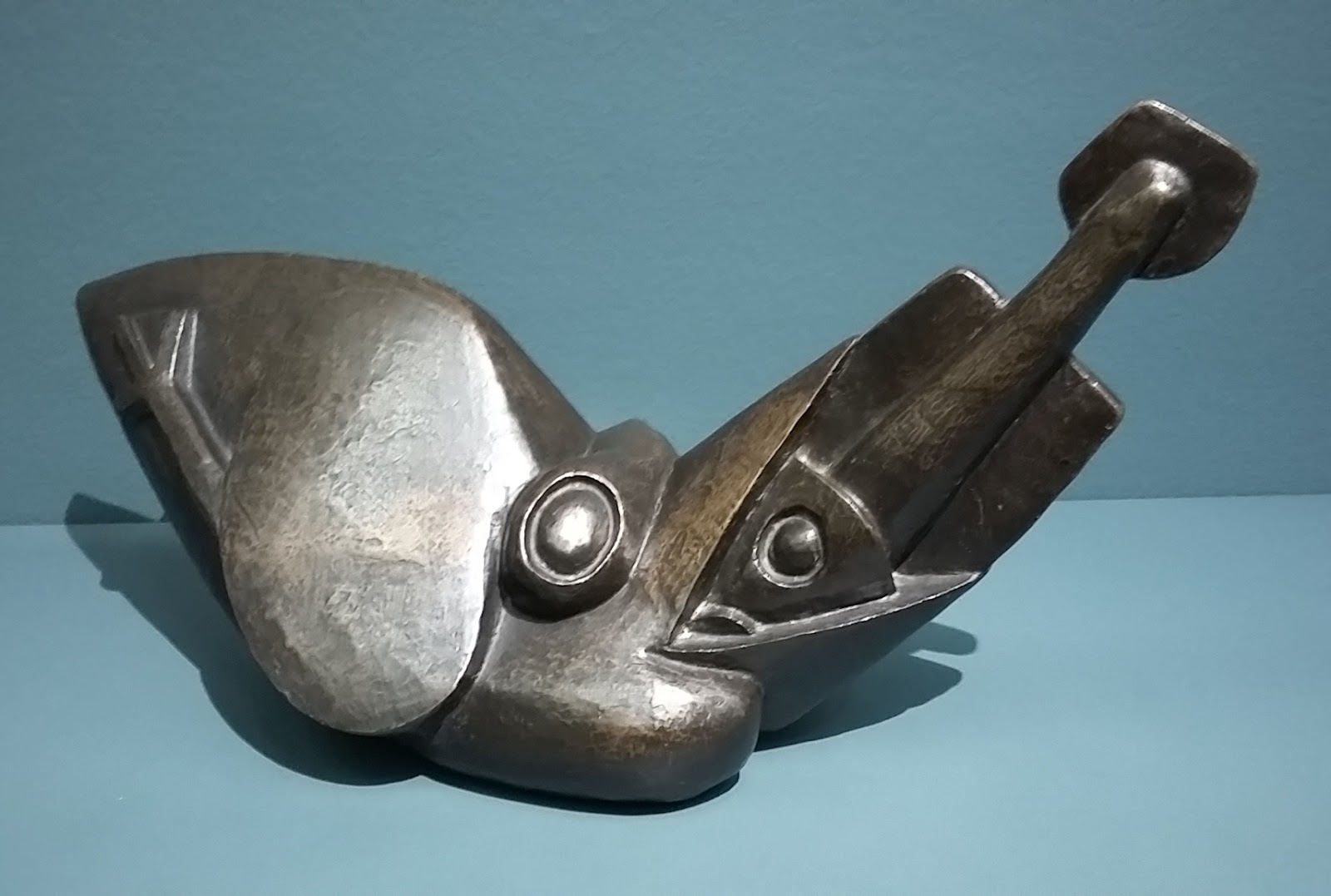
Beatifully stylised Bird Swallowing A Fish by Henri Gaudier-Brzeska, 1914.


This piece, Der Rächer by Ernst Barlach from October 1914 is a good reminder that Germans at that time didn't see themselves as evil invaders but as righteous avengers. The avenger is holding a saex, an ancient Germanic sword type. I feel there's an uncanny resemblance between the face and that of then Emperor Wilhelm II.


Barlach's enthusiasm for the war quickly wore off on the front and he returned as a pacifist. His post war work includes many commemorative signs at war cemeteries. His work was later labeled as Entartete Kunst by the Nazis. Just like Käthe Kollwitz, who lost her son in the Great War. This is her Turm der Mutter from 1937.


Friday, 7 March 2014

Wexy comes out of the depot

If you have any interest in Waterloo the one thing you have to do in the next few months is go to Dordrecht and visit the exhibition on the art collection of king Willem II. Willem was an avid collector and connaisseur, but after his sudden death in 1849 the collection was sold to cover his debts. It has been partly reconstructed for this exhibition.

From the Dordrecht Museum website
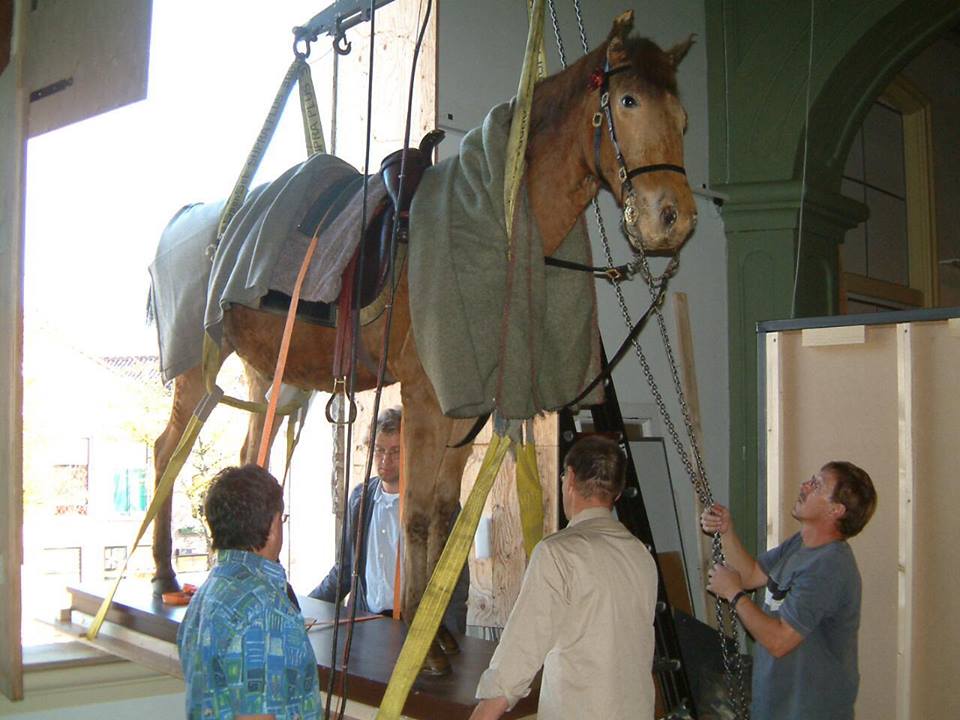
The special guest in the exhibition is Wexy, Willem's longtime favourite horse. He rode it at Waterloo where Wexy was wounded. The horse lived on to ripe age, but even then Willem couldn't part. Wexy's body  was preserved and remained in Willem's collection, but was also dragged around Ghent after Belgium split from the United Kingdom of the Netherlands to garner support for the Orange family.

These days it is mostly locked away so this is a unique opportunity to see Willem's faithful charger.

Tuesday, 4 June 2013

Catlin's paintings of North American Indians

Yesterday Nick and I went to the National Portrait Gallery and among other stuff, we saw George Catlin's portraits of North American Indians in the 1830s and 1840s.


Catlin began his project because he saw the Indians as a vanishing culture and wanted to conserve as much of it as possible. At the same time he needed to make money and these two goals didn't always go together well. But it has resulted in a unique collection of hundreds of portraits and paintings of most of the tribes of the east and west.

Apart from the information on the dress, appearance, customs and beliefs of the Indians, the paintings offer beautiful facial expressions. It's evident that Catlin empathised with his sitters. Not all paintings are of even quality because Catlin did many of them and fast, but even some of the unfinished ones are fascinating.

Catlin's other interest like geology also feature on the side of the exhibition. And since the National Portrait Gallery is free to visit, make sure you give it a try when you get to London. The turnover of exhibitions is quite high and there is lots to see.

Monday, 20 May 2013

I need more walls!

Since last month I am the lucky owner of three large, historical posters. They're from a series of widely known school posters, used for history lessons in the old days (the first ones were printed over a century ago). They show episodes in the (military) history of the Netherlands that were considered important at the time..


The first I won in a quiz. It is a complicated story, but it all comes down to the question not being related to the event depicted on the poster. Thanks anyway, Peter. The poster is in fact of the relief of Leiden in 1574. This is probably around the current Lammenschans (ie redoubt). In the distance you can see the main churches.


The other posters I got from my old house mate and friend Mat. The first depicts the crossing of the frozen River Lek by the French Revolutionary forces in January 1795. This broke the defense of the regime of the house of Orange and gave way to the Batavian Republic, a French client state, but also the unitarian ancestor of the later Kingdom of the Netherlands.


The last poster deals with an equally cold episode from the Napoleonic Wars, as the Dutch infantry defends the crossings of the Berezina during the retreat from Moscow in 1812. by J.Hoynck van Papendrecht.

Tuesday, 29 January 2013

The Magnificent Monsters of Anthony the Abbot

On a trip to Antwerp over a week ago, we visited a few interesting places, like the excellent MAS (Museum aan de Stroom), with a rich combination of four collections stretching from anthropology (international and local) to local history. And Antwerp has a illustrious history as the greatest and richest port of Europe in the late Middle Ages.


A 17th century interpretation by Antwerp painter David Teniers
You can still find many remains of that golden age around the city, and one of the best places is the Mayer van den Bergh house, which holds a small but excellent collection of medieval and early modern art. The collector after whom the house is named started to buy all these art objects on business trips. He didn't think like a museum director, pursuing a direction and filling in gaps, but bought what was available through local traders and other collectors, all based on his personal preferences.

This means there is stuff from the Low Countries down to France, Germany, Switzerland and Italy and the objects range from religious objects to bourgeois furniture. I stood amazed watching a piece of beautifully crafted ivory from the 10th century, which had been carved in the back of an Byzantine original from a century earlier.

The Dulle Griet
But the top stuff are a couple of paintings by Pieter Bruegel, the most famous being the Dulle Griet, an apocalyptic view with an armed and armoured women carrying her spoils across it. I easily spent a quarter of an hour enjoying this.

But there's another bit that I found interesting, which were a couple of paintings showing the temptation of Anthony the Abbot, one of the founders of the Christian monasterial tradition. It was a theme I hadn't noticed before, but which happens to have been popular in the Middle Ages, but also inspired Dali.

Bruegel's take on the temptations of Anthony the Abbot

The reason why I was so interested is because it shows contemporary views on what monsters and demons would look like and I am fascinated. The monsters are all a bit comical, rather than scary. There´s a brilliant site on Anthony with lots of illustrations of paintings over the ages. Below I post one from 1490 that I actually like best, because it is so different from contemporary paintings. The colours are so bold and the monsters so stylised! It made me think of Indian art.

Giovanni Pietro da Birago, ca 1490. Incredible


Wednesday, 31 October 2012

The Hero of Waterloo, part II plus Hermitage


Last Sunday we went to the Hermitage in Amsterdam to watch the Van Gogh collection that’s temporarily housed there, as well as a nice collection of impressionist and contemporary paintings.

In the museum shop I picked up a book by Michel Didier, De Ridder en de grootvorstin. Kunst en leven van Willem II en Anna Paulowna. This can be loosely translated as The knight and the Grand Duchess. Art and Life of … The book looks at this couple mainly from an art historical viewpoint, but includes a lot of biography. The advantage is that this also brings a lot of illustrations.


Willem was rarely out of uniform, nor were his sons

For me the interesting bits were how Willem’s actions at Quatre Bras and Waterloo were remembered in Dutch (and foreign) art. It’s not my style of poetry or painting, and its purpose didn’t lend itself well to better characterisations of the man. But it illustrates well how Willem's military successes (deserved or not) served the nation building and legitimacy of the Orange monarchy. 

Didier is not too sure on military details, as even I could spot. It is unlikely that Willem would have received his honours for the battle of Nivelles already in 1814. Willem’s tactical abilities are not questioned but his bravery is highlighted.

The book also glosses lightly over the darker side of Willem’s life, the many scandals, affairs and schemes and his political failures. I think this book (and publisher, from the other books it publishes) is aimed at the loyal monarchist crowd and therefor not too critical. What does get a fair amount of attention is the difficult relationship with Willem’s father and other family relations, as well as dynastic concerns.

So not much to recommend it to military historians, unless you have a particular interest in the artistic expressions rendered in tribute or in commission of Willem. Or if you are a loyal monarchist, of course.

Of course, this book was in the shop because of the link between the Netherlands and Russia, as the Hermitage's home is in Petersburg. 

A interesting combination of two great artists:Van Gogh's 'copy' of a woodprint by Hiroshige

The Van Gogh collection is amazing and charts Vincent’s progression as an artist in detail. From his peasant painter period to impressionism to expressionism, continuously learning and adapting his style. And all this in the span of only 10 years. He must have been an exceptionally driven person.


It's hard to capture the mastery of this painting, as the picture of a postcard dulls the colours, but you can see how the strokework emphasises the lightfall

We also enjoyed the exhibition on the impressionists. I enjoyed how the exhibition opposed the impressionist with the established art from the Academie Francaise and how the impressionist were forced to create their own parallel network of exhibitions. I found it telling to see that many of the impressionist, such as Renoir, still attempted to gain access to the Academie, and thus to the galleries and collectors.

The exhibition really mixed impressionism, conventional artists and contemporary event very well. You get this view from the perspective of Russian art collectors that have wound up in the Hermitage collection.

If you're in Amsterdam in the coming months, I highly recommend you add this to your programme.

Tuesday, 18 September 2012

Bronze exhibition at Royal Academy

The Bronze exhibition at the Royal Academy comes highly recommended. There are really some stunningly beautiful bronze statues out there, not the least the Nigerian ones. The Etruscan Hombre della Sera, Willem de Kooning's Clam Digger, Boccioni, Giacometti and some other modern stuff was cool as well (and a welcome change from the very figurative stuff).


There is an astonishing range of styles and techniques in bronze, and the exhibition does not attempt to be complete in themes and countries of origin, but to show those wide ranges according to human forms, animal forms, objects, reliefs and heads/bustes.

It works well that way. There's a beautiful 19th century bust of a north African Jewess that combines marble and bronze, paint and gold. There's prehistoric votive statues which we still can't interpret. There's the wonderful turkey from 1567 (when it had just been discovered in the Americas), an emaciated Buddha from Thailand which I hadn't ever seen there.

So enough to discover for the art lover. For a miniature wargamer, it was also interesting to have a look at the casting and finishing process, which was described in some detail.

Friday, 17 August 2012

The opening of the Memorial for le Mille on May 9th 1915

On May 9th 1915, the monument was christened for the 1,000 redshirts that accompanied Garibaldi on his trip to Sicily in 1860, beginning the 'liberation' of Southern Italy.

I put liberation in quotations because it soon became clear that the replacement of the Bourbon dynasty with that of Savoy didn't make that much of a difference to the Apulians, Sicilians and Calabrians. For decades the new Italian army was involved in putting down the ongoing revolt in the south, and banditism continued well into the 20th century.

The opening ceremony stood in the light of the Italian intervention in WWI at the side of the Entente. Italy had been allied to Germany and Austria-Hungary since 1882 but now opportunistically threw its weight on the other side, claiming not only the Trentino, Friuli and Triëste, but large parts of the Dalmatian coast in the secret treaty with Great Britain and France.

Gabriele d'Annunzio, Italy's most famous poet was recalled from Paris to whip up public fervour for war. France paid off his debts so he wouldn't be arrested.

On May 9th he promised, demanded bloody sacrifice: 'Blessed are the merciful, for they shall have splendid blood to wipe away, radiant pain to bind up'.

I'd think d'Annunzio got what he wanted. By 1918 over 670,000 Italians had lost their lives.

Friday, 10 August 2012

Mussolini at the helm

Another fine painting from the Wolfsonia collection in Nervi.

Close to the outbreak of WWII, this shows Mussolini at the helm (it's called 'Il Nocchiero').

I like it a lot, with the crazy references to barbed wire, but also airplanes and the map of Europe.

Thursday, 9 August 2012

Fascist fascination with flight

This painting from the Wolfsonia collection in Genova-Nervi shows how the Futurist obsession with movement and action perfectly fitted fascism.

It is hard to separate the ideas of Futurism, which are grotesque and become soiled with fascist ideology, from the products, which are beautiful.

I went back early this morning to Nervi, just to see this collection, because I think it's a brilliant combination of design objects, graphics and more conventional forms of art. The trip was well worth the trouble.

I had to rush back for the train to Levanto.

Tuesday, 7 August 2012

Women in times of war

A painting by Alba Giuppone from 1942-3 called Donne in tempo di guerra from the Galeria d'Arte Moderne in Genova-Nervi.

Nervi, a former upper middle class sea resort near Genoa, houses some nice art museums.

The GAM holds a few works of Futurist and later fascist influence, but this on transcends political lines, I feel.