Showing posts with label museum. Show all posts

Thursday, 8 December 2016

Egyptian encounter

Went to see the renovated Egyptian exhibition and the Valley of the Queens exhibition in the ancient history museum in town. Really well done, lovely stuff on display. Text is slowly disappearing from museums, to get people to hire the audio tour, but there is enough to go round.

Bes, dwarf god
I'm surprised at the breadth of objects available now and the depth of knowledge that we seem to have reconstructed of this age. The beauty of objects that have remained fairly intact over 4,000 years still amazes me.

Taweret, hippopotamus goddess
Revisited my old friends Bes and Taweret, Egyptians god that were mostly revered in the household as defenders of the children. There were two exceptionally beautiful statues last summer in the British Museum, but these examples are probably closer to what real people kept in their homes.

Queen Hatshepsut, Pharao
The Queens of the Valley has some wonderful stuff about the few women that became pharaos themselves, about court life, the workers that built the monuments in the Valley of the Queens and the burial site of queen Nefertiti.

Saturday, 31 May 2014

Megagames and LARPs: Food for Thought

Two weeks ago I was invited to do a demonstration of a megagame at the PLAY Masterclass by the Dutch Society of Play. The Society of Play aims at increasing the use of games in Dutch education and heritage institutions. The day provided a number of examples of game forms, but also three interesting talks on the subject.


In the following posts I want to go into a few things that I took away from the talks by Morgan Jarl, a Swede with long experience of designing and running games and especially LARPS. His first talks focused on using LARPs for educational purposes. You can find the presentation slides here.


Short aside: it is good  to realise that there is more to LARP than fake pointy ears and foam swords. Especially in Scandinavia there has been a development towards different settings and more emotionally involving story lines. There is an inspiring  collection of examples from Nordic LARPs available online for free.


Megagames and LARP

Although megagames and LARPs are strands of the larger family of ‘real life gaming’ and that these strands can occasionally come very close (because both focus heavily on human interaction) , there are some general distinctions you could make between the two. LARP which lays more emphasis on immersion, collaboration and artistic vision and such comes closer to theatre. Megagames tend more towards hierarchy, decision making and conflict. But as said, some megagames have come closer to mass role playing and some LARPs contain hierarchies and conflicts.

The different levels of immersion in the role might roughly be described in terms of role and character. Players in megagames generally adopt a role like prime minister, general or staff officer while in LARP they more often adopt a character, where players find further motivation in the personal life. Again, many megagames have personal briefings for players, or invest their personage with additional motives during the game, and this is a generalisation.

You can try to add as much character to a game as you can, but that might not work for your purpose because...


Types of games… and gamers

Morgan identified four types of game, whether they were based on a narrative, on immersion, on simulation or on the mechanics. I then realised that this might match players' preferences for types of games. Some people like story telling, others role playing, others want to recreate and still others focus on mastering the rules and winning. 

I'm used to being on the part of the spectrum where you argue between simulation and mechanics, ie where you balance the model between the two or try to find solutions where you can retain as much of both. But one of the problems in many board and miniature wargames is that you spend your effort on that instead of immersion or narrative and it becomes empty, a pure puzzle and in a sense devoid of meaning.

This is probably why LARPs recruit easily from tabletop rpgs and megagames recruit from boardgames and miniature wargames. But both can relate closely to Ameritrash games because they combine these four elements. In can't see a megagame like Operation Market Garden gaining as enthusiastic a response from the board gaming crowd of Shut Up & Sit Down as Watch the Skies! did.

So a good thing in design is thinking about which groups you want to engage and in what way and how to write it accordingly. Do you go for one type or do you try to cater to several groups?

Game structure

As all games have at least a few rules (if only on conduct and setting), each game needs an introduction or briefing. After the game, it is also necessary to have a debriefing, not only to bring all the strands back together, but also to discuss experiences and learning. 

You can do this as one cycle, but there’s also the possibility of using debriefs halfway through the game or more often to bring every player up to the same level of information or to insert new elements into the game. As an alternative you can do this between games, like in a rpg or miniature wargames campaign. But I like the idea of using this halfway feedback loop in a game.

Next up: learning through games…

Friday, 21 March 2014

It's Official: I'm not a Witch!

Had a nice trip cycling from Woerden via Oudewater and Montfoort to Vleuten. Not only was it a beautiful sunny day, but this is classic polder country.


In Oudewater we visited De Waag, where goods were traditionally weighed before sale, but it is better known for its weighing of witches. The first recorded witch trials in the northern Netherlands stem from the 1540s, and de Waag probably acquired the privilege to weigh witches sometime after that. However, since you have to pay for weighing, this was only of use to the wealthy.

Unsurprisingly, my 190 pounds proved I am not a witch

Although the coming of Protestantism helped in driving out the belief in witchcraft the last trial in the northern Netherlands was in 1614. But in the year before several dozens of people had been killed during a trial in Roermond. The last official weighing was in 1729 but it is still done for visitors. The museum has a small but engaging exhibition on witchcraft and trials.


From there on to Montfoort where with some luck we ran into the gate of the former castle of Montfoort. The castle was destroyed by the French during one of their attempts to break into the Water Line (oude Hollandse Waterlinie) in 1672.

A sign showing the castle in the mid 17th century

Friday, 7 March 2014

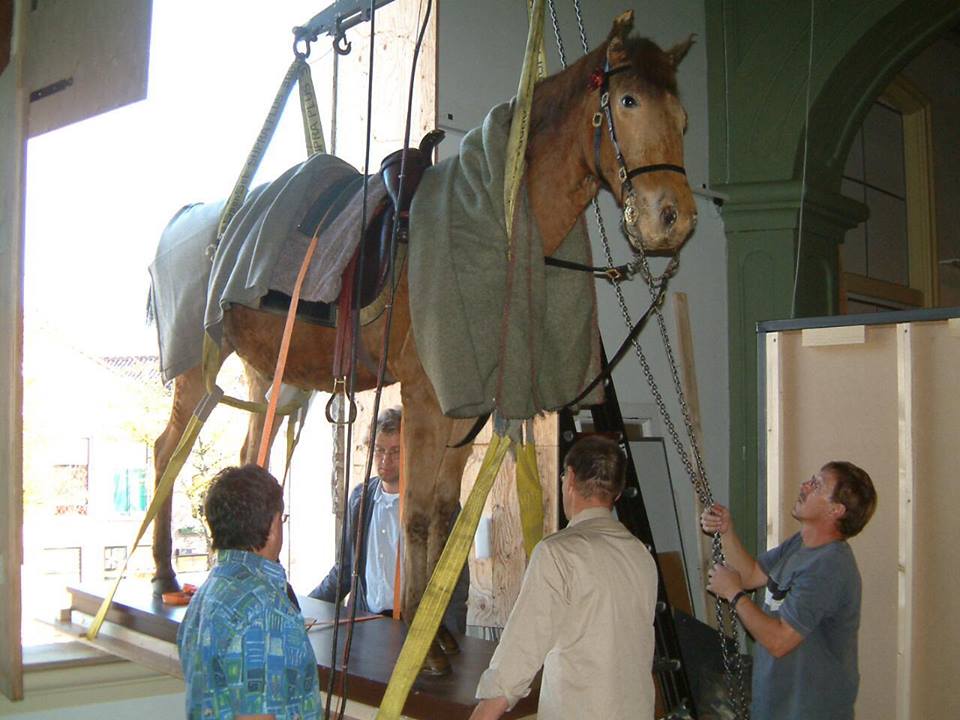
Wexy comes out of the depot

If you have any interest in Waterloo the one thing you have to do in the next few months is go to Dordrecht and visit the exhibition on the art collection of king Willem II. Willem was an avid collector and connaisseur, but after his sudden death in 1849 the collection was sold to cover his debts. It has been partly reconstructed for this exhibition.

From the Dordrecht Museum website
The special guest in the exhibition is Wexy, Willem's longtime favourite horse. He rode it at Waterloo where Wexy was wounded. The horse lived on to ripe age, but even then Willem couldn't part. Wexy's body  was preserved and remained in Willem's collection, but was also dragged around Ghent after Belgium split from the United Kingdom of the Netherlands to garner support for the Orange family.

These days it is mostly locked away so this is a unique opportunity to see Willem's faithful charger.

Friday, 21 February 2014

Review: In the Wake of Napoleon: The Dutch in Time of War 1792-1815


In the Wake of Napoleon: The Dutch in Time of War 1792-1815 by Mark van Hatten

My rating: 3 of 5 stars


Book written around items from the Napoleonic collection of the Dutch army museum. The main part consists of short biographies of individuals illustrated with their personal belongings or uniforms. This ranges from the princes of Orange, king Louis Napoleon, and several officers from different units to Wexy, the favourite horse of Willem, prince of Orange, which was killed at the battle of Waterloo.

As such, the book offers no synthesis and is rather anecdotal. But the illustrations are special.


View all my reviews

Tuesday, 4 June 2013

Catlin's paintings of North American Indians

Yesterday Nick and I went to the National Portrait Gallery and among other stuff, we saw George Catlin's portraits of North American Indians in the 1830s and 1840s.


Catlin began his project because he saw the Indians as a vanishing culture and wanted to conserve as much of it as possible. At the same time he needed to make money and these two goals didn't always go together well. But it has resulted in a unique collection of hundreds of portraits and paintings of most of the tribes of the east and west.

Apart from the information on the dress, appearance, customs and beliefs of the Indians, the paintings offer beautiful facial expressions. It's evident that Catlin empathised with his sitters. Not all paintings are of even quality because Catlin did many of them and fast, but even some of the unfinished ones are fascinating.

Catlin's other interest like geology also feature on the side of the exhibition. And since the National Portrait Gallery is free to visit, make sure you give it a try when you get to London. The turnover of exhibitions is quite high and there is lots to see.

Tuesday, 29 January 2013

The Magnificent Monsters of Anthony the Abbot

On a trip to Antwerp over a week ago, we visited a few interesting places, like the excellent MAS (Museum aan de Stroom), with a rich combination of four collections stretching from anthropology (international and local) to local history. And Antwerp has a illustrious history as the greatest and richest port of Europe in the late Middle Ages.


A 17th century interpretation by Antwerp painter David Teniers
You can still find many remains of that golden age around the city, and one of the best places is the Mayer van den Bergh house, which holds a small but excellent collection of medieval and early modern art. The collector after whom the house is named started to buy all these art objects on business trips. He didn't think like a museum director, pursuing a direction and filling in gaps, but bought what was available through local traders and other collectors, all based on his personal preferences.

This means there is stuff from the Low Countries down to France, Germany, Switzerland and Italy and the objects range from religious objects to bourgeois furniture. I stood amazed watching a piece of beautifully crafted ivory from the 10th century, which had been carved in the back of an Byzantine original from a century earlier.

The Dulle Griet
But the top stuff are a couple of paintings by Pieter Bruegel, the most famous being the Dulle Griet, an apocalyptic view with an armed and armoured women carrying her spoils across it. I easily spent a quarter of an hour enjoying this.

But there's another bit that I found interesting, which were a couple of paintings showing the temptation of Anthony the Abbot, one of the founders of the Christian monasterial tradition. It was a theme I hadn't noticed before, but which happens to have been popular in the Middle Ages, but also inspired Dali.

Bruegel's take on the temptations of Anthony the Abbot

The reason why I was so interested is because it shows contemporary views on what monsters and demons would look like and I am fascinated. The monsters are all a bit comical, rather than scary. There´s a brilliant site on Anthony with lots of illustrations of paintings over the ages. Below I post one from 1490 that I actually like best, because it is so different from contemporary paintings. The colours are so bold and the monsters so stylised! It made me think of Indian art.

Giovanni Pietro da Birago, ca 1490. Incredible


Wednesday, 31 October 2012

The Hero of Waterloo, part II plus Hermitage


Last Sunday we went to the Hermitage in Amsterdam to watch the Van Gogh collection that’s temporarily housed there, as well as a nice collection of impressionist and contemporary paintings.

In the museum shop I picked up a book by Michel Didier, De Ridder en de grootvorstin. Kunst en leven van Willem II en Anna Paulowna. This can be loosely translated as The knight and the Grand Duchess. Art and Life of … The book looks at this couple mainly from an art historical viewpoint, but includes a lot of biography. The advantage is that this also brings a lot of illustrations.


Willem was rarely out of uniform, nor were his sons

For me the interesting bits were how Willem’s actions at Quatre Bras and Waterloo were remembered in Dutch (and foreign) art. It’s not my style of poetry or painting, and its purpose didn’t lend itself well to better characterisations of the man. But it illustrates well how Willem's military successes (deserved or not) served the nation building and legitimacy of the Orange monarchy. 

Didier is not too sure on military details, as even I could spot. It is unlikely that Willem would have received his honours for the battle of Nivelles already in 1814. Willem’s tactical abilities are not questioned but his bravery is highlighted.

The book also glosses lightly over the darker side of Willem’s life, the many scandals, affairs and schemes and his political failures. I think this book (and publisher, from the other books it publishes) is aimed at the loyal monarchist crowd and therefor not too critical. What does get a fair amount of attention is the difficult relationship with Willem’s father and other family relations, as well as dynastic concerns.

So not much to recommend it to military historians, unless you have a particular interest in the artistic expressions rendered in tribute or in commission of Willem. Or if you are a loyal monarchist, of course.

Of course, this book was in the shop because of the link between the Netherlands and Russia, as the Hermitage's home is in Petersburg. 

A interesting combination of two great artists:Van Gogh's 'copy' of a woodprint by Hiroshige

The Van Gogh collection is amazing and charts Vincent’s progression as an artist in detail. From his peasant painter period to impressionism to expressionism, continuously learning and adapting his style. And all this in the span of only 10 years. He must have been an exceptionally driven person.


It's hard to capture the mastery of this painting, as the picture of a postcard dulls the colours, but you can see how the strokework emphasises the lightfall

We also enjoyed the exhibition on the impressionists. I enjoyed how the exhibition opposed the impressionist with the established art from the Academie Francaise and how the impressionist were forced to create their own parallel network of exhibitions. I found it telling to see that many of the impressionist, such as Renoir, still attempted to gain access to the Academie, and thus to the galleries and collectors.

The exhibition really mixed impressionism, conventional artists and contemporary event very well. You get this view from the perspective of Russian art collectors that have wound up in the Hermitage collection.

If you're in Amsterdam in the coming months, I highly recommend you add this to your programme.

Tuesday, 18 September 2012

Bronze exhibition at Royal Academy

The Bronze exhibition at the Royal Academy comes highly recommended. There are really some stunningly beautiful bronze statues out there, not the least the Nigerian ones. The Etruscan Hombre della Sera, Willem de Kooning's Clam Digger, Boccioni, Giacometti and some other modern stuff was cool as well (and a welcome change from the very figurative stuff).


There is an astonishing range of styles and techniques in bronze, and the exhibition does not attempt to be complete in themes and countries of origin, but to show those wide ranges according to human forms, animal forms, objects, reliefs and heads/bustes.

It works well that way. There's a beautiful 19th century bust of a north African Jewess that combines marble and bronze, paint and gold. There's prehistoric votive statues which we still can't interpret. There's the wonderful turkey from 1567 (when it had just been discovered in the Americas), an emaciated Buddha from Thailand which I hadn't ever seen there.

So enough to discover for the art lover. For a miniature wargamer, it was also interesting to have a look at the casting and finishing process, which was described in some detail.

Saturday, 15 September 2012

St Pauls in the Blitz

I bought a card of St Pauls during the Blitz, pictured by Cecil Beaton. There's a nice exhibition of his photographical work in the Imperial War Museum.

Beaton was a socialite theater designer who became more famous for his photography.

He did lots of fashion and portraits in the 1930s, but got ostracised after an antisemitic outburst.

When war broke out, he got a second chance taking photographs of the war effort, getting himself employed for propaganda work.

He did this so well he did a series of books for the RAF and later went on tours of the Middle East, India and China.

Go and see, because his eye for composition is very good and the black & white contrasts are phenomenal.

Wednesday, 12 September 2012

Some WWI and plans for the weekend

I've finished my review of Tom Behan's The Resistible Rise of Benito Mussolini. so have a look there.


Furthermore I've booked tickets for two exhibitions this weekend, Bronze in the Royal Academy and the one on war p¨hotographer Cecil Beaton in the Imperial War Museum.

Reading for Lost Youth continues. I´ve tried to get a view from the (North) Vietnamese side. Bergerud's Dynamics of Defeat has a good insight into the tactics and strategy of the National Liberation Front/Viet Cong and one that challenges Nagl's views.

And yeah, a bit of fun. Not a terribly innovative design, I know.


Thursday, 23 August 2012

Canadian Museum of Flight

In January 2008 I visited the Canadian Museum of Flight in Langley, BC with my brother who then lived in Vancouver. It's a small museum, but has a nice collection with some interesting bits you won't find as easily in Europe.

I'm putting up some of the pictures, but as I'm no expert on aviation, I won't be able to dish out on details. I've provided links to the excellent website of the museum if you want to know more.

Canadian Quicky, a homebuilt design from the 1970s. It still looks cool.


Beechcraft 3NMT Expeditor, a Canadian C-45 in ample use


Canadair CT-114 Tutor. This plane was used by the Snowbirds, the RCAF demonstration team, in the 1970s


Avro Canada CF-100 Canuck
, a Canadian designed and built aircraft from around 1950


Replica of SE5A


Saturday, 11 August 2012

Uniform of the Carabinieri Genovese

The Carabinieri Genovese were formed in 1851 as a rifle association.

The club was heavily influenced by the desire for Italian unity and many members were involved in the failed 1857 plot in Milan, Garibaldi's Cacciatory delle Alpi in 1859 and the Mille that set sail for Sicily with Garibaldi in 1860.

The uniform is on display in the Risorgimento museum in Genova.

Friday, 10 August 2012

Mussolini at the helm

Another fine painting from the Wolfsonia collection in Nervi.

Close to the outbreak of WWII, this shows Mussolini at the helm (it's called 'Il Nocchiero').

I like it a lot, with the crazy references to barbed wire, but also airplanes and the map of Europe.

Thursday, 9 August 2012

Fascist fascination with flight

This painting from the Wolfsonia collection in Genova-Nervi shows how the Futurist obsession with movement and action perfectly fitted fascism.

It is hard to separate the ideas of Futurism, which are grotesque and become soiled with fascist ideology, from the products, which are beautiful.

I went back early this morning to Nervi, just to see this collection, because I think it's a brilliant combination of design objects, graphics and more conventional forms of art. The trip was well worth the trouble.

I had to rush back for the train to Levanto.

Wednesday, 8 August 2012

Bust of Garibaldi

This bust is displayed at the Risorgimento museum in Genova.

It's an old school museum in transition, now having some multimedia displays.

Yet, it has an intreaguing collection because nationalists and revolutionaries Mazzini and Garibaldi had links to the city. Mazzini lived in the building for a while.

The museum doesn't expect non-Italians, I guess. There were few English texts and promotional material is only in Italian.

Tuesday, 7 August 2012

Women in times of war

A painting by Alba Giuppone from 1942-3 called Donne in tempo di guerra from the Galeria d'Arte Moderne in Genova-Nervi.

Nervi, a former upper middle class sea resort near Genoa, houses some nice art museums.

The GAM holds a few works of Futurist and later fascist influence, but this on transcends political lines, I feel.

Wednesday, 25 July 2012

Gun from German destroyer UJ-126

The UJ-126 Steiermark was sunk near Terschelling on 10 July 1940 by British submarine H-31

Tuesday, 24 July 2012

Control panel from German cruiser Lützow

Apparently a panel controlling emergency pumps on the German cruiser Lützow which was sunk during the Battle of Jutland in 1916.

Picture taken in the Wrakkenmuseum on Terschelling. Probably ended up there because of the diving club going abroad, as I don't think the panel would have been found near the island.

Sunday, 22 July 2012

Spanish gun

Made by royal foundries in Brussels in 1623, by Johannes Sithoff. Probably captured by the Dutch and then used as naval gun.

Ship probably from Amsterdam admiralty and sunk around 1630 near Terschelling

All the latest naval bits were recovered by the Ecuador diving team of Terschelling