Showing posts with label Indians. Show all posts

Tuesday, 28 February 2017

And yet another forgotten colonial war

Even when I was young, we didn’t play Cowboys & Indians any more and Westerns have declined as a movie theme. But despite the relative neglect, the Indian wars remain a fascinating colonial conflict.


By the time the U.S. army took on the Apache tribes in the middle of the 19th century, the issue was no longer in doubt. The demographic and industrial weight of the US totally overshadowed that of the hunting and farming Apache who number in the tens of thousands.

This was a war of relatively small battles, neither side bringing more than several hundred combatants to the fight. However, each Apache killed had long term consequences for the survival of his tribe, while there was a steady flow of new recruits for the cavalry.  At the same time, expanding settlement reduced the hunting grounds on which the Apache depended, thus forcing them into raiding.

Nevertheless, the struggle was a long and bitter one, which could only be brought to an end by employing Apache versus Apache. This although the cavalry itself made significant strides in its counter guerilla capabilities. Equipment and tactics were adapted to the climate and Apache warrior society.

Likewise the Apache adapted to the western world, improving their weaponry, and finding ways to sabotage telegraph communications. They also used their superior knowledge of the terrain to move and live undetected.

The only way to really get at them was to use scouts from rival tribes. There was little sense of common cause between these tribes and for many warriors the opportunity to stick to their warrior lifestyle, plus a gun and free meals, was too good to be missed.


McLachlan does an excellent job using first hand accounts from both sides to illustrate the challenges that both sides faced and how the social-political dynamics of the Apache and white settler society made conflict inevitable. The narrative flows well, the analysis is crisp and the illustrations fit the narrative. Probably the best Osprey book that I’ve read on ‘non-western‘ armies.

Monday, 8 July 2013

Experiencing Muskets and Tomahawks

In January a couple of people from the Dutch Miniature Wargaming group on Facebook decided to meet up and have a beer and a chat. The idea was to meet people from all over the country in a central location. For the third outing we opted for a game of Muskets and Tomahawks in Zutphen.

My militia guarding the flank supported by Minutemen in the woods

I had already picked up on the buzz for this skirmish rule set for North American colonial warfare in the 18th and early 19th century. It combines mission driven scenario's with a card driven turn sequence.

Firefight between my sharpshooters & Minutemen and the Hessians.
Although I won round one, they later wiped out my sharpshooters

M&T works with a point system to determine the forces. 200 point gives you three to four units and enough to start with.  There is quite a range of troops types, from British grenadiers to Canadian Coureurs du Bois and New England militia. Each has special traits that give them the historical feel (eg some units have the 'native' trait, which means they are harder to spot because they are better at using the local terrain).Further variety is provided by optional upgrades to units and traits to your leaders.

Indians charging into the flank of the Continental Army. Although the Continentals were destroyed,
the braves were too hard hit to threaten the issue on the other flank

Both sides get open and hidden objectives to win the game. For example, your force may have the objective to torch the enemy buildings or inflict as many casualties as possible. On the other hand, your leader can have the instructions not to get within 6" of the enemy, or to make a glorious charge. It's up to you to reconcile these objectives.


The Hessian Jaeger taken in the flank. This further weakened the Imperialist force
The mechanics are simple. Combat is D6s with to hit and 'saving throws'. The card driven turn sequence allows for some gambles. You can try to race your opponent while reloading. Do I wait or go now? It´s a nice tactical challenge.


I was very much taken by the rules and how it plays out on the table. Enough tactics to be a challenge, but still fast and fun. Apparently only with skirmish sets are designers able to break from the urge to add too much detail and turn the game into an accounting excercise.

The coup de grace. Because they have lost more than 50% of their force,
the Imperialist Morale card is added to the deck. When it came up, 
all the imperialists units had to check morale at -2. Goodbye!

All in all a great day in good company. Leo, thanks for your good natured reaction to your grenadiers getting wiped out. Jasper and Christy thanks for the hospitality and good luck with the book on the Duke of Alva (where do I pre-order?).

Looking forward to the next Wargame-biertje

Monday, 17 June 2013

Napoleonic and Native American Cavalry

Two more books I ordered some time ago and only arrived recently. I was very much impressed by Paul Dawson's thesis on the rebuilding of the French cavalry in 1813. It had lots of stuff on the organisation of remounts and the corners Napoleon could cut to rapidly increase his number of horses. Dawson argues that it wasn't a shortage of remounts but rather a shortage of trained cavalrymen combined with a breakdown of logistics that hamstrung Napoleon's army in the autumn campaign.


Not surprising that I was interested when Paul's Au Galop. Horses and riders of Napoleon´s Army was published on the French cavalry from an equestrian viewpoint. There is certainly a lot of the stuff in here, but not all the exciting bits of his thesis.

In one fell swoop I also picked up from the same publisher The Warhorse in the modern era by Ann Nyland, which does the same for a much longer period but in less depth. It is also somewhat older. Unexpected boon were the chapters on the use of horses by the Indian Plains tribes.


Of course these books are on the list for reading after this weekend, when we play the Leipzig campaign in one day with over forty guys in two large rooms. It's a double blind map game, with each team representing a headquarters or political leaders. So if I don't post much in the coming days, you know what I'm doing..


ps I vaguely recall a post not long ago in which I said I didn't expect much in the mail for the future. I guess I was fooling myself there.

Sunday, 16 June 2013

Maroons and slave revolts

When my interest was raised in slavery at university, I also learned about the maroons (called bosnegers in Dutch controlled Surinam). These escaped slaves formed communities in hard to reach areas of British Jamaica, Surinam, French Saint-Domingue (present day Haiti). I assume there were also maroon communities in North and Latin America.
 These include the French, Haitian, British and even Dutch units involved in the
Napoleonic Wars in the Caribbean, in my possession since last Friday 
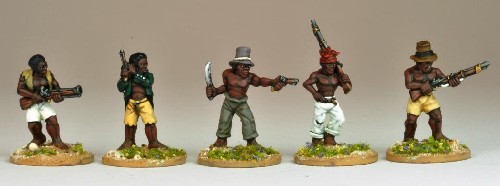
The subject has not left me since but was rekindled with the 150th anniversary of abolition of slavery in the Dutch West-Indian colonies coming up on July 1st (more on this later). It made me wonder why there have been no wargame rules that included maroons or slave revolts in their rules, at least none that I know of. But there's references in a few Ospreys (shown above) and at least I've found a miniature manufacture, Trent Miniatures, that offers maroons, Haitian rebels and regulars.

For the rules, I've been looking at Muskets and Tomahawks, as it also focuses on 18th century skirmish wargaming in the North American colonies. I think it can be easily adapted to include actions in the Caribbean. As it uses card driven scenarios, it could be well suited for the raiding, tracking and harassing expeditions of slave societies.

Revolting slaves by Trent Miniatures, from NorthStar website
It could also include scenario's based on the larger slave rebellions, like the one on Saint-Domingue in 1792 that led to its independence. With British, Spanish and French attempts to (re)gain control, there's all kinds of interesting angles to take.

So I've done myself a big favour by getting a few relevant Ospreys and ordering Muskets & Tomahawks, and the Trent minis (as well as some French and Indians for the French & Indian wars). This isn't a project yet, and will have to wait a while, but I'm looking forward to working on it. René, are you reading this?

Tuesday, 4 June 2013

Catlin's paintings of North American Indians

Yesterday Nick and I went to the National Portrait Gallery and among other stuff, we saw George Catlin's portraits of North American Indians in the 1830s and 1840s.


Catlin began his project because he saw the Indians as a vanishing culture and wanted to conserve as much of it as possible. At the same time he needed to make money and these two goals didn't always go together well. But it has resulted in a unique collection of hundreds of portraits and paintings of most of the tribes of the east and west.

Apart from the information on the dress, appearance, customs and beliefs of the Indians, the paintings offer beautiful facial expressions. It's evident that Catlin empathised with his sitters. Not all paintings are of even quality because Catlin did many of them and fast, but even some of the unfinished ones are fascinating.

Catlin's other interest like geology also feature on the side of the exhibition. And since the National Portrait Gallery is free to visit, make sure you give it a try when you get to London. The turnover of exhibitions is quite high and there is lots to see.