Showing posts with label slavery. Show all posts

Friday, 20 January 2017

How not to write a history of slavery

Rarely have I been so disappointed in a historian that I held in high regard as by Jeremy Black’s Slavery. A New Global History. There are probably very few untruths in this book, but there is a glaring imbalance.


There are markets and goods, there is military technology and repression. Slavery was more harsh in the Carolinas than in the Chesapeake Bay. But beyond the abstractions that Black uses, you’ll be hard pressed to find out what life would have been like for a slave or a slaver or a freed slave living in a slave society: the daily routines, housing conditions, punishments, or slave markets.

Also the agency of the slaves in ending slavery is dismissed in a few sentences as ‘evidence ... is limited’. But since this is a major theory in the study of slavery, you might expect a serious discussion. As would be warranted by the rest of half century of research and debate on slavery that Black mostly ignores.

The imbalance is especially striking when the book is full of not that relevant detail on imperial and colonial history, and on the abolition debate in Great Britain and its role in the following decades. To the point where becomes self-congratulatory.

Alright, there are some redeeming features. This book has a more global perspective than most, looking beyond the early modern Caribbean. What it basically underwrites is that slavery was part and parcel of most societies up to the 19th century and its sudden retreat in that century is something worth noting.

But essentially this is a White Englishman’s History of Slavers that might have been written in the 1960s. Black should have known his limits and stuck to military history.

Monday, 28 November 2016

Paint it black

Quite some time since I last picked up the paintbrush, but I cleared up some space on a table so I can leave it where it is and have a good lamp close by.


Started and finished a bunch of riflemen and black militia members. The ones in the long coats would probably end up with northern units. The ones in shirt sleeves in the south.

In the former case they probably fought on the American side, where manpower shortage saw the enlistment of quite a few free blacks and slaves, who did so because this meant a job and a chance to be freed after service. Didn't always work out that way apparently according to Ray Raphael's brilliant The American Revolution. A People's History.

Raphael also shows how in the latter case, tens of thousands of southern slaves escaped from the plantations to the freedom promised them by the British. They joined the British and loyalist units, or accompanied them as servants. Many died of hunger and disease and by the time of the British retreat, they were often left to their own devices.

Jim Piecuch, in his Cavalry of the American Revolution devotes an article to the Black Dragoons, a cavalry unit composed of and led by escaped slaves in South Carolina. They appear to have performed to the satisfaction of the British, but their existence enraged the white planters in the south, making it less likely that they would accept a return of British rule.

As far as  I am concerned, A People's History is an indispensable companion to the military history of the American revolution. Apart from showing how blacks could end up fighting on both sides, there's good stuff on the role of women, native Americans, Loyalists and common American males sympathetic to the revolution. It shows how this war affected them, but also, how they tried to make the best of it, or even turn it to their advantage.

I'll come back to this book, because it was an eye opener for me on the vastly different experiences of native American tribes. But worth every penny and widely available in second hand.

Friday, 3 January 2014

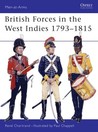
Review: British Forces in the West Indies 1793-1815


British Forces in the West Indies 1793-1815
British Forces in the West Indies 1793-1815 by René Chartrand

My rating: 3 of 5 stars


Overview of British forces in the West Indies during revolutionary and Napoleonic wars. Not generally known is that this was a major theatre of war for the British at the time (also a major market!) where tens of thousands of troops were sent to attack French colonial possessions, the most important being Saint Domingue, even after it became independent. There was serious concern that the slave revolt in Saint Domingue would spread to other colonies, as it did on Dutch Curacao in 1795 and Jamaica in 1796.

This was also a brutal theatre, with maybe as many as 45,000 British troops dying of fever in the decade up to the peace of Amiens in 1802.

The book is a bit eclectic as it includes so many different and often temporary units, like foreign regiments recruited in Europe, local militias and (Dutch)colonial troops from enemies taken into British service. Interestingly also has images of Jamaican Maroons, black troops from Surinam ('redimusi') and Cuban slave hunters with dogs.


View all my reviews

Review: Napoleon's Overseas Army


Napoleon's Overseas Army
Napoleon's Overseas Army by René Chartrand

My rating: 3 of 5 stars


Broad description of the dress and actions of French colonial units during the revolutionary and Napoleonic wars. With the 20 year struggle between France and Great Britain, it is not surprising that fighting also reached France's and the Dutch colonial possessions, as the Britons steadily gobbled up the French empire overseas, with only a short intermission after the Peace of Amiens in 1802.

This book focuses mainly on the Americas, rather than Asia and Africa. The war of independence of the former slave population of Saint Domingue, present day Haïti, features prominently. There's even a short section on the Dutch colonial troops in the West Indies.


View all my reviews

Thursday, 18 July 2013

Muskets & Tomahawks (and More) in the Mail

In the mail the long awaited:


Some nice French & Indian Wars minis as well:

Coureurs du Bois and Indians
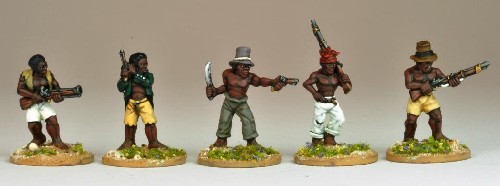
Maroons, revolting slaves, slave hunting dogs


and a few French Revolutionary.

To fight the revolting slaves

And I couldn't resist Sam Mustafa's Maurice.


None of this will see immediate action, but I hope to get at least the F&IW ready for a battle this year.

Monday, 1 July 2013

The end of slavery in the Dutch West Indies


On the 1st of July 1863 (the same day that gun fire opened around the town of Gettysburg) cannon fired from the capitals of the Dutch West Indies announced the emancipation of 34,800 slaves in Surinam and 11,800 slaves on the Dutch Antilles. 


Slaves and those placed under state supervision after 1863 

Although liberated in name, the former slaves aged between 15 and 60 in Surinam were required to work on the plantations as contract labourers for another ten years under state supervision (staatstoezicht). When this requirement ended in 1873, many former slaves left the plantations. The planters replaced them by contract labourers from India, Indonesia and China. Because no great loss of labour supply was feared on the Dutch Antilles, there was no period of forced contract labour on these islands.

The slave trade in the Dutch West Indies had been abolished under British occupation in 1808. The new Dutch government reiterated this measure in 1814. Lacking fresh supply, the number of slaves in Surinam fell from over 50,000 at the time of prohibition to 34,800 in 1862. The main reason was that fewer slaves were born than died. There was also a small but steady drain from manumission and slaves buying their freedom. Even fewer slaves escaped. On the Dutch Antilles slave births outnumbered deaths, so that despite manumission and emigration, slave population remained relatively stable above 10,000.

Slaves in 1863 for which an indemnity was paid


Following emancipation, the Dutch government paid an indemnity to the slave owners for all healthy slaves. After inspection the number of slaves for which an indemnity would be paid was established at 32,900 in Surinam and 11,000 on the Antilles. The Dutch Parliament set a sum of 300 guilders per slave in Surinam and 200 guilders on the islands*. The total amount of the indemnity reached almost 12 million guilders, or about 10 % of Dutch state expenditure in 1863.
 
Surinam:  a plantation economy

The plantations in Surinam grew mostly sugar cane and to a lesser extent coffee, cocoa and cotton. At the time of emancipation over half of the slaves were employed on sugar plantations. Another 14 % were involved in the production of cotton and 7 % in forestry. The remaining 22 % worked in the cultivation of coffee, cocoa and food.

Slaves by type of plantation, Surinam 1857

Not all slaves worked in the fields. Over a quarter of them was too young, too old or too ill to work, got an education or was reported absent. Six % served in their masters’ households or mended their children. More than 60 % of slaves was involved in the cultivation of crops or the tending of flock and in the processing of raw materials in factories or as craftsmen. Above them stood a small layer of supervisors, engineers and medics.

Slaves by type of labour, Surinam 1857

Autarchy on the Dutch Antilles

The effects of emancipation were different for the Dutch Antilles. Their economy was built around trade. Part of the slaves was therefor involved in crafts and industries like salt mining. Agriculture was mostly focused on food for consumption on the islands themselves. In dry years food even had to be imported.

Free and slave population in Surinam and on the Dutch Antilles, 1857

In comparison to Surinam the slaves were a smaller part of the total population. Over the course of the 19th century they were able to acquire more control over their own labour so that many were effectively working as wage labourers before the official liberation.


Outside the Caribbean

Surinam and the Dutch Antilles were not the only areas under Dutch administration with slavery. It was abolished in different parts of the Dutch East Indies between 1860 en 1910. On the Gold Coast (present day Ghana) emancipation occurred in 1872, when the colony was sold to Great-Britain. Slavery had been abolished there in 1834.

I’ve taken the statistics for this article from the Staatkundig en Staathuishoudkundig Jaarboekje. This source has been recently made available digitally through the Historical Collection Statistics Netherlands

* The amount set for the indemnityof slave owners on St Martin was originally only 30 guilders because they had effectively become free in 1848. In that year France abolished slavery, and the slaves on the French side of St Martin were emancipated. Faced by the threat of a mass exodus to the French part of the island, Dutch planters accepted the de facto freedom of their slaves as well. However, after waiting 15 years for an indemnity, they refused the amount of 30 guilders per slave. Dutch parliament then decided to offer 100 guilders per slave.


Sunday, 30 June 2013

Slave population of the Dutch Caribbean in perspective

To get an impression of how important the Dutch colonies were in the Caribbean, let's look at the most important staple crop of the region: sugar. While yesterday I looked at the numbers of slaves in the Dutch Caribbean, it was clear that the Dutch import of slaves was significant, but minor. This was also the case in terms of sugar exports.

Sugar exports of main producers in the Caribbean and Surinam just before
the French Revolution. Knight, The Caribbean p 365-370

Surinam was only a small producer of sugar compared to powerhouses like British controlled Jamaica and French St Domingue. And although the French Revolution ultimately destroyed sugar production in St Domingue (which continued independently as Haïti), Surinam was unable to capture more of the sugar market..

Sugar exports of main producers in the Caribbean and Surinam
early 19th century. Knight, The Caribbean p 365-370

In terms of slave population, Surinam was more considerable, although it was still dwarfed by Jamaica, St Domingue and Cuba.

Slave populations of the largest Caribbean colonies in the
early 19th century. Knight, The Caribbean p 366-7

Saturday, 29 June 2013

Slavery in the Dutch Caribbean: numbers

Okay, so how many slaves were there in Surinam and on the Dutch Antilles?

First, let's look at the number of slaves coming in to the Dutch colonies in the Caribbean. Numbers are difficult, because the Dutch Antilles served as an entrepot and a number of slaves may have finally ended up elsewhere.

Over two centuries around half a million slaves were imported to the Dutch colonies, out of more than 9 million slaves brought to the new world from 1600 to 1870. That's a significant bit minor share. Brazil, Spanish America and the British and French Antilles received much larger numbers.

Knight, The Caribbean p 364

The high watermark of slavery in the Dutch Antilles lay in the late 18th century, when there were well over 20,000. More than half of the the slaves worked on Curacao, the main commercial center.

Slave population of the Dutch Antilles
Dalhuisen, Geschiedenis van de Antillen p55

Immediately after the British occupation and the abolition of the slave trade (effective in 1808, but officially confirmed by the new United Kingdom of the Netherlands in 1814), the number of slaves had dropped to 12,000 and remained mostly stable after that.  Natural population growth was positive and balanced manumissions and several thousand slaves emigrating (ostensibly as freedmen).  The excess of births over deaths was probably mostly because the economic focus of the Dutch Antilles was on trade and self sufficiency instead of export of plantation crops for the world market.

The late 18th century was also the prime time for Surinam. There may have been as many as 60,000 slaves at that time. In the 19th century the numbers declined.  This was mostly the result of negative natural population growth, a common feature of plantation slave societies. Combined with manumissions and escapes, the only possibility was for a decline in the number of slaves. By 1863 there were only some 35,000 slaves left.


Slave populations in the 19th century
Staatkundig en Staatshuishoudkundig Jaarboekje
After abolition in 1863, the freed slaves between the ages of 15 and 60 were required by the Dutch government to work as contract labourers on the plantations for another 10 years. They were nominally under state supervision, or staatstoezicht. As soon as the requirement to work under contract disappeared, many former slaves left the plantations. This signalled the start of an era where plantation owners imported contract labour from India, Indonesia and China.

Until 1863 the population of Surinam was dominated by slaves. The white population was a small minority, living mostly in the capital, Paramaribo. In Paramaribo also lived the freed slaves, but while the colonial records account for 600 in 1844, Panday lists over 5000 of them in 1835. I have no way of reconciling those numbers.

There was also a significant group of maroons, called Bosnegers in Dutch, that lived in the interior. The were reckoned at 7 to 8,000 in the middle of the 19th century. The Surinam jungle also provided a refuge for maybe around a thousand Indians.
Population of Surinam 1844
Staatkundig en Staathuishoudkundig Jaarboekje 1850

Considering that about half a million slaves came in to the Dutch Caribbean, the death rate must have been horrendous if you consider the slave population at the end of the 18th century (just over 80,000). Apparently, slave owners felt no need to be careful with their investments as replacements were relatively cheap.

Friday, 28 June 2013

Surinam exports in the age of slavery: sugar, coffee, cotton and cacao

This is a bit that I didn't put in next Monday's article, partially because not all of this data is from a source I could use, and partially because it didn't fit in the article.

These are export volumes of the four main plantation staples from the early 18th century until the end of slavery in 1863 and a little bit further. For ten years after 1863, the former slaves of Surinam were forced to work as contract labourers on the plantations.

Sugar exports from Surinam in tons
Sugar was the main plantation export product throughout the Caribbean. Surinam was a relatively small producer.


Coffee exports from Surinam in tons
Coffee exports peaked late in the 18th century but all but disappeared by the end of slavery


Cotton exports from Surinam in tons
Cotton had a short period of success in Surinam but like coffee, didn't live past the end of slavery.


Cacao exports from Surinam in tons
Although cacao wasn't a major export product, it was the only one of the old plantation staples to to increase with the end of slavery.

Wednesday, 26 June 2013

Upcoming: Slavery Statistics in the Dutch West Indies

Working on a short article with stats about the abolition of slavery in the Dutch West Indies, 150 years ago next Monday. It will be published in Dutch, but you might like an English version.


My source: Het Staatkundig en Staathuishoudkundig Jaarboekje


Sunday, 16 June 2013

Maroons and slave revolts

When my interest was raised in slavery at university, I also learned about the maroons (called bosnegers in Dutch controlled Surinam). These escaped slaves formed communities in hard to reach areas of British Jamaica, Surinam, French Saint-Domingue (present day Haiti). I assume there were also maroon communities in North and Latin America.
 These include the French, Haitian, British and even Dutch units involved in the
Napoleonic Wars in the Caribbean, in my possession since last Friday 
The subject has not left me since but was rekindled with the 150th anniversary of abolition of slavery in the Dutch West-Indian colonies coming up on July 1st (more on this later). It made me wonder why there have been no wargame rules that included maroons or slave revolts in their rules, at least none that I know of. But there's references in a few Ospreys (shown above) and at least I've found a miniature manufacture, Trent Miniatures, that offers maroons, Haitian rebels and regulars.

For the rules, I've been looking at Muskets and Tomahawks, as it also focuses on 18th century skirmish wargaming in the North American colonies. I think it can be easily adapted to include actions in the Caribbean. As it uses card driven scenarios, it could be well suited for the raiding, tracking and harassing expeditions of slave societies.

Revolting slaves by Trent Miniatures, from NorthStar website
It could also include scenario's based on the larger slave rebellions, like the one on Saint-Domingue in 1792 that led to its independence. With British, Spanish and French attempts to (re)gain control, there's all kinds of interesting angles to take.

So I've done myself a big favour by getting a few relevant Ospreys and ordering Muskets & Tomahawks, and the Trent minis (as well as some French and Indians for the French & Indian wars). This isn't a project yet, and will have to wait a while, but I'm looking forward to working on it. René, are you reading this?

Wednesday, 20 February 2013

Slavery: 50 shades of grey

Jumped into the subject of slavery over the last couple of days, because coming July 1 it will be 150 years since slavery was abolished in the Dutch colonies (although I'm not 100% sure this also was the case in the Dutch East Indies, that needs figuring out).

I'm hoping to do a little bit on this subject for work, but that requires that I can find some official statistics to anchor the story on. Preferably some source the Statistics Office has digitised and is publicly available. There is some stuff in trade statistics (ie the products made by slaves) and in taxes (slaves, like all property, were liable to taxation), but I'm actually hoping for something on real numbers of slaves. If I figure out how, I'll put on some stuff here.

Since the British had abolished the slave trade while they held the Dutch colonies during the Napoleonic Wars and this was confirmed by the reinstated Sovereign Prince William in 1814, there are no statistics for the slave trade in the 19th century.

On Saturday I bought De slavernij, mensenhandel van de koloniale tijd tot nu (Slavery, trade in human beings from colonial times to the present) by Carla Boos. She was the chief editor for a 5 part television series on slavery that was aired on Dutch television in 2011. The book is therefor aimed at a broad audience and covers lots of ground with not a lot of depth. It has some great illustrations but sometimes it´s clear that it was hard to translate the action on screen to paper.

But what struck me most in this book is that the history of slavery is (as most of history) pretty resistant against black and white, right and wrong interpretations. Very few of the people covered in the book are utterly evil and very few are all in all good.

Look for example at Jacobus Capitein, a freed slave who grew up in the Netherlands in the 18th century and became a reverend. He wrote a book defending slavery on the basis of the bible (not surprisingly, given that it's full of rules on slavery). He died in one of the slave fortresses on the Gold Coast after having failed to convert slaves, age 30.

Or Philip Quassie, a black Surinamese professor of botany, who brought the medicinal effects of Bitterash to the attention of Linnaeus in the 18th century. But he also hunted runaway slaves.

Even Bartolomeo de las Casas, the 16th century Spanish bishop who wrote his book to stop the terrible treatment of the Indians of America, thereby condemned black Africans to work in their stead. Even when he realised his mistake, he was unable to undo it.

Willem Bosman, a Dutch employee of the a Dutch slave trading company had very low esteem of the mulattoes and mixed race, but on the other hand fathered a number of children who to this day live in Ghana carrying his name.

The two great communities of marrons, or runaway slaves, in Suriname signed peace treaties with the colonial authorities in 1758 and 1760, recognising their freedom but also agreeing to return any further runaways to their masters.

Or E.J. Bartelink, a black supervisor of Dutch plantations in Suriname before and after abolition, with great deferrence to his white employers and often low esteem for his black slaves or labourers.

From the 1770s the Dutch employed black troops, known as het Neger Vrijkorps, de Zwarte Jagers or redimusi (for their red hats). They gained their freedom and some land by chasing runaways and fighting the marrons.

Europeans were as much victims as perpetrators of slavery. Hundreds of thousands were taken by Barbary Pirates from the coast of North Africa. Special insurance societies were set up to buy the freedom of sailors, but most never saw home again.

Many Africans were involved in the slave trade, such as the Ashanti tribe and 19th century Ghanese trader Mohammed Babatu. The Zanzibar slave trader Tippo Tip ruled an area as large as the half of Europe and was employed by the Belgian king Leopold for a time to administer areas in the Congo. In all, muslim slave traders may have taken as many black Africans to the Middle East as the Europeans.

On Dutch ships on average about 1 in 7 of the slaves died during the trip from Africa to the Americas. This rate was the same as the death rate among the European crews on these ships.

Although there never was a Dutch abolitionist movement like in Britain, when it took off it was quickly successful. Especially after the publication of Harriet Beecher Stowe's Uncle Tom's Cabin, the decision to abolish slavery was quickly taken, but it took almost a decade to dismantle it completely.

The most prominent abolitionists, Julien Wolters and Wolter baron Van Hoëvell, were not great lovers of the black race and displayed prejudices common for the age, for example against Jews and non-christian slaves.

I'm not making moral judgements here, because I don't know what emotional conundrums these (mostly) men faced in many cases with the choice between poverty and great riches or survival and death or a life of forced hard labour. Most of them were religious and must have struggled with their consciences.

That is the real world. Muddied, fucked up, hypocritical, delusional, hopeful, bittersweet, guilty, melancholy.

Treasure it in your work.