Showing posts with label Africa. Show all posts

Sunday, 26 February 2017

Another forgotten colonial war

Got a bit frustrated with my lack of reading lately and so decided to take on some lighter stuff, and Ospreys have proven excellent in that regard. Easy to pick up and lay down on the commute.


First off was King’s African Rifles vs Schutztruppe, continuing the theme of forgotten colonial wars. Not a middle of the military history road subject. First of all it deals with an African side show in World War I, when troops from British colonies tried to conquer the German colonies. And secondly, it prominently features the African soldiers fighting the war.

And compared to most Osprey books, there is more information on the non-western protagonists. It is made clear that in the British units, with fewer white NCOs, more responsibility devolved on the black NCOs especially when the (always white) officers became casualties.

And the author very cautiously treads the subject whether having more European NCOs was better for battlefield performance. There are even a few passages from the memoires of black participants.

On the other hand, in the operational narrative, the perspective of the black soldiers fades into the background. The prime actors there are the natural environment dictating the tactical and strategic decisions made by white officers. And you can still wonder how the askaris felt about fighting a colonial war.

On all the other elements the book score above average. It does a good job of explaining the challenges of bush warfare in southeastern Africa and the differences in British and German policies towards war in Africa. Also, the operational narrative is clear and highlights the most important factors which are brought together in the final analysis. Special kudos for the illustrations, which are very well integrated into the narrative, reinforcing it with examples.

Saturday, 15 June 2013

Crisis in Binni - Operation Succesful, Patient Deceased

Two weeks ago I joined in for Crisis in Binni, the megagame about humanitarian intervention in a failing African state (think of Somalia in the early 1990s) as the commander of the US contingent to the international force. I was going to write peacekeeping force, but then realised that was not our mission. Remember this, because it is important.


When the UN decided to intervene in Binni, there had been low level conflict in the country for some years, with the autocratic government of President Ancongo having suppressed rebellions in the north of the country. The direct occasion for action was a famine developing in the northern region.

While the security council (formed for this game of the US, Britain, France and Italy) worked out our exact mission, the commanders of the military contingents planned for their role, in coordination with the UN refugee commissariat and World Food Programme.

As US commander my aims were to keep the commitment of ground troops to a minimum, but to still be seen as the leading nation. I managed to circumvent this seeming paradox by providing the expensive HQ, airbase and transport and attack helicopters for the mission. A few marines were used for protecting the force HQ, airbase and UN depots in Binni’s capital, out of harm's way. And as the Security Council resolution that formed the basis for our deployment implicitly put the US in command, I just treated that as a fait accompli which nobody questioned.

My briefing material for the game, with extensive historical information

The UN military force got a very limited brief: to protect the aid workers and refugees under their care. This also meant very restricted Rules of Engagement, effectively to only shoot when shot at.

My next priorities were to establish a unified command structure and get men on the ground as soon as possible to get a feel for the developing situation. The first French troops were on the ground in a month, with other contingents following two weeks later.

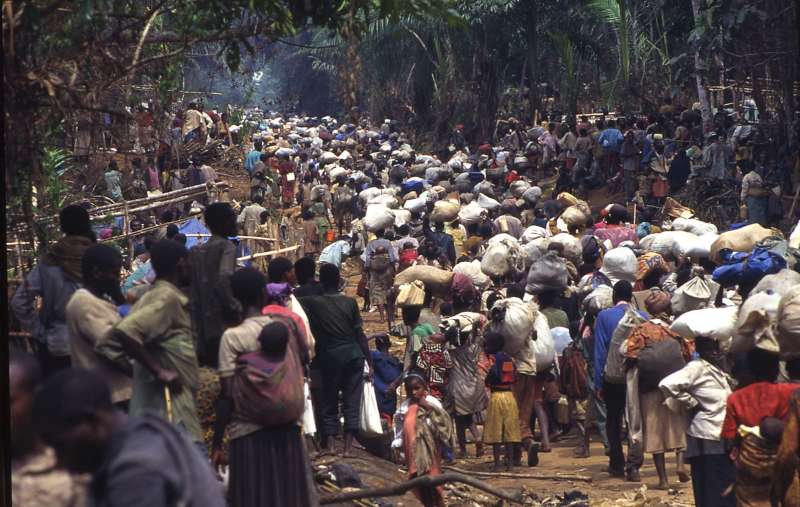
By that time the north of the country had seen extensive ethnic cleansing, with several thousand refugees shot to encourage others to make a move. The smart warlords then corralled the refugees in their area into large camps and waited for UN officials to turn up.


This actually helped the UN aid operation a lot, because it allowed them to concentrate on a few locations. That also made the military mission easier. Part of the aid flowed through Binni’s northern neighbouring country, which was expensive, but saved us the costs and risks of a very long line of communications. We also established on refugee operation in the north based only on air transport to which the same applies.

As expected, the government tried to squeeze us for money, but I was determined to prevent outright bribes as much as possible. So when president Ancongo demanded money to supply his troops, I agreed to a convention that only committed us to paying government troops that would be used solely to protect our refugee camps. In that way I hoped to limit the amount of units we had to support and also gain some leverage over them should push come to shove.

This deal may however been the reason for government troops to try to forcibly take over protection of the refugee camp at Cleopatra from the local warlord. This resulted in a three week battle over the town which gave us some headaches. Mostly because our forces in the area were split: a single British company guarding the camp to the north of the town and a slightly bigger garrison of the UN depots to the south.

We were afraid some of the indigenous force would find the 90,000 lightly protected refugees as a far more alluring target than the opposition and turn on the camp. We solved this by having our Black Hawks flying constantly over the refugee camp to discourage such thoughts. The commander of the British contingent remained anxious and enquired when and how he would be allowed to pull out. Of course I wasn´t keen on UN troops running off from their primary mission when put to the test, but I also understood that a company would not be enough to hold against a determined attack. So I put a number of transport helicopters on call to extract his force when attacked in force and this seems to have been enough to assure him. Anyway we were lucky we weren´t attacked.

UN military personnel at the gate of Cleopatra Refugee Camp

But apart from this and a few pot shots taken at a convoy the game was rather quiet for the UN military. In this we were really helped by the ´constructive´ stance taken by the warlords and the government. As long as they could make some money from us, they had no incentive to create trouble for us. In all I think that the level of bribing in this game was probably lower than in reality, and it was definitely only a small part of our total expenses.

Meanwhile, another neighbouring country had decided to take advantage of the internal turmoil in Binni to invade a disputed region. The Ancongo government therefore kept holding its hand up for money, but the US Ambassador was eventually able to wrench a promise of elections from the president for it.

The Battle of Cleopatra also proved an incentive for the US president to take an interest in the operation, and the US ambassador managed to broker a ceasefire and peace talks. This resulted in a government of national unity and a photo opportunity for the US ambassador.

Of course these peace talks were mainly meant to allow the government to turn on the invaders, which they had duly expelled by the end of the game. On the other hand, the power sharing didn’t fare well with Ancongo’s other clan leaders and rumours were rife of a coup by that time.

Nothing of the sort happened

The generally cooperative behaviour of the warlords and Ancongo government gave the UN a relatively easy game. Those refugees that we got to in time were saved and the concentration worked to our benefit. However, outside UN reach the world was less safe. The Security Council whisked away independent reports on human rights violations by the Ancongo government and evidence of ethnic cleansing and death marches in the north in order to maintain a working relationship. Of course, that didn’t mean that by the end of the game Binni was in a better position for the future.

I think that the UN could have had a lot more criticism in how it dealt with the crisis: the limited brief, the bribes, the support for an autocratic government, no attempts to create peace or safety for ethnic minorities. From all sides there was a lot of Realpolitik and very little principled behaviour. I guess that is due to a general disillusionment with human intervention and what it can achieve in the long run. As far as I understand, UN forces in earlier games were more ambitious and ready to get stuck in. So after six runs of Crisis in Binni, maybe it’s time to shift the situation in Binni by 20 years as well.

Thursday, 30 May 2013

Just received: Crisis in Binni game materials

The Crisis in Binni game materials. Found them yesterday evening returning home after a few days. Will provide for some interesting reading today and tomorrow.


There's the game handbook and the Travellers Guide to Binni, with all the background you need to play the game: who you are, what you did,who you hate, what your objectives are..

Wednesday, 29 May 2013

The Day of the Rangers - Black Hawk Down 20 years on


In my continuing quest to prepare for my role as commander of the U.S. contingent in a humanitarian operation, I have read Black Hawk Down by Mark Bowden. It provides an in depth account of the U.S. (not U.N.) operation to capture two main partners of General Aidid, leader of the Habr Gidr, the clan dominating Somalia at the time. 

My second hand copy
Although the targets were captured, the crash of two Black Hawk helicopters totally changed the dynamic of the battle and forced the troops on the ground into an improvised rescue operation. The troops were surrounded near one of the crash sites, but had to be relieved by a scratch U.N. force. The crew of the second chopper was captured or killed and paraded through the city by outraged Somalis, for all the world to see. This led to the departure of U.S. forces from Somalia soon after.

Last weekend I also watched the movie and there's a couple of disconcerting differences, the main being that the movie strips out most of the uncomfortable parts of the book. That is the very strong criticism on the leadership (although Bowden often uses the Delta Force participants to voice it) and the Somali side of the experience. And I think these two points are the most significant in the book, and they explain a lot about what went wrong.


By October 1993 the Somalis had figured out a way to go after the choppers

Ridley Scott does an awesome job of portraying the tactical side of the battle. I can't tell how realistic it is, but it generally conforms with the book, except the small force of Deltas attacking the Somali heavy weapons from behind. But Bowden provides several accounts of Somalis that show that a large part of the people fighting the Americans were not militiamen but civilians angry at being invaded by the Americans.

And that leads to the question the movie doesn't ask: wasn't this a stupid plan in the first place? Jumping in the midst of the town would always result in considerable collateral damage and civilian deaths. Scott neatly hides that fact that the Americans were shooting civilian from the word go (Bakara market was not just a hang out for arms salesmen, as the movie suggests, and they emptied it with M-60s).

In the movie the streets seem empty of civilians, in reality they were hiding everywhere and the millions of shots fired by the Americans must have made numerous innocent victims among the 500 dead and 1,000 wounded. That may be portrayed as a military necessity, but it was obviously the Americans weren't concerned about anything but themselves. 
This lack of sensitivity is understandable to a degree. To see so many people in a position of helplessness and degrading themselves in order to survive, sometimes to the point of lying, stealing and murder (see what I wrote about that when discussing Linda Polman's book) will not improve your opinion of them. The dirt, poverty and stench are noted often and in a negative way.

Also the Somali society was fundamentally different on ideas about honour, fairness, hospitality and allegiance. Even the strong concept of individual agency that every American is spoonfed from birth contrasts with the stoic fatalism inherent in lesser developed societies. The fact that Somalis often didn't grab at the chances provided to them by humanitarian aid and their refusal to lay aside their factional differences in the light of the crisis will have made them look ungrateful.

I'm pretty sure racism wasn't a major part of this attitude, although there were a few remarks in the book where I suspected it. I wonder if the nickname 'Skinnies' was a reference to Heinlein's Starship Troopers.


The lack of sensitivity, coupled with their obvious dislike of the local population  had already irked the Somalis, for example when U.S. choppers flew low over town, damaging houses and stampeding animals. They had also killed and captured a large part of the civilian leadership in a pretty brutal assault some weeks before. ‘The Day of the Rangers’ pushed many Somalis, friends of Aidid or not, into active hostility towards the U.S. troops.

The Somalis made innovative use of cheaply available communications
to narrow the intelligence gap
The Americans had also badly underestimated their opponents’ capabilities and willingness to take them on. The availability and smart deployment of RPGs caught them by surprise. The swift reaction and the amount of people mobilised by their attack as well. 

Most dangerously, they misjudged the reaction of the Somalis to their invasion per se. Even if no Black Hawk had been downed, the number of casualties on both sides would have been considerable. Half of the Americans on the initial convoy became casualties, and they could have easily accounted for several hundred Somali casualties. The damage, although less extensive, would still have angered a lot of people. Together, it would probably have changed the political dynamics of the conflict as much as the battle did in the end.

Scott conveniently portrays the local militia leader (appropriately dressed in black) as a 'bad guy' at the start of the movie by having him rob people of humanitarian aid, and then kills him off later as a sort of minor revenge victory which apparently needed to be scored to wash down the humiliation of the American force. It is not in the book.

...refusing to look the part of bad guy

At the end of the movie it seems all okay because Aidid is murdered in 1996 (by Somali competitors, not a U.S. operation). Although Aidid certainly was no saint, on the other hand he was not the ultimate bad guy the Americans turned him into (not the first and last time they did that). He was the leader of the most powerful clan in Somalia and de facto head of state, but also a former general in the regular army and he had defeated the dictator Siad Barre a few years before. Again, the movie reduces Bowden's multilayered story to two dimensions. 

As Bowden points out, the fact that the situation in Somalia didn´t change after Aidid´s death says enough about the misjudgement of the U.S. to pick that particular fight, and of their misjudgement of conflict in failed states in general: “In the end, the Battle of the Black Sea is another lesson in the limits of what force can accomplish.”

Because although military there is some claim to a U.S. victory, morally this was a huge defeat. Yes, a small force of Americans had held off a huge mass of irregulars, but with overwhelming firepower. Also, the force had effectively been incapacitated. It couldn’t move without leaving behind a considerable number of wounded and it couldn’t defend both crash sites.

And in my reading of the book, the people in charge of the operation were paralysed by the unforeseen events and overwhelming information. They were unable to improvise and make tough decisions. The movie makes the creed of ‘leave no man behind’ a virtue, but tactically it hamstrung the Americans. It prevented them from taking up a better defensive position and the recovery of a dead pilot cost them precious hours of darkness.

The only known photograph taken on the ground during the Battle of Mogadishu, on 3 October 1993
(US DoD via Court Chick, linked from acig.org)


In the book, Bowden shows the Somali sensed that the Americans were unwilling to die and to risk their lives which gave them a moral ascendancy. Despite the overwhelming firepower of the Rangers, I felt at times that an old fashioned bayonet charge would have been more effective (but the Rangers had left those at the base).

Sure, it is easy for me to criticise these points from my armchair, but these elements have come back during many humanitarian operations:

1. elite western troops with an inflated sense of their power, which translated into underestimation of their opponents and disdain for the civilian population. Derogatory nicknames, prostitution rings, firelighters with jam handed to children, it´s all happened.

2. irregular opponents who adopt to asymmetrical warfare and counter Western technological superiority by using terrain, subterfuge, or hiding among the population. It´s not always within the Geneva Convention, but civil war is a different beast than conventional conflict and U.N. troops should be take their opponents seriously.

3. In a tight corner the elite troops are unwilling to take casualties to do what is necessary to fulfill their primary mission: protect civilians. Belgians in Rwanda, Dutch in Srebrenica. Or they just blast away the opposition by massive firepower, regardless of the collateral damage, as in Mogadishu. This also harms the primary mission. Both forms of fuck up also undermine the trust of people in the ability and the will of the international community to protect them. What´s not to say that this provided a hotbed for anti-Western sentiments that the radical islamist have fed on since?

I´ll tell you next week if I did any better!

The page of the Crisis in Binni megagame (there's still room if you want to play)


Monday, 27 May 2013

More Preparation For Humanitarian Intervention - The Depressing Bit

In my preparation for megagame Crisis in Binni, I have read a few books and watched the inevitable Black Hawk Down. There's some interesting differences between the book and the movie, to which I hope to come back at some later stage. But suffice it to say that Ridley Scott could have made a movie much more critical of the American actions in Somalia than he did.

But I also reread Linda Polman´s The Crisis Caravan (In Dutch: De crisiskaravaan. Achter de schermen van de noodhulpindustrie). The book paints a pretty depressing picture of the crisis aid industry. She shows how the interaction between aid organisations, victims, local powers and the press have changed since the early 1990s

Me trying to organise Polman´s argument


The major development in the field is that since the early 1990s there has been a huge proliferation in the number of NGOs, especially with the appearance of MONGOs, or 'My Own NGO's. These micro-NGOs evolved from the disappointment many people felt in the effectiveness of the larger, more bureaucratic international NGOs. So people hop on a plain to DO SOMETHING.

Of course this leads to frustration, lack of coordination, double work and cruel excess. Polman gives harrowing stories of American doctors flying in, picking up kids in refugee camps and operating on them and taking them home on crowd-funding trips or even for adoption (while their parents are still alive).

But the main effect has been that the NGOs need to put much more effort in PR to catch attention of potential donors. And this has put them at the mercy of the press, who need to have a reason to turn up. So the NGOs need to inflate the scale of suffering and their role in ameliorating it. Because unfamiliar people in far off places don't sell papers by themselves.

The press, mostly genuinely sympathetic to the plight of the victims and the work of the aid organisations, needs to inflate the level of suffering above that of the last crisis. And some victims are more newsworthy than others: cut off limbs and children's bellies swollen from hunger do better than forced labour.

Another development, which Polman doesn't touch on, but which I have just read about from the other side, is the increasing rationalisation of the news media, so that there is less and less time for research, fact checking and analysis. Nick Davies´ Flat Earth News shows this development in bold colours, and shows why the press in turn has become so dependent on the NGOs and so uncritical of the information they provide (review is coming up).


A secondary effect of the competition between NGOs is their lack of negotiating power relative to the local powers. For the war lords and local governments, the flow of aid provides fantastic opportunities for improving their position. They can also cream off part of the aid that reaches the victims. And in case they are losing in a civil war, they can use the refugee masses to hide in and recuperate for another round (as for example the fleeing Hutu's did in Goma in 1994).

Indigenous government organisations and warlords also sell access to the victims to the highest bidder (both press and NGOs). This has led to NGOs making compromises which put them on the wrong side of the ethical conundrum: do we help or does helping make things worse?

Finally, the side that Polman references to only in passing, but the victims themselves play an important role in all this. It is in their interest to lie, beg and steal to improve their lot. The books shows some examples of kids lying to get prettier protheses, to be taken to the U.S. or just to get more attention from reporters.

It is enough to turn cynical at the whole aid industry, but Polman says we shouldn't leave it at that. Sometimes we have no choice but to shake hands with the devil to save lives, but also sometimes, we need to decide that by providing aid, we are only prolonging the suffering and destabilising a country for a long time.

Thursday, 23 May 2013

The Bitter Lessons of UN intervention - Can I do better?

The early 1990s were an incredibly hopeful time for keen young adults like me. The Berlin wall had fallen, the Soviet Union collapsed and the ideological conflict with accompanying doom scenarios of global nuclear war had disappeared like snow before the sun.It really felt like a new chance had come for a.world working united to end poverty, hunger and war. I even wrote a song or two expressing that naieve belief.

A lesser known edition of the famous book

We were soon to be disappointed. The disappearance of ideological conflict gave room for ethnic strife and unscrupulous warlords in failed states. The international community proved powerless to end it, even made it worse by intervening half-heartedly and then pulling out when things got tough.


So for me Yugoslavia, Somalia and Ruanda are the moral anchors when it comes to intervention by UN or NATO troops, and I am sure also for many of the leading politicians today. They are not much older than I am.

One of the most impressing and depressing books I've ever read was Deliver Us From Evil by William Shawcross. The book paints a depressing picture of the attempts of the international community (more or less reluctantly led by the United States) in the 1990s to effect the new world order that seemed to be in its grasp.

It is clear that after 9/11 the perspective has changed. There is something like a new world order emerging and not many people in the West like what they see. It has kept them from intervening for humanitarian reasons. And the experience in nation building seems not to have taught the U.S. very much in its so-called war on terrorism.

But there have been a few repeats in Western Africa and recently in Libya and Mali. Syria could go live any minute. The feeling that somethingmust be done is still alive, even if more muted than 15 years ago.


So what am I thinking a week before joining in the Crisis in Binni megagame? The game focuses on a humanitarian crisis in a fictional African country riven by civil war. Factions of warlords fight each other and probably refugees are stampeding in some unfortunate direction. The international community is waiting to jump in with a minimu of preparation and a maximum of photo opportunities.

I'm thinking how can I do a good job as a U.S. military commander. I'm not the one setting the goals of the mission, but I should try to get as clear a picture of my resources, so I can help my diplomatic counterpart, and my counterparts in other UN contingents to achieve those goals.

I will need to think of the security of my troops, try not to chose sides, try not to get into a messy situation. And all this with only a theoretical experience in AirLand Battle and fighting doctrinal wars over manoeuvre warfare. Most helpful.

So what advice have you guys got for me?