Showing posts with label Movies. Show all posts

Friday, 3 May 2019

2 movies and some commemorations - part II

So this was another movie I went to (see yesterday's post) and it is wry humour that does the trick in this one. Although you could argue that most of the characters come out of this all too well, there is no doubt that many remarks in the movie have a kick if you realise what they would have meant in practice. The summary executions now are portrayed as comic rather than beastly, and Malenkow now comes across as an obseqious toad, without his direct and indirect responsibilities for the deaths of hundreds of thousands.


I remember reading parts of the Black Book of Communism (which sounds better in the original French) and being stymied by 100,000 deaths per page (for a 1,000 pages long if you can bear it).


The Mayday celebrations and the commemoration of Karl Marx' 200th birthday of course reopened that old discussion. While right wingers dismissed Marx completely and blamed all 100 million deaths of Communism on him, left wingers at least defended his scientific contributions, even if his predictions were widely off.

The allure of Whataboutism


The temptation of taking the easy way out it great. You can go a long way fending of the challenges to your beliefs by pointing out that crimes committed in the name of another belief were worse. We can try and just argue why imperialism was a worse crime than nazism or communism or slavery. As if determining which crime is worse would actually solve our dilemmas today.

So what if communism should prove to have made more deadly victims than any other ' bad thing', would that mean that inequality is okay and slavery too? Do the Gulags justify the Holocaust, or the other way around? Do the Crusades justify the bombing of the Twin Towers? Why even get close to such a trap?


We are not alone


But my promise to myself this year is that I will no longer stand idly by in these discussions. Not by outshouting others or letting go of the good manners in discussion just to win once. Because civilisation is not built on winning one argument, but on setting the conditions for resolving many arguments. Be it through laws, democratic process, rules for argumentation or  'good behaviour'.

In that way, even if we are not as committed to a cause as some others, by sticking to nuance and understanding, we set an example and show the value of those ideas. And we shall be beacons to those like us, also reluctant to join the fray. We are not alone. In fact, we are the majority. And our values are worth standing up for. So we need to be out there (wherever the discussion takes place) and visible/audible and support each other.

We can leave the floor to those on the extremes, but if any of the above commemorations should teach us anything, it is that if one extreme wins out, not just the other extreme loses out, but we all become limited in our freedoms, accomplices in the crimes of murderous regimes and chance victims of the violence they bring.


Like the mother in In Syria, we can't keep the world out. When it knocks on our door, it will be too late.

Thursday, 2 May 2019

2 movies and some commemorations - part I


About a year ago I went to watch In Syria, a very powerful movie about a woman and her extended family trying to make it through a day in war torn Damascus. The camera work is excellent drawing you into the claustrophobia of the appartment, even more powerfully than the tank in Lebanon.

What made it even more powerful to me is that these people are recognisable, westernised and hip, worrying about shaving their legs and the availability of broadband on their phones. It emphasises how much out of place are the bombardments and bouts of gunfire close by. And even though the  door of the appartment is blockaded, the sanctity of the home will be violated.

I cannot recommend this movie strongly enough to you.

Commemorating 'the war'


On May 4th last year, the official day of commemorating the war victims in the Netherlands, I joined the commemoration at Kamp Amersfoort, a concentration camp where the Germans in WWII kept Dutch high profile hostages from political parties and civic organisations to disencourage sabotage as well as people suspected of being part of the resistance. Over half were at some point moved on to camps in Germany, often with fatal results. Several hundred were shot or died from cruel treatment or the bad conditions during the war.

It was cathartic to file past the monument on the execution place in silence, with nothing but the evening sunlight and the spring chatter of birds.

Further on, at eight o' clock we kept the two minutes silence. As always, I thought of my grandfather who fought the German invasion in May 1940 and later survived as a POW in eastern Europe. But thanks to In Syria, I was now also more aware of the plight of those at home trying to keep going as best they could.

Whose commemoration is it anyway?


But the past isn't the past. It's here every day and part of today's struggles. The Dutch commemoration on the 4th of May has become part of the discussion about integration and inclusion. Anticolonial activists demanded that the commemoration also include the victims of the Dutch decolonisation wars, on the grounds that the Dutch soldiers killed in those wars were being commemorated as well.

On the other hand some right wing commentators tried to debunk the narrative that Moroccan soldiers (and other French colonial subjects) were actively involved in the defense of the Netherlands in 1940.

While there is no use in overstating the impact of Moroccan soldiers in this instance, it is good to realise that millions of Moroccans, Algerians, Senegalese and others from French colonies, but also similar amounts of Africans and Indians from British colonies, and Indonesians from Dutch colonies were enrolled in the armies that liberated Europe, Africa and Asia.

Many of them volunteers, many of them motivated by the struggle against nazism, or otherwise to show that by liberating others they were worthy of their own independence. At least, they are as worthy of our thanks as the American, British, Canadian, French and Russian soldiers.

Not to mention the length the colonial powers went to extract resources from these countries, even if it caused famine and poverty. Millions died in famines like that in Bengal, where food was denied the population to feed troops at the front, or working in mines, plantations or field works, or as carriers. It is a side of the war that doesn't always get its fair share.

And if we want immigrants to identfy with their new home, there is no harm in showing that at that point in time we were on the same side, the right side. And that the fruits of that struggle are for them to reap as much as anyone.

Some people disagree with changing anything about the commemorations on the grounds that 'things have always been done like this'. But I was enlightened by a historian pointing out that only from 1966 did the official commemoration in the Netherlands include the victims of the Holocaust. The most important lesson for me is that we should be very critical of the argument that 'this is how we've always done it'. People's memories are very poor and short.


More in tomorrow's post.

Friday, 19 July 2013

Godzilla in Amsterdam - A Civilian Crisis Game

From the dark water it rose. The ferry rolled heavily to port as the frightened passengers stared incredulously into the air and the fiery eyes of the monster. Their panicked cries smothered in the waves as the boat capsized into the river. Without noticing, the monster made landfall, placing its feet carelessly on and between the sleepy crowd of early commuters at the Central Station. As fear spread quickly, soon the alarm rang at all police stations and the mayor was awakened. Within an hour the crisis team was convened at the mayor's office, determined to deal with the thread as it presented itself.


As nobody knew Godzilla's drive and had no way of dealing with her, the first efforts were aimed at saving the roaming tourists and local population. Entrance into the town centre was blocked. Another objective was to save as much of the art treasures and monumental areas of the town for future generations. With Godzilla striding towards Museum Square, this became an increasing concern.

But while a team of brilliant scientists was set up to deal with the monster, the local services proved quite capable of limiting the immediate destruction. The fire brigade limited fires around Godzilla to a minimum, tourist were led out of town. And then disaster struck...

The Game Map
Fearing the potential damage to the Rijksmuseum, the Van Gogh Gallery and the monumental Concertgebouw, the government had ordered the air force to prepare an air strike. The air force took this as a remit to actually bomb and laid all its powers of annihilation on Godzilla, destroying large amounts of fire brigade and ambulance material. The museums were levelled as hysterical conservators frantically laid down their lives in a heroic, but utterly futile effort to save Rembrandt's Night Watch and Van Gogh's Sunflowers.


All to the displeasure of the monster, which only became more enraged and determined to reach its goal. With the government and the rescue effort in shambles, all hope was laid in the hands of the scientists, who had been happily discussing alternative theories of Godzilla's descent and interesting evolutionary traits not commonly known in other bipedal reptiles.

They were rudely awakened to the enormity of their task and despite their pleas to save the specimen for future scientific research, they were persuaded at last to rather render their services to save human lives. The solution then proved relatively simple.

In the meantime Godzilla had continued her way leaving a smouldering wasteland in her trail. She was now reaching the edge of the city centre, where masses of refugees had been collected as well as the inbound commuters. No way in hell that these people could be evacuated from there in time.

In their race against the clock the scientist managed to apply their device to the monster and release the hollow charges to puncture its armoured scales, thereby releasing a compound (the composition of which is still to this day classified) that finally ended the life of Godzilla. Writhing in her dying flames, the giant reptile's anguished cries echoed over the badly damaged city...

Where the politicians immediately set out a parliamentary investigation of the decisions that led to the fateful bombing mission...

Then prime minister Jan Peter Balkenende
cleared by the parliamentary investigation
Godzilla is a game that employs more political aspects than operational games. In Godzilla the players were all members of the police, fire brigade and ambulance service in the great city of Amsterdam. The mayor and his staff were to coordinate the life saving effort faced with the towering hulk of the monster rising up from the river. In the background the Dutch government was bringing in fresh assets, like the armed forces and the team of brilliant scientists.

Most players stood around the table taking care of their units, convening for a few minutes every turn as their leaders coordinated their efforts. The mayor's office, the government and the headquarters of the armed forces were further away and relied on reports from the mayor to decide on issues off the map and dealt with anxious journalists.


If you are interested in playing in a megagame sometime, have a look at Megagame Makers. They do about six games a year in London and Leeds in the UK. Or Megagames NL, who do one game a year in the Netherlands.

Tuesday, 2 July 2013

Another bunch of interesting blog posts

Another batch of blog posts you might not have seen otherwise


Let´s start with digital cryptologist and security expert Bruce Schneier. I am very impressed by his sensible attitudes towards terrorist threats and his insight into cyber war. And I loved his book Liars & Outliers.

On hig blog he gives interesting pointers to research on (digital) security such as the cost of terrorism in Pakistan

the Japanese response to terrorism

US offensive cyber war strategy

and on the psychology of conspiracy theories


And a few more by those dastardly people at the Guardian 

A map showing all events in the Syrian civil war.

The Global Peace Index 2013, including the cost of war.

Arms exports from the EU

followed by an infographic on the world´s armies

and the refugee statistics from the UN High Commissioner for Refugees

What do you think of an analysis of comic book sales and movies?

Image by Sean McLachlan
And a few posts by lesser knowns

Sean McLachlan on castles in Spain and Slovakia

A short movie showing the strategic positions around Damascus of the Syrian government and rebels.

Tuesday, 25 June 2013

La Religieuse, Riducule and the War That Made America

I very much enjoyed the French movie La Religieuse, based on the late 18th century book by Denis Diderot, better known for his encyclopedia.


The story is about a daughter of lower gentry that gets send to a convent because her parents can't afford her a dowry. She doesn't want to go but is lured in, then refuses to take the vows. But as she brings shame on her family, it is even more difficult to escape the life of a nun and she goes back, more or less of her own free will. Of course she comes to regret it and the movie then documents her struggle to get out.

It was an interesting look at 18th century society, and gives a bit of background to 18th century gaming.

Another French movie I can recommend for this period is Ridicule. In Ridicule, a lowly nobleman travels to Paris to ask the king's aid in financing a project to improve his village. But as the king is bored with audiences the only way to gain access is through the court circuit in which wit and sarcasm provide the means to attract attention. 

But of course, you guys want hardcore military history, so my last recommendation is through the Bloggers for Charity, not only a lofty cause, but cleverly combined with the miniature refight of the Battle of La Belle Famille in 1759.

The War That Made America is a four part documentary on the French & Indian Wars and has some interesting combat sequences with reenactors. It is also surprisingly good on introducing the perspectives of Britons, Americans, French and Indians of various persuasions. It takes George Washington's experiences as a main lead, and I see this as inescapable if you consider he was involved in some of the actions and that that is the best way to gain the attention of the general audience.

Thursday, 6 June 2013

Movie education

Saturday my host Richard delighted me with two excellent low budget movies. They prove that a good story and creative use of limitations can beat million dollar budgets.


The first was The Call of Cthulhu by the Lovecraft historical society. Although fairly recent it was shot in black and white and in a 1920s silent movie style. This worked excellently.

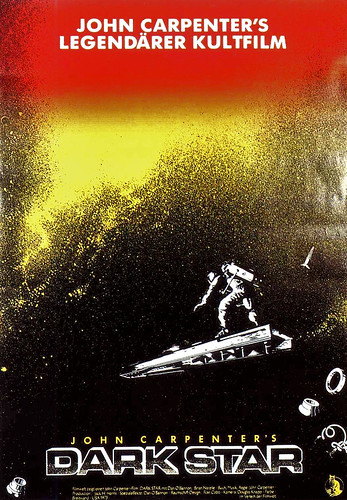
The second was Dark Star by John Carpenter (who went on to make other great movies). It is the story of group of astronauts after 20 years of their scouting mission, charting the stars and blowing up instable planets.


You could see how it had influenced later sci fi movies. But it has more merrit than that. There's great dialogue (especially with the intelligent bombs) and monologue, hilarious chase of the pet alien and like in The Call of Cthulhu , creative use of materials to create props. And it's given me a few interesting quotes to throw at people.

Both movies come highly recommended.

Richard and Jim also educated me on sci fi novels. I'll see if I can fit that hobby in somewhere.