Showing posts with label 19th century. Show all posts

Sunday, 11 March 2018

Some of my recent reading: military innovation

So I'm on for a new adventure, starting in October. I'll be cooperating on a part of a larger series of handbooks about Dutch military history. Personally, it looks like I will mostly be writing on the 1813-1870 period.


Of course there'll be several themes discussed in this book, but I have taken a special interest in the development of technology and how it's integrated into military practice. It's become an interesting field in this century, since the military revolutions / revolutions in military affairs discussion blossomed up. Mostly this is a discussion about how you can foster innovation and draw the right lessons from the past to guide technological development towards succes while avoiding the pitfalls.


Part of that discussion focusses on where in the military organisation this innovation takes place? Is it top down (reforms of Prince Maurice or Gustavus Adolphus), is it bottom up (battlefield adaptation in WWI)? Or is it perhaps a complex interaction of military entrepreneurs in the military hierarchy that may or may not succeed in catching the ear of those with decision making power. And perhaps, I add as an historian, this changes based on social structures over time and space?


So I'm diving into some old and new literature...


Mostly on the 19th century, but if a valid theoretical point seems to be made, I'm happy to look beyond.


Let's say I'm pretty psyched about this project


Sunday, 12 November 2017

Forgotten colonial war revisited

Ok, just a small step back to one of the books about colonial wars I posted on some time ago. I follow the excellent podcast series New Books in Military History, which has an interesting selection of new material. Some time ago I listened to a comparison of genocide and conquest on the Eastern Front in WWII and the the American West.


What I found interesting is that the author, Westermann, took up this project based on discussions in his classes, where he found the students would naturally compare different forms of genocide. When it comes to genocide, Nazi Germany remains the archetype/Idealtype, although the last decades our historical knowledge of other genocides has widened.

Of course looking at genocide involves a discussion of the definition, but most definitions go farther than just the mass murder of a particular group with the intent of total destruction. Some include the destruction of culture and separate identity.

While it easy to dismiss referring to the Holocaust as a Godwin, in this vase it is actually helpful.

Westermann notes that what happens 'at the sharp end' of policy doesn't necessarily align with what happens at the centre. And while what happens at the sharp end may seem very similar in both cases, Westermann argues that the main difference between the American and the German case is that in the former, the authorities were not bent on genocide and in the latter they were.

It's worth listening to his argument in full.


Tuesday, 28 February 2017

And yet another forgotten colonial war

Even when I was young, we didn’t play Cowboys & Indians any more and Westerns have declined as a movie theme. But despite the relative neglect, the Indian wars remain a fascinating colonial conflict.


By the time the U.S. army took on the Apache tribes in the middle of the 19th century, the issue was no longer in doubt. The demographic and industrial weight of the US totally overshadowed that of the hunting and farming Apache who number in the tens of thousands.

This was a war of relatively small battles, neither side bringing more than several hundred combatants to the fight. However, each Apache killed had long term consequences for the survival of his tribe, while there was a steady flow of new recruits for the cavalry.  At the same time, expanding settlement reduced the hunting grounds on which the Apache depended, thus forcing them into raiding.

Nevertheless, the struggle was a long and bitter one, which could only be brought to an end by employing Apache versus Apache. This although the cavalry itself made significant strides in its counter guerilla capabilities. Equipment and tactics were adapted to the climate and Apache warrior society.

Likewise the Apache adapted to the western world, improving their weaponry, and finding ways to sabotage telegraph communications. They also used their superior knowledge of the terrain to move and live undetected.

The only way to really get at them was to use scouts from rival tribes. There was little sense of common cause between these tribes and for many warriors the opportunity to stick to their warrior lifestyle, plus a gun and free meals, was too good to be missed.


McLachlan does an excellent job using first hand accounts from both sides to illustrate the challenges that both sides faced and how the social-political dynamics of the Apache and white settler society made conflict inevitable. The narrative flows well, the analysis is crisp and the illustrations fit the narrative. Probably the best Osprey book that I’ve read on ‘non-western‘ armies.

Thursday, 24 April 2014

Across Two Lines of Fortifications

Last Saturday by some coincidence I biked all the way from Leiden to Houten, a distance of some 73 km. It was a pretty epic endeavour from my perspective as it has been some time since I spent 3 hours in the saddle and because I needed to be on time for another three and a half hours of frying fries and cleaning up afterwards. It left me pretty much broken at the end of the day.

Entrance to fort Wierickerschans along the Oude Rijn
between Bodegraven and Woerden

I also ran a flat tire, but luckily this was only 100 meters from my destination.

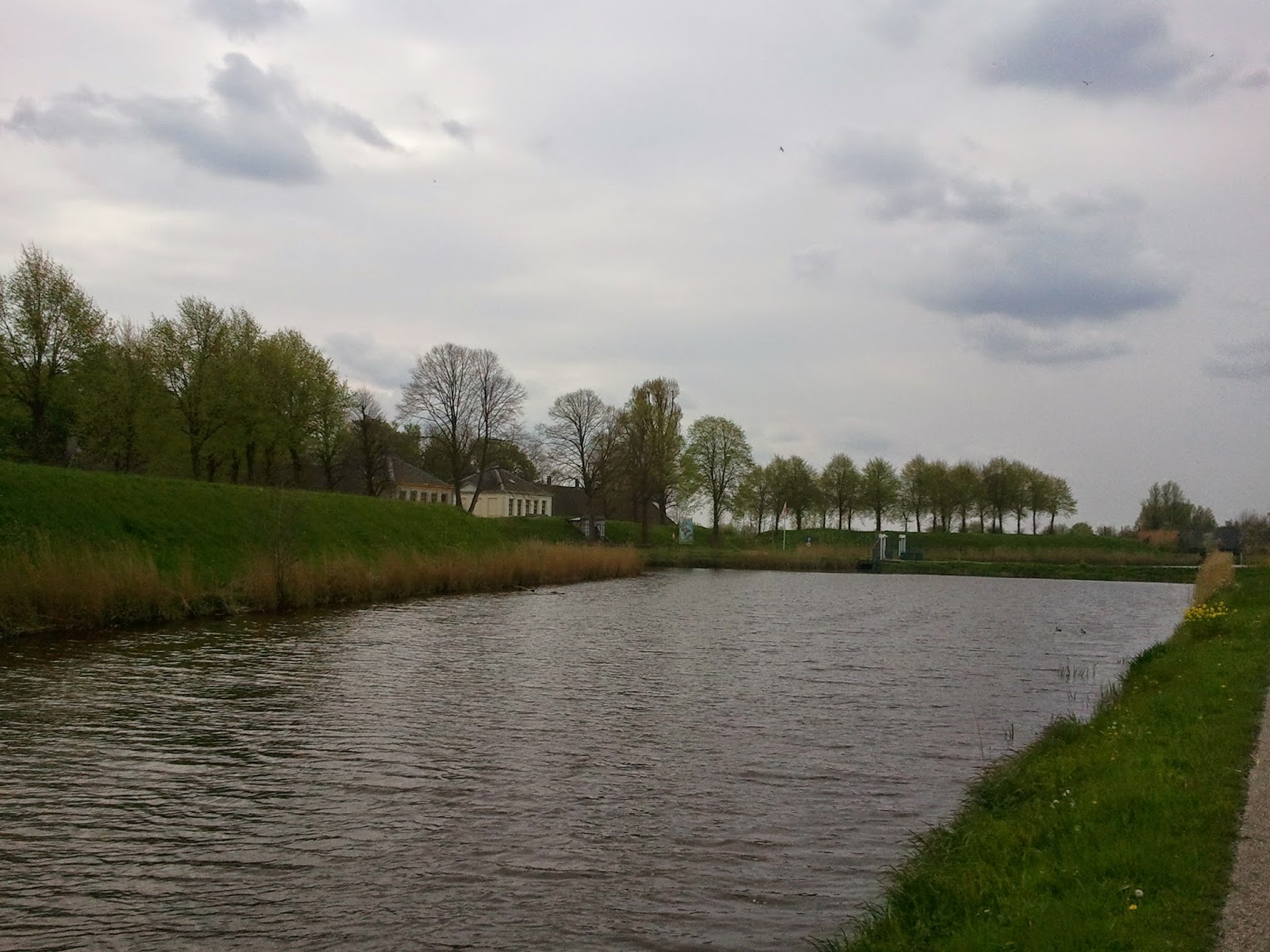
However, it took me through the two most heralded Dutch lines of fortifications: the Old and New Water Line. While the 17th century line runs from north to south (the IJsselmeer to the main rivers) to the west of Utrecht, the 19th century line runs to the east of the city.


The old line had it's day in the sun in 1672/3 when it stopped the best army and generals of its time. The later line was saved the embarrassment, although Dutch troops fell back in good order on the line during the night of May 13th and 14th 1940 after the breaching of the Grebbe Linie.

Fort Jutphaas in Nieuwegein now shelters a wine shop

Although in this case I didn't have enough time to make a relaxed visit, fort Jutphaas (and several others of the New Water Line) are within easy cycling distance of Houten, where my iron horse has now been parked. Once I get my tube fixed, I'll start exploring them.

Sunday, 16 February 2014

Review: Officieren aan het woord. De geschiedenis van de Militaire Spectator 1832-2007


Officieren aan het woord. De geschiedenis van de Militaire Spectator 1832-2007 by Ben Schoenmaker

My rating: 3 of 5 stars


Precursor of Schoenmakers' more detailed Burgerzin en Soldatengeest. While the latter is a detailed discussion of several Dutch military periodicals in the 19th century and the debates about the place of the military in a changing society, this book focuses on the history of the first and most popular magazine.

It is more institutional: the editors and appearance are as important as the content. It charts the change from a conservative to a professional magazine, although the road takes some twists.

Written as well as might be hoped


View all my reviews

Thursday, 2 January 2014

Review: Met man en macht. De militaire geschiedenis van Nederland 1550-2000


Met man en macht. De militaire geschiedenis van Nederland 1550-2000
Met man en macht. De militaire geschiedenis van Nederland 1550-2000 by Jaap Bruijn

My rating: 3 of 5 stars


Handbook, good scientific introduction to Dutch military history, written by people who mostly know their subject. High text to image ratio. Not the smoothest of reads. Combines naval, land and colonial (naval) warfare, which is a huge plus.


View all my reviews