Showing posts with label AWI. Show all posts

Thursday, 9 November 2017

Summer painting seamlesly devolving into beer and games

This is what I did for our club's Summer Painting Challenge (inspired by Curt's). Ran from late June till halfway September. I set myself 400 points to paint, although I felt 200 would have been more  realistic. In the end I ended up somewhere above 300 points, so setting the goal probably made me more productive than I'd otherwise been. That's a good thing I guess.


This was the main bit: a bunch of 18th century civilians, some scenery and goodies for scenarios and Frostgrave. And a bunch of farm and pack animals for the same purpose.


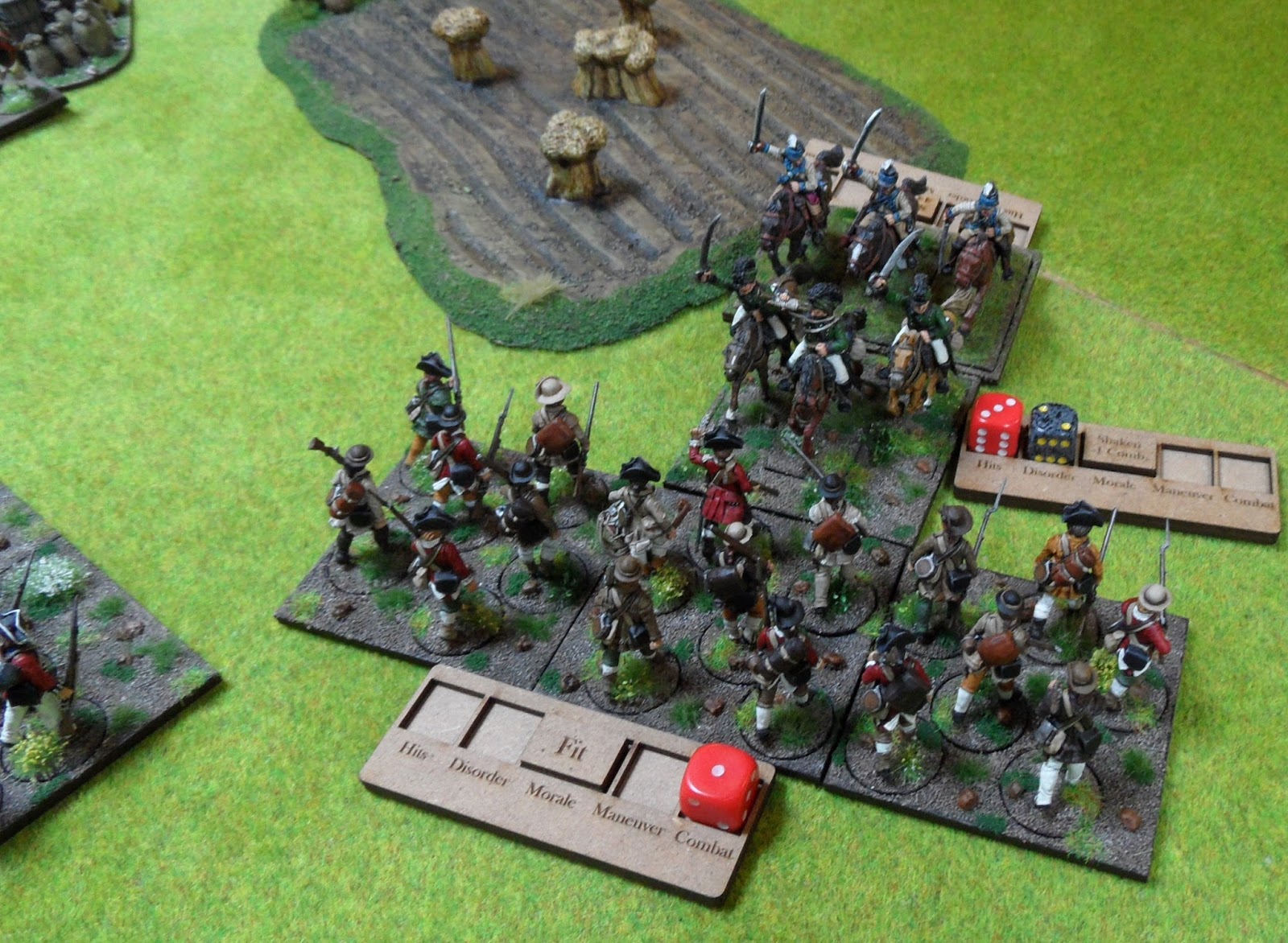
But I also finished a unit of British light infantry for AWI. This is them still glossy because I didn't get them sprayed with matt varnish before the received their baptism of fire.


Ten wargamers got together in September for a Wargame Beer and Game session, with me hosting Rens and Henny for a practice game of Sharp Practice 2, and seven other guys doing a Big Chain of Command game. Beautiful table!


And a very good dinner was had afterwards.

Monday, 21 November 2016

Last post before the AWI battle

(AWI project retrospective, part 9)

I wrote this post at the end of an evening where I had based my prospective army for the big battle. It’s the worst job I can think of in preparing a wargaming army. I resent it like nothing else. And yet, this meant that I was about to finish the job. There was this relaxed sense that I would make this deadline.


And not just make it. Sunday morning sun rising, I had ready all four regiments of Smallwood’s brigade present at the battle of Camden. And more: woodland Indians, Stockbridge Indians and surplus militia. That was far beyond what I had thought to achieve when starting on this journey almost a year before. I even slipped in painting three Dark Age houses.


That doesn’t mean there wasn’t a pile of pewter and plastic left waiting for me still. Some last Indians and militia, several units of British and loyalist troops and the 2nd South Carolina regiment. But that was all beyond the task I had set myself, so no worries there. I was just proud of my achievement irrespective of the outcome of the game.

In further developments in preparation for the big day, I did manage another test game of Land of the Free. This was very useful. Needless to say I got my behind handed to me by Patrick. SO I decided to read through the rules again and again, because I kept finding rules I’d overlooked or misinterpreted.


Apart from the painting challenge and the rules, and in direct contradiction to my intentions at the start, this has turned into a reading project as well. Over a dozen Ospreys somehow came into my possession, and a further dozen paper and digital books on the AWI. And somehow I managed to read most of them.

I was first infatuated with the militia side of the war; then the Indian conflict grabbed my attention. Four of the books I bought on my summer holiday to the UK dug deeper into the subject. I discovered the Black Dragoons of South Carolina, and how choosing to become a loyalist sometimes depended more on the side that the people you hated chose, than on your ideology.


But the crown on my reading spree has been Barbarians & Brothers by Wayne Lee, a brilliant book weaving together the civil and colonial wars in England, Ireland and North America from the 16th to the 19th century. Lee explains how conflicts between civilians and between cultures turned much more violent than between regulars. This clash of regular soldiers, warriors and citizens in these centuries, and more specifically in the AWI, has proved a fascinating discovery that I had not expected a year ago.

That legacy will endure.

This blog was first published on the Wargames, Soldiers & Strategy blog on August 23rd 2016

Friday, 18 November 2016

Seeing the elephant

(AWI project retrospective, part 8)

The painting progress was quite satisfactory in May and June. I finished a small group of Stockbridge Indians (which were allied to the rebels) and a large group of Woodland Indians. I also managed to construct a few wooden cabins and a load of wicket fences.


This happily coincided with an occasion for all my painted units to see the elephant. In May we played a game of Land of the Free with some of the participants in the AWI project. As we were all novices to the set, Jasper gave us an introduction to the rules. That helped a lot; I now at least had a basic grasp of the mechanics.


There is ample appreciation in LotF for the problems of command and control, and I think the activation system works fine. Movement and fire are pretty standard. The charge mechanism, in combination with the morale rules, as so often seems to be the Achilles heel and it will take some effort to master. We didn’t the advanced rules at the time, so that Indians operated the same as light infantry. No need to say that I was happy to move on to advanced rules as soon as possible!

The game itself turned out in our favour, largely due good initial positioning, good use of cavalry and some lucky dice rolls. I was able to concentrate my regulars and militia before the enemy regulars could reach the battlefield. The cavalry was used a bit as a Napoleonic shock force, which seems anachronistic, but worked because it operated on the flanks. And lucky dice rolls… well, Napoleon had something to say about that.


My troops generally acquitted themselves well. The Continentals, positioned at the anchor of my line, took a serious pounding but stayed in the field and dealt out in equal measure. The militia was tentative but provided valuable support. The delicate Stockbridge group got severely punished for its small but crucial contribution, and the Indians didn’t get into the fight.

All in all a good first impression, that would need a few more test games to play smoothly in August. There was still the uniformed militia and some officers to finish before then as well, but was getting confident that these would be ready well in time. Something I hadn’t expected to say when I started out in December!

This blog was first published on the Wargames, Soldiers & Strategy blog on June 16th 2016

Thursday, 17 November 2016

The Model Militia

(AWI project retrospective, part 7)

Incredibly, in April managed to finish a big unit of Continental infantry! Less busy-ness at work and more determination saw me accelerate, and I even picked up the next batch of uniformed militia. Enrolling militia into Continental units was a regular feature in the South after the bulk of the Continental units there had surrendered after the siege of Charleston in May 1780.


Slowly running out of militia to paint, I wished to round off my triptych on the subject, and the best way was to look at the legacy the militia system left. Because as somebody who has a footing in Napoleonic history, the American militia first appeared as an icon that others tried to emulate.

Before the Age of Revolutions, the European battlefield had been dominated by mercenaries. These soldiers served for money, not to protect their homes or their rights. In most cases they were recruited from the lowest classes of society and kept in place by brutal discipline. Of course, remnants of the old chivalric way of war remained among the officer class, but it had been subjected to the demands of the early modern state.

That changed in the late 18th century. With closer identification of the individual to his fatherland, the preferred type of soldier to serve the nation shifted from the professional soldier to the armed citizen motivated by love for his country and ideals. Surely the latter would be more committed to carry the struggle to its successful conclusion?

In this light, the use of German troops on the American continent confirmed the revolutionary frame that freedom loving citizens were suppressed by rigid automatons serving a tyranny. French newspapers and commentators were quick to pick up the image of the intrepid citizen soldier, who elected his own officers and made up for his lack of discipline with revolutionary zeal.

As it was, the revolution provided the first test case for the armed citizen in ages, and rightly or wrongly, to European observers it appeared a resounding success. Lexington, Concord and Bunker Hill inspired the Dutch Patriots who formed societies practicing drill. However, those Patriots were easily beaten by Prussian regulars in 1787.


The amateur soldier made a comeback during the French Revolution. First, politically motivated volunteers joined the army in 1791 and 1792. When these proved unable to save the revolution, mass employment of conscripts saved the day. And the Batavian Republic, the spiritual heir of the Dutch Patriot movement, again attempted to build on citizen soldiers for the defence of the state.

Eventually, the limitations of volunteer forces were outshone by the success of conscription in mobilising mass armies. And with the increased convergence between nation and state in the 19th century, the intrinsic motivation of the citizen could now also be assumed to inspire professional soldiers. Accepting the dominance of regular armies on the battlefield, by the 20th century revolutionary movements relied mostly on irregular warfare.

The historical question whether the militia was the key to the revolutionary victory has always been about more than just the American revolutionary war. As closely as it was linked to the concept of the nation in arms, the answer could never fail to impact the ideological struggle about which type of army best fits a democratic society.

Over time, the lack of success of citizen armies on a voluntary basis has clouded our view of the militia in the American Revolution. But as we have seen, it was the combination of militia and regulars that ensured the final victory. Neither could succeed alone.

This blog was first published on the Wargames, Soldiers & Strategy blog on April 13th 2016

Tuesday, 15 November 2016

The Militant Militia

(AWI project retrospective, part 6)

So I finally finished my  second militia unit in March. There was a point I thought it might never happen, even though the minis were close to completion. But then I overcame painter’s block, dipped and immediately started out on my Continentals. I was happy with the progress and happy with the results.


While I was painting these troops, I wondered what made these men put their life on the line for something ephemeral as liberty, in what was arguably one of the most liberal environments of its time. Surely some of these men will have been ideologically motivated, but I haven’t come across recent literature that suggests this was more than a minority of combatants. What gave the militia its strength were its firm roots in local communities, and motivation to fight was maintained by family ties and larger networks of patronage.

For a long time after the revolution, it was not done to acknowledge the existence of a large part of the American population friendly to British rule, or even indifferent to the cause of the revolution. These days this fact is a much more commonly accepted, and estimates of loyalist population range from one in six to one in three. British commanders at the time were convinced that the majority of the population in the southern colonies would welcome them. This was the reason they shifted troops and resources from the north southward in 1779.

However, they found it hard to rally local support unless British troops provided security. Part of the reason for that is that the same pitfalls which made the militia such an unreliable military instrument, made it so effective politically. Widespread military presence secured political control of the area. There is ample evidence that patriot militias exacted a heavy toll on loyalists in their communities, appropriating their goods for the cause of liberty.


And indeed, the opposing militias treated each other harshly. Prisoners could expect physical abuse and risked being executed; and each incident invited retaliation. Especially in the south local conflict escalated into a civil war. Not for nothing did tens of thousands of loyalists flee the area as the British left, including about 20,000 that had served in the British army or loyalist militias.

As most militia didn’t wear uniforms, it was hard to tell the difference between combatants and civilians. It allowed them to harass the enemy and blend into the population afterwards. In frustration, the British sometimes took retribution on communities, thus creating a circular dynamic of retaliation. In a sense, this blending of civilian and military roles thus drove the conflict towards total war. Some later commentators, argued that therefore it was truly a revolutionary war, presaging the ideas of Mao and Che Guevara….

This blog was first published on the Wargames, Soldiers & Strategy blog on March 18th 2016

Monday, 14 November 2016

The Mercurial Militia

(AWI project retrospective, part 5)

Few discussions on the American War of Independence have been as lively and enduring as that on the militia. Its proponents, pointing at the impact of Lexington, Concord and Bunker Hill, claim it as the winning factor in the conflict. Detractors bring up the desperate correspondence of US generals decrying the inability of militia to win big battles. So who is right?


As you may have gathered from my previous post, I am unwillingly but irrevocably drawn to the history of the period. What seems to attract my interest most, is the widespread use of militia forces. Let me try to explain my fascination.

Even more so than in the northern states, militias dominated warfare in the south. First of all, because the main effort by the Continental army was and remained in the north, but also because by the time the British strategy was redirected to the south, the British commanders increased their efforts to enlist loyalist inhabitants to their cause.

The main problem of the militia was its unpredictability. No commander could tell how many would show up at muster, because most men decided themselves whether the work at home was more pressing than duty in the field. Militiamen deserted when it suited them, perhaps considering the enemy either too far away from their homes, or too close. As Washington once quipped: “here today & gone tomorrow”.

Similarly in battle, militia units could not be counted upon. The quality of the units varied depending on who turned up and discipline tended to be lax. Later in the war, militia units might be bolstered by returning veterans from the Continental army. So a unit could run one battle and stand the next.

At Camden, the Virginia and North Carolina militias almost entirely ran without putting up a fight. But not much later, almost the same militia forces achieved a notable success at Cowpens where they were handled with consideration for their specific character and in combination with Continentals.

Still, the role of the militia off the field of battle was probably more important than on it. Maintaining military control over areas ensured political control, which in turn harnessed supply of men and materials for the wider war. Knowledge of local terrain and situation made the militia an indispensible partner on an operational level.

And given the scarcity of regular troops, especially in the south, the allegiance of large parts of the colonies was in the hands of regional militia forces of both sides. And this contest was generally won by the revolutionaries.

So while the militia on its own could not have forced the British Empire to acknowledge American independence, a regular army on its own could not have sustained itself.


This blog was first published on the Wargames, Soldiers & Strategy blog on February 25th 2016

Friday, 11 November 2016

Read it and weep!

(AWI project retrospective, part 4)

Although I got my painting mojo back in January, progress was not prodigious. I got about halfway into my second militia unit of eighteen figures. So it was probably a good thing I was too late entering the Painting Challenge. Better to tell you a bit more on my other line of preparation for the battle in August.


At the start of this project I kept telling myself I wasn’t going to read upon the background of the Revolutionary War. Just focus on painting, and be done with it. But there I was browsing through new books about warfare in North America in the second half of the 18th century. And a group of us decided to recreate on the Battle of Camden for the battle in August.


Of course, there are the Osprey books for uniforms and equipment, and the campaign series offers good introductions to the battles. The recent combat series book on the combat tactics used by both the British and the rebels in the Southern campaign adds new light by using more contemporary eyewitness accounts. And there was a new campaign book about the Battle of Camden planned for publication in March, so that seemed like an obvious addition to my AWI shelf.

But all that proved to be just the beginning. I started out with a little gem I have long kept: Greg Novak’s “We have always governed ourselves” about the organisation and strength of both armies in the northern states, later expanded as the two-part American War of Independence.


Then Jasper Oorthuys (who also introduced me to Muskets & Tomahawks) pointed me to With Zeal and With Bayonets Only by Matthew Spring, about the development of the strategy and tactics of the British army in North America. Then there was John Grenier’s First Way of War about frontier warfare against the indigenous population. Although it only briefly talks about the Revolutionary war, it gives a good account of the style of warfare that the Americans were used to and which they would also employ against the British, and against their patriot neighbours.

So apart from painting project, this also turned into a reading project. Oh noes!

This blog was first published on the Wargames, Soldiers & Strategy blog on January 14th 2016

Thursday, 10 November 2016

Painting mojo

(AWI project retrospective, part 3)

Progress had not been good since my previous post. But nothing helps to get you going like playing a game and seeing other people’s progress. In November 2015 over a dozen Dutch gamers came together to try out a couple of rule sets, among which Land of the Free. You’ll be hearing more about this rule set later.

As the meeting included quite a few of the people in the AWI project, the post-game chat provided some more inspiration. As a result, I got my minutemen to the point where they could be dipped.


At the games day I also received the new miniatures from the communal AWI order. Some more militia and Stockbridge Indians to complete my rebel force, and also some British and loyalists. I needed some opposition, didn’t I? 

I considered signing up to Curt’s (of Analogue Hobbies) Painting Challenge. It’s good to have that extra motivation to paint. The challenge runs from December to March so effectively three months in the darkest period of the year. Dozens sign up, and I always look enviously at their results. As tempting as that seemed, I didn’t get round to signing up and I wasn’t as productive in the winter as I’d have liked.

This blog was first published on the Wargames, Soldiers & Strategy blog on December 3rd 2015

Tuesday, 8 November 2016

First world problems

(AWI project retrospective, part 2)

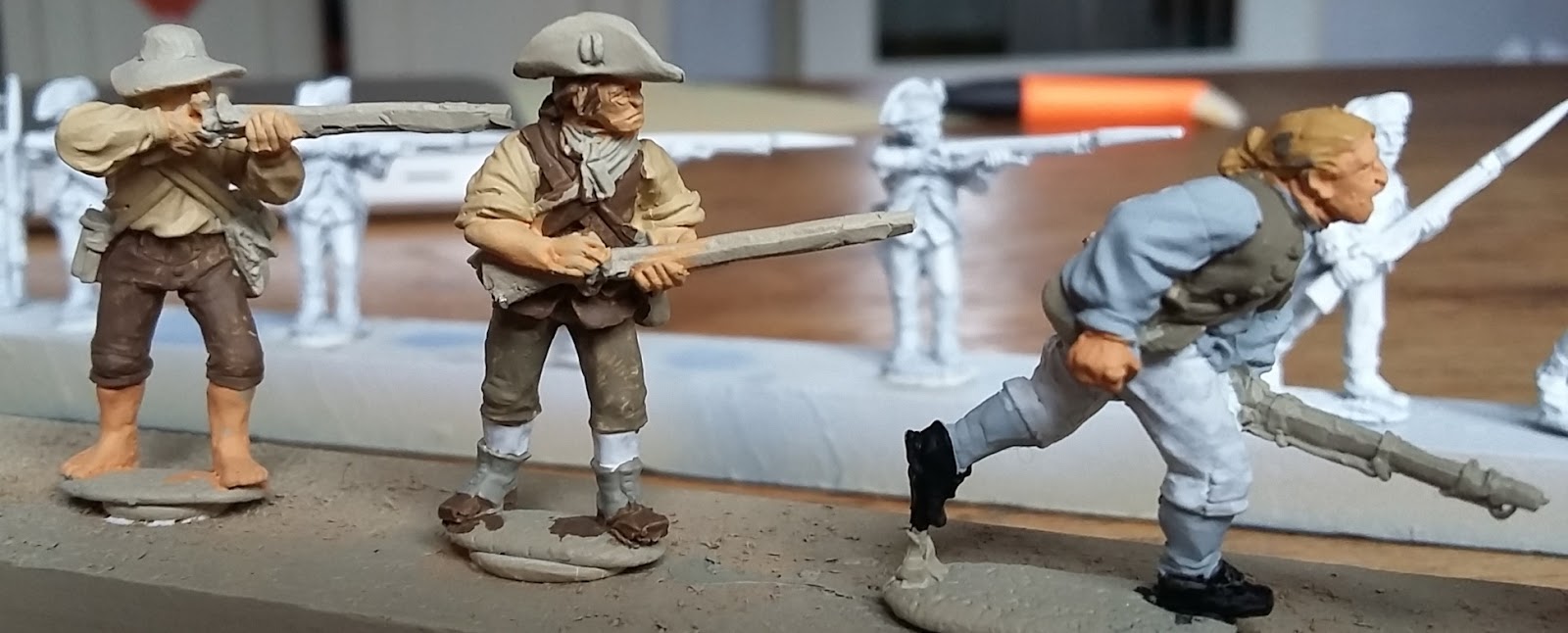
 I left you just about when I was picking up my can of spray-paint to lay down a base coat for my minutemen. This was all still very much in that first wave of excitement I told you about. In fact, in that weekend I got a considerable amount of brush painting done as well. This left me with a few questions of painting technique.


Just so you know: I’m a pretty mediocre painter. I lack practice and have spent years hardly painting at all. Due to time constraints, a few years ago I overcame my antipathy towards letting somebody else paint my miniatures and in this way I have obtained beautiful Dark Age Saxons and WWII Americans for skirmish games. I have even bought armies and single units, so that I now have a nice medieval Norman force and an eclectic collection of fantasy figures.

But as you may have noticed I’ve found I quite enjoy the painting, and when a limited amount of miniatures is combined with a reasonable deadline, I even get things done. Which is why 80 miniatures and 10 months seemed so attractive. But I still realised I wasn’t very good at painting and quite slow. To save time I adopted the army painter philosophy, which I used previously on my Prussian Landwehr and some medieval monks. Overall I’m pretty pleased with the results.

But what about highlighting? Experience suggests that only extreme highlighting works in combination with dipping (although I don’t actually dip. Does anyone really dip?). I finally decided against it as I was displeased with test result.


My other question was how to get a good balance between diversity and uniformity for my minutemen. I’ve seen some beautiful examples of far better painters than me using understated hues to great effect: no miniature is the same, but there is a real sense of unity to them.

What I was afraid of was having a very colourful collection of minutemen who would not look very good as a collective. And of course, even if I managed to configure a balanced palette, I’d still be a mediocre painter, and it wouldn’t look as good as the pros.

You know… first world problems!

This blog was first published on the Wargames, Soldiers & Strategy blog on November 5th 2015

Monday, 7 November 2016

To explore strange new worlds

(AWI project retrospective, part 1)

There’s no feeling like starting on a new project. The adrenaline rush of exploring a new topic, the possibilities opening up, the ooooh shiny!

So I was very excited as two dozen Dutchmen embarked upon the new adventure to recreate a number of battles from the American Rebellion all on one day almost a year from now. And in this case the good news was that I was slightly ahead of the pack as I already had the relevant miniatures at home.


Actually, I had just been contemplating what painting project I was going to take on for 2016. My Foundry Americans were high on the list because I wanted to play Musket & Tomahawk, a rule set that I liked straight away when I played it first. That was right up my alley then.

In fact, my force was already about complete. I had about 80 miniatures consisting of Continentals, militia and minutemen. They could be used as a 400 - 500 point force for M&T, but also as about a brigade’s worth in other rule sets. Maybe a few additions would be needed, but I really didn’y plan on overdoing it because this was about the number I could see myself finishing in the period set.

Just to make life difficult for myself, I was enticed to participate in a combined purchase of miniatures. The siren’s call of creating an opposing force for my Americans proved too strong. Some British regulars and a few loyalists… Okay, and maybe some militia from the Southern states, and a few Continentals to create the right size of units. Inevitably, this resulted in me having to paint more.

Of course then loomed the choice of units, which would decide the uniforms to be painted. To put off this important but time consuming question, I decided to start out on my minutemen. So the enterprise began…

This blog was first published on the Wargames, Soldiers & Strategy blog on October 8 2015.