Showing posts with label holidays. Show all posts

Tuesday, 5 November 2013

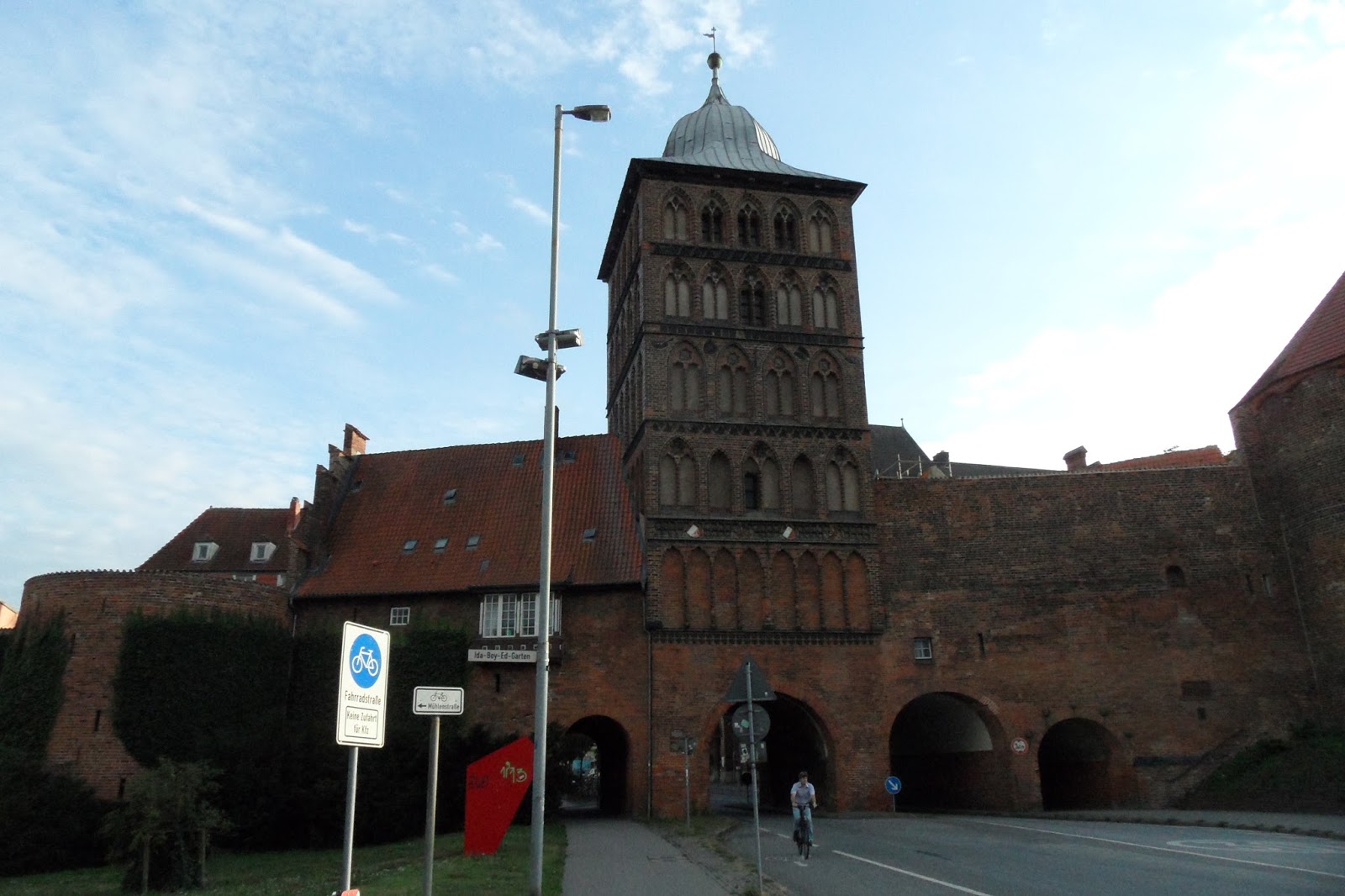
Blücher at the Burgtor

It is time to set the spotlights on Gebhard Leberecht von Blücher, the charging Hussar general who once believed he was pregnant with an elephant (true story!). That didn't stop him from some prodigious feats on the battlefield while in his seventies and of giving Napoleon and his marshals a few bloody noses.

The Burgtor, or Castle Gate

This is the site from where he made the leap to national hero. On holiday in Hamburg last summer, we made a day trip to Lübeck and the nearby beach at Travemünde. When you enter the town from the east, you do so through the Burgtor.

Commemorative plaque on the wall of the gate

In the autumn of 1806, with the Prussian army in flight from its humiliating defeats at Jena and Auerstädt, Blücher was one of the few that kept ahead of the furious French pursuit. On November 5th his troops reached Lübeck and he set out to prepare the city for defence.*

The Burgtor from a slightly different angle

Next day the French attacked the city and managed to enter through the Burgtor, which was defended with little competence. Desperate counterattacks failed to throw the invaders back and Blücher's chief of staff, Scharnhorst was taken captive. The general himself managed to fight his way out of the city with the remnants of his force. However, on 7th November his men and ammunition were exhausted and there was nowhere left to run as they had entered Danish territory. The general realised that further resistance was futile and accepted a French demand for surrender.

The fight for the Castle Gate from a contemporary  print
(wiki commons)
* Some of you will know that Lübeck was then still an independent city. Blücher demanded access to the city from the city council. The French sacked Lübeck as they would have any defended city, not knowing that it had been against the wishes of the population.

Friday, 1 November 2013

A Lonely Wargrave, or not so lonely

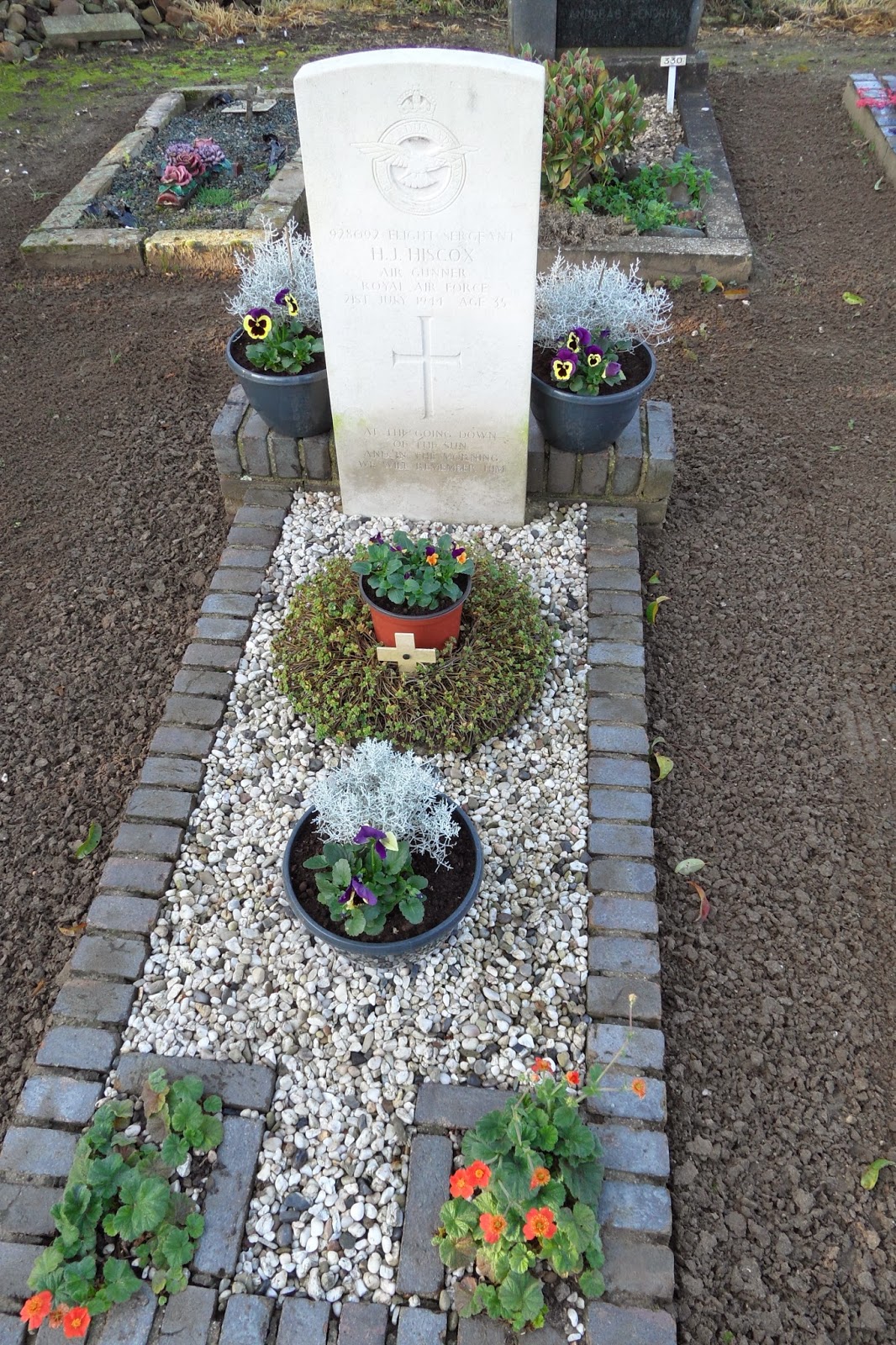
Found last week on the cemetry of Beesel, Limburg. On the eastern bank of the Maas (or Meuse, as the French say)


The grave contains the body of  RAF air gunner, Flight Sergeant H.J. Hiscox, a New Zealander whose Lancaster crashed in July 1944 a few miles away on the way back from a bombing run on Homberg in Germany. There is a webpage in his honour.


As you can see, the grave is well looked after. One of the people we met there, preparing the cemetry for All Souls, told me a woman had been tending the grave for several decades now. Kids from the village learn of his history, also through the stories of his former comrades in arms. It is good to know that even this lone soldier is not forgotten.

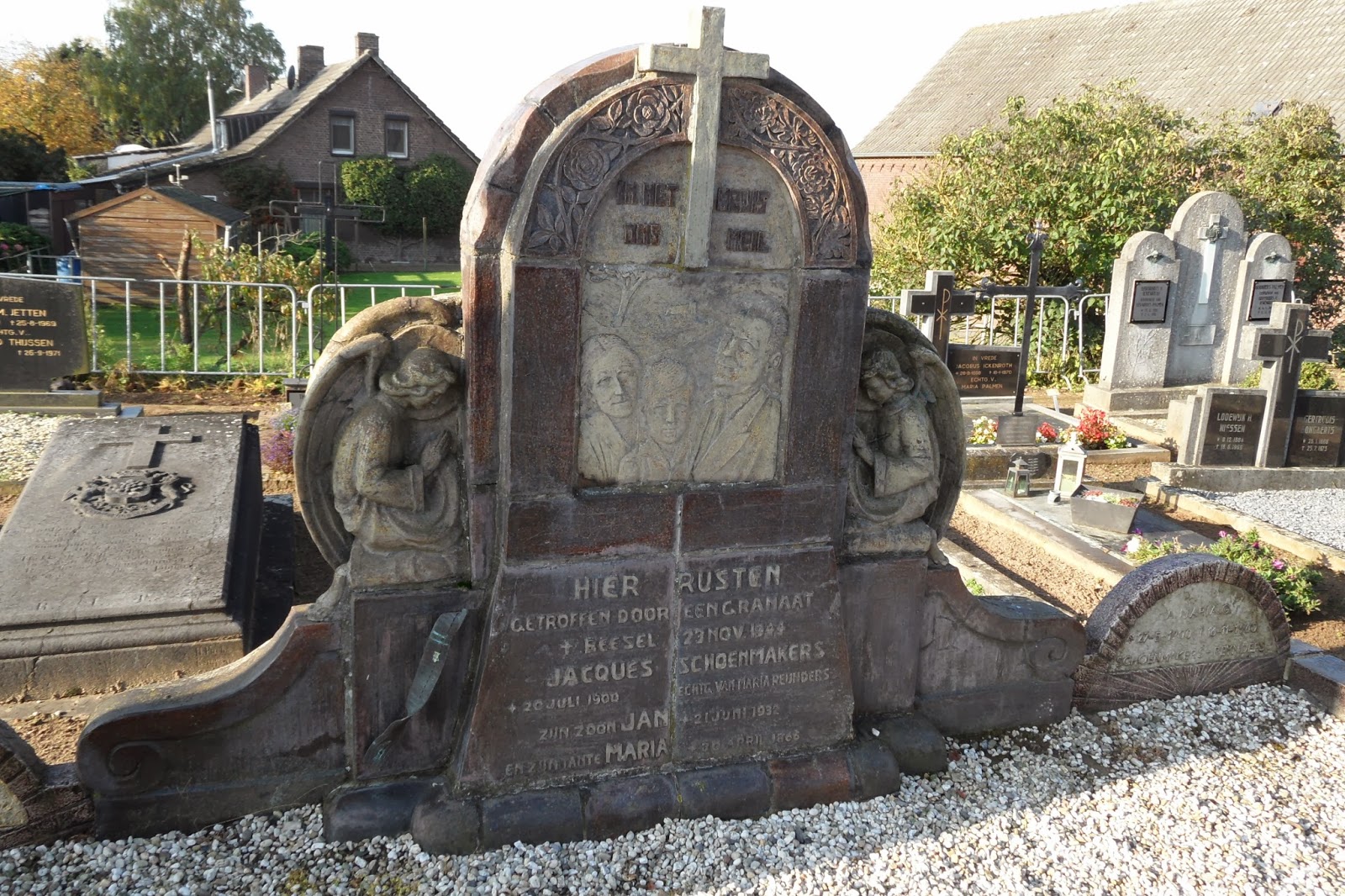
This area along the Meuse was in the frontline in from Market Garden until the Allies crossed the river in early March 1945. The cemetry also contains a grave of three local victims of the war, a father, his 12 year old son and his aunt, killed by a grenade or shell (the Dutch word granaat can mean either) in November 1944.


In those last months of occupation the Germans rounded up 3,000 young men from the western bank of the Maas to work in German factories. 120 of them didn't return.

A commemorative plate on the church in Nunhem


Saturday, 24 August 2013

Gomorrah in Hamburg

In the summer of 1943, RAF Bomber Command and the Eight USAAF took on the most important German port Hamburg, also a major industrial center. Over the space of a week in late July the American and British bombers alternatied day and night raids targeting industrial, but also civilian areas. It was called operation Gomorrah. I was faced with some of the remains during my trip to Hamburg last week.

Indestructible flak tower built 1942 in central Hamburg
By the RAF standards of the time, the initial raid was a success. This means that losses were light and over 40% of airplanes claimed to have dropped their load within 5 km of the target. Yes, let that last bit sink in. So the other 60%... indeed.

The low losses were due to the first time use of Window, small tin foil strips that messed up the German radar defenses so that the flak defenses were firing blind into the night sky. However, the Germans quickly recovered from the surprise and reorganised their air defenses accordingly.


Plaque commemorating the destruction of the previous
building in 1943 and the rebuilding in 1956
With the limited aiming techniques of the time, large parts of the urban area were hit, but more critically,a firestorm was caused as the heat of fires sucked in more oxygen. The fire raged for days as the exhausted fire brigades watched helplessly. This resulted in the destruction of 60 % of the city and the death of about 42,000 to 50,000 people, according to your source. Although the firestorm was unintentional, Bomber Command was impressed with the results and would later try to recreate the effect.

The success of the Hamburg raids for a few months gave the Allies the hope that they could bomb Germany out of the war, and even gave the Nazi and Luftwaffe leadership a great scare. However, the Allies didn´t pursue their advantage and the Luftwaffe quickly found counter measures and the balance swung back to favour the defenders.


The 1943 raids were not the first nor the last of the war.  Civilian morale recovered and fugitives returned. Within months most Hamburg factories were up and running again. So the RAF had to go back  By 1945 three quarters of the town had been flattened. Although as brutal as Dresden, the Hamburg bombings are not as notorious as the former, probably because they occurred with victory a distant prospect in 1943.

Friday, 23 August 2013

German bookshops, not like those at home

I went to Hamburg last week and was well intentioned to drop money on some books on the Befreiungskriege in 1813 as a context for the Waterloo campaign, the Prussian army of 1815 and how the remembrance of the Befreiungskriege and Leipzig in particular compare to that of Waterloo and the 100 Days Campaign. This is all the more interesting because Prussia (and some other German states) were the only ones involved in both battles.

Okay, five books on the Befreiungskriege is not all bad,
but the quality is mixed


The German brick & mortar book retail trade is dominated by the Thalia chain, which offers nice spacious stores with a reasonable general audience stock, including sizeable foreign language sections, and some local variance. However, their English language history section is as big as the German one.

The history sections of the independent book sellers I visited were comparable in size and scope, with the exception of the Heinrich Heine bookshop near Hamburg University, which was sadly renovating so it had only a small but interesting history selection on display. 

While the two big tomes are serious books for a broad audience, they differ in scope. Platthaus' a lively record of the actual battle, Krause's looking at the whole era of Prussian reform and ousting of French influence. Gabriele Hoffmann's book on the fate of Hamburg in 1813 and 1814 under the heel of Marshal Davout offers warm portraits of leading and not so leading participants through their private correspondence. Especially the contrast of Davout's harsh official commitment to the Napoleonic cause and his devoted but also business like relationship with his wife has struck me.

The two smaller books offer shorter introductions on the battle of Leipzig and Freiherr vom Stein. Von Stein was not only the reformer of Prussia after the 1806 defeat, but also the administrator of the areas 'liberated' by the allies in 1813. As such he had enormous influence on events behind the front in Germany, and the perspective of his regime will ahve influenced the choice of Dutch rebels against Napoleon in late 1813.

Colonial, Weimar and the mobilised nation


As a secondary objective, I was looking for books on WWI which, although in torpor, is still a topic a fancy taking on at some point in the future. But even a year before the commemoration starts, bookshops are eerily silent. Yes, lots of stuff on WWII, the Holocaust. Also lots of stuff on Prussia (general history) and Frederick the Great in particular. But the 1800-1923 period almost seems not to have happened.


Guido Knopp's history of Germany's overseas empire gives an interesting and well illustrated overview of Germany's 'Places in the Sun' in Africa and the Pacific, while also venturing into those promoting colonial expansion in Germany. The small Reclam series of cheap editions of classic books offers a bargain, which I could not resist an in depth history of the ill-fated Weimar Republic, which combined chronologic with thematic chapters. Lastly, Lutz Raphael's book looks at the social and political consequences of national mobilisation in Europe in both world wars and in between. Refreshing to have such a broad spectrum book from a non-Anglo-Saxon perspective.


I finally picked up a nice essay on the nature of war by French  philosopher Myriam Reveault d'Allonnes and an intreaguing book on the Art of Capitulation. It looks at the structure of society and war aims and how they determine the ending of wars. Could prove an interesting counterpoint to James Whitman's The Verdict of Battle and Russell Weigly's The Age of Battles. I have my problems with the concept of decisive battles, and these books give me some perspective.

Sadly, too little time
And finally a recommendation if you get to Hamburg and you're a military history buff and like in depth stuff on German (WW2) tanks, aircraft and ships. At the Bernhardt second hand book store you should have a field day. There´s much more than just WW2, but you catch my drift. It´s at Johanniswall 3, within 5-10 minutes walk from the Hauptbahnhof. Sadly not enough time and not on my subjects so I left empty handed.

So I was a bit disappointed with what I could pick up on my preferred subjects, but I ended up with a nice stack anyway.

Tuesday, 20 August 2013

Evidence of Derrick's guilt turns up

I read the news today, oh boy...

Horst Tappert, the German actor famous for his role as inspector Derrick in the series with the same title never talked about his war record. Recently, it was revealed he'd been in the SS and now physical evidence has turned up.

Like in a good Krimi, good research gets the bad guy in the end.

Monday, 7 January 2013

Wandering in the past in the Czech Republic

I spent last week near the Giants' Mountains in the Czech Republic. On account of most people opting for alpine joys, there was little in the way of cultural refinement. The surroundings would have been promising, since our base was near Jicin, the main town in the famous Imperialist condottiere Wallerstein´s domains.

At least I had a closer look at the local brewery on a hike I managed to make. It looked pretty old.


A neat but disused building just outside Nova Paka

There was a hint of the old imperial legacy in this war monument to the fallen in WWI. Not a conflict many Czechs would feel proud of.


And in downtown Nova Paka, the once glorious Hotel Central had now been taken over by a nice Vietnamese textile salesman.
Note the plastic flowers at the entrance
And even though I didn't get to taste the local beer, I tasted another. It still had this pilzner taste, but carried 11% of alcohol.
It's all a blur now

Such time as I could spend, I dug into Britain After Rome, Robin Fleming's account of the years between the Roman 'occupation' and the occupation by the Normans. There's a lot of interesting stuff in there, mostly because it has a firm grounding in archeological evidence. This often trumps the historical 'evidence', as I also noticed earlier in my review of Edge of Empire, which deals with the Roman presence in the Low Countries.

Gamewise, I managed a game of chess and a few games of Dobble (or Spot It) with the kids. But I pride myself on two victories at de Val van Rome (Struggle For Rome) my favourite version of the Settlers line. More about that tomorrow.

Wednesday, 19 December 2012

Memorial at the Chemin des Dames

For several years I visited the Champagne-Ardennes in France with a bunch of friends for a weekend in summer. We'd travel to nearby sights, and occassionally some battlefield trips. These are pictures of a trip to a French war cemetary and memorial at Cerny-en-Laonnois on the Chemin des Dames battlefields near Laon in 2007. The places on the plaques still resound: Craonne, Hurtebise, Cerny...

The chapel

The  Chemin de Dames offensive in the spring of 1917 was so mismanaged my French commander in chief, Nivelles, that mutinees broke out. Nivelles was replaced by Petain, who then proceeded to rebuild the army.


The cemetary outside