
Showing posts with label Quatre Bras. Show all posts
Showing posts with label Quatre Bras. Show all posts
Tuesday, 18 June 2013
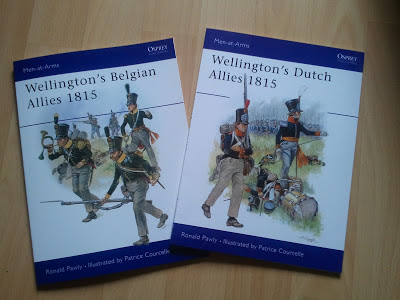
Dutch and Belgians at Waterloo Ospreys
Yes, the day before yesterday was the 198th anniversay of the Battle of Quatre Bras, and so today is that of the Battle of Waterloo. And then I found out I was not the owner of the two Osprey Men at Arms about the Dutch and Belgians in the campaign! Incredible. So I rectified that omission last Friday. I hope nobody noticed them missing in my collection...


Wednesday, 12 June 2013
All Shill For Quatre Bras book by Erwin Muilwijk
Also in the mail last week: Erwin Muilwijk's second volume in his history of the Dutch army during the Waterloo campaign: Perponcher's Gamble. This concerns the Battle at Quatre Bras, where a Dutch vanguard managed to hold out long enough for the rest of the Allied army to come up and hold the cross roads at the village.
Erwin's book fills some gaps that English (and other) writers have neglected to lack of Dutch language skills or the fact that Wellington was having a chat with Blücher somewhere else at the time. For them the battle only starts when Wellington returns.
The maps and illustrations add a lot to the story, because some episodes were confusing even to the participants. It helps to figure out what was going on and where. I heartily recommend the colour version to take full advantage of them, but for the cheapskates (and all others) there is a downloadable version of the maps.
The two extra contributions by Ab Küchler on the Quatre Bras painting by Pieneman and Marco Bijl on the Bois de Bossu also provide added value.
I did have a small role in getting this book to the printer, although I still think a native speaker would have done much better.
Next up is the book on the Battle of Waterloo itself, to be published in about a year from now. Must read for anyone that is interested in the Waterloo campaign or the Dutch army of the Napoleonic and restauration period
 |
| The black & white and the colour version |
Erwin's book fills some gaps that English (and other) writers have neglected to lack of Dutch language skills or the fact that Wellington was having a chat with Blücher somewhere else at the time. For them the battle only starts when Wellington returns.
The maps and illustrations add a lot to the story, because some episodes were confusing even to the participants. It helps to figure out what was going on and where. I heartily recommend the colour version to take full advantage of them, but for the cheapskates (and all others) there is a downloadable version of the maps.
The two extra contributions by Ab Küchler on the Quatre Bras painting by Pieneman and Marco Bijl on the Bois de Bossu also provide added value.
I did have a small role in getting this book to the printer, although I still think a native speaker would have done much better.
Next up is the book on the Battle of Waterloo itself, to be published in about a year from now. Must read for anyone that is interested in the Waterloo campaign or the Dutch army of the Napoleonic and restauration period
Wednesday, 31 October 2012
The Hero of Waterloo, part II plus Hermitage
Last Sunday
we went to the Hermitage in Amsterdam
In the
museum shop I picked up a book by Michel Didier, De Ridder en de grootvorstin. Kunst en leven van Willem II en Anna
Paulowna. This can be loosely translated as The knight and the Grand Duchess. Art and Life of … The book looks
at this couple mainly from an art historical viewpoint, but includes a lot of
biography. The advantage is that this also brings a lot of illustrations.
 |
| Willem was rarely out of uniform, nor were his sons |
For me the
interesting bits were how Willem’s actions at Quatre Bras and Waterloo
Didier is
not too sure on military details, as even I could spot. It is unlikely that
Willem would have received his honours for the battle of Nivelles already in
1814. Willem’s tactical abilities are not questioned but his bravery is
highlighted.
The book
also glosses lightly over the darker side of Willem’s life, the many scandals,
affairs and schemes and his political failures. I think this book (and
publisher, from the other books it publishes) is aimed at the loyal monarchist
crowd and therefor not too critical. What does get a fair amount of attention is the difficult relationship with Willem’s
father and other family relations, as well as dynastic concerns.
So not much
to recommend it to military historians, unless you have a particular interest in the artistic
expressions rendered in tribute or in commission of Willem. Or if you are a
loyal monarchist, of course.
Of course, this book was in the shop because of the link between the Netherlands and Russia, as the Hermitage's home is in Petersburg.
 |
| A interesting combination of two great artists:Van Gogh's 'copy' of a woodprint by Hiroshige |
The Van
Gogh collection is amazing and charts Vincent’s progression as an artist in
detail. From his peasant painter period to impressionism to expressionism,
continuously learning and adapting his style. And all this in the span of only
10 years. He must have been an exceptionally driven person.
 |
| It's hard to capture the mastery of this painting, as the picture of a postcard dulls the colours, but you can see how the strokework emphasises the lightfall |
We also
enjoyed the exhibition on the impressionists. I enjoyed how the exhibition
opposed the impressionist with the established art from the Academie Francaise
and how the impressionist were forced to create their own parallel network of
exhibitions. I found it telling to see that many of the impressionist, such as
Renoir, still attempted to gain access to the Academie, and thus to the
galleries and collectors.
The
exhibition really mixed impressionism, conventional artists and contemporary
event very well. You get this view from the perspective of Russian art
collectors that have wound up in the Hermitage collection.
Friday, 15 June 2012
The Hero of Waterloo? part I
Lately, I've been reading several books on the Waterloo campaign as a friend of mine is doing a biography of Dutch king William II, who fought in the Peninsula and at Quatre Bras and Waterloo. Friend's given me the Waterloo chapter in manuscript for a military history check. You can imagine how happy I am to help out!

William, then known as Prince of Orange, has a bad reputation in the English press, as many cock ups in the field are blamed on him. This new book (based on new research of primary resources from all participant nations) puts all that into a different perspective. It is supposed to be published in 2013 for the celebration of 200 years of The Netherlands. At some point (2014/5) the parts on the Napoleonic Wars are hoped to be published in English as well.
Looked at Geoff Wootten's Waterloo from the Osprey Campaign series, Haythornthwaite's introduction to Uniforms of Waterloo, Chandler's Campaigns of Napoleon and Hofschroers 1815 Waterloo Campaign, plus George Blond's La Grande Armee.

Chandler's book is still the standard work in English on Napoleonic warfare, even though published more than 45 years ago. You can easily trace his influence through other English accounts of the battle. However, the absense of German and Dutch sources (even those published in French) is a considerable limitation. Chandler can be a bit critical of Wellington when it comes to his deployments on 15th and 16th of June. The Prince of Orange only features in his narrative of Quatre Bras, not very condemning, so the negative attitude displayed by Haythornthwaite and Wootten must come from another source. I guess Siborne. It wouldn't be surprising if British officers after the war tried to put all problems at the door of a foreigner.

Haythornthwaite's book, first published in 1974, is of course more about uniforms and considering the references don't think the author did a lot of research on his account of the campaign and battle. No foreign language sources. The Brits are great, the Dutch-Belgians doubtful and William plain rubbish. Wellington of course can do no wrong.
Wootten ( the original publication is from 1992, I have a 2005 edition) still writes for a primary English audience but with more tactfull treatment of the allies. Book list not much improved on Haythornthwaite's. The Brits are still great, the Dutch-Belgians remain doubtful but William is now just inexperienced and doesn't seem to have so many battallions run down by French cavalry. He also notes that the Dutch held on to Quatre Bras in direct violation of Wellington's orders.

Blond's Grande Armee (published in French in 1979 and translated in 1995) hardly notices there being others than British at Quatre Bras and Waterloo, so wasn't much use.

Hofschroer (1998) is a different beast. It includes German, but also English and even a few Dutch sources. The Hof notes that William spend 2,5 years on Wellington's staff in the Peninsula and is therefor not totally inexperienced. Hofschroer mentions him generally in a positive light: leading the troops at Quatre Bras from the front, and doesn't point at his presumed mistakes. But as Hofschroer's objective is not a close description of the military events of the Anglo-Dutch army, William mostly appears as a conduit of Wellington's misinformation to the Prussians. Since the book is mostly a revision of English dominated historiography of the campaign, Hofschroer is critical of Wellington's conduct of the campaign and his dealings with the Prussians.

William, then known as Prince of Orange, has a bad reputation in the English press, as many cock ups in the field are blamed on him. This new book (based on new research of primary resources from all participant nations) puts all that into a different perspective. It is supposed to be published in 2013 for the celebration of 200 years of The Netherlands. At some point (2014/5) the parts on the Napoleonic Wars are hoped to be published in English as well.
Looked at Geoff Wootten's Waterloo from the Osprey Campaign series, Haythornthwaite's introduction to Uniforms of Waterloo, Chandler's Campaigns of Napoleon and Hofschroers 1815 Waterloo Campaign, plus George Blond's La Grande Armee.

Chandler's book is still the standard work in English on Napoleonic warfare, even though published more than 45 years ago. You can easily trace his influence through other English accounts of the battle. However, the absense of German and Dutch sources (even those published in French) is a considerable limitation. Chandler can be a bit critical of Wellington when it comes to his deployments on 15th and 16th of June. The Prince of Orange only features in his narrative of Quatre Bras, not very condemning, so the negative attitude displayed by Haythornthwaite and Wootten must come from another source. I guess Siborne. It wouldn't be surprising if British officers after the war tried to put all problems at the door of a foreigner.

Haythornthwaite's book, first published in 1974, is of course more about uniforms and considering the references don't think the author did a lot of research on his account of the campaign and battle. No foreign language sources. The Brits are great, the Dutch-Belgians doubtful and William plain rubbish. Wellington of course can do no wrong.
Wootten ( the original publication is from 1992, I have a 2005 edition) still writes for a primary English audience but with more tactfull treatment of the allies. Book list not much improved on Haythornthwaite's. The Brits are still great, the Dutch-Belgians remain doubtful but William is now just inexperienced and doesn't seem to have so many battallions run down by French cavalry. He also notes that the Dutch held on to Quatre Bras in direct violation of Wellington's orders.

Blond's Grande Armee (published in French in 1979 and translated in 1995) hardly notices there being others than British at Quatre Bras and Waterloo, so wasn't much use.

Hofschroer (1998) is a different beast. It includes German, but also English and even a few Dutch sources. The Hof notes that William spend 2,5 years on Wellington's staff in the Peninsula and is therefor not totally inexperienced. Hofschroer mentions him generally in a positive light: leading the troops at Quatre Bras from the front, and doesn't point at his presumed mistakes. But as Hofschroer's objective is not a close description of the military events of the Anglo-Dutch army, William mostly appears as a conduit of Wellington's misinformation to the Prussians. Since the book is mostly a revision of English dominated historiography of the campaign, Hofschroer is critical of Wellington's conduct of the campaign and his dealings with the Prussians.
Subscribe to:
Posts (Atom)