Showing posts with label megagames. Show all posts

Saturday, 24 May 2014

Exciting Megagame News!

All kinds of good news on megagames these days. Of course I had a good demo of the Monsters game Friday a week ago (will provide more info later).

A Global News Network Bulletin

But it gets better. The guys from Shut Up & Sit Down participated in the Watch the Skies megagame in London and were hooked. See the excellent video they made.


Really good impression of what it's like to be in a megagame. Also, the Global News Network bulletins are up on the Megagame Makers facebook page. Fun to read!


There will be a megagame in the Netherlands on August 30. In the spirit of tradition it will be Operation Market Garden, just like we did in 1994 and 2004. The game will run in Nijmegen. Run to the MegagamesNL webpage for more info and registration.

The game will also feature a planning game for the allied HQs to determine the plans of attack and more detailed instructions for Corps Boundaries, Supply Routes, Drop Zones, Landing Zones etc etc. Should be lots of fun!


The next megagame in the UK will be Iron Dice on September 20th, the opening moves of WWI. Highly recommended as well!


Friday, 19 July 2013

Godzilla in Amsterdam - A Civilian Crisis Game

From the dark water it rose. The ferry rolled heavily to port as the frightened passengers stared incredulously into the air and the fiery eyes of the monster. Their panicked cries smothered in the waves as the boat capsized into the river. Without noticing, the monster made landfall, placing its feet carelessly on and between the sleepy crowd of early commuters at the Central Station. As fear spread quickly, soon the alarm rang at all police stations and the mayor was awakened. Within an hour the crisis team was convened at the mayor's office, determined to deal with the thread as it presented itself.


As nobody knew Godzilla's drive and had no way of dealing with her, the first efforts were aimed at saving the roaming tourists and local population. Entrance into the town centre was blocked. Another objective was to save as much of the art treasures and monumental areas of the town for future generations. With Godzilla striding towards Museum Square, this became an increasing concern.

But while a team of brilliant scientists was set up to deal with the monster, the local services proved quite capable of limiting the immediate destruction. The fire brigade limited fires around Godzilla to a minimum, tourist were led out of town. And then disaster struck...

The Game Map
Fearing the potential damage to the Rijksmuseum, the Van Gogh Gallery and the monumental Concertgebouw, the government had ordered the air force to prepare an air strike. The air force took this as a remit to actually bomb and laid all its powers of annihilation on Godzilla, destroying large amounts of fire brigade and ambulance material. The museums were levelled as hysterical conservators frantically laid down their lives in a heroic, but utterly futile effort to save Rembrandt's Night Watch and Van Gogh's Sunflowers.


All to the displeasure of the monster, which only became more enraged and determined to reach its goal. With the government and the rescue effort in shambles, all hope was laid in the hands of the scientists, who had been happily discussing alternative theories of Godzilla's descent and interesting evolutionary traits not commonly known in other bipedal reptiles.

They were rudely awakened to the enormity of their task and despite their pleas to save the specimen for future scientific research, they were persuaded at last to rather render their services to save human lives. The solution then proved relatively simple.

In the meantime Godzilla had continued her way leaving a smouldering wasteland in her trail. She was now reaching the edge of the city centre, where masses of refugees had been collected as well as the inbound commuters. No way in hell that these people could be evacuated from there in time.

In their race against the clock the scientist managed to apply their device to the monster and release the hollow charges to puncture its armoured scales, thereby releasing a compound (the composition of which is still to this day classified) that finally ended the life of Godzilla. Writhing in her dying flames, the giant reptile's anguished cries echoed over the badly damaged city...

Where the politicians immediately set out a parliamentary investigation of the decisions that led to the fateful bombing mission...

Then prime minister Jan Peter Balkenende
cleared by the parliamentary investigation
Godzilla is a game that employs more political aspects than operational games. In Godzilla the players were all members of the police, fire brigade and ambulance service in the great city of Amsterdam. The mayor and his staff were to coordinate the life saving effort faced with the towering hulk of the monster rising up from the river. In the background the Dutch government was bringing in fresh assets, like the armed forces and the team of brilliant scientists.

Most players stood around the table taking care of their units, convening for a few minutes every turn as their leaders coordinated their efforts. The mayor's office, the government and the headquarters of the armed forces were further away and relied on reports from the mayor to decide on issues off the map and dealt with anxious journalists.


If you are interested in playing in a megagame sometime, have a look at Megagame Makers. They do about six games a year in London and Leeds in the UK. Or Megagames NL, who do one game a year in the Netherlands.

Saturday, 15 June 2013

Crisis in Binni - Operation Succesful, Patient Deceased

Two weeks ago I joined in for Crisis in Binni, the megagame about humanitarian intervention in a failing African state (think of Somalia in the early 1990s) as the commander of the US contingent to the international force. I was going to write peacekeeping force, but then realised that was not our mission. Remember this, because it is important.


When the UN decided to intervene in Binni, there had been low level conflict in the country for some years, with the autocratic government of President Ancongo having suppressed rebellions in the north of the country. The direct occasion for action was a famine developing in the northern region.

While the security council (formed for this game of the US, Britain, France and Italy) worked out our exact mission, the commanders of the military contingents planned for their role, in coordination with the UN refugee commissariat and World Food Programme.

As US commander my aims were to keep the commitment of ground troops to a minimum, but to still be seen as the leading nation. I managed to circumvent this seeming paradox by providing the expensive HQ, airbase and transport and attack helicopters for the mission. A few marines were used for protecting the force HQ, airbase and UN depots in Binni’s capital, out of harm's way. And as the Security Council resolution that formed the basis for our deployment implicitly put the US in command, I just treated that as a fait accompli which nobody questioned.

My briefing material for the game, with extensive historical information

The UN military force got a very limited brief: to protect the aid workers and refugees under their care. This also meant very restricted Rules of Engagement, effectively to only shoot when shot at.

My next priorities were to establish a unified command structure and get men on the ground as soon as possible to get a feel for the developing situation. The first French troops were on the ground in a month, with other contingents following two weeks later.

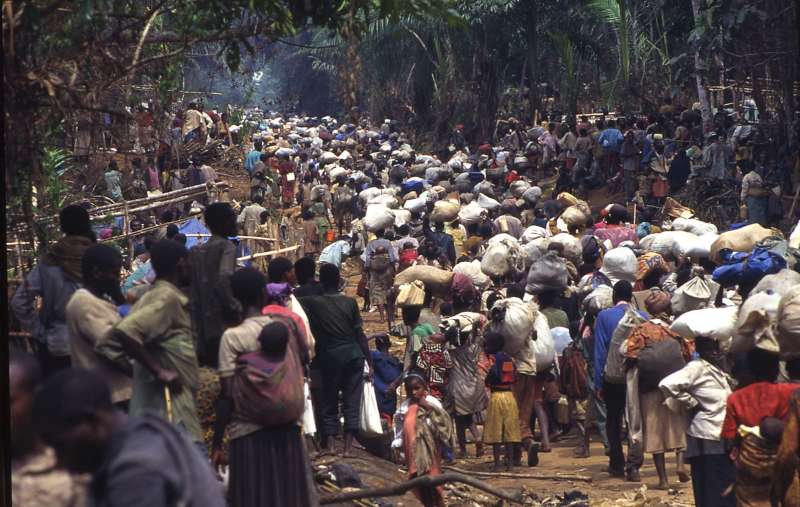
By that time the north of the country had seen extensive ethnic cleansing, with several thousand refugees shot to encourage others to make a move. The smart warlords then corralled the refugees in their area into large camps and waited for UN officials to turn up.


This actually helped the UN aid operation a lot, because it allowed them to concentrate on a few locations. That also made the military mission easier. Part of the aid flowed through Binni’s northern neighbouring country, which was expensive, but saved us the costs and risks of a very long line of communications. We also established on refugee operation in the north based only on air transport to which the same applies.

As expected, the government tried to squeeze us for money, but I was determined to prevent outright bribes as much as possible. So when president Ancongo demanded money to supply his troops, I agreed to a convention that only committed us to paying government troops that would be used solely to protect our refugee camps. In that way I hoped to limit the amount of units we had to support and also gain some leverage over them should push come to shove.

This deal may however been the reason for government troops to try to forcibly take over protection of the refugee camp at Cleopatra from the local warlord. This resulted in a three week battle over the town which gave us some headaches. Mostly because our forces in the area were split: a single British company guarding the camp to the north of the town and a slightly bigger garrison of the UN depots to the south.

We were afraid some of the indigenous force would find the 90,000 lightly protected refugees as a far more alluring target than the opposition and turn on the camp. We solved this by having our Black Hawks flying constantly over the refugee camp to discourage such thoughts. The commander of the British contingent remained anxious and enquired when and how he would be allowed to pull out. Of course I wasn´t keen on UN troops running off from their primary mission when put to the test, but I also understood that a company would not be enough to hold against a determined attack. So I put a number of transport helicopters on call to extract his force when attacked in force and this seems to have been enough to assure him. Anyway we were lucky we weren´t attacked.

UN military personnel at the gate of Cleopatra Refugee Camp

But apart from this and a few pot shots taken at a convoy the game was rather quiet for the UN military. In this we were really helped by the ´constructive´ stance taken by the warlords and the government. As long as they could make some money from us, they had no incentive to create trouble for us. In all I think that the level of bribing in this game was probably lower than in reality, and it was definitely only a small part of our total expenses.

Meanwhile, another neighbouring country had decided to take advantage of the internal turmoil in Binni to invade a disputed region. The Ancongo government therefore kept holding its hand up for money, but the US Ambassador was eventually able to wrench a promise of elections from the president for it.

The Battle of Cleopatra also proved an incentive for the US president to take an interest in the operation, and the US ambassador managed to broker a ceasefire and peace talks. This resulted in a government of national unity and a photo opportunity for the US ambassador.

Of course these peace talks were mainly meant to allow the government to turn on the invaders, which they had duly expelled by the end of the game. On the other hand, the power sharing didn’t fare well with Ancongo’s other clan leaders and rumours were rife of a coup by that time.

Nothing of the sort happened

The generally cooperative behaviour of the warlords and Ancongo government gave the UN a relatively easy game. Those refugees that we got to in time were saved and the concentration worked to our benefit. However, outside UN reach the world was less safe. The Security Council whisked away independent reports on human rights violations by the Ancongo government and evidence of ethnic cleansing and death marches in the north in order to maintain a working relationship. Of course, that didn’t mean that by the end of the game Binni was in a better position for the future.

I think that the UN could have had a lot more criticism in how it dealt with the crisis: the limited brief, the bribes, the support for an autocratic government, no attempts to create peace or safety for ethnic minorities. From all sides there was a lot of Realpolitik and very little principled behaviour. I guess that is due to a general disillusionment with human intervention and what it can achieve in the long run. As far as I understand, UN forces in earlier games were more ambitious and ready to get stuck in. So after six runs of Crisis in Binni, maybe it’s time to shift the situation in Binni by 20 years as well.

Friday, 7 June 2013

Maps for Master of Europe

Jim gave me a set of maps to take with me to the Netherlands: player and umpire maps for Master of Europe. The game is on for June 22nd in Nijmegen. Casting is done and handbooks and invitations will go out later this week.

Note the larger scale umpire map!

Sunday, 2 June 2013

How I love going to Chestnut Lodge

Sunday I joined a meeting of Chestnut Lodge Wargames Group, a rare pleasure because megagames and CLWG don't often coincide.
We had 3 great sessions, the first set in the A Very British Civil War alternate universe where Britain descends into vivi war after Edward decides to ascend the throne with Wallis Simpson as queen.
It was a tactical scenario by John Seaton on attempts by fascists and worker militias to capture the neutral borough of Croydon, including the important airport.
Next was a session discussing Muku Patel's design for an army group level game on the opening stages of WWI on the eastern front.
We discussed some design parameters (which period, what area, at what level of resolution, the character of combat on the eastern front (and how it differed from the west) and some mechanics (trading speed for combat effectiveness, effect of terrain, intensity).
Last was a meeting of the board of a large multinational discussing how it would make the best use of revolutionary new technology.
We faced several fundamental decisions. Given its cooperation with a superpower, how would that affect it's ability to trade with others? What was our window in which we were the sole owners of this technology, and how could we leverage this towards customers and competition?
A busy day with some fascinating insights, good discussion and inspiration

Thursday, 30 May 2013

Just received: Crisis in Binni game materials

The Crisis in Binni game materials. Found them yesterday evening returning home after a few days. Will provide for some interesting reading today and tomorrow.


There's the game handbook and the Travellers Guide to Binni, with all the background you need to play the game: who you are, what you did,who you hate, what your objectives are..

Wednesday, 29 May 2013

The Day of the Rangers - Black Hawk Down 20 years on


In my continuing quest to prepare for my role as commander of the U.S. contingent in a humanitarian operation, I have read Black Hawk Down by Mark Bowden. It provides an in depth account of the U.S. (not U.N.) operation to capture two main partners of General Aidid, leader of the Habr Gidr, the clan dominating Somalia at the time. 

My second hand copy
Although the targets were captured, the crash of two Black Hawk helicopters totally changed the dynamic of the battle and forced the troops on the ground into an improvised rescue operation. The troops were surrounded near one of the crash sites, but had to be relieved by a scratch U.N. force. The crew of the second chopper was captured or killed and paraded through the city by outraged Somalis, for all the world to see. This led to the departure of U.S. forces from Somalia soon after.

Last weekend I also watched the movie and there's a couple of disconcerting differences, the main being that the movie strips out most of the uncomfortable parts of the book. That is the very strong criticism on the leadership (although Bowden often uses the Delta Force participants to voice it) and the Somali side of the experience. And I think these two points are the most significant in the book, and they explain a lot about what went wrong.


By October 1993 the Somalis had figured out a way to go after the choppers

Ridley Scott does an awesome job of portraying the tactical side of the battle. I can't tell how realistic it is, but it generally conforms with the book, except the small force of Deltas attacking the Somali heavy weapons from behind. But Bowden provides several accounts of Somalis that show that a large part of the people fighting the Americans were not militiamen but civilians angry at being invaded by the Americans.

And that leads to the question the movie doesn't ask: wasn't this a stupid plan in the first place? Jumping in the midst of the town would always result in considerable collateral damage and civilian deaths. Scott neatly hides that fact that the Americans were shooting civilian from the word go (Bakara market was not just a hang out for arms salesmen, as the movie suggests, and they emptied it with M-60s).

In the movie the streets seem empty of civilians, in reality they were hiding everywhere and the millions of shots fired by the Americans must have made numerous innocent victims among the 500 dead and 1,000 wounded. That may be portrayed as a military necessity, but it was obviously the Americans weren't concerned about anything but themselves. 
This lack of sensitivity is understandable to a degree. To see so many people in a position of helplessness and degrading themselves in order to survive, sometimes to the point of lying, stealing and murder (see what I wrote about that when discussing Linda Polman's book) will not improve your opinion of them. The dirt, poverty and stench are noted often and in a negative way.

Also the Somali society was fundamentally different on ideas about honour, fairness, hospitality and allegiance. Even the strong concept of individual agency that every American is spoonfed from birth contrasts with the stoic fatalism inherent in lesser developed societies. The fact that Somalis often didn't grab at the chances provided to them by humanitarian aid and their refusal to lay aside their factional differences in the light of the crisis will have made them look ungrateful.

I'm pretty sure racism wasn't a major part of this attitude, although there were a few remarks in the book where I suspected it. I wonder if the nickname 'Skinnies' was a reference to Heinlein's Starship Troopers.


The lack of sensitivity, coupled with their obvious dislike of the local population  had already irked the Somalis, for example when U.S. choppers flew low over town, damaging houses and stampeding animals. They had also killed and captured a large part of the civilian leadership in a pretty brutal assault some weeks before. ‘The Day of the Rangers’ pushed many Somalis, friends of Aidid or not, into active hostility towards the U.S. troops.

The Somalis made innovative use of cheaply available communications
to narrow the intelligence gap
The Americans had also badly underestimated their opponents’ capabilities and willingness to take them on. The availability and smart deployment of RPGs caught them by surprise. The swift reaction and the amount of people mobilised by their attack as well. 

Most dangerously, they misjudged the reaction of the Somalis to their invasion per se. Even if no Black Hawk had been downed, the number of casualties on both sides would have been considerable. Half of the Americans on the initial convoy became casualties, and they could have easily accounted for several hundred Somali casualties. The damage, although less extensive, would still have angered a lot of people. Together, it would probably have changed the political dynamics of the conflict as much as the battle did in the end.

Scott conveniently portrays the local militia leader (appropriately dressed in black) as a 'bad guy' at the start of the movie by having him rob people of humanitarian aid, and then kills him off later as a sort of minor revenge victory which apparently needed to be scored to wash down the humiliation of the American force. It is not in the book.

...refusing to look the part of bad guy

At the end of the movie it seems all okay because Aidid is murdered in 1996 (by Somali competitors, not a U.S. operation). Although Aidid certainly was no saint, on the other hand he was not the ultimate bad guy the Americans turned him into (not the first and last time they did that). He was the leader of the most powerful clan in Somalia and de facto head of state, but also a former general in the regular army and he had defeated the dictator Siad Barre a few years before. Again, the movie reduces Bowden's multilayered story to two dimensions. 

As Bowden points out, the fact that the situation in Somalia didn´t change after Aidid´s death says enough about the misjudgement of the U.S. to pick that particular fight, and of their misjudgement of conflict in failed states in general: “In the end, the Battle of the Black Sea is another lesson in the limits of what force can accomplish.”

Because although military there is some claim to a U.S. victory, morally this was a huge defeat. Yes, a small force of Americans had held off a huge mass of irregulars, but with overwhelming firepower. Also, the force had effectively been incapacitated. It couldn’t move without leaving behind a considerable number of wounded and it couldn’t defend both crash sites.

And in my reading of the book, the people in charge of the operation were paralysed by the unforeseen events and overwhelming information. They were unable to improvise and make tough decisions. The movie makes the creed of ‘leave no man behind’ a virtue, but tactically it hamstrung the Americans. It prevented them from taking up a better defensive position and the recovery of a dead pilot cost them precious hours of darkness.

The only known photograph taken on the ground during the Battle of Mogadishu, on 3 October 1993
(US DoD via Court Chick, linked from acig.org)


In the book, Bowden shows the Somali sensed that the Americans were unwilling to die and to risk their lives which gave them a moral ascendancy. Despite the overwhelming firepower of the Rangers, I felt at times that an old fashioned bayonet charge would have been more effective (but the Rangers had left those at the base).

Sure, it is easy for me to criticise these points from my armchair, but these elements have come back during many humanitarian operations:

1. elite western troops with an inflated sense of their power, which translated into underestimation of their opponents and disdain for the civilian population. Derogatory nicknames, prostitution rings, firelighters with jam handed to children, it´s all happened.

2. irregular opponents who adopt to asymmetrical warfare and counter Western technological superiority by using terrain, subterfuge, or hiding among the population. It´s not always within the Geneva Convention, but civil war is a different beast than conventional conflict and U.N. troops should be take their opponents seriously.

3. In a tight corner the elite troops are unwilling to take casualties to do what is necessary to fulfill their primary mission: protect civilians. Belgians in Rwanda, Dutch in Srebrenica. Or they just blast away the opposition by massive firepower, regardless of the collateral damage, as in Mogadishu. This also harms the primary mission. Both forms of fuck up also undermine the trust of people in the ability and the will of the international community to protect them. What´s not to say that this provided a hotbed for anti-Western sentiments that the radical islamist have fed on since?

I´ll tell you next week if I did any better!

The page of the Crisis in Binni megagame (there's still room if you want to play)


Monday, 27 May 2013

More Preparation For Humanitarian Intervention - The Depressing Bit

In my preparation for megagame Crisis in Binni, I have read a few books and watched the inevitable Black Hawk Down. There's some interesting differences between the book and the movie, to which I hope to come back at some later stage. But suffice it to say that Ridley Scott could have made a movie much more critical of the American actions in Somalia than he did.

But I also reread Linda Polman´s The Crisis Caravan (In Dutch: De crisiskaravaan. Achter de schermen van de noodhulpindustrie). The book paints a pretty depressing picture of the crisis aid industry. She shows how the interaction between aid organisations, victims, local powers and the press have changed since the early 1990s

Me trying to organise Polman´s argument


The major development in the field is that since the early 1990s there has been a huge proliferation in the number of NGOs, especially with the appearance of MONGOs, or 'My Own NGO's. These micro-NGOs evolved from the disappointment many people felt in the effectiveness of the larger, more bureaucratic international NGOs. So people hop on a plain to DO SOMETHING.

Of course this leads to frustration, lack of coordination, double work and cruel excess. Polman gives harrowing stories of American doctors flying in, picking up kids in refugee camps and operating on them and taking them home on crowd-funding trips or even for adoption (while their parents are still alive).

But the main effect has been that the NGOs need to put much more effort in PR to catch attention of potential donors. And this has put them at the mercy of the press, who need to have a reason to turn up. So the NGOs need to inflate the scale of suffering and their role in ameliorating it. Because unfamiliar people in far off places don't sell papers by themselves.

The press, mostly genuinely sympathetic to the plight of the victims and the work of the aid organisations, needs to inflate the level of suffering above that of the last crisis. And some victims are more newsworthy than others: cut off limbs and children's bellies swollen from hunger do better than forced labour.

Another development, which Polman doesn't touch on, but which I have just read about from the other side, is the increasing rationalisation of the news media, so that there is less and less time for research, fact checking and analysis. Nick Davies´ Flat Earth News shows this development in bold colours, and shows why the press in turn has become so dependent on the NGOs and so uncritical of the information they provide (review is coming up).


A secondary effect of the competition between NGOs is their lack of negotiating power relative to the local powers. For the war lords and local governments, the flow of aid provides fantastic opportunities for improving their position. They can also cream off part of the aid that reaches the victims. And in case they are losing in a civil war, they can use the refugee masses to hide in and recuperate for another round (as for example the fleeing Hutu's did in Goma in 1994).

Indigenous government organisations and warlords also sell access to the victims to the highest bidder (both press and NGOs). This has led to NGOs making compromises which put them on the wrong side of the ethical conundrum: do we help or does helping make things worse?

Finally, the side that Polman references to only in passing, but the victims themselves play an important role in all this. It is in their interest to lie, beg and steal to improve their lot. The books shows some examples of kids lying to get prettier protheses, to be taken to the U.S. or just to get more attention from reporters.

It is enough to turn cynical at the whole aid industry, but Polman says we shouldn't leave it at that. Sometimes we have no choice but to shake hands with the devil to save lives, but also sometimes, we need to decide that by providing aid, we are only prolonging the suffering and destabilising a country for a long time.

Thursday, 23 May 2013

The Bitter Lessons of UN intervention - Can I do better?

The early 1990s were an incredibly hopeful time for keen young adults like me. The Berlin wall had fallen, the Soviet Union collapsed and the ideological conflict with accompanying doom scenarios of global nuclear war had disappeared like snow before the sun.It really felt like a new chance had come for a.world working united to end poverty, hunger and war. I even wrote a song or two expressing that naieve belief.

A lesser known edition of the famous book

We were soon to be disappointed. The disappearance of ideological conflict gave room for ethnic strife and unscrupulous warlords in failed states. The international community proved powerless to end it, even made it worse by intervening half-heartedly and then pulling out when things got tough.


So for me Yugoslavia, Somalia and Ruanda are the moral anchors when it comes to intervention by UN or NATO troops, and I am sure also for many of the leading politicians today. They are not much older than I am.

One of the most impressing and depressing books I've ever read was Deliver Us From Evil by William Shawcross. The book paints a depressing picture of the attempts of the international community (more or less reluctantly led by the United States) in the 1990s to effect the new world order that seemed to be in its grasp.

It is clear that after 9/11 the perspective has changed. There is something like a new world order emerging and not many people in the West like what they see. It has kept them from intervening for humanitarian reasons. And the experience in nation building seems not to have taught the U.S. very much in its so-called war on terrorism.

But there have been a few repeats in Western Africa and recently in Libya and Mali. Syria could go live any minute. The feeling that somethingmust be done is still alive, even if more muted than 15 years ago.


So what am I thinking a week before joining in the Crisis in Binni megagame? The game focuses on a humanitarian crisis in a fictional African country riven by civil war. Factions of warlords fight each other and probably refugees are stampeding in some unfortunate direction. The international community is waiting to jump in with a minimu of preparation and a maximum of photo opportunities.

I'm thinking how can I do a good job as a U.S. military commander. I'm not the one setting the goals of the mission, but I should try to get as clear a picture of my resources, so I can help my diplomatic counterpart, and my counterparts in other UN contingents to achieve those goals.

I will need to think of the security of my troops, try not to chose sides, try not to get into a messy situation. And all this with only a theoretical experience in AirLand Battle and fighting doctrinal wars over manoeuvre warfare. Most helpful.

So what advice have you guys got for me?


Monday, 13 May 2013

Playtests for megagame Master of Europe on May 18th and 19th

Calling you all to join in the playtest of megagame Master of Europe.


In the weekend of Easter/Whitsunday (Pinksteren), Jim Wallman will be in the Netherlands to test the new combat system. These playtests will be organised with gaming club Murphy's Heroes in Delftstede (Phoenixstraat 66 Delft), on the 18th of May, 12.00-17.00, and with gaming club Casus Belli in Cafe de Verdieping (Platenmakerstraat 3 Nijmegen), on the 19th of May from 14.00-18.00.

The playtest will cover the operational part of the game, the movement and combat of troops on the map. For those of you participating in the game on June 22nd, this may be a good way to get a feel for the system. For those of you unable to join in on the 22nd this may be a good opportunity to get an impression of what it will be like!

Please notify Marc Seutter by mail at marcs@cs.ru.nl if you plan to join in (also for questions)

I also want to urge those of you who plan to come to the megagame on June 22 but haven't registered yet, to do so RIGHT NOW! We will be doint the casting not long after the playtest, and after that your chances at your favourite spot are much lower.

The game will take place Saturday 22nd of June at Activiteitencentrum Doddendaal in Nijmegen, The Netherlands. This is the same place as last year’s Barbarossa game.

Costs to participate in the game are 25€ for players and 12,50€ for umpires. You can enlist individually or as a group. You can register by following this link:

Monday, 18 February 2013

Megagames in the UK in 2013

For your interest, my friends and supporters of Megagame Makers will be putting on half a dozen games in the UK this year, both in London and Leeds. If you get the change to participate, I highly recommend it.


Saturday 2 March 2013
ENDGAME, the campaign in Tunisia 1943
London

The slots are filling up for this one. If you're interested in seeing what roles are still available, see the provisional cast list


Saturday 13 April 2013
INVASION FROM MARS, a military / political game about interstellar conquest of a single world
Leeds Armouries


Saturday 1 June 2013
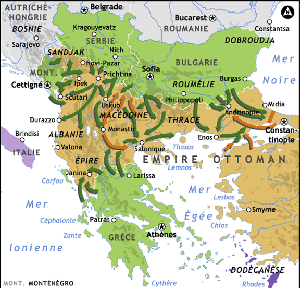
Rehearsal For Armageddon - The Balkan Wars 1912-13
London


Saturday 21 September 2013
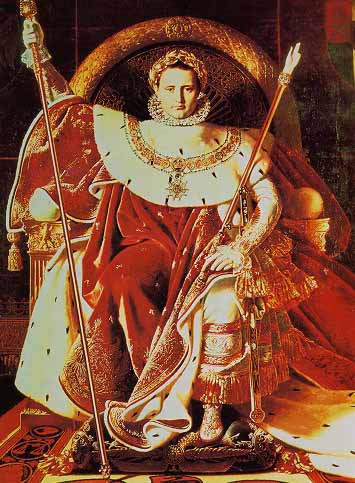
Master of Europe 1813 - Napoleon's campaign in Germany (Yes, that's the same one as will be put on in the Netherlands)
London


October 2013
The End of the Beginning : El Alamein 1942
Leeds Armouries


9 November 2013
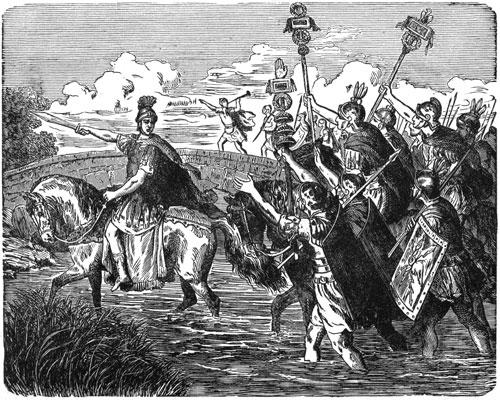
'Alea Iacta Est Iterum', megagame of crisis in the Roman Empire - 60 BC.
London


To get an idea of what it is like to play in a megagame, read this great report of last year´s Urban Nightmare game, which pitted an urban administration against a zombie outbreak. Or check out some of my reports here.

You can also join Megagame Makers facebook page, and see how the development of these games is progressing or read player´s experiences

Sunday, 17 February 2013

Master of Europe - Megagame of the Leipzig campaign

Given the 200 year anniversary of the Battle of Leipzig Megagames Nederland will be running Master of Europe, a megagame designed by Brian Cameron and Jim Wallman that brings you all the drama of the autumn campaign of 1813.


On the one hand the military campaign throwing the Russian, Prussian, Swedish and Austrian armies against the rebuilt Grande Armée in a struggle for the control of Germany. On the other hand the political manoeuvring between the four allied monarchs and their ministers and Napoleon and his German underlings. Can the allies force Napoleon back and will they be able to wrestle away his control over a continent?

This game was designed by Brian Cameron and Jim Wallman and played before on several occasions in the United Kingdom. Brian and Jim have been so kind to allow us to use their design.

When & Where

The game will take place Saturday 22nd of June at Activiteitencentrum Doddendaal in Nijmegen, The Netherlands. This is the same place as last year’s Barbarossa game.

Costs to participate in the game are 25€ for players and 12,50€ for umpires. You can enlist individually or as a group. To register, follow this link to our website. We will try to fit players to their preferences where possible.

Have a look at our website for the roles and nations involved
and register for the game!

For more information see our website, or contact megagamesnl@gmail.com

I’ll be bringing you updates in the coming months.

You can also follow us on Twitter @megagamesnl
and on Facebook at the Megagamesnl page.
Apart from upcoming games we also bring you a lot of stuff about military history and innovative ways of gaming

Hope to see you in June!

Monday, 10 December 2012

If you like miniature battles and if you like them big, the Liphook Historical Wargames group is just what you're looking for. They're objective is to play as many major Napoleonic battles over the course of 2005-2015 and they are very much on course. These wargames will require between 25 and 50 commanders. Battles in the past have included Friedland, Wagram and Borodino.


This was just one of the four tables needed to play Friedland.
There about 30 people involved including 3 umpires

Their programme for 2013 is as follows:

14th April 2013 - Lützen
Fought historically on 2nd May 1813. French v Allies (Prussian & Russian)
Can General Wittgenstein’s Allied Army 100,000 strong destroy Ney’s III Corps before Napoleon can reinforce him?

23rd June 2013 - Vittoria
Fought historically on 21st June 1813. French v Allies (British, Portuguese & Spanish).
Can King Joseph and Maréchal Jourdan with 50,000 and 153 guns in a strong defensive position stop Wellington’s 70,000 and 90 guns from driving them out of Spain?

8th September 2013 - Leipzig
Fought historically on 16th – 18th October 1813. French v Allies (Austrian, Prussian, Russian & Swedish).
Can Napoleon with 177,000 men and 700 guns surrounded at Leipzig defeat the combined Allied Army of 257,000 troops and 915 guns led by Prince Schwarzenburg before it can be reinforced to over 365,000?

24th November 2013 - Nivelle
Fought on 10th November 1813. French v Allies (British, Portuguese & Spanish).
Can Maréchal Soult with 60,000 men defending the Nivelle river line defeat Wellington’s Army?

To get involved email - tmaroney at hotmail dot co dot uk for enlistment papers

Tuesday, 4 December 2012

Megagames in 2013

Megagame Makers have set their programme for 2013. If you haven't played in a megagame yet, you should definitely try it. These are all exciting subjects and will deliver a momentous experience of time pressure, meticulous planning, courageous leadership and wheeling and dealing.


ENDGAME - The culmination in North Africa 1943. The follow-up to last year´s anniversary game of the Battle of El Alamein now sees the Axis troops defending their last foothold on the African continent. An operational game that will see you lead the remnants of the Afrika Korps, the Eight Army and motley reinforcements of Italians, Americans and French.
London - Saturday 2 March 2013 


Rehearsal For Armageddon - The Balkan Wars 1912-13. A hundred years ago the powder keg of Europe exploded as the Balkan states turned first on the ailing Ottoman Empire and then on each other. Taste the challenge of marshaling a third rate army to battle or cleaning up the mess at the negotiating table.
London - Saturday 1 June 2013  


Master of Europe 1813 - Napoleon's campaign in Germany: Two centuries ago the three emperors of France, Russia and Austria-Hungary (and the kings of Sweden and Prussia, not to mention a host of minor German princes) slugged it out on the fields around Leipzig to determine the fate of Europe. Tough operational choices for leaders of multinational armies and tough diplomatic shenanigans for diplomats of competing powers.
London - Saturday 21 September 2013 


End of the Beginning: The Battle of El Alamein:  Can the Eight Army emulate its historical success (or avoid Monty's historical blunders, depending on which interpretation you hold)?  
Leeds - date to be announced, October 2013


ALEA IACTA EST ITERUM - Crisis in Rome 60 BC: As the Roman Republic enters its death throes, abundantly talented and abundantly ambitious men like Pompeius, Crassus and Caesar make their bid for the remains against defenders of the corrupted senator class like Cato and Cicero. Epic campaigns across the stormy Mediterranean, through the riotous streets of Rome and the across the clamorous Senate floor.
London -  date to be announced, November 2013


To get into the mood, read this great report of last month´s Urban Nightmare game, which pitted an urban administration against a zombie outbreak.

You can also join Megagame Makers facebook page, and see how the development of these games is progressing or read player´s experiences.

Thursday, 27 September 2012

South of the DMZ - Vietnam Megagame Lost Youth


Last Saturday I took part in Lost Youth, the megagame on the Vietnam War designed by Jim Wallman. It was a small episode set during the early deployment of US troops, somewhere close to the DMZ, and as such it challenged many of the perceptions about this war. Our ideas of the drug ridden, gung ho US army are mostly based upon the later war and this turned out different.

The ground: open close to the DMZ, jungle to the south
The opposing forces

On the US-allied side there were four teams, an American and an Vietnamese army batallion, an American regimental command team and a press team. Their challenge was to coordinate their action while showing success towards the press and hiding the nastier side of war. They succeeded almost up to the end of the game.

The National Liberation Front consisted of three batallion teams led by a brigade HQ and a number of local cadres. These had their own, slightly lonely game in setting up booby traps and ammunition depots and maintaining local morale in the face of US activity.

The VC self criticism session. Note the red stars on the chest for ideological rigour!


Much fun was had on the NLF side during the two self criticism sessions, which didn't turn into with hunts but actually improved the planning and created a sense of united purpose. Umpires rewarded proper ideological composure and terminology.

As it happened

The scenario was a US batallion sized sweep through a a number of hamlets, which attracted a response by a Viet Cong regiment to hurt the Americans or at least take the heat of their local cadres. The US-allied forces used the main highway at the eastern edge of the map and of course helicopters to enter the map. The NLF entered from the southwest.

The US commander took a methodical approach, sweeping through open country near the DMZ while the VC decided on an attempt to draw them into an ambush in the wooded area. However, this was based on the false assumption that the US troops would drop all else to go on some kind of search and destroy mission. That didn't happen.

There's the batallion drawn up to attack the village

One of the Viet Cong batallions threatened the ARVN batalion in the southeastern corner of the map, guarding the highway, but drew no response. In a desperate attempt to force a reaction, the VC unit attacked, but by then the ARVN was well prepared and the attacked floundered unceremoniously.

By then the US troops had 'cleared' most of the open country (devastating one village under bombardment). As they prepared to move into the jungle, the VC hastily retreated.

The experience on the ground

As an operational staff officer in the VC batallion that got into the thick of it, I had an active, but straightforward day. We were first on the map and last to be off. If I say so myself I managed the approach march to the eastern edge of the map and the defensive deployment well. However, we had no orders to attack and we lost an oppportunity to attack on the first night as the ARVN were not yet dug in but this was also because of lack of preparation. Hasty attacks were not the NLF preferred option.

And that us after hurrying back to safety

By the end of the game we were set for a sharp rearguard action, covering the retreat of the other batallions, but given the presence of the ARVN batallion, this might not have ended at happily as we'd wish. The interesting picture is of course from the umpire map, showing the location of both sides and our supply status (yellow and white discs).

The umpire map shows the ARVN batallion following up... oops!

So how did it feel?

Feedback to the game was generally positive. Most players enjoyed the operational challenge and the ideological side of the game, even if for two VC batallions the day was a bit uneventfull. The local NLF cadres had difficulty in imposing themselves on the game and there was a tendency for the batallion players to focus on the military side at the expense of the local cadres.

Jim's idea is to do a number of follow up games set later in the war so players can develop some experience with asyymmetrical warfare, which is different from the set piece operational games we do more regularly.

There's a wealth of possibilities for scenarios, but maybe these are not all in the same time and ground scale. We now played on a very small battlefield (7x7 km) for three days of game time.

The umpire map: not many VC left on the map at the end


ps You might have missed the discussion the development of artillery around WWI at the Maximum Effort blog.

Saturday, 7 July 2012

Jim Wallman, my favourite game designer

My game designing hero is Jim Wallman, a friendly guy from South London with a warped mind and the English sense of humour. He has a good grasp of (military) technology and history, of popular culture and of gaming. One of my fondest memories of him is sitting together on the ground in a wargames convention hall and trying to design a game on global crime networks.

Jim started out playing ith the likes of miniature wargaming icons Paddy Griffith and Donald Featherstone, then became involved in Wargame Developments, an innovative English game design group. Their foremost inspirations were miniature wargames and Kriegsspiel and the games mostly assumed pretty good knowledge of the subject to play. The club was a fertile ground for aspiring game designers and has done a lot in the development of matrix games for example.


Jim was one of the founding members of Chestnut Lodge Wargames Group in South London, which over the years has dedicated itself to the design of new games. I find it a very inspiring club of people that are supportive and critical of game design and I’ve played some of the most fun games ever there.

The range of game formats and mechanisms Jim has used is just astounding and he really uses the form he thinks fits the theme and approach best. They range from WWII company actions and samurai skirmish to 18th century English colonels leading their regiments and large scale space battles. Jim has put most of his game designs online for everyone to benefit and has been glad to assist and discuss with aspiring game designers and players like me. It's even led to a translation by an Italian group.

His designs assume that players don´t try to bend the rules and play ´historically´, mostly assisted by umpires. Also he doesn´t believe in complex rules, because player interaction is more important to him. A lot of effort is taken to give perspective through player briefings. Of course, the use of umpires allows rules to be kept to covering only the most likely events, and let wizard wheezes and exceptions be handled separately. As a result, Jim hasn´t designed many board games as he finds the medium too restrictive, but I´ve got a fine example below.


In the early 80s Jim also started doing megagames and over the years has designed and organised dozens of them. After a couple of years he and a couple of friends/designers set up Megagame Makers. In 2005 the organised their ‘hundredth’ megagame, The Last War, with about 150 players and umpires fighting WWII from January 1942 to the bitter end in two days. Search out their archive of megagames and stand in awe of the number of games they actually put on over the years, especially if you consider what a shitload of work these games take to organise. I’ll go deeper into megagames elsewhere.

And these are my favourite (non-mega)game designs of his:


Tank duel: a double blind tank dog fight. The teams are on opposite sides of a curtain with the terrain duplicated. They only see their own tank until the enemy gets into the line of sight. Both teams consist of commander, gunner, loader and driver (depending on tank type of course). The commander has to order each of the other crew members on direction, type of ammo use, firing etc etc. By keeping the pace of the game up it becomes extremely tense and fast, with most games done in under 15 minutes.

My worst session was against an experienced team that used an antitank gun. All the time I was wondering why they hardly gave any orders. Until they hit me while turning the corner.

Decapitation: a boardgame of the ‘Freedonian attempts’ to take out an ‘Evil Dictator’ before they invade his country to bring peace, democracy and prosperity. The Freedonians have intelligence teams on the ground and radio listening to pinpoint the dictator’s whereabouts, but the latter has a few stand ins to deceive them. Of course, bombing and cruise missiles can have collateral damage that will lower public support for the war. This game shows what is possible in designing and producing a game as it was ready before the Iraq war was over. The map is here.


The Universe: the Universe is actually a living background to a whole range of games, including a strategic campaign Humanity will Prevail (running for over 10 years now), pirates (erm… independent traders), space marines and ships’ crew role playing campaigns, large space battles, and sports.

The major polities in the campaign have gained an eerie level of realness over the years as players have added their political styles and popular cultures. Political summits are hosted, battles fought, propaganda wars waged and elections rigged.


I used to sort of rule the government of the postcommunist Sirian Socialist Republic, an egalitarian bureaucracy that has greatly expanded its robot workforce to lessen the burden of human labour. When not in a meeting, the SSR leads the opposition to the Evil Empire of Sol, unless distracted by piracy, terrorism, natural disasters, alien invasions or out of control AIs.

Do have a look. And enjoy!

This was posted earlier to Fortress Ameritrash