Showing posts with label holiday. Show all posts

Monday, 4 November 2019

Gaming goals - October update


This can be a very short post as I didn't do anything in terms of gaming goals. Yup, not one block changed colour this October. I didn't lift a brush, rolled no dice, dumped no book.

Technically I did play three games of Lost Cities, but that doesn't count.

I hardly cycled as well. Not even 200km.

The reason? Holidays and the big project still lumbering in the background.

Ten days cruising to Italy and back was awesome enough, though, and I slipped in the odd bit of (military) history. Looked upon Fortress Ehrenbreitstein in Koblenz, walked the 17th century walls of Lucca and spent the night on the battlefield of Arcis-sur-Aube.

Ehrenbreitstein

Lucca


Porto Venere


There was good food, beautiful countryside...

View from the hammock

Cinque Terre


and some awesome art

Werner Bischof, Dresden 1945
Barbari Baldi poster for Lucca Games & Comics

Jeffrey Catherine Jones at Lucca Games & Comics

But November will have to be different: the 1672 project needs work for a credible outing in February. So I need to make a decision on my painting method soon.

Also, PolderCon is back on the menu (yeah, I know...). Hope to see you there on February 2nd in Utrecht !

Sunday, 3 December 2017

Back from South East Asia

It's been two and a half fascinating weeks. First ten days travelling through western Thailand in the footsteps of the 100.000 POWs who contributed to the construction of the infamous Burma railway (together with thousands of Japanese and perhaps 200.000 South East Asians). Then five days in Cambodia around the fabled temples of Angkor.

The party of premier Hun Sen, a former Khmer Rouge cadre, has effectively ruled Cambodia since 1979


It's been a lot of information to take in, even though much of that was self-inflicted. And as always while travelling, full of impressions that go beyond the immediate subjects of the trip. You can't help to notice that both Thailand and Cambodia have shed much of the essence of democracy despite still maintaining the trappings. Thailand is ruled by a military junta (that isn't very good at listening to the people) and the Cambodian government has just had the major opposition party banned.


Police booth in Kanchanaburi, Thailand


Yet life seems to be going on anyway. Military and police presence are light. In Bangkok and Siem Reap the Christmas season has started. Around the royal palace in downtown Bangkok we experienced the perfect storm of tourists, graduation day at university and the last opportunity to visit the ashes of revered former king Bhumibol (the exhibition has since been extended).

Tourist entrance to the inner sanctum of the royal palace, Bangkok


The poverty gap in these countries is still huge between those in the airconditioned zone (including us tourists) and those outside. Yes, I caught a cold.

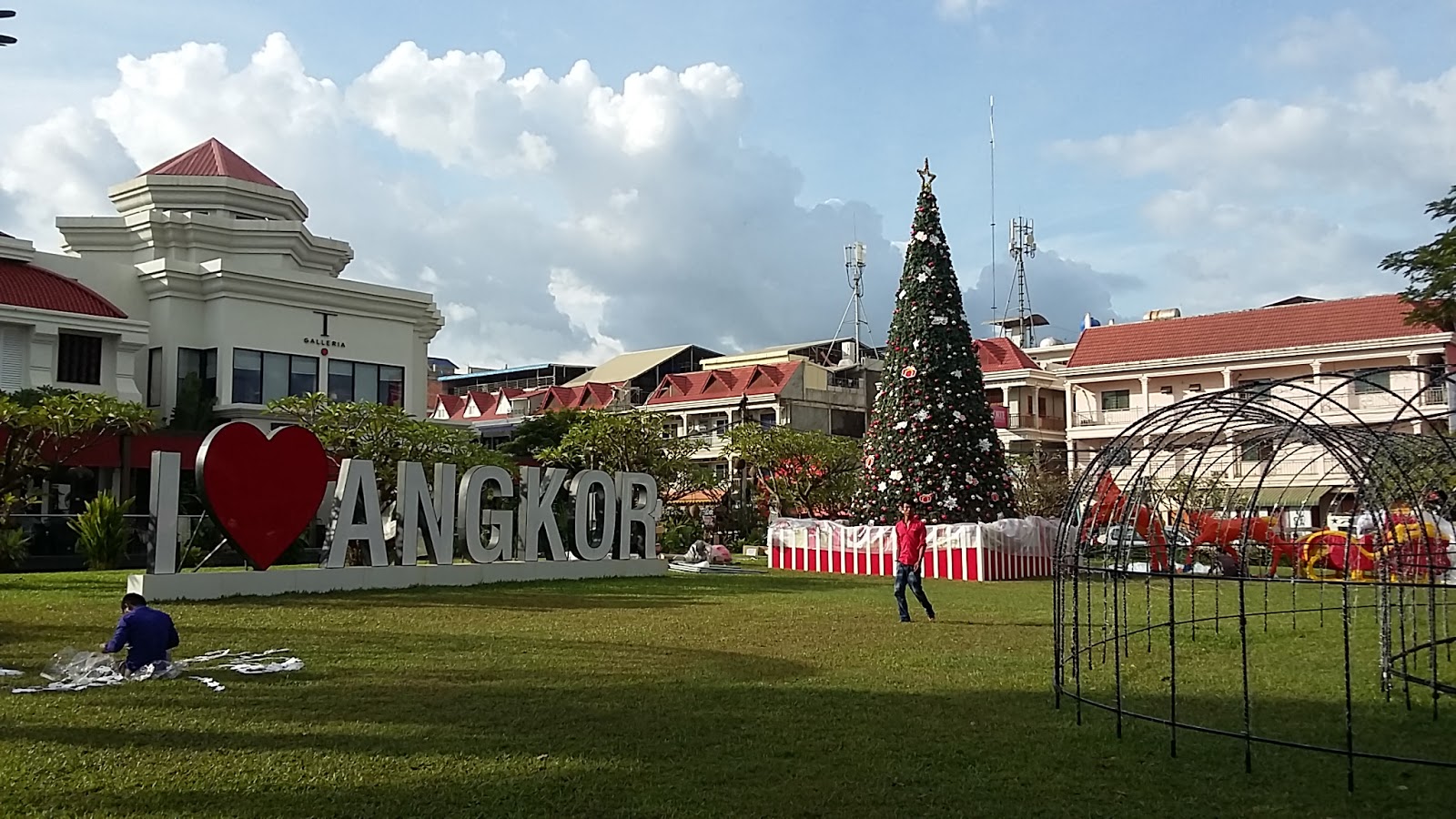
Christmas decorations are prepared before the luxury mall in Siem Reap (opened in 2016)
And Bangkok is a powerhouse, ever expanding its network of flyover roads and sky trains. I remember that the first skytrain rode between my first two trips in Thailand in 1999 and 2000. Now there are several lines and an underground. Then there were 6.3 million inhabitants, now 9.6 million.

Flyover roads under construction, Bangkok


It was also intense to make this trip. I'm not a group travel person and when you are around 35-40 co travellers, that takes some energy out of me. Most of these people had a direct personal relation to the railway, which for them made it an emotional experience that I could only relate to from a distance. I wouldn't have survived if it had not been for my travel companion Michael. We never ran out of topics to discuss and events to comment on, however silly.


I will be posting a few bits from the Angkor part over the next week, but the Thailand-Burma railway story will arrive after that and in a different format as I have a distant personal stake in it.

Wednesday, 5 November 2014

From Dynasty to Banzaï to Matchbox

There’s weird connections in your brain, ya know? Stuff that apparently has nothing to do with each other but makes sense because it all came together at some point in your life. One of those weird connections to me is this one.


The memory came back to me playing Kiss' best selling album Dynasty. It connects me to a holiday on Schiermonnikoog, late 1979 or early 1980. Schiermonnikoog is a small island just north of the Dutch coast and a regular place for our spring or autumn holidays around that time.

Right then my brother and I had discovered a series of comic books depicting the history of WWII. At the time of this holiday we had just bought the volume on the war in the Pacific, and I remember reading it while listening to Dirty Livin’, a Peter Criss song which would be called a guilty pleasure now. I never got all the volumes of the series of eight comic books, and some only a decade ago. But the ones we had then, they’re worn out and very dear to me.


I also remember my brother and me playing with our Matchbox American infantry on the wooden floor of our holiday house with Ace Frehley's Save Your Love, another of my favourites from the album, in the background. I still love those Matchbox plastics although I gave almost all of it away a long time ago.


Friday, 21 March 2014

It's Official: I'm not a Witch!

Had a nice trip cycling from Woerden via Oudewater and Montfoort to Vleuten. Not only was it a beautiful sunny day, but this is classic polder country.


In Oudewater we visited De Waag, where goods were traditionally weighed before sale, but it is better known for its weighing of witches. The first recorded witch trials in the northern Netherlands stem from the 1540s, and de Waag probably acquired the privilege to weigh witches sometime after that. However, since you have to pay for weighing, this was only of use to the wealthy.

Unsurprisingly, my 190 pounds proved I am not a witch

Although the coming of Protestantism helped in driving out the belief in witchcraft the last trial in the northern Netherlands was in 1614. But in the year before several dozens of people had been killed during a trial in Roermond. The last official weighing was in 1729 but it is still done for visitors. The museum has a small but engaging exhibition on witchcraft and trials.


From there on to Montfoort where with some luck we ran into the gate of the former castle of Montfoort. The castle was destroyed by the French during one of their attempts to break into the Water Line (oude Hollandse Waterlinie) in 1672.

A sign showing the castle in the mid 17th century

Monday, 19 August 2013

Soviet sub in Hamburg

Made a quick snap of the U-434 in.Hamburg harbour. It's a former Soviet sub, built in 1976 and was used mainly for intelligence operations.
It's now a museum.

Sunday, 18 August 2013

Hamburg honours Unification heroes

Cycled through a neighbourhood celebrating the German heroes of unification this morning. Others streets were named after Roon, Waldersee and Manstein.
This marked the neighbourhood as build probably somewhere around 1900. Nice houses, spacious streets.

Monday, 10 June 2013

Chemin des Dames books

Last week I brought Some books for Michiel, since he's going to camp around Compiegne in France this summer. Right in the middle of a number of WWI battlefields.


For a number of years I used to go to the nearby Champagne Ardennes region for a weekend in summer with a bunch of friends. On a few occassions we visited the Chemin des Dames battlefields, and I picked up the books in the picture.

One local guide, with a cover by Tardi, the French comic artist who has had a great impact on the way we see WWI. And another a more extensive account of the many battles fought on the Chemin des Dames, starting with the 1814 battle of Craonne (Napoleon's Last Victory), the 1914 battles, the disastrous 1917 offensive and the German offensive of 1918.

Added are two monographies: Pyrrhic Victory by Robert Doughty on the French Army in WWI and Pierre Miquel's book on the Chemin des Dames. And finally an issue of the French WWI magazine Tranchées, dealing with the offensive with limited objectives, among which the capture of Fort Malmaison on the Chemin des Dames in October 1917.

So Michiel is well prepared for his holiday.

Michiel bought me a Dutch translation of Albert Nofi's book on Waterloo for my birthday. An interesting take, you can spot the wargamer from miles away.

Friday, 17 August 2012

The opening of the Memorial for le Mille on May 9th 1915

On May 9th 1915, the monument was christened for the 1,000 redshirts that accompanied Garibaldi on his trip to Sicily in 1860, beginning the 'liberation' of Southern Italy.

I put liberation in quotations because it soon became clear that the replacement of the Bourbon dynasty with that of Savoy didn't make that much of a difference to the Apulians, Sicilians and Calabrians. For decades the new Italian army was involved in putting down the ongoing revolt in the south, and banditism continued well into the 20th century.

The opening ceremony stood in the light of the Italian intervention in WWI at the side of the Entente. Italy had been allied to Germany and Austria-Hungary since 1882 but now opportunistically threw its weight on the other side, claiming not only the Trentino, Friuli and Triëste, but large parts of the Dalmatian coast in the secret treaty with Great Britain and France.

Gabriele d'Annunzio, Italy's most famous poet was recalled from Paris to whip up public fervour for war. France paid off his debts so he wouldn't be arrested.

On May 9th he promised, demanded bloody sacrifice: 'Blessed are the merciful, for they shall have splendid blood to wipe away, radiant pain to bind up'.

I'd think d'Annunzio got what he wanted. By 1918 over 670,000 Italians had lost their lives.

Thursday, 16 August 2012

Alpini, Go Home!


The Alpini are the Italian elite mountain troops. They earned their distinctions during the mountain battles of WWI, but also elsewhere in WWII. I've come across quite a few memorials in Italian towns and villages specifically for them.

They have characteristic hats with a feather. You can almost make it out in the picture.

However, the love is not universal, as you can see. Taken in Genova last week.

Saturday, 11 August 2012

Uniform of the Carabinieri Genovese

The Carabinieri Genovese were formed in 1851 as a rifle association.

The club was heavily influenced by the desire for Italian unity and many members were involved in the failed 1857 plot in Milan, Garibaldi's Cacciatory delle Alpi in 1859 and the Mille that set sail for Sicily with Garibaldi in 1860.

The uniform is on display in the Risorgimento museum in Genova.

Friday, 10 August 2012

Mussolini at the helm

Another fine painting from the Wolfsonia collection in Nervi.

Close to the outbreak of WWII, this shows Mussolini at the helm (it's called 'Il Nocchiero').

I like it a lot, with the crazy references to barbed wire, but also airplanes and the map of Europe.

Thursday, 9 August 2012

Fascist fascination with flight

This painting from the Wolfsonia collection in Genova-Nervi shows how the Futurist obsession with movement and action perfectly fitted fascism.

It is hard to separate the ideas of Futurism, which are grotesque and become soiled with fascist ideology, from the products, which are beautiful.

I went back early this morning to Nervi, just to see this collection, because I think it's a brilliant combination of design objects, graphics and more conventional forms of art. The trip was well worth the trouble.

I had to rush back for the train to Levanto.

Wednesday, 8 August 2012

Bust of Garibaldi

This bust is displayed at the Risorgimento museum in Genova.

It's an old school museum in transition, now having some multimedia displays.

Yet, it has an intreaguing collection because nationalists and revolutionaries Mazzini and Garibaldi had links to the city. Mazzini lived in the building for a while.

The museum doesn't expect non-Italians, I guess. There were few English texts and promotional material is only in Italian.

Tuesday, 7 August 2012

Women in times of war

A painting by Alba Giuppone from 1942-3 called Donne in tempo di guerra from the Galeria d'Arte Moderne in Genova-Nervi.

Nervi, a former upper middle class sea resort near Genoa, houses some nice art museums.

The GAM holds a few works of Futurist and later fascist influence, but this on transcends political lines, I feel.

Sunday, 5 August 2012

Gate of St Matteo church in Genoa

The S Matteo church was the private church of the Doria family, as can be seen from the eagle motives next to the door.

Inside is buried Andrea Doria, the legendary Genovese admiral, who led a coalition of Spain, Genoa, Venice and the Papacy to victory over the Turks in 1571 at Lepanto.

Thursday, 2 August 2012

Monument for the fallen of the Risorgimento in Tortona

This momument was erected around 1890 in Tortona to commemorate those fallen in the Risorgimento battles.

The period spans from 1848 to 1867

.

The list of battlefields includes all those I knew and a few more: Milano, Santa


Lucia, Peschiera (1848) Novara (1849), Palestro, San Martino, Peschiera, Solferino (1859), Milazzo (1860), Custoza, Villafranca, Montesuello (1866) and one battle from 1867 which I can't decipher and can hardly imagine. Not sure whether there was much fighting in 1867, or maybe this guy died of his wounds.

In terms of lives, the 1859/60 campaign was the most costly: 27 lives were lost, of which 10 at Solferino. The 1848/49 war cost 10 lives, and the 1866 campaign 5.

Remarkably, there are three deaths credited to the Crimea in 1854/1855, possibly the Battle of the Chernaya, but equally likely deaths of disease. It is interesting to see the Italians reckoning their participation in the Crimean War so directly to the Risorgimento. A quid pro quo for French intervention in Italy in 1859.

Anyway, 45 deaths in 20 years was a considerable sacrifice for an agricultural community.

Tuesday, 31 July 2012

Wednesday, 25 July 2012

Gun from German destroyer UJ-126

The UJ-126 Steiermark was sunk near Terschelling on 10 July 1940 by British submarine H-31

Tuesday, 24 July 2012

Control panel from German cruiser Lützow

Apparently a panel controlling emergency pumps on the German cruiser Lützow which was sunk during the Battle of Jutland in 1916.

Picture taken in the Wrakkenmuseum on Terschelling. Probably ended up there because of the diving club going abroad, as I don't think the panel would have been found near the island.

Sunday, 22 July 2012

Spanish gun

Made by royal foundries in Brussels in 1623, by Johannes Sithoff. Probably captured by the Dutch and then used as naval gun.

Ship probably from Amsterdam admiralty and sunk around 1630 near Terschelling

All the latest naval bits were recovered by the Ecuador diving team of Terschelling