Showing posts with label megagame. Show all posts

Saturday, 31 May 2014

Megagames and LARPs: Food for Thought

Two weeks ago I was invited to do a demonstration of a megagame at the PLAY Masterclass by the Dutch Society of Play. The Society of Play aims at increasing the use of games in Dutch education and heritage institutions. The day provided a number of examples of game forms, but also three interesting talks on the subject.


In the following posts I want to go into a few things that I took away from the talks by Morgan Jarl, a Swede with long experience of designing and running games and especially LARPS. His first talks focused on using LARPs for educational purposes. You can find the presentation slides here.


Short aside: it is good  to realise that there is more to LARP than fake pointy ears and foam swords. Especially in Scandinavia there has been a development towards different settings and more emotionally involving story lines. There is an inspiring  collection of examples from Nordic LARPs available online for free.


Megagames and LARP

Although megagames and LARPs are strands of the larger family of ‘real life gaming’ and that these strands can occasionally come very close (because both focus heavily on human interaction) , there are some general distinctions you could make between the two. LARP which lays more emphasis on immersion, collaboration and artistic vision and such comes closer to theatre. Megagames tend more towards hierarchy, decision making and conflict. But as said, some megagames have come closer to mass role playing and some LARPs contain hierarchies and conflicts.

The different levels of immersion in the role might roughly be described in terms of role and character. Players in megagames generally adopt a role like prime minister, general or staff officer while in LARP they more often adopt a character, where players find further motivation in the personal life. Again, many megagames have personal briefings for players, or invest their personage with additional motives during the game, and this is a generalisation.

You can try to add as much character to a game as you can, but that might not work for your purpose because...


Types of games… and gamers

Morgan identified four types of game, whether they were based on a narrative, on immersion, on simulation or on the mechanics. I then realised that this might match players' preferences for types of games. Some people like story telling, others role playing, others want to recreate and still others focus on mastering the rules and winning. 

I'm used to being on the part of the spectrum where you argue between simulation and mechanics, ie where you balance the model between the two or try to find solutions where you can retain as much of both. But one of the problems in many board and miniature wargames is that you spend your effort on that instead of immersion or narrative and it becomes empty, a pure puzzle and in a sense devoid of meaning.

This is probably why LARPs recruit easily from tabletop rpgs and megagames recruit from boardgames and miniature wargames. But both can relate closely to Ameritrash games because they combine these four elements. In can't see a megagame like Operation Market Garden gaining as enthusiastic a response from the board gaming crowd of Shut Up & Sit Down as Watch the Skies! did.

So a good thing in design is thinking about which groups you want to engage and in what way and how to write it accordingly. Do you go for one type or do you try to cater to several groups?

Game structure

As all games have at least a few rules (if only on conduct and setting), each game needs an introduction or briefing. After the game, it is also necessary to have a debriefing, not only to bring all the strands back together, but also to discuss experiences and learning. 

You can do this as one cycle, but there’s also the possibility of using debriefs halfway through the game or more often to bring every player up to the same level of information or to insert new elements into the game. As an alternative you can do this between games, like in a rpg or miniature wargames campaign. But I like the idea of using this halfway feedback loop in a game.

Next up: learning through games…

Saturday, 15 June 2013

Crisis in Binni - Operation Succesful, Patient Deceased

Two weeks ago I joined in for Crisis in Binni, the megagame about humanitarian intervention in a failing African state (think of Somalia in the early 1990s) as the commander of the US contingent to the international force. I was going to write peacekeeping force, but then realised that was not our mission. Remember this, because it is important.


When the UN decided to intervene in Binni, there had been low level conflict in the country for some years, with the autocratic government of President Ancongo having suppressed rebellions in the north of the country. The direct occasion for action was a famine developing in the northern region.

While the security council (formed for this game of the US, Britain, France and Italy) worked out our exact mission, the commanders of the military contingents planned for their role, in coordination with the UN refugee commissariat and World Food Programme.

As US commander my aims were to keep the commitment of ground troops to a minimum, but to still be seen as the leading nation. I managed to circumvent this seeming paradox by providing the expensive HQ, airbase and transport and attack helicopters for the mission. A few marines were used for protecting the force HQ, airbase and UN depots in Binni’s capital, out of harm's way. And as the Security Council resolution that formed the basis for our deployment implicitly put the US in command, I just treated that as a fait accompli which nobody questioned.

My briefing material for the game, with extensive historical information

The UN military force got a very limited brief: to protect the aid workers and refugees under their care. This also meant very restricted Rules of Engagement, effectively to only shoot when shot at.

My next priorities were to establish a unified command structure and get men on the ground as soon as possible to get a feel for the developing situation. The first French troops were on the ground in a month, with other contingents following two weeks later.

By that time the north of the country had seen extensive ethnic cleansing, with several thousand refugees shot to encourage others to make a move. The smart warlords then corralled the refugees in their area into large camps and waited for UN officials to turn up.


This actually helped the UN aid operation a lot, because it allowed them to concentrate on a few locations. That also made the military mission easier. Part of the aid flowed through Binni’s northern neighbouring country, which was expensive, but saved us the costs and risks of a very long line of communications. We also established on refugee operation in the north based only on air transport to which the same applies.

As expected, the government tried to squeeze us for money, but I was determined to prevent outright bribes as much as possible. So when president Ancongo demanded money to supply his troops, I agreed to a convention that only committed us to paying government troops that would be used solely to protect our refugee camps. In that way I hoped to limit the amount of units we had to support and also gain some leverage over them should push come to shove.

This deal may however been the reason for government troops to try to forcibly take over protection of the refugee camp at Cleopatra from the local warlord. This resulted in a three week battle over the town which gave us some headaches. Mostly because our forces in the area were split: a single British company guarding the camp to the north of the town and a slightly bigger garrison of the UN depots to the south.

We were afraid some of the indigenous force would find the 90,000 lightly protected refugees as a far more alluring target than the opposition and turn on the camp. We solved this by having our Black Hawks flying constantly over the refugee camp to discourage such thoughts. The commander of the British contingent remained anxious and enquired when and how he would be allowed to pull out. Of course I wasn´t keen on UN troops running off from their primary mission when put to the test, but I also understood that a company would not be enough to hold against a determined attack. So I put a number of transport helicopters on call to extract his force when attacked in force and this seems to have been enough to assure him. Anyway we were lucky we weren´t attacked.

UN military personnel at the gate of Cleopatra Refugee Camp

But apart from this and a few pot shots taken at a convoy the game was rather quiet for the UN military. In this we were really helped by the ´constructive´ stance taken by the warlords and the government. As long as they could make some money from us, they had no incentive to create trouble for us. In all I think that the level of bribing in this game was probably lower than in reality, and it was definitely only a small part of our total expenses.

Meanwhile, another neighbouring country had decided to take advantage of the internal turmoil in Binni to invade a disputed region. The Ancongo government therefore kept holding its hand up for money, but the US Ambassador was eventually able to wrench a promise of elections from the president for it.

The Battle of Cleopatra also proved an incentive for the US president to take an interest in the operation, and the US ambassador managed to broker a ceasefire and peace talks. This resulted in a government of national unity and a photo opportunity for the US ambassador.

Of course these peace talks were mainly meant to allow the government to turn on the invaders, which they had duly expelled by the end of the game. On the other hand, the power sharing didn’t fare well with Ancongo’s other clan leaders and rumours were rife of a coup by that time.

Nothing of the sort happened

The generally cooperative behaviour of the warlords and Ancongo government gave the UN a relatively easy game. Those refugees that we got to in time were saved and the concentration worked to our benefit. However, outside UN reach the world was less safe. The Security Council whisked away independent reports on human rights violations by the Ancongo government and evidence of ethnic cleansing and death marches in the north in order to maintain a working relationship. Of course, that didn’t mean that by the end of the game Binni was in a better position for the future.

I think that the UN could have had a lot more criticism in how it dealt with the crisis: the limited brief, the bribes, the support for an autocratic government, no attempts to create peace or safety for ethnic minorities. From all sides there was a lot of Realpolitik and very little principled behaviour. I guess that is due to a general disillusionment with human intervention and what it can achieve in the long run. As far as I understand, UN forces in earlier games were more ambitious and ready to get stuck in. So after six runs of Crisis in Binni, maybe it’s time to shift the situation in Binni by 20 years as well.

Friday, 7 June 2013

Maps for Master of Europe

Jim gave me a set of maps to take with me to the Netherlands: player and umpire maps for Master of Europe. The game is on for June 22nd in Nijmegen. Casting is done and handbooks and invitations will go out later this week.

Note the larger scale umpire map!

Thursday, 30 May 2013

Just received: Crisis in Binni game materials

The Crisis in Binni game materials. Found them yesterday evening returning home after a few days. Will provide for some interesting reading today and tomorrow.


There's the game handbook and the Travellers Guide to Binni, with all the background you need to play the game: who you are, what you did,who you hate, what your objectives are..

Wednesday, 29 May 2013

The Day of the Rangers - Black Hawk Down 20 years on


In my continuing quest to prepare for my role as commander of the U.S. contingent in a humanitarian operation, I have read Black Hawk Down by Mark Bowden. It provides an in depth account of the U.S. (not U.N.) operation to capture two main partners of General Aidid, leader of the Habr Gidr, the clan dominating Somalia at the time. 

My second hand copy
Although the targets were captured, the crash of two Black Hawk helicopters totally changed the dynamic of the battle and forced the troops on the ground into an improvised rescue operation. The troops were surrounded near one of the crash sites, but had to be relieved by a scratch U.N. force. The crew of the second chopper was captured or killed and paraded through the city by outraged Somalis, for all the world to see. This led to the departure of U.S. forces from Somalia soon after.

Last weekend I also watched the movie and there's a couple of disconcerting differences, the main being that the movie strips out most of the uncomfortable parts of the book. That is the very strong criticism on the leadership (although Bowden often uses the Delta Force participants to voice it) and the Somali side of the experience. And I think these two points are the most significant in the book, and they explain a lot about what went wrong.


By October 1993 the Somalis had figured out a way to go after the choppers

Ridley Scott does an awesome job of portraying the tactical side of the battle. I can't tell how realistic it is, but it generally conforms with the book, except the small force of Deltas attacking the Somali heavy weapons from behind. But Bowden provides several accounts of Somalis that show that a large part of the people fighting the Americans were not militiamen but civilians angry at being invaded by the Americans.

And that leads to the question the movie doesn't ask: wasn't this a stupid plan in the first place? Jumping in the midst of the town would always result in considerable collateral damage and civilian deaths. Scott neatly hides that fact that the Americans were shooting civilian from the word go (Bakara market was not just a hang out for arms salesmen, as the movie suggests, and they emptied it with M-60s).

In the movie the streets seem empty of civilians, in reality they were hiding everywhere and the millions of shots fired by the Americans must have made numerous innocent victims among the 500 dead and 1,000 wounded. That may be portrayed as a military necessity, but it was obviously the Americans weren't concerned about anything but themselves. 
This lack of sensitivity is understandable to a degree. To see so many people in a position of helplessness and degrading themselves in order to survive, sometimes to the point of lying, stealing and murder (see what I wrote about that when discussing Linda Polman's book) will not improve your opinion of them. The dirt, poverty and stench are noted often and in a negative way.

Also the Somali society was fundamentally different on ideas about honour, fairness, hospitality and allegiance. Even the strong concept of individual agency that every American is spoonfed from birth contrasts with the stoic fatalism inherent in lesser developed societies. The fact that Somalis often didn't grab at the chances provided to them by humanitarian aid and their refusal to lay aside their factional differences in the light of the crisis will have made them look ungrateful.

I'm pretty sure racism wasn't a major part of this attitude, although there were a few remarks in the book where I suspected it. I wonder if the nickname 'Skinnies' was a reference to Heinlein's Starship Troopers.


The lack of sensitivity, coupled with their obvious dislike of the local population  had already irked the Somalis, for example when U.S. choppers flew low over town, damaging houses and stampeding animals. They had also killed and captured a large part of the civilian leadership in a pretty brutal assault some weeks before. ‘The Day of the Rangers’ pushed many Somalis, friends of Aidid or not, into active hostility towards the U.S. troops.

The Somalis made innovative use of cheaply available communications
to narrow the intelligence gap
The Americans had also badly underestimated their opponents’ capabilities and willingness to take them on. The availability and smart deployment of RPGs caught them by surprise. The swift reaction and the amount of people mobilised by their attack as well. 

Most dangerously, they misjudged the reaction of the Somalis to their invasion per se. Even if no Black Hawk had been downed, the number of casualties on both sides would have been considerable. Half of the Americans on the initial convoy became casualties, and they could have easily accounted for several hundred Somali casualties. The damage, although less extensive, would still have angered a lot of people. Together, it would probably have changed the political dynamics of the conflict as much as the battle did in the end.

Scott conveniently portrays the local militia leader (appropriately dressed in black) as a 'bad guy' at the start of the movie by having him rob people of humanitarian aid, and then kills him off later as a sort of minor revenge victory which apparently needed to be scored to wash down the humiliation of the American force. It is not in the book.

...refusing to look the part of bad guy

At the end of the movie it seems all okay because Aidid is murdered in 1996 (by Somali competitors, not a U.S. operation). Although Aidid certainly was no saint, on the other hand he was not the ultimate bad guy the Americans turned him into (not the first and last time they did that). He was the leader of the most powerful clan in Somalia and de facto head of state, but also a former general in the regular army and he had defeated the dictator Siad Barre a few years before. Again, the movie reduces Bowden's multilayered story to two dimensions. 

As Bowden points out, the fact that the situation in Somalia didn´t change after Aidid´s death says enough about the misjudgement of the U.S. to pick that particular fight, and of their misjudgement of conflict in failed states in general: “In the end, the Battle of the Black Sea is another lesson in the limits of what force can accomplish.”

Because although military there is some claim to a U.S. victory, morally this was a huge defeat. Yes, a small force of Americans had held off a huge mass of irregulars, but with overwhelming firepower. Also, the force had effectively been incapacitated. It couldn’t move without leaving behind a considerable number of wounded and it couldn’t defend both crash sites.

And in my reading of the book, the people in charge of the operation were paralysed by the unforeseen events and overwhelming information. They were unable to improvise and make tough decisions. The movie makes the creed of ‘leave no man behind’ a virtue, but tactically it hamstrung the Americans. It prevented them from taking up a better defensive position and the recovery of a dead pilot cost them precious hours of darkness.

The only known photograph taken on the ground during the Battle of Mogadishu, on 3 October 1993
(US DoD via Court Chick, linked from acig.org)


In the book, Bowden shows the Somali sensed that the Americans were unwilling to die and to risk their lives which gave them a moral ascendancy. Despite the overwhelming firepower of the Rangers, I felt at times that an old fashioned bayonet charge would have been more effective (but the Rangers had left those at the base).

Sure, it is easy for me to criticise these points from my armchair, but these elements have come back during many humanitarian operations:

1. elite western troops with an inflated sense of their power, which translated into underestimation of their opponents and disdain for the civilian population. Derogatory nicknames, prostitution rings, firelighters with jam handed to children, it´s all happened.

2. irregular opponents who adopt to asymmetrical warfare and counter Western technological superiority by using terrain, subterfuge, or hiding among the population. It´s not always within the Geneva Convention, but civil war is a different beast than conventional conflict and U.N. troops should be take their opponents seriously.

3. In a tight corner the elite troops are unwilling to take casualties to do what is necessary to fulfill their primary mission: protect civilians. Belgians in Rwanda, Dutch in Srebrenica. Or they just blast away the opposition by massive firepower, regardless of the collateral damage, as in Mogadishu. This also harms the primary mission. Both forms of fuck up also undermine the trust of people in the ability and the will of the international community to protect them. What´s not to say that this provided a hotbed for anti-Western sentiments that the radical islamist have fed on since?

I´ll tell you next week if I did any better!

The page of the Crisis in Binni megagame (there's still room if you want to play)


Monday, 27 May 2013

More Preparation For Humanitarian Intervention - The Depressing Bit

In my preparation for megagame Crisis in Binni, I have read a few books and watched the inevitable Black Hawk Down. There's some interesting differences between the book and the movie, to which I hope to come back at some later stage. But suffice it to say that Ridley Scott could have made a movie much more critical of the American actions in Somalia than he did.

But I also reread Linda Polman´s The Crisis Caravan (In Dutch: De crisiskaravaan. Achter de schermen van de noodhulpindustrie). The book paints a pretty depressing picture of the crisis aid industry. She shows how the interaction between aid organisations, victims, local powers and the press have changed since the early 1990s

Me trying to organise Polman´s argument


The major development in the field is that since the early 1990s there has been a huge proliferation in the number of NGOs, especially with the appearance of MONGOs, or 'My Own NGO's. These micro-NGOs evolved from the disappointment many people felt in the effectiveness of the larger, more bureaucratic international NGOs. So people hop on a plain to DO SOMETHING.

Of course this leads to frustration, lack of coordination, double work and cruel excess. Polman gives harrowing stories of American doctors flying in, picking up kids in refugee camps and operating on them and taking them home on crowd-funding trips or even for adoption (while their parents are still alive).

But the main effect has been that the NGOs need to put much more effort in PR to catch attention of potential donors. And this has put them at the mercy of the press, who need to have a reason to turn up. So the NGOs need to inflate the scale of suffering and their role in ameliorating it. Because unfamiliar people in far off places don't sell papers by themselves.

The press, mostly genuinely sympathetic to the plight of the victims and the work of the aid organisations, needs to inflate the level of suffering above that of the last crisis. And some victims are more newsworthy than others: cut off limbs and children's bellies swollen from hunger do better than forced labour.

Another development, which Polman doesn't touch on, but which I have just read about from the other side, is the increasing rationalisation of the news media, so that there is less and less time for research, fact checking and analysis. Nick Davies´ Flat Earth News shows this development in bold colours, and shows why the press in turn has become so dependent on the NGOs and so uncritical of the information they provide (review is coming up).


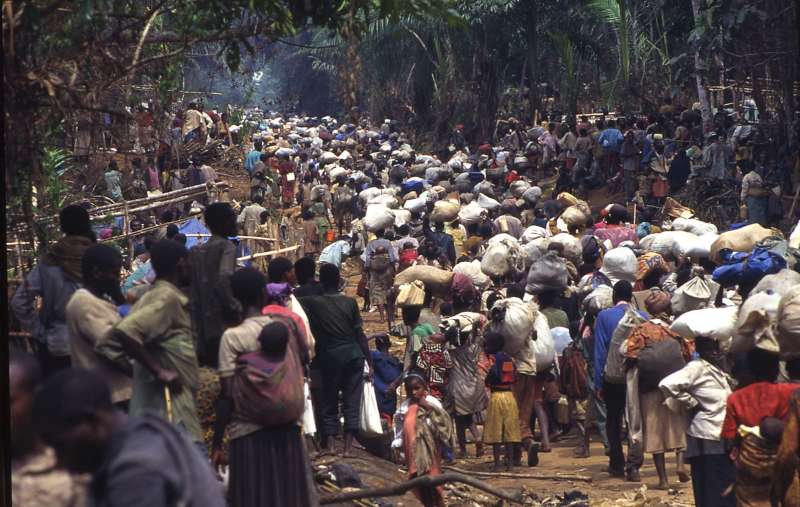
A secondary effect of the competition between NGOs is their lack of negotiating power relative to the local powers. For the war lords and local governments, the flow of aid provides fantastic opportunities for improving their position. They can also cream off part of the aid that reaches the victims. And in case they are losing in a civil war, they can use the refugee masses to hide in and recuperate for another round (as for example the fleeing Hutu's did in Goma in 1994).

Indigenous government organisations and warlords also sell access to the victims to the highest bidder (both press and NGOs). This has led to NGOs making compromises which put them on the wrong side of the ethical conundrum: do we help or does helping make things worse?

Finally, the side that Polman references to only in passing, but the victims themselves play an important role in all this. It is in their interest to lie, beg and steal to improve their lot. The books shows some examples of kids lying to get prettier protheses, to be taken to the U.S. or just to get more attention from reporters.

It is enough to turn cynical at the whole aid industry, but Polman says we shouldn't leave it at that. Sometimes we have no choice but to shake hands with the devil to save lives, but also sometimes, we need to decide that by providing aid, we are only prolonging the suffering and destabilising a country for a long time.

Monday, 13 May 2013

Playtests for megagame Master of Europe on May 18th and 19th

Calling you all to join in the playtest of megagame Master of Europe.


In the weekend of Easter/Whitsunday (Pinksteren), Jim Wallman will be in the Netherlands to test the new combat system. These playtests will be organised with gaming club Murphy's Heroes in Delftstede (Phoenixstraat 66 Delft), on the 18th of May, 12.00-17.00, and with gaming club Casus Belli in Cafe de Verdieping (Platenmakerstraat 3 Nijmegen), on the 19th of May from 14.00-18.00.

The playtest will cover the operational part of the game, the movement and combat of troops on the map. For those of you participating in the game on June 22nd, this may be a good way to get a feel for the system. For those of you unable to join in on the 22nd this may be a good opportunity to get an impression of what it will be like!

Please notify Marc Seutter by mail at marcs@cs.ru.nl if you plan to join in (also for questions)

I also want to urge those of you who plan to come to the megagame on June 22 but haven't registered yet, to do so RIGHT NOW! We will be doint the casting not long after the playtest, and after that your chances at your favourite spot are much lower.

The game will take place Saturday 22nd of June at Activiteitencentrum Doddendaal in Nijmegen, The Netherlands. This is the same place as last year’s Barbarossa game.

Costs to participate in the game are 25€ for players and 12,50€ for umpires. You can enlist individually or as a group. You can register by following this link:

Sunday, 18 November 2012

Am I A Proper Wargamer? Trebian´s Alternative List

Here are my answers to the alternative questions put up by Trebian of Wargaming4Adults. They are a responseto the original list of Phil Broeders. I like many of these questions, as they are signs of a more independent strand of wargaming. Yes, even in this niche of a niche, there's strands.

There's a mainstream of commercially published wargaming rules, but Trebian is an exponent of the self-publishing, houseruling and modelling type of wargamers. The questions will therefor not apply to all wargamers.

Is there anything that Featherstone did that ranks up with these?

  • You've read at least one book by Donald Featherstone
Nope, and I don't think I miss much except nostalgia, maybe. But I got some of the other classics, like Asquith, Grant, Griffith and Quarry.
  • You've tried to game a period for which there are no figures.
Nope. Although I've wondered about Thai vs Khmer wars in the 18th century and just assumed there wouldn't be minis.
  •  You've played in a game using two way radios or field telephones.
Several, of which Star Trek: The Final Frontier is well remembered for excellent radio procedures by the Klingons! But my first real, operational megagame, Kirovograd (third edition, I believe) with phones was just beyond anything I'd ever experienced before. Brilliant!
  •  You've taken part in a games day or tournament
Done a few club tournaments in the old days, and occasional big battles, like Waterloo, the Crusades, Borodino, Siege of Peking.
  • You've called down fire on your own forces.
Probably.
  •  You've done at least one plastic kit conversion
No, I'm not the modelling type.

Samurai battles ruleset I wrote together with Dick Bax. Took a bit of digging to find my own copy back

  • You've written a set of rules that have been played by people without you there
Yes, two I think, but only a few times without me there
  • You've started to amend a set of rules two turns into a game (or less).
I don't think agreeing on a shared interpretation of the rules is the same as amending it
  • You've completely misunderstood at least part of a set of rules.
Yes, dozens of times. And it doesn't speak well for rules writing.
  • You've built your own wargames table.
No, I'm not the modelling type. Even though I used to lay railroad track all across the living room  and had a grass matt on a table where I played with toy soldiers when I was young.
  •  You've submitted at least one wargames magazine article that wasn't a battle report
Oh yes.
  •  You've at least tried to play one of those enormous SPI games (Campaign for North Africa, for example)
No SPI biggies, but I think Empires in Arms counts for this.
  • You've run a participation game at a wargames show.
A few times
  •  You've won a wargames campaign by doing something completely different
No, rather by doing exactly the same. We did a France vs Prussia Napoleonic campaign and as the French we just headed straight in without waiting for the reinforcements, catching the Prussians off guard before the Russians could come up like in 1806.
  • You've helped to run a wargames club.
Founding member and many years of duty at Murphy's Heroes!
  • You've dogmatically insisted you're done with a period....then gone back to it.
I never go deep enough into a period to be done with it. I've refused WWI, naval and air combat rules for a long time without having ever played them but come around. No spine, Sir. No spine at all.

My three shelves of WWI books and half shelf of air warfare books.
Almost all collected within the last 5 years

  •  You've played in a command post exercise game without enough space to unfold the map
Sadly, no.
  • You've been stiffled at least once on TMP
I don't do The Miniatures Page. This probably discounts me as a miniature wargamer. Whatevah!
  • You've taken part in mega-game
Dozens. Like this recent one about Vietnam, and a slightly less recent one about Operation Goodwood.

Umpiring in Long Live Death, megagame of the Spanish Civil War.
Dramatic win for the Republicans

  • You've umpired in a mega-game
Dozens. Designed and organised a few, too. And here's my shrine to Jim Wallman, Lord of Megagames.
  • You have your own blog
QED. But that doesn´t mean you´re a real wargamer. It just means you like the sound of your own keyboard.

See also my answers to Phil Broeders' original questions and to Lee Hadley's extension.

Sunday, 9 September 2012

Vietnam, a war the US Army didn't want to win


"I'll be damned if I permit the United States Army, its institutions, its doctrine, and its traditions to be destroyed just to win this lousy war"

I thought Counterinsurgency in Modern Warfare by Daniel Marston and Carter Malkasian would be a good way to get a long term perspective on counterinsurgency warfare ofr Lost Youth. Sadly, there was no time to read the whole book, so I focused on the short introduction and the chapter on Vietnam.


In the introduction the authors give a skeleton overview of the literature on the subject, as it moved from the colonial experience (think Caldwell's Small Wars) to decolonisation and Cold War. Three authors from the 1960s were formative in present thinking: Galula, Thompson and Kitson.

Galula was a French officer who worked on his experiences in Algeria. His 1964 book focussed on the political nature of the conflict and the necessity to protect/separate the population from the insurgents.

Thompson, a British officer, wrote in 1966 about the necessity for a government to clearly define it's aims, plan for the long term and operate within the law, so as to keep the population on it's side. Kitson, like Thompson a British officer with ample experience in 'low intensity' warfare, further stressed the importance of intelligence gathering. His book appeared in 1971.

From these three books Marston and Malkasian draw as the primary conclusion that insurgency is first and foremost a political conflict. Further more the have a list of general guidelines for counterinsurgency warfare:
  • aim for political compromise
  • adapt to local circumstances and be aware of ethnic and social sensibilities.
  • protect the population
  • know your enemy
  • organisational culture, home support and good cooperation between military and civil institutions are vital to successful execution.


Then I moved on to the chapter 'Counterinsurgency in Vietnam. American Organizational Culture and Learning' by John Nagl. This is based on his book Learning to Eat Soup With a Knife: Counterinsurgence Lessons from Malaya and Vietnam.

Nagl's main claim is that the US Army as an institution refused to accept that the nature of the conflict in Vietnam was primarily political. Therefor they worked towards the conventional military solutions that mirrored the conflict they had fought in WWII and Korea, and which they expected to encounter elsewhere.

This was apparent in US Army doctrine, which was founded on overwhelming firepower. But this doctrine was also taught to the Army of the Republic of Vietnam (ARVN) from the first advisors in 1950 till the fall of Saigon in 1975. Apart from the question whether this type of army was best suited to the mission of maintaining South Vietnam as an independent state, this doctrine was unsustainable economically.

What is interesting is that the three books mentioned earlier were all published when the Vietnam war was already escalating and thus were essentialy too late to influence the discussion. As said, the official US doctrine was formulated in 1962. However, there was a wealth of experience from the 1940s and 1950s available, and of course from Vietnam itself, even if not always congested in a clear theory.

It is clear that those lessons were being learned by some Americans. Nagl shows a number of attempts to change doctrine or experiments with alternative methods to face the nature of counterinsurgency. A presidential committee in 1959, Kennedy in 1961, CIA civilian irregular defense groups, the combined action platoons of the Marines and the PROVN study in 1965/6.

At best these attempts were paid lip service by the army. A section on counterinsurgency warfare was added to the Field Manual in 1962. But in practice the Army stuck to its guns. The CIA and USMC initiatives were terminated by the Army to make way for their own, more aggressive tactics. Even general Abrams, who had been part of some of these initiatives, couldn't effect a change when he replaced Westmoreland in 1968.

The organisational culture of the US Army was thus highly resistant to change. It refused to accept that to beat the insurgency, the political struggle was the most important, rather than an 'other war'. It stubbornly continued to wage the war the way it wanted to fight. Nagl refers to a 1981 book by Summers that even argued that Vietnam was lost because too much focus was put on counterinsurgency at the expense of the big unit war.

From this perspective, the claim that the US Army won the war but was let down by the home front is thus pathetic and wrong. The US army maybe achieved the objectives it set itself, but the North Vietnamese won the real war for control of Vietnam. It is difficult to see how more US troops and firepower could have changed that outcome.

Of course in the end this was foremost a failure by successive US administrations to take control of the effort in South East Asia. By subordinating the civilian effort to that of the military, counterproductive methods like carpet bombing, burning villages, defoliants etc could continue at the expensive of protecting the population and removing the support for the insurgents. If anything, Vietnam showed that war is too important to leave to the military.

Saturday, 8 September 2012

Lost Youth, Vietnam megagame

The good news yesterday was that I received my briefings in the mail for Lost Youth, the Vietnam megagame next Saturday.

Although the exact situation is unknown as yet, it will be an early war operation putting a U.S. Army regiment plus ARVN batallion against a Peoples Army brigade (ie North Vietnamese) with local Viet Cong (National Liberation Front) support.

This game will focuss on the Vietnamese experience as much as on the US and ARVN. I will be serving in a PAVN batallion staff.

On the day we'll receive the relevant information and start out planning for the operation in the morning. In the afternoon the operation will unfold, hopefully according to plan.

Looking forward to this one!

Thursday, 6 September 2012

Upcoming megagames: Vietnam, Alamein and zombies

I'm using this space to plug the megagames organised by Megagame Makers in the UK the coming months. In the past 18 years I've played or umpired in many of their games and we've worked together in organising games in the Netherlands. Most of all, I think megagames are about the funnest way to spend a day gaming. The dynamics of interaction with so many real people are just way beyond anything you can experience in a two player wargame or multiplayer boardgame.


The Vietnam War megagame Lost Youth will be held at Anerley Town Hall on Saturday 15th September 2012. There's still a few spots open if you want to experience this game about asymmetrical warfare 'in country'. To give you a sense of the possible roles look at the provisional casting.

There are two more megagames coming up later this year:


End of the Beginning - an operational megagame on the Battle of Alamein, being run at Anerley on 20th October


Urban Nightmare 2 being run at the Royal Armouries, Leeds on 17th November. This is a more northerly venue than usual so if you are from oop north, take this chance to experience a zombie outbreak from the wrong side. The game handbook is downloadable from the website.

If you want to know more about what megagames are, have a look at this introduction to megagaming and my account of the megagame on Operation Goodwood last year and my examples of Operation Market Garden and Godzilla in Amsterdam (which is familiar in style to Urban Nightmare).

Wednesday, 22 August 2012

"Western" boardgaming and egalitarianism

Sagrilarius put some interesting questions in his blog " The Culture of Gaming, and Vice Versa". I was struck especially by one point he made, in that "western" society doesn't accept hierarchical games.

Sagrilarius wrote: "Games with binding contracts or hierarchical player roles are simply unheard of in the genre, not because they aren't fundamentally sound, but because they simply don't occur to the usual suspects that drive boardgaming's technological progress. Not just a eurogame thing, this a western game thing." Not to leave my thoughts in the comments section, I put them up here.


The comment may strike true for boardgames (although the Great Dalmuti springs to mind as the obvious exception) but is patently untrue if you look at other forms of gaming. In games with many players there is the opportunity for both hierarchical and 'contractual' relationships.

If you look at the mass player games occuring online, the hierarchical (and diplomatic) aspects are very clear, with structures like guilds, corporations, alliances and clans. In these structures some players take leading roles, whether formally or informally. Another aspect is specialisation of character types and team balance.

Another form of gaming which is inherently hierarchical is megagaming , games which involved 25 players and more. Player are grouped in hierarchies of teams, which in turn are hierarchical. In "The Last War ", a two day game about the latter half of WWII, about 150 players were grouped into 35 political or military teams , ranging for example from Roosevelt's cabinet through the Joint Chiefs of Staff to theater headquarters.

In both types of games players seem to happily accept the different roles, some relishing in the opportunity to exert leadership, others preferring to stay out of the limelight. Some people take pride in the team effort.

Of course, problems do occur when arguments start. Because this is only a game, and not real life, the extent to which players accept formal authority is limited. And even though there are limits to formal authority in real life (think of Guderian pushing on to the Channel Coast in May 1940, despite orders to halt), the options to punish players for disloyalty and insubordination in games are much less. On the other hand there is greater opportunity for players to excel on merrit, charisma, setting the example or by taking the lead.

I think the lack of hierarchy in boardgames has more to do with the format of a small group of players that need about an even chance of winning, than with cultural traits. Interestingly, informal hierarchy also works with semi-cooperative boardgames, especially if connected to special powers connected to certain offices, like in Republic of Rome and Battlestar Galactica.


So while there is a cultural propensity in the west for egalitarianism, it is not absolute, and it would be very interesting to see comparative studies of gaming culture, just like is being done for business culture (where for example the German business culture is more hierarchical than the Dutch). Do Chinese MMRPG player groups have different forms of organisations than Americans, or British?

There is an academic literature building up that looks at these kinds of dynamic in computer games, but I'm not sure it's as easy to do the same for boardgames.

An earlier version of this post was published on Fortress Ameritrash

Sunday, 24 June 2012

Stalin's preparations for war in the west, review

Kampfplatz Deutschland: Stalins Kriegspläne gegen den Westen, by Bogdan Musial


This book´s main contribution lies in the daring attempt to bring together all the developments relevant to the rearmament of Soviet Russia in the 1930s in one coherent frame. Furthermore, Musial contends that after the failure of autonomous revolution in the early 1920s, Bolshevik doctrine leadership under Staline became that the Red Army would be the instrument to spread the revolution by armed force. Finally, Musial gives an interesting view on the chain of events leading up to the German invasion of the Soviet Union in 1941. Despite Stalin´s long term intention to strike west, Hitler´s invasion of the Soviet Union in 1941 cannot be defended as a preventive strike.

Musial starts out the argument with the attempts of the new Soviet leadership trying to export its revolution to the west. After fighting off the White forces and foreign interventions, Soviet Russia in 1920/1 aimed to burst through the new Polish state towards the heartland of the revolution: Germany. Not only did that attempt falter, but by 1924 it was also clear that the revolution in Germany could not prevail by itself.

This forced Lenin & co to reset their course. After a few years of argument between the factions, those with continued commitment to world revolution lost out to Stalin, who aimed at building up a strong socialist state in Russia that could export the revolution by force of arms.

Although the title and Musial suggest that Germany was the primary goal of Soviet plans throughout this period, the book spends surprisingly little time convincing the reader that Germany is indeed the specific target of revolutionary ambition, rather than that the direction is more generally to the West. It isn’t particularly relevant to most of the arguments made in the book, but surprising all the same. Maybe the publisher felt that a more specific focus on Germany was necessary to sell the book.

Musial’s main line of argument integrates fundamental ideological choices with military build up, industrialisation, collectivisation of agriculture and purges. That is an audacious undertaking, because it assumes a coherent and consistent line of policy over almost 15 years. Even with hardheaded bureaucrats like Stalin, this looks a little too much to believe.

Soviet attempts to modernise the army in the 1920s were largely unsuccessful due to economic underdevelopment and inability of the regime to enforce its policies. Stalin's consolidation of power and focus on military expansion provided a more forceful drive.

According to Musial the military build up for the expansion of the revolution required both creating a war industry and securing the homeland. All important developments in the USSR from that moment on flowed logically from this aim.

Rearmament required heavy industries that Soviet Russia no longer possessed and could not recreate quickly enough by itself. The import of foreign capital goods and knowledge required foreign currency. This in turn required higher exports, for which mostly agricultural products were available. But because of the low level of concentration and low level of productivity it was necessary to collectivise Soviet agriculture. Attempts to increase agricultural production in the 1920s had foundered on the unwillingness of the peasants to sell their surplus to the market. With collectivisation Moscow could enforce deliveries from the kolchoz for exports.

Collectivisation was also the solution to the problem of opposition to the Bolshevik regime. After the civil war against the White forces had ended the struggle against the Green revolutionaries continued without a clear victory for the communists. By collectivisation, the regime finally suppressed the Green opposition. Musial goes into depressing detail to show the level of resistance and the ruthless way in which it was dealt with. The kulaks were destroyed, national minorities suppressed or relocated to Siberia.

Musial then looks in more detail at the rearmament programme. The plans of 1927/8 were staggering in their scope but this proved to be mere megalomania. Although an evaluation of the results in 1930/1 reinvigorated the drive, production continued to fall far short of the targets and quality was low. Tank engines broke down so fast, and airplanes crashed so often that training time was limited.

These mechanical breakdowns were not only caused by the low quality of the materials but also by the low level of training among troops and officers. Considering that housing and supply were also neglected, it is no surprise discipline was weak. In the mid-1930s it became clear the Red Army was nowhere near ready to take the revolution abroad.

The failures of Russian rearmament deeply frustrated the Soviet leadership and caused a quest for scapegoats. Accounts of the Red Army in the 1930s always focus on the purges in the military leadership, but a similar fate was met by many officials in the heavy industry and transport services.

No need to say that the purges removed a large part of the experience of the Red Army, but authors like Overy have already argued that the effects of the purges on combat efficiency were limited because many of those officers were not particularly well trained nor motivated anyway. It is also clear that many of those removed from the Red Army returned to duty before and during the war.

To me it is more intreaguing whether the purges were indeed an integral part of the Soviet rearmament drive, or did they have a dynamic of their own? I have too little knowledge of Soviet history to argue either way, but an indication to the contrary would be that the purges affected many more parts of Soviet society than just those related to the military build up.

In the last part of the book Musial covers a lot of ground in short time and this will probably leave a lot of room for discussion.

First of all, Musial contends that Stalin misjudged the threat that the Nazis posed. Through the German communist party, the KPD, Moscow joined the Nazis in undermining the Weimar democracy. And like the Nazis, the KPD opposed the reparations and annexations of the Versailles treaty. The Soviets even continued the economic relationship with Germany after Hitler had come to power in 1933 and accounted for most of German exports of capital goods.

Only in 1934 did Stalin reverse this course as it became apparent that Hitler was there to stay and suppressing the KPD. Stalin then turned to a Popular Front approach to counter fascist movements throughout Europe. He also sought closer ties to the western democracies as a counterweight to German designs to the East. However, Musial interprets his sources as to indicate that Stalin didn’t take Hitler’s statements on Lebensraum in the east too seriously.

Nevertheless, in the late 1930s Stalin put rearmament in overdrive, with clear intent to export the Revolution westward. On the one hand he feared to be drawn into a conflict the Red Army was not ready for, on the other hand he hoped that the confrontation between Fascism and the western democracies would turn ugly and weaken them both. He interpreted the Munich agreement (where the Soviet Union was conspicuously absent) as an attempt by the western democracies to turn Hitler on him and therefor afterwards sought a defensive alliance with them to counter that threat.

I was curious to see how Musial, a Polish political refugee in the 1980s, would judge the Molotov-Ribbentrop pact in 1939. After the German occupation of the remnants of Czechia in March 1939, Hitler recognised that France and Britain would support Poland against him, and that he therefor needed Stalin’s help to deal with Poland before that support could materialise.

In the end, Musial argues, Hitler had more to offer than Chamberlain and Briand. While the latter could only offer a defensive alliance (and they didn’t try very hard at that, although Musial doesn’t note this), Hitler could offer a partition of Eastern Europe in spheres of interest.

This allowed Stalin to expand into Poland, Finland, the Baltic States and Rumania. More importantly, Musial argues, after 20 years it again gave the Soviet Union direct access to Central Europe. It also set Hitler on a direct course of confrontation with the West, as a German attack on Poland was now ensured. From both sides, the deal was a calculated move that only served their own short term needs.

The winter war against Finland advertised the deplorable state of preparation of the Red Army to the whole world, and this sent waves of panic through the Soviet leadership. Full scale military reforms were enacted as a result. And although Stalin now had his hoped for war between the capitalist states, German success against France in May 1940 did little to ease the sense of urgency.

But by spring 1941 Stalin seems to have felt much more secure. Secure enough to talk confidently about a future confrontation and to make plans to recast the propaganda effort to prepare the party and the Russian people for an offensive war.

However, Musial doesn't end up condoning Hitler's attack in 1941 as a preventive war against Soviet aggression. Instead he argues that both Hitler and Stalin saw a confrontation as inevitable, and prepared for the final showdown. In due course, both sides misjudged each other, although in different ways.

German intelligence fatally underestimated the Russian rearmament drive, which led to surprise at the resilience of the Red Army in the summer of 1941. Making the decision to attack at that moment, the Germans aimed to get in the first blow while the Soviets were still weak. However, by 1941 the Soviets had recovered a bit from the 1937/38 repression and learned from the Finnish fiasco, as well as expanded the size of the army and production of modern equipment.

Stalin, on the other hand, assumed that no German leader would make the mistake of fighting a two-front war. This led him to dismiss the overwhelming evidence of the German build up as an attempt by the British to involve him in the war before the Red Army was ready. This meant that apart from being in the middle of a major reform, it was also unfavourably deployed and strategically surprised.

Musial’s account shows that the Red Army was in no state in 1941 to take the offensive, and that only in 1941 did Stalin & co decide that the time had come for the revolution to take the offensive. Although a date is never mentioned, Musial believes that the sources point to 1943 rather than earlier.

All-in all Musial brings together a lot of the new information coming from the Russian archives since 1990, some of which I hadn’t seen before. His view is broader than most military histories that focus on this period and discusses the logic behind many of the decisions made. That’s probably where the book will proves its worth and generate the most heated argument.

This review was posted earlier at Fortress Ameritrash