Showing posts with label social. Show all posts

Sunday, 9 March 2014

The Social in analogue games

I'd like to point you to this thought provoking post on social gaming on designer site Gamesbrief. It is about computer games, but I think the golden question is: can miniature and board game companies use these same techniques? I think they can, and they should. The technology is there.

From Gamesbrief

It seems analogue game designers are too busy designing mechanisms rather than building a product to make money. And apparently, analogue publishers are still behind the video game, movie and music businesses.

Obviously the technologies involved have to be different than for video games, but it shouldn´t be too hard to develop a multimedia strategy to promote a game. Fans have shown themselves to be only too happy to contribute.

So if you design miniatures, why not set up a Pinterest or Instagram page where people can post their efforts? Why not reward them? Why not bring them together?  Why not offer them workshops?

Or if you design games, use your fans to test play. Challenge them to 'break' the game. Invite them to promote your game (like Too Fat Lardies does). Incorporate their story lines in a universe of stories around your game.

Of course, that means you delegate some of the control over your creation to others. That's nothing new in RPGs, so why not do it? Games Workshop could have had all that, but they left that huge social gap up for grabs. Who is going to jump in it?

Friday, 21 February 2014

Review: Ongewilde revolutie. Limburgs Maasland onder Frankrijk


Ongewilde revolutie. Limburgs Maasland onder Frankrijk by Ubachs, P.J.H.

My rating: 4 of 5 stars


A case study of the Nedermaas department under French administration. With the French conquest of the Southern Netherlands in 1794 the whole area was placed under French administration, but it would take a decade before it was fully integrated in the French empire. The area had been a patchwork of states so that the new department included parts of the Dutch Republic, the Austrian Netherlands, the Duchy of Gulik, the Prince Bishopric of Liège and some others.

Very interesting to read this just after Woolf's Napoleon's Integration of Europe, which touches on many similar subjects: the long and winding road of incorporating territories outside France into France (or the Empire), administrative reform and creation of a modern bureaucracy, conscription, the struggle with the catholic church, regional cultures and attempts to integrate elites by setting up societies and through masonic lodges. And of course forms of resistance or at least maintaining distance from the regime.


View all my reviews

Tuesday, 8 October 2013

A Hint of Gamer Dad

I started this blog out of a sense of giving up time while gaining a family, but it is nice to see that these things can be combined occasionally. Surprisingly, the kids come asking to paint and build model tanks with me. So in the past month we've


built a 1:72 Supermarine Spitfire

Many thanks to my step parents for gifting this one bringing this as a gift!

and GW Skaven warriors


built and painted M3 half tracks

while I worked on two M3A4 Shermans

 which the kids can paint as well. The advantage of US plain colour scheme is apparent immediately.

And to top off last Sunday,

we built bows and arrows in the woods

Not so bad at all.

Tuesday, 3 September 2013

Saying Goodbye To Seth

I'm going to go through all the blogs I follow on Feedly and cast out as many as I can (a quarter would be nice).

The first on my list is Seth Godin's blog. Not because it's crap, it isn't. On the contrary, it has been an inspiration over the past few years as I was wondering about what I wanted to do with my life. One of his most important lessons (which I haven't fully internalised yet) is to get going. To start and set off without fear of failure. Now I realise that I must throw of some of the weight of stuff I look at so as to spend more time creating. I'm sure Seth will understand and support my decision.

 I will throw out a few other things work related, where watching should turn to doing as well. The problem is that these days I have this list of blog posts I feel I need to take some time for to read at ease. And this just adds up because I never find the time, the list becomes endless and I just feel guilty.

My best salute to the blogs I'm throwing out is to mention them here so you can check them out. They are all valuable in their own right, but I need to create room and I'm not radical enough to just ignore all blogs, deactivate facebook and twitter. Besides, I still want to communicate with people. More than ever.


Front Towards Enemy (aka Miah´s Tannhauser blog). Previously dedicated to FFG's Tannhauser, but now includes reviews of new Dust (Tactics), Heroes of Normandie and Zombicide products. But it is best for its high quality self-designed stuff, like customised Zombicide survivors and map tiles.

Savage Tales. All things pulp. Nice

2D6. A boardgaming blog with the focus on euro games, but with wargames and some Ameritrash as well.


Lonely Gamers. These guys have such beautifully painted minis: ACW, Napoleonics, Samurai, and the most wonderful colonial.

Opinionated Gamers. The old Boardgaming News site, without the news (which was acquired by Boardgamegeek.com). These guys, with the exception of Matt Carlson, all prefer euros over my beloved Ameritrash.

Military Obituaries. A tradition in the Daily Telegraph. Well written, often interesting people or interesting views on small actions in war.


Senchus. Author Tim Clarkson's blog on Dark Age Scotland.

Plastic Zombie. About zombies, obviously. Just much more creative about it than most other zombie lovers.

Civil War Horror. I'm a fan of Sean McLachlan's military history writing, like his Osprey books on western gunfights and the Battle of Adowa (1896 - Italians vs Ethiopians). He´s also a travel and fiction writer.


Korosho. This is self protection. This guy is a great designer of fantasy/scifi/nearfuture miniatures, with occassionally brilliant posts about the quality differences in 3d printing. So far I've managed to resist the temptation. I don't know how much longer I can hold out.

The Arabist. Some of the most original reporting on and from the Middle East. Puts most western pundits to shame.

Mark Mardell. I've followed Mark Mardell since he was BBC correspondent in Brussels, clearly disecting the behind the scenes issues in the EU. Now in the US.


Bruce Schneier. He's done great stuff on internet security, the surveillance state and how our society deals with non-conformist behaviour, often with a link military issues. That link is to a review of his great book Liars & Outliers.

Steve Buttry. An evangelist on using digital means in journalism. He's obviously ahead of most of the pack that still clings to paper. Good for suggestions on software and digital approach, as well as journalism in general.

Presentation Zen. A blog that looks at presenting from a bit more distance. I go there for inspiration when I have to make a presentation, and from this guy I took the useful rule: NO BULLET POINTS. There's always an image that conveys that point better. I've also learned to make presentations shorter (if you can bring your message in 15 minutes, you can do it in 5).

Saturday, 29 June 2013

Bruce Schneier´s Liars & Outliers

We learn to trust strangers from a very young age. Not just uncles, cousins and neighbours, but also teachers, policemen, doctors and even newsreaders on TV. Compared to our ancestors and other animal species, humans have raised trust to unknown heights. Bruce Schneier , in his new book Liars & Outliers, takes us on a tour of how that trust came to be, how it manages to work in the majority of cases and why it doesn’t work in the rest.

Schneier uses Francis Fukuyama’s definition of trust, which holds that other members of society act in a predictable, honest and co-operative way, based on shared norms. This is enormously helpful for society as a whole, because there are costs and risks involved in dealing with others and establishing their trustworthiness. If society can organise itself so that we can safely trust other members, that save sus a lot of time and money.

Liars & Outliers most pressing question is how society can function based on trust when the short term and selfish interest of it’s members are often contrary to the long term benefit of the group. Put in different terms: people continuously decide whether to co-operate with the group or to defect.

There’s a number of pressures that society exerts to keep its members in the fold. Moral pressure makes us feel good or bad about our choices, reputational pressure makes us worry about the judgement of our peers. In a small group, those pressures are quite powerful and will generally convince us to stick to the norms.

But in bigger groups this no longer works as well, as fewer people know us and not as well. There is also less social control and more alternatives if our peers ostracise us. In these larger groups, the maintenance of the group norms has been delegated institutions: the church, the state, the council, the company.These institutions work with officials and formalised rules like laws, regulations and protocols.

Finally, there are security systems designed to keep you conformant. Locks and keys keep you out, your antivirus software protects your computer and cameras in the public space watch your movement and actions.

All these pressures determine the parameters in the trade off that every member of a group makes dozens if not hundreds of times a day. In simple cases, all these pressures point the same way, but often the pressures compete. You conscience may guide you one way, but the pressure of your peers keeps you from speaking out. You may be desperate to get food for your kids but gates and walls keep you from taking it from others. And group loyalties may conflict. Your membership of a gang may be more important than that of your local community. In some cases this can make decisions to co-operate or defect very difficult.

Societies have built institutions that can set these parameters. It can hire more policemen, set tougher penalties, offer more aid to potential victims (easing your conscience). However, this not easy to get right. First of all, there is delay in adjustment and longer in more complex institutions. Legislation may take years and funds allocated to execute policies take years to get in the budget. The transgressor are ahead of you all this time. Which gets worse if the technological advance is very fast. It takes even longer to measures the effects of new policies, and it´s hard to tell whether the policies were responsible for the observed changes at all. And even if you get the desired result, it may have unwanted side effects that require new policies to deal with.

Also, society sometimes goes after the wrong problems. The fact that we have the illusion that we can actually handle risk, that we can eliminate it, is very dangerous and makes it hard to remain objective. We tend to overstate the risk of catastrophic, singular and unexpected and understate the risk of what is familiar and controlable. That’s why more money is spent on counter-terrorism than road safety, although the latter causes more deaths. In fact, the most scary things imaginable are unknown risks.

Therefor it is all the more surprising that most people (to paraphrase Lincoln) stick to most of the rules most of the time. The first part of Schneier’s book deals with the theoretical and empirical evidence from evolutionary psychology, (socio)biology, game theory and other fields of science on what makes people so surprisingly co-operative. Especially when you compare it to our cousins, the baboons, who will defect from co-operating midway through a chase for prey. In some way humans have developed a wide array of pressures to get people to put their own short term interests aside and join with others for future benefit.

Schneier uses defection and society in a neutral sense. His view is that nobody sticks to all the rules all the time, and that this is natural. Moreover, some societies, or aspects of societies are bad (or can be seen as bad) and worth changing, and defection thus can be a good thing. This is different from the good/evil dichotomy that some people work by.
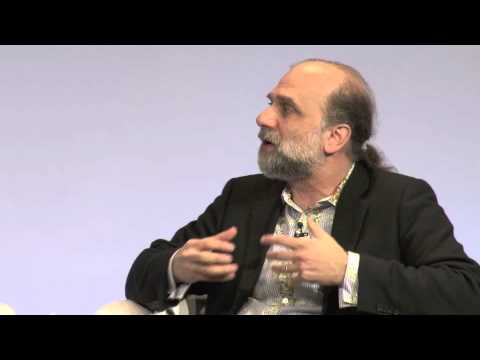
Schneier in action

The pressures mentioned above are strong positive feedbacks loops to conformity and they tend to stifle societal change. So an important question is whether we should foster non-conformity more? What I missed in Schneier’s book was that long term vision, maybe because I’m a historian and he’s a securitarian. By keeping society abstract, he doesn’t touch the subject whether certain societies have been better at dealing with non-conformity and whether they profited from this. For example democratic societies with free speech and protection from violent and legal repression by other members of society, the church and the state?

Modern societies have developed ways for people to defect without being ostracised from society as a whole. We have since long given artists more room for individual expression and have accepted that they not only break artistic rules but also have looser morals, dress more extravagantly and permit themselves a more critical stance towards authority. More recently we tolerate conscientious objectors, encourage whistle blowers and cheer on noble bandits like Robin Hood.

Has western society struck a balance between individual and collective that is superior to authoritarian societies? Not for nothing do most comparative studies show that western societies are more trusting in general than other societies? So can the lesson be, even if Schneier doesn’t make it explicit, that a society which allows its members to break some of the rules is stronger, as long as they don’t break them all?

Full disclosure: I won a galley copy of this book in a competition because I promised to give it away