Showing posts with label Dux Britanniarum. Show all posts

Sunday, 23 December 2012

Learning Dux Britanniarum the hard way

I guess I didn´t take the best approach to my first battle of Dux Britanniarum. Although I flicked through several parts of the rules, I hadn´t memorised them too well. Also the night before I didn´t sleep before 4 am and maybe could have left a few beers.

But anyway... I was there! And as I unloaded my troops, Dick and I went through creating my characters (yes, I pre rolled a group, but I didn't have the stats handy yesterday). This resulted in my leader Olwin being very average, and with no remarkable traits. My young noble Stig was an excellent horseman (might come in useful someday) while the other, Klapmund, was a local Briton. Stocky, but athletic.

We then selected the scenario and our points of entry. My raid was aimed at a village at the other side of the table, with Dick's forces entering the table halfway between me and the village. This meant that even if I managed to get past him to the village, I would have to get back through him on the way back. I decided to worry about getting back later.


My archers covering my troops against Dick's fully deployed battle line
So Klapmund with two groups of duguth (warriors) managed to race to the village past Dick's troops, while my other troops covered for them and then retreated back to the village facing of his deployed shield wall, There didn't seem to be a point in rushing at him in his strongest formation, while my troops were divided.

When Dick's milites (regulars) were forced to break up the shield wall to follow me up, I had Stig charge them with a group of gedridht, my elite warriors. This was fairly even against superior forces, but I decided to send in the other group as well to turn the balance in my favour. The milites fell back with some losses and a lot of shock, while I had only lost one man. But I had also lost Stig, who in his youthful zeal had tried to hard to gain his warrior's glory.


Stig leading his gedridht against the milites

Even as my gedridht fell back past the village, my warriors were unsuccessful in looting. And because Dick's elite comanipulares showed up, I couldn't try all the huts. At this point I decided to try to make it around Dick's troops while they were divided. I also hoped to gain a bit more speed.

This didn't work. Although I beat off a charge of Dick's numeri (levies), my gedridht lost heavily. And Dick could bring together his comanipulares and milites in shield wall under his own command. This allowed him to break up the shield wall, move and then enter shield wall again. In this way he could still catch me.


My gedridth exacting fearful retribution from the numeri

Although he received a bloody nose in that last fight, he broke up the last effective forces and my troops returned home scattered and I lost almost half of them in this raid. It will take me two months to build up my force again.

Dick´s losses were as heavy as mine (a monument to the skill and courage of my men, or the luck of the dice), so his victory didn't gain him much, except a bit of loot. Luckily for him, he didn't lose many elite troops nor levies, because these are most valuable.

A few lessons: defense is really difficult in these rules. Many combat cards are only useful in your own turn.

I also didn't have a good feeling for the effect of the combat cards before the game, so I didn't work as hard as Dick to prune my hand for the best combinations. That's something I need to study as well

But the battlefield is the better place to learn how to fight, so I'll just be grateful for the lessons I was taught and trust in better results next time.

Friday, 21 December 2012

Special delivery, coincidence and basing

Yesterday evening I was informed my new washing machine would be delivered today. Luckily I could skip today at work, so close to christmas.

This also allowed me to do a small chore I'd been putting off, but which really needs done: putting the magnetic tape on the bases of my Saxons. Tomorrow is their first day in battle! They'll be bled in a Dux Britanniarum battle facing Dick's Romano-British.

You see? Excellent fit!
Started yesterday evening late, to cut up the tape into 19mm squares or rectangles and cutting off the corners. Today's been gluing, with the odd mistake rectified (it does matter which side of the magnetic tape is on the bottom).


But the happy coincidence doesn't end there. So last week I'd ordered these magnetic tape circles to put under the round bases. Because that's a pain to cut yourself. You know what? They arrived just past lunch as well! Got it finished before the guys came to deliver the new washing machine.

I've got my basic army plus some archers ready now, the glue needing a bit of time to dry.


Very happy boy. This is the stuff I hate about modelling, so the less time it takes, the better!

Saturday, 15 December 2012

Welsh starter army for SAGA and Dux Britanniarum

Also in the mail this week: a Gripping Beast starter army. Thanks Arvid!


Usable both for SAGA and  as British opponent for my Saxons in Dux Britanniarum. In that case it will need a few additions, but that's okay. No hurry.

Potential candidate for army painter treatment as well.

Sunday, 14 October 2012

Notes on Britannia in the Roman Age


A few notes from Edge of Empire of interest to the situation in Britannia. See my review yesterday for more on the Low Countries.

Milestone commemorating the edge of the Roman Empire in Utrecht
Britannia was a grain exporting region, and also delivered to the garrisons on the lower Rhine. This testifies to the fertility of the land. After the Romans left, grain exports ceased, probably as much because of the lack of social organisation, as from the fall of population. 

I wonder whether and when the country became a grain exporting country again. As said, the loss of Britannia also effectively made the Rhine frontier undefendable. Even though grain might have been provided from further away, this would have been too expensive. 

Like Belgica, you could argue that considering its economic role and the relative peace, Britannia was part of the core of the Roman Empire rather than the outer ring. I would like to see whether Britannia was a net tax exporting region. This would give some indication whether it would be able to maintain the required defenses by itself (if politically united).

The North Sea in this period was more alive than I’d have thought. Considering that the large raids by Chauki pirates on the coast of Flanders in 47 and 172 AD were recorded, suggests that they were also active at other times. They probably also were part of the threat that led to the establishment of the Saxon Shore fortresses. Lendering and Bosman suggest that the Saxons took over the role of pirates. 

I'm now firmly in the camp that thinks that Saxon was a generic name for Germans from the continent in the 5th and 6th centuries..

Dutch 2010 edition
Also, with the establishment of Saxon settlements in Britannia, the North Sea effectively became an Saxon inland sea in the 5th and 6th centuries. This reminds me of discussions about the North Sea as an economic and cultural community in later periods, much like Braudel described for the Mediterranean. This means that the North Sea was a conduit of interaction (economic, cultural, social) rather than a barrier.


Saturday, 13 October 2012

Edge of Empire review


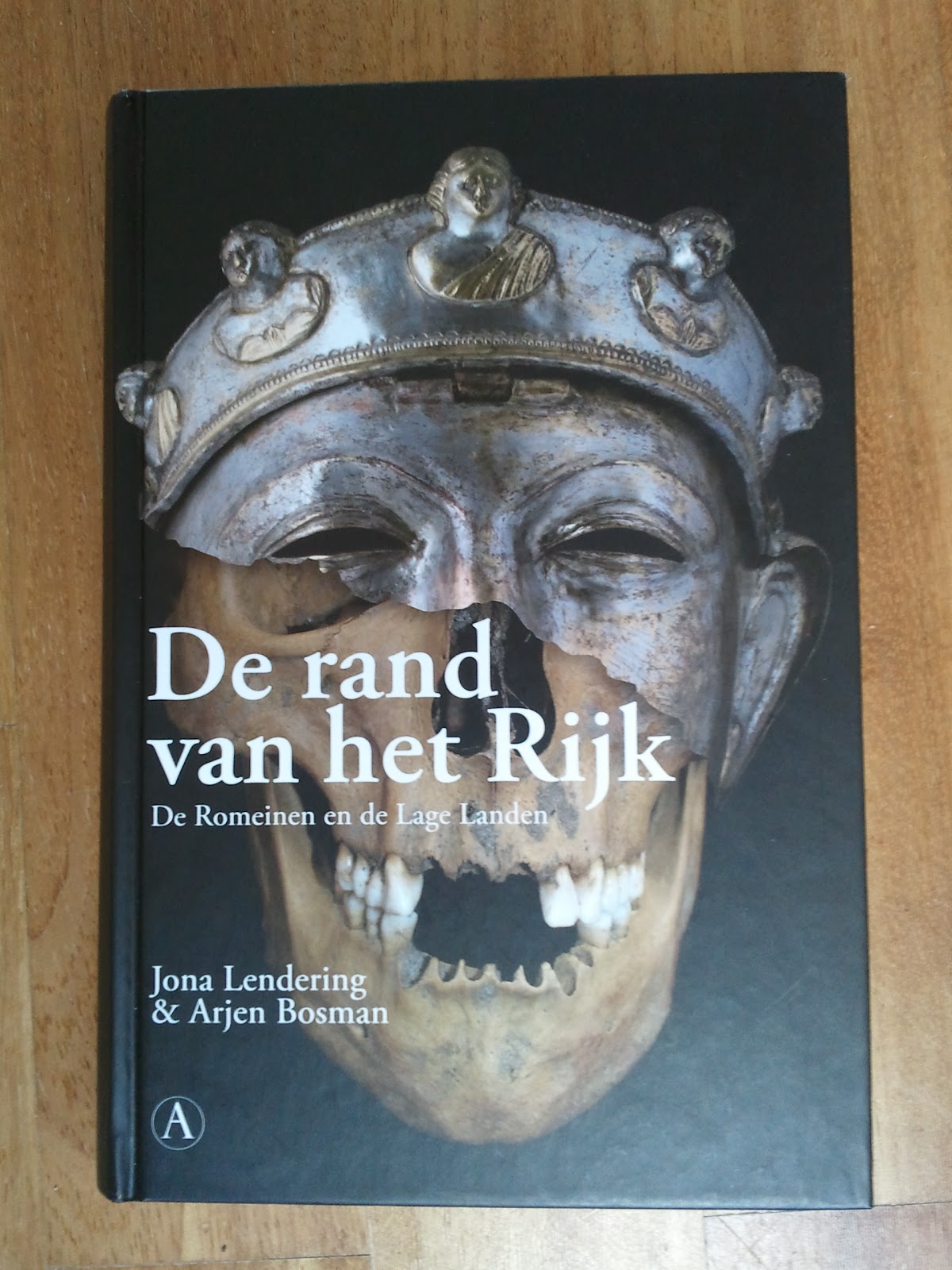
De Rand van het Rijk. De Romeinen en de Lage Landen by  Jona Lendering and Arjen Bosman

Dutch 2010 edition

Edge of Empire, as it will be released in English, is in fact more of a military than a general history of the area between the Somme and the Weser in the Roman era. This is of course due to the remaining evidence, which mostly focuses on warfare.

The book starts off in earnest with the campaigns of Caesar in northern Gaul. The authors argue that the distinction between Gauls and Germans was not as strong as Caesar suggested (he had his own agenda to emphasize it). This remains a problem throughout this era of shifting tribal allegiances and confusion of ethnicity brought about by the fact that we mostly know these people through the heavily coloured writings of the Romans. Although the areas in the outer ring and even in Germania were Romanised over time, the clichés of the barbarians kept being used until the fall of empire.

In the 1st century AD the Rhine border was consolidated, while there were attempts at expansion across the Rhine. Although colonisation beyond the great river proved unsustainable, Roman influence extended across the Rhine through alliances and divide and rule politics.

Under Roman rule, the difference in economic development between the southern area and the Rhine frontier became more pronounced. This difference is a recurring theme throughout the book. The province of Lower Germania was part of the outer crust of the Roman Empire and the garrisons were an economic stimulus. Belgica, on the other hand, was part of the core, and a net tax exporter. This meant that after Roman power diminished, the outer ring declined, while Belgica could hold out on its own.

This was most pronounced during crises, for example in the 3rd century when internal conflict opened opportunities for external attacks. The new German alliances were more aggressive and more dangerous and mounted major incursions in 240 and 256-260.

The Gallic Empire under Postumus from 260-274 was a local response to the crisis in the absence of central aid. German troops were incorporated as foederati and more troops were stationed in the interior. However, in 274 the central authority was reasserted and troops were sent elsewhere at the expense of local garrisons. This in turn led to renewed incursions.

Although Belgica seems to have recovered well from the crisis, Lower Germany entered a long period of decline. The area north of the line Doornik, Bavay, Tongeren, Maastricht, Cologne was effectively given up as no mans land inhabited by German farmers. There is evidence that the language border shifted in this period as a result. The Frisians disappeared as a separate people and reappear as Saxons in present day Friesland. This was combined with ecological crises, like floods due to intensive salt pans.

Relative peace returned until troops from the west were called east in the crisis of 405-6, never to return. The abandonment of Britannia also meant the end of grain exports and maintaining the Rhine fortresses became unsustainable. Rome now effectively gave up the west.

Northern France and Belgium now became the power base for the Frankish kings. It remained a wealthy and self-supporting area and relatively stable as compared to the decline in the Mediterranean.

After the Frankish takeover a process of creeping Germanisation set in. Chlovis was still a Roman in name, but later Merovingians dropped all pretense. There is a tendency to paint the Germanisation as bringing along decline, but Lendering and Bosman argue that institutions like serfdom and feudalism not imported by Germans but already introduced by the Romans.

The book is well written in a clear style, much like its Roman examples. It´s richly illustrated with maps, portraits and photographs of archeological finds and reconstructions.

Lendering and Bosman emphasize the dearth of evidence and the extent of their conjecture. In many cases the archeological evidence points to different conclusions than the historical sources or contradictory historical sources must both be discounted.
  

The book is now reprinted in English as Edge of Empire - Rome's Frontier on the Lower Rhine and of course I heartily recommend it.


There's a few interesting tidbits relating to Britain at this time as well, which I will post later.

Thursday, 11 October 2012

Dux Britanniarum characters

I've done the character generation for my Dux Britanniarum warband. The rules have a simple and reasonably fast method of generating characters through a few dice rolls. This results in characters with enough debth to add atmosphere to the game.

Lord Wilmar, the Tony Montana of the Dark Ages
My lord is Wilmar, born on this side (ie the British) of the waters from noble stock. All his life his desire has been to advance his status among his people and his actions tell the tale. This has gained him a reputation for ruthless ambition. While this makes him useful to a king, it is of course also a risk. And Wilmar would be wiser than to covet the wives of his master and peers.

Apart from your lord, there's two nobles and a champion. Wilmar's two nobles are Sasbout and Osmond.

Sasbout, the miser

Sasbout is Wilmar's elder cousin and likewise strong and tall. But he lacks his cousin's burning ambition and is instead thrifty and conscientious. Those people who have an interest in Wilmar´s carreer quietly hope that Sasbout proves a tempering influence on his lust for glory and carnal gratification.

Osmond, the flatulent

Osmond is younger than Wilmar and more slender. He is of low ancestry but his devotion to the gods makes him a dependable lieutenant. His gastric troubles, which no prayer or gift to the gods will drive away, make him the butt of many a joke.

Swidbert killed that wolf with his bare hands

Swidbert is Wilmar's champion, a distant relative from across the sea. The men are only separated by a moon in age, but the difference in appearance is striking. While Wilmar sticks out in a crowd himself, Swidbert towers even over him, bulky and bristling with muscles. Many times has he crushed his opponents by sheer strength.

As a Saxon noble, you don´t live in a political vacuum. Your ambitions are curtailed by your king. In Dux Britanniarum, the characteristics of the king are generated much like those of your nobles.  

Wilmar's king is called Markwart, an upstart bastard of peasant stock who has risen through the ranks through his skill at arms. Though pretty secure in his position, he´s just turned fifty-four and may soon meet his ancestors.

Now it's just waiting for a Romano-British opponent and an area for a campaign. Luckily, Derk has almost finished his army.

Sunday, 7 October 2012

Saxons bring up reinforcements

 As if the Romano-British haven't enough to worry about, this is a bunch of Gripping Beast Franks I  received in the mail this weekend.

Army in a box


Bought from Marktplaats/eBay with some unpainted stuff, including a box of Gripping Beast Anglo-Saxon thegn for the SAGA period. It was reasonable value for money. The painting is okay (although not as good as René). This means I now also have ample cavalry and skirmishers.

Considering I also have some great minis from Musketeer coming in, that about settles my army for this period.

And then I find out they do prepainted dark ages buildings from Gripping Beast and Warlord. That'll be my next objective then.

Thursday, 4 October 2012

More pics of my Saxons

Some more pictures of my Saxons. As said, they were painted excellently by René van den Assem. Check out his other work at his Paint_in weblog. Click on the images for close up.

A German warband

The gedrith or hearthguard, the close retainers of the lord
More gedrith


These will probably provide some of my named characters. You've got to love the dog minder and the shaman.


This is a warband of veteran warriors (duguth) in a linear formation with a fair bit of aggression


And finally a warband of duguth at ease


Now looking forward to my first game of Dux Britanniarum! I've been working on my main characters, who I will introduce to you soon.

Friday, 28 September 2012

First glimpse of my Saxons


Saxons are coming!
A quick snap of my newly painted figures. This was done with my not so great mobile, but I will do some better pictures with a better camera this weekend.

I am very pleased by the paint job René did, and I'll be happy to recommend his work to anyone. René really enhanced the already great sculpts of Gripping Beast.

In fact, these figures are not Saxons specific for Britain, but continental Germans. There's an overlap in miniatures between the two areas of course, but this gives my army a bit more identity.