Showing posts with label medieval. Show all posts

Sunday, 18 March 2018

Some of my recent reading: dark ages Frisia

Another couple of books I read the past moths were triggered by plans for some medieval wargaming. Somebody suggested that we should try the Battle of Vlaardingen in 1018, a smallish affair by today's standards. It was pretty momentous however, as it established the independence of the counts of Frisia against the Holy Roman Emperor.


Sadly the execution wasn't compatible with stuff I already had lying, waiting to be used, so my project will deal with the Battle of Hastings. But I read the stuff on Frisia anyway...


And the most amazing I learned is that the Dutch coast was mostly deserted in the 3rd and 4th centuries AD. Apparently rising water levels, combined with moving sand dunes made life extremely hard so it essentially depopulated. The people that came to inhabit the area afterwards were not the original Frisians of Roman times, but migrants from present day Northern Germany and Scandinavia, with a different material culture and different language. However, they were named after the area and for a long time people assumed there was a continuous link of Frisian inhabitation.

Saturday, 7 November 2015

More Monks

Well... they are not actually new. I think I painted them about 25 years ago, for a big crusade game where I was the pope and needed some emissaries and bodyguards.


They came out of a box a few months ago as I was rummaging for something else. No clue what miniature company I got them from.

But now they can form a gang for Frostgrave, together with my other monks. The good thing about it is that I don't need to paint any new figures, so it doesn't interfere with the AWI project.


I bought the Frostgrave handbook in epub format so I could look at what I would need. This either calls for a thaumaturg wizard, or maybe a sigilist, as I've got the monks for that as well.

Should be up and running soon. Perhaps only two weeks till my first game.

Sunday, 6 September 2015

Miniature painting projects for last part of 2015

I promised myself two small painting projects for the 2nd half of 2015. I had already compiled a short list of possible projects in the early part of the year.


And then by chance I started off on the 1815 Prussians for the Battle of Waterloo, a game that was put on for the end of August. Somebody put a few batallions up for sale in May and I decided to buy them, including some unpainted stuff, adding up to two batallions of Landwehr. It was a pretty tough job finishing in time for that, but as always a deadline helps.

I've managed to resist the temptation of buying more unpainted lead/plastic, because once this deadline's gone, there's not much chance of me painting it. I bought a bunch of painted limbers and guns and staff officers was offered by someone at the club. Good buy, but it also included a bag of unpainted cuirassiers...


The good thing is that I felt so happy about painting that I picked up another tiny project last Monday, spraying a base coat and putting on three colours on a set of six medieval monks useful for either Dux Brittanniarum or SAGA. And then some more work this weekend! Pretty easy to paint and limited detail, which is good to keep momentum going!


So what after this short project? This is what I'm thinking off:
  • Finish the vehicles for my American WWII Chain of Command force. It will be a bit of glueing, and not too much painting. Mostly spray painting and finishing. It's good to finish a project!
  • Scenery for Dark Ages which will be useful for either Dux Brittanniarum or SAGA

More distant and ambitious projects:

  • Muskets and Tomahawks. I've got Indians, French and Americans, so I can try both French & Indian Wars and American War of Independence. M&T doesn't require many troops, so doable. With an added Maroon project stemming from my interest in slavery in the West Indies. There's also this big project a number of people are starting for a big AWI battle day...
  • I've got loads of Fantasy stuff lying around for some vague project. goblins, skaven, an unfinished batch of bats, and loads more. Tempting. I might also join in the Frostgrave fun, which doesn't require a lot of figures, but with the risk of buying their plastic soldiers set, which will make excellent adventurers...
  • Normans. I bought a good sized army but half of it only in base coating. It's already enough for what I intended with them (SAGA), but finishing the force would give a feeling of completion. It does however pose questions about matching the quality and style of the miniatures already finished. That will be very hard
  • Vikings and Late Saxons. I've got two Gripping Beast boxes of plastics which with some army painter treatment might finish in good time.
  • Welsh. I've got this Welsh starter army for SAGA which can also be used against the Saxons. And Picts. And Normans. And Vikings. And Late Saxons.
  • Samurai and fantasy Japanese. Some lovely stuff from the Indiegogo, and some buildings. It's just that my painting technique is not good enough to do it justice


Oh well... I can still try to get somebody else to paint some of this stuff, which is what I decided on two years ago.

Thursday, 27 August 2015

Finding Arthur

Somehow, what started out as an anything-but-Waterloo summer has turned in to a medieval reading tournament. After the wonderful Quest for El-Cid, I turned to Guy Halsall’s Worlds of Arthur. And of course it’s hard not to compare the books.


Essentially the books have a similar approach: to use the story of one semi-mythical character to gain a wider understanding of the time and place they lived in. And they face similar challenges: a flood of artistically and ideologically embellished literature obscuring a dearth of dependable sources.

Rodrigo was retroactively incorporated into the Reconquista propaganda and 19th and 20th century Spanish-Castilian nationalism. Much of the popular image of Arthur is based on 12th century romantic literature, which by the way has strong ideological or at least moralistic overtones, as Halsall points out. This has not been improved by 20th century fantasts who have claimed to have proven certain myths based on very crude and fanciful interpretation of isolated snippets of evidence.

There are differences too: while Rodrigo can be proven to have lived and the main occurrences in his life are beyond doubt, Arthur’s best bet is that it cannot be disproven that he has existed, but that it is unclear when exactly and where. But the fundamental challenge remains to construct a narrative from very slim and unreliable evidence.

"Indeed, whether or not one of the post-imperial British kings was called Arthur is probably the least interesting question that one can ask about this important period."

Like Fletcher, Halsall is less interested in the main character than in the society that he (supposedly) lived in. Halsall effectively dismantles the 'barbarian invasion' interpretation of British medieval history. But the historical discourse which has replaced it (well presented by Robin Fleming in Britain after Rome), and focusses more on non-violent and cultural domination by relatively small groups of immigrants, also doesn't satisfy him entirely.

First of all, Halsall more strongly emphasises that Britain was not an island but part of a North Sea cultural zone where migration, like trade, was not a one-way phenomenon. This means that cultural change was not the result of conquest, but of interaction and shows parallels on the continent.

Halsall agrees with the new historiography of British decline even before the end of Roman presence and that for a long time the population of Britain saw the removal of Roman forces to the continent as temporary. Also the coming of the Saxons started as allies to the local population some time before the Roman departure. This may have been part of a civil war(s) between Roman competitors.

Finally, post-Roman Britain probably had larger political units than long assumed. Even if not strongly unified, patterns of overlordship by weak states existed, in connection to mainland Europe.

Reading Halsall it is clear that he has a very deep and keen insight into the different material available. His scientific criticism of the written sources is unparalleled and his points out many logical pitfalls in the interpretation of archeological findings. It is clear that what we can infer from them is very limited. So when he keeps open the possibility that Arthur may have really existed this is more from the viewpoint that there is no evidence to disprove his existence, just as there is no proof that he actually did. I think the book is a must read for any serious student of ancient and medieval for its state of the approach and methods.

But in the end, it's the organisation of the book where Fletcher prevails. Halsall's convoluted break up of the development of the 'historiography' of Arthur makes the book tough to finish and the part that is most interesting, Halsall's alternative view of post-Roman Britain, suffers from the reader's desire just to be done with it. Which is a shame.

Tuesday, 7 July 2015

Finding El Cid

What a joy!


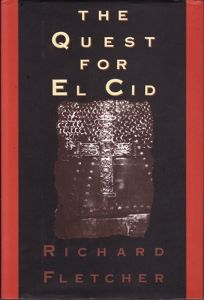
After a year of almost exclusive focus on Napoleonics I am now returning to the promiscuous reading selection of old. One of the books I had been saving up for this moment was Richard Fletcher's The Quest For El Cid. My interest in The Leader was aroused by my visit to Spain two years ago.

The beauty of the book is that it not only describes the life of The Cid, about whom there is only a limited amount of hard evidence, but also the Spain that he lived in, and also the Spain that turned him in to a crusader saint later on.

The age of El Cid was a fluid one, with disintegration of the old Muslim Caliphate into successor states that were unable to maintain themselves against Castilian expansion. So many of them became dependents, riven apart by internal struggle to be exploited by rising Christian states in the north. However, those fought amongst themselves as well.

Christians, Jews and Muslims lived among each other, just like Spanish born were mixed with Arab and Berber immigrants and descendants. Not that it was a multicultural paradise, but at least a period of relative tolerance (see my discussion of that topic earlier on this blog).


Spain in 1086, just before the coming of the Almoravids

But that was about to change during The Cid's lifetime. On the one hand hard line Christians were starting to build a vision of reconquest, while from the North and South of the Sahara the strict Almoravid sect made rapid progress toward the Mediterranean.

The Cid was always more his own man than a courtly insider after he lost his royal patron early in life. He wasn't particularly liked and easily made enemies, but his skill at leading troops made him very useful to the leaders of his age. He served the king of Castile but also the Muslim leader of Zaragoza. And late in life he primarily served his own interest, capturing Valencia to rule himself.

In the last chapter Fletcher shows how the legend was built on this, partly from a need to attract pilgrims in monasteries and later from a need to build a reconquista ideology, and finally in the modern ago, the need to create a unifying myth for Spain.

Highly recommended, therefor

And yes, this is a perfect setting for a megagame.

Wednesday, 13 November 2013

A Posh Neighbourhood

Apart from the stone commemorating the crash of Régis Deleuze the area around Houten is thick with castles that trace back to medieval times. The marshy area north of the Kromme Rijn was drained and turned into polder in the 12th and 13th centuries, soon followed by keeps of local lords.

The medieval keep of castle Sterkenburg
with 19th century additions
Like many of the remaining castles, Sterkenburg (ca 1200) now has been converted to a hotel/B&B. Apparently it was up for sale earlier this year for slightly less than 10 million euros (a bargain I'm sure). They do tours in the weekends. Tempting!

Castle Weerdensteyn with the moat and entry gate

But the real prize was the discovery of Castle Weerdensteyn, built around 1300 and hidden within a wood so it cannot be seen from any road. By chance we hit the path that passes it. The top of the keep is reasonably intact, but the base has been reworked in the late 19th century. Apparently it has been refurbished again recently and is still inhabited. Just shows that it pays not to stick to the beaten path.


Castle Lunenburg
Another reasonably well preserved keep, castle Lunenburg. Bombed in WWII because German vehicles had been spotted near it.

There are dozens more in the area so I'll be keeping my eyes open. With the fortifications of the Oude Hollandsche Waterlinie also in the neighbourhood and the remnants of the Roman limes, which lay at the Kromme Rijn, this is an interesting place.

Sunday, 10 November 2013

Commemorating with my friends across the pond

Had  a very beautiful and interesting round of cycling yesterday. Surprising how much history there is to be found literally around the corner.

Commemorative stone for Régis Deleuze at his crash site
After 15 minutes we ran in to a stone commemorating the death of Flight Lieutenant Régis Deleuze, who crashed on this spot near castle Beverweerd in Werkhoven on February 25th 1945. Apparently engine trouble forced him to put his Tempest down. He crashed after hitting the top of the tree line in the background.

Régis came from either a French family of nobles. From his operational history is gather that he left France as is was being overrun by the Germans in June 1940 and signed up for the RAF.  In 1943 he joined 501 Squadron and brought down V1s aimed at England. He transferred to 274 Sqn early in 1945. This seems to have been  his first operational flight in the unit, from airbase Volkel in Noord-Brabant. Régis was initially burried in Werkhoven but transferred to Evere in Belgium after the war.

Régis at age 17 (from the website below)
As in the case of the grave of air gunner Hiscox I found in Beesel a few weeks ago, this stone has been adopted by a local woman, Yvonne Jager, starting when she was 10 years old. She lays fresh flowers at the grave four times a year. The lengths to which she has gone to retrace the family and former brothers in arms of this pilot are remarkable. Her story and that of Régis Deleuze can be found on this website. It shows once again that even a simple reminder can have great impact on individual lives and that many people still value the effort of allied soldiers for our freedom.


Castle Beverweerd, with 19th century fantasy decoration
The brick part at the centre of the picture is from the 13th century, with the later additions in white plaster. Apparently the castle is now inhabited by master forger, Geert Jan Jansen. He´s famous enough now to paint under his ow name. More castles on Wednesday!

Monday, 4 November 2013

Crisis Loot

Okay, so I brought some stuff back with me, despite all the talking.

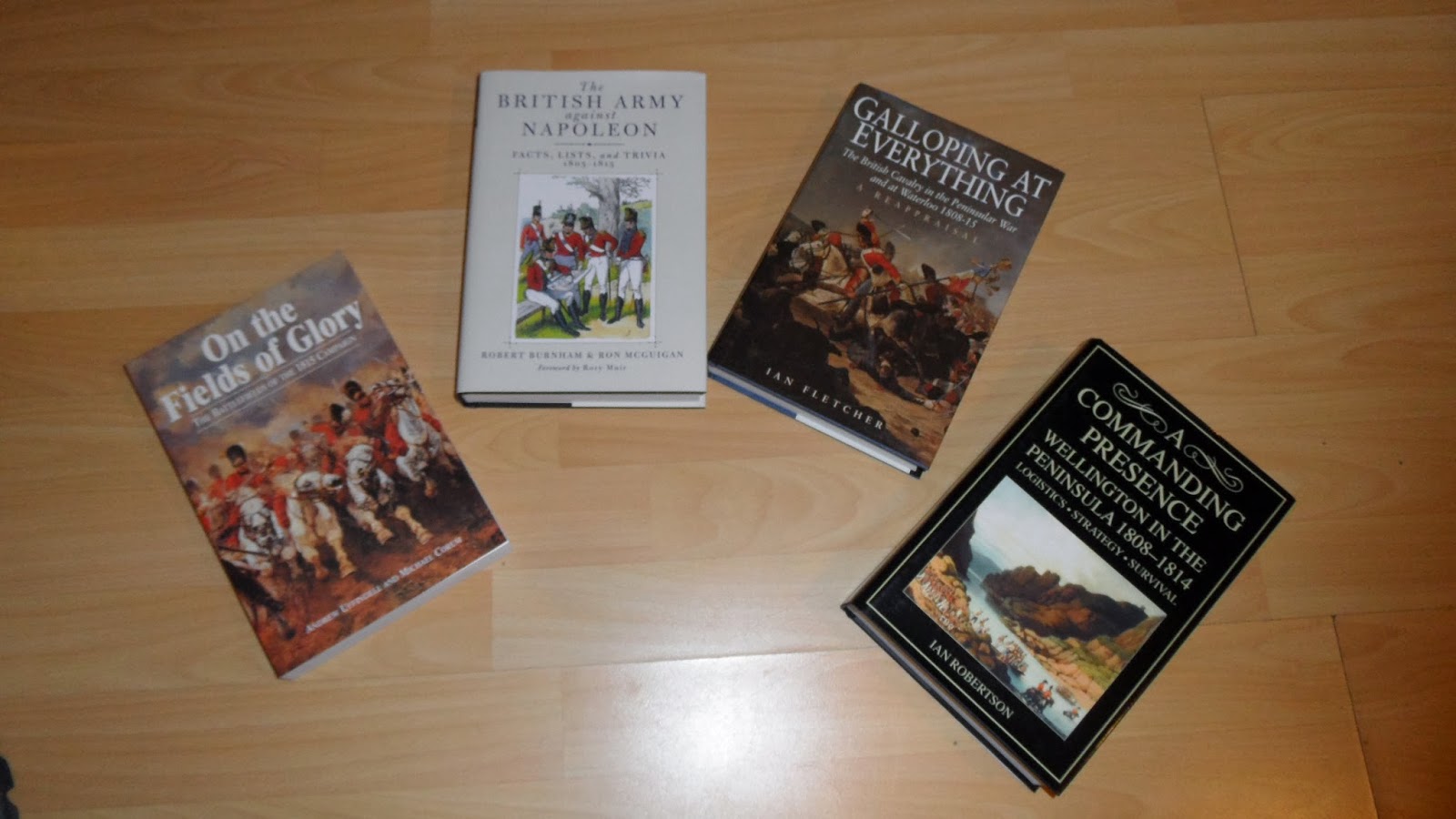
Some books for my Waterloo project. Although I have more than enough books on the Brits already. But on the Fields of Glory offers a battlefield guide and A Commanding Presence focusses on logistics. I'm a sucker for logistics.

Bought at very reasonable prices at David Lanchester

Three Ospreys about the 100 Years War. A project for 2027... or 2028. Teenage dreams since reading the Thea Beckman Geef Me De Ruimte trilogy.

Gained at the bring & buy

You must be worrying whether I bought anything wargames related at all and I can set your mind at ease here. I bought the hard copy of Chain of Command plus some dice, counters and the jump off points. Yes, I have the pdf version, but I like giving these guys money. They won best participation game award at the show and well deserved for the Hardest Working Men In Showbiz.

To the right is the Crisis complimentary miniature in the package (will fit in somewhere in my slavery & maroons project) and a bunch of Japanese 16th century civilians. They will fit well with any stuff I might ever do on samurai.

Purchases from Too Fat Lardies and Dave Thomas

I also added some 1/72 Stuarts, M3 halftracks and a Jeep to my American WWII forces. Too bad that I didn't like the SHQ 20mm Americans and almost nobody else makes them. Given the flood of Germans, Soviets and British I find this lack of love for the Americans in 20mm and 28mm (excepting the US paras of course) surprising.

Very spirited discussion around amateurism and professionalism in the wargaming hobby on the Dutch Miniature Wargaming facebook page (not just due to my post here). My mind is brewing with ideas. Damn! I have no time for that!


ps more beautiful pictures of Crisis at Little Lions and Modus Reg Magni Momenti

Tuesday, 27 August 2013

More thoughts on miniatures rules and the future


Yesterday´s post was about some favourite miniature rule sets, but later that night I also had a discussion about rule sets at the birthday of Michel with Hans and Ed.

Hans is working on a fantasy rule set (For Reign or Ruin, see him testing it here) and very interested in what happens before the battle and how that affects the battle. Delays in the arrival of troops or in their deployment would offer their enemies opportunities for pre-emptive attacks or send an battle plan into disarray. Pre-battle speeches could lift the hearts of the troops.

Ed is thinking not so much of a rule set, but more a scenario generator because he feels that in many rule sets there is no context to the battle and organising and above all keeping campaigns going is hard work.

Maurice, by Sam Mustafa
This made me think of Maurice, the 18th century European battles rule set by Sam Mustafa. It works with a card deck for special personalities, national characteristics and special events before and during the battle. Obviously, Maurice is in the direction of what Ed looks for, but not the final answer.

Another example of a new direction in wargaming is Dux Britanniarum, another Too Fat Lardies set about the struggle between Arthurian British and Anglo-Saxon invaders. The rules focus on the main characters in the war band as it raids or defends the frontier over several years. With rudimentary character generation like in an RPG and with opportunities to rise through the hierarchy and expand your force, the simple campaign rules offer a structure to each battle.


Dux Britanniarum by Too Fat Lardies
What I have noticed is, that as with other great games (like boardgames War of the Ring and Battlestar Galactica), immersion is so strong that the game generates and unprecedented literary effort as players write their battle reports as first-person stories in a long saga or even medieval ballads. I think that speak volumes of the appeal of this rule set.

What I like about the rules is that they are aimed on a small period of time (you know, just a century or two) and move away from the generic setting so common in ancient and medieval wargaming (why is there no rule set just for the Pelopponesian War?). The other side of the coin is that it offers only a relatively small sales volume at reasonably low costs for the designer.

I think there are opportunities for new products by combining card decks a la Maurice with limited ancients/medieval settings like Dux Britanniarum. The card sets build a mini campaign or act as a scenario builder, compatible with whatever rules people use to fight their battles. You could link it to new miniatures ranges, but I think there are also advantages in offering players new ways to use armies that they already have.

The upside is that creating a deck is not expensive. You can sell the decks themselves or offer them via print on demand services. It requires some research to include the kind of events and characters and the dynamics of a particular conflict or campaign. There are a lot of ancient and medieval wars and campaigns so this adds up.

A possible solution to that challenge is to provide a much larger set of cards that players can use to build decks for particular campaigns or wars themselves. It is a good way to engage players with the product.  If you allow them to publish their decks on a forum it will build a community or when they publish in magazines they advertise for you.

What do you think? Is this something you are looking for? Do you think it is viable?

Monday, 29 July 2013

Jolly Monks

A fine addition to my Dux Brittaniarum host, a bunch of priests to rob and despoil.


 Part one of my new Foundry shipment.  

Tuesday, 16 July 2013

Age of Renaissance - Old Skool Ameritrash

I played two games of Age of Renaissance in the last month. It had been almost a decade since we last played it, so we all had to have a good look at the rules. Although rusty, we were back up to speed by the end of the first evening.


Age of Renaissance is an Old Skool Ameritrash game by Avalon Hill. As suggested by the title, the game is set in the period leading up to the Renaissance, starting in the 8th century. The game is not about empires conquering territories but about trade metropolises dominating markets. The trade empires are Venice, Genoa, Barcelona, Paris, London and Hamburg.

Movement by sea is the best way to expand your trade empire. You start out with slow galleys that have to hug the coastline. Although you can extend the range (and carrying capacity) of your galleys, improving shipbuilding technology first removes range limits, first to all of Europe, then to the East Indies and finally the New World.

A familiar map, very early in the first game. With five players, Hamburg
(and the Baltic and Russia region) isn't included


The map is asymmetric with the most high value areas in the Levant (the eastern board of the Mediterranean), the Black Sea and East Indies and New World. This favours Venice and Genoa, because they are closest to the Levant and the Black Sea. It also means Paris, Hamburg and London should be aggressive (or locked out from the juicy bits).

My list of technological advances, about 3/4 into the game
In the right corner below, you see my biddings
The game mechanics are a development on the original Civilization, and similar in feel but a bit more complex. Like in Civilization there are trade goods where the value grows exponentially the more you have, there’s a tech tree and conflict is abstracted and requires a minimum number of counters to engage.

The trade goods are not based on cities but on areas on the map you control and they each produce different goods like timber, wine, spice and ivory. The tech tree is a bit more structured and expanded, and all the technologies now provide benefits in the game. And conflict is influenced by control of neighbouring areas and technology.

A few sample event cards
The major change to the game as opposed to Civilization is the addition of event cards: you can play them to score trade goods and bonuses on technology or tactical advantages in conflict. There’s also a number of catastrophes such as famine, epidemics and religious strife that will increase the misery of your population. 

The Misery track is another addition to the game. As a result of catastrophes and certain technologies, your people will suffer, and at the end of the game, misery will cost you points. And the higher you are on the track, the bigger the steps, so the harder it becomes to reduce misery. Money and some technologies allow you to reduce misery, but it takes some effort to keep on top of it.

The event cards can be very powerful: scoring a high value trade good or a good leader bonus can buy you an extra technology, a tactical advantage can make you win two more areas. And a catastrophe can lose you half your money. Pretty powerful stuff that can determine the outcome of a game and will have players arguing whether the player targeted is the one in front or not.

The Black Sea and the Levant, cornered mostly by
Genoa and Venice in the four player game
Your basic economy depends on the number of areas you control, but as said above the type of area makes a difference when trade cards are scored by playing event cards. The value of your harvest is determined by the square of the number of areas you hold in that trade good, so monopolies can be very profitable. It’s not possible for all trade goods and sometimes it’s better not to monopolise a good because other players won’t score their cards if you’re the only one benefiting. On the other hand, if you have a trade good card yourself and you can try to collect a few more areas to improve your haul.

As an old skool Ameritrash game, it has many of the flaws associated with the genre. The game is long, taking 5 to 6 hours with 4 players (longer with more players) but that also increases the sense of epic achievement by the end. There is the possibility of a runaway leader if nobody goes after him and it is prone to king making. Like Civilization, there’s lots of calculation going on to optimise your score, and that is something not everybody likes to do in their spare time.

The game is also different with fewer players. There’s too much room in a 4 player game, while 5 players is too hard on Barcelona (with London breathing down its neck). I would like to try six players sometime again because that might be the best balance.

Were it designed or republished today it would be more streamlined to fit into 3 hours. I should try the recent Romanian game Warriors & Traders to see how that works, because it basically has the same theme. But despite all its flaws Age of Renaissance is still worth digging out once every couple of years and probably a great game when you're in school or university and have more time to burn.

Friday, 28 June 2013

Warfare in Al-Andalus

It took me a while to finish this last part of the Al-Andalus project because I needed to sit down and have a look at the books again.

My reading list for Andalusia

These three books are  bound together by the author and illustrator and this results well researched books, which draw their strength from David Nicolle´s good knowledge of Arabic sources and the in beautiful paintings of Angus McBride. But there´s also a broad variety of photographs and maps that add to the text without overlap between the books.

The weakest of the three books is El Cid and the Reconquista, 1050-1492. Spanning four and a half centuries, it suffers from bad organisation. By splitting up the discussion of the armies over different periods, any sense of continuity of change is lost. There is quite a lot of emphasis on equipment at the expense of other subjects, which feel rather general.

This is the only book of the three giving much detail on the armies of the Christian kingdoms. They relied on royal retainers, military religious orders and later urban militias to expand to the south. Their equipment and tactics were heavily influenced by their Arabic opponents.

One of the important lessons is that it is hard to talk of Christian or Muslim armies, because both sides employed warriors of both faiths and many different ethnicities: Spanish born, but also Arab and Berber Muslims, and Spanish as well as French Christians, not forgetting renegades. El Cid’s story is the best known of these soldiers fighting on both sides.

A model showing the Gibralfaro and Alcazaba of
Malaga and the double walls connecting them

Much better is the Moors, where the development is much better explained. Organisation, equipment, architecture and naval warfare are all better structured. It details the change from a Ummayad caliphate based on Spain to Almoravid and later Almohad empires that were both rooted in North Africa. These were seen, by the Muslims as well as the Christian, as foreign invaders. Their fundamentalist teachings meant that they remained separated from the Spanish elites.

Interesting is that these invasion always followed on fragmentation of the previous Muslim empire. Encroachment by Christian kingdoms then forced the Spanish Muslims to call for help from the south. They would have rather remained masters of their own fate.


The walls of Ronda served the town well, but the town
surrendered after its water supply was compromised
Granada 1492. The Twilight of Moorish Spain, on the last campaign is well structured, but has the advantage of a limited period of time with relatively few changes in equipment and organisation. It rolls like a narrative of the campaigns, with good analysis of the strategic considerations on both sides.


The war was pretty one-sided due to the infighting among the Granadese pretenders, although the financial burden of the war would have set limits on the Spanish side had it lasted longer. On the other hand, the quick progress was probably a factor in the ability to gain new loans.

The walls of the Alcazaba of Malaga
One of the few fortresses to stand up to Spanish cannon

But it was not only the internal strife on the Granadese side that won the Spanish the war. This war was about raid and sieges. And while the Granadese gave as good as they received on the first count, the Spanish enjoyed a marked advantage in the latter department. Although there was some artillery in the forts, the Spanish had more and better. Most sieges against smaller towns were therefore resolved quickly. Only Malaga and Granada could put up prolonged resistance. 

Having seen the terrain around Malaga and Ronda, I got the impression that the war in Al-Andalus was a struggle over valleys, with fortification providing control over the areas. This suited the Spanish well as fortifications could be taken at ease most of the time.


The church door of Alozaina commemorating the capture
of the town by Spanish troops on June 21st 1484

Looking at the long term, Granada’s long survival had only been obtained by bending its knees deeply to the Christian kingdoms, war among the Christians and support from North Africa. When these points were resolved in the late 15th century with the unification of Castile and Aragon, and the loss of connections to Muslim rulers across the Straits of Gibraltar, the days of a Muslim state on the Iberian peninsula were marked.


One minaret remains of the mosque of Ronda


Check out my earlier post on the struggle between Christians and Muslims from the perspective of the other side of the Mediterranean, that is from Rhodes.

Tuesday, 19 March 2013

Twilight Companions

I may have remarked sometime before that I spent many a rainy wednesday in the local library when I was young. I didn't read books but went through the collection of comics and quickly shifted to the adult section when I was about 10.


One of the comics that made the biggest impression on me was what I thought to be a two part series about two youngsters in the Middle Ages hooking up with a lone knight and wondering into some half fantasy world with kobolds and dreadful monsters. It was pretty dark. The style reminded me of the Passengers of the Wind.

I did try a few times to remember what the name of the series had been but got confused with les Tours de Bois-Maury by Hermann, or de Torens van Schemerwoude in Dutch, which also features a knight and some youngsters. Not a bad series at all of course, but not what I had been looking for.


Then I was in the comic shop on Saturday and I had the insight to just ask the proprietor, who immediately knew what I was talking about. I had been right about the style because it was the same artist: Francois Bourgeon. The series is called The Twilight Companions (De Gezellen van de Schemering in Dutch, no wonder I got confused!) and actually consisted of four books. So much the better!

The series is now sold in a complete edition
The books are still brilliant and reading it had a profound sobering effect on me. The story, set in Hundred Years War France, is of a former mercenary captain trying to make amends for his cruel past. He is accompanied by two survivors, a boy and a girl, he rescues and serve him in return.


There´s lots of bickering between the two kids and all characters have their flaws. But Bourgeon manages to make us care about them: foolish, cowardly or vengeful. Their ultimate fate struck a very powerful chord with me and is on my mind very much still. Likewise, very few of the supporting characters are solely evil, but rather twisted, wounded, corrupted or victims of fate.

The peasants and townsfolk are not hapless spectators or victims, but often willing accomplices and fickle. Most of them are cruel but pitiful survivors of a pretty hopeless age. That fits pretty well with my world view, but given that this is what I read when I was 10 or 11, who knows to what extent these books shaped it?

The main theme in all these books is revenge and redemption. Most characters have devils from their past, and must make difficult choices to accept new ones. The fact that often they have little influence on those decisions, or the outcomes, makes it  a tragic story.


The drawings are stunning. Facial expressions are rich and subtle, the monsters terrifying, the countryside, towns and castles atmospheric. The many 'extra' images, for example the owl in one of the later books, are subplots that effectively convey the atmosphere of the story.

Now I've found them back, Mariotte, Anicet and the knight will forever be my Twilight Companions.

Monday, 4 March 2013

Scandinavian crusades in the Baltic

Michiel bought a bunch of second hand Ospreys from the Dutch equivalent of eBay. And this one he already had, so I got it from him (it's good to have friends!). It's a quick read, but not necessarily a very worthwhile one.


For me the book was badly organised and confusing. The language is a bit convoluted sometimes, and David Nicolle might have done a better job editing his Swedish (?)co-author.

It already starts with the exposition of the Baltic crusades. This doesn´t go much farther than generalisations about causes and motivations you can find everywhere. Then you get a chronology and a very short introduction about the organisation of the armies, which basically says we don´t know much about it. Strangely, much of this context is stuck on at the end of the book.

Most of the book is about weapons and armour, broken up in four time periods for both the Scandinavians and their Baltic opponents. This leads to fragmentation and repetition, because in every one of these some development in the make of swords must be mentioned, even if it is irrelevant.

The part on strategy and tactics, despite the terrible writing style, offers the best bits of the book. The influence of the terrain and the very small size of the forces involved explain how the campaigns were slow and grinding and stuck to main rivers and siegecraft. And unlike the west, the winter was a season suited to campaigning.

As always, the illustrations by Angus McBride are the real boon. But that won´t save this book. It doesn´t inspire further research, nor does it give you the barest necessities to start a wargame army. It could have done with a couple of examples of important campaigns.

Sunday, 9 December 2012

The benefits of Christmas shopping season

Was able to pick up two interesting books today, from the same Dutch publisher (Verloren). Pure coincidence.

First one in the Netherlands during its incorporation in the French Empire (1810-13), because it has stuff on the Dutch army of the period and the implementation of conscription. Published in 2012 & Ideal for my Waterloo interest.

Second is about the war of Arkel. It's a ten year struggle between the counts of Holland, the bishops of Utrecht and the dukes of Gelre over the lands of the lords of Arkel.

It was written in 1990 and one of the first in the Netherlands picking up on new trends in military history. So it has a lot of stuff on the economics and logistics as well.

It's not for any direct purpose, but I might use it sometime in the future.