It's been a long time, but I came back to playing The Prince: The Struggle of the House Borgia (sold as Borgia in the Netherlands) last week. The Italian renaissance has a strong attraction to game designers, it combines economic growth with art and architecture and intellectual growth. Princes of Florence, La Citta, Fresco, Leonardo Da Vinci and Medici are just some examples of games combining these elements. And that is ignoring all the games covering the exploration of the world in the same period.
But there's another side to the renaissance that attracts designers and that's the Machiavellian politics. When you want a game that has conflict and backstabbing as well as the above, the exploits of the condottiere and scheming of the renaissance popes offer a good background.
Not for nothing one of the games that takes this approach is named after the Florentine politician and philosopher. But there's others as well: Martin Wallace's Princes of the Renaissance and Borgia. While Machiavelli is a more detailed version of Diplomacy, the latter two games leave the physical map and use cards and counters to portray the expansion of power.
Borgia is the less complex of the latter two games. It plays in three phases where auctioning resource and action cards and attacking each other's resources make up the player's turns. The attacks can always be made on unprotected resources, ie they are not combined with a city. Otherwise it needs playing a condottiere card. They can be defended by playing condottiere cards as well.
The phase ends when all available cards have been auctioned. Then income is gathered and a papal election held, followed by a point tally. The points come from cities, famous artists and being chosen pope.
What proved interesting is that you can have a fun game threatening other players by attacking unprotected resource cards and then not play a condottiere card, hoping that the other player plays one, effectively wasting it. The downside is that you waste one of your limited actions and get nothing in return.
It became a very close run game in the end, with me losing by 151 to 147 points. I managed to take out a very valuable artist from my rival by stealing the medicine card of him first and then playing my plague card.
But he saved his victory by good defensive pairing of his stronger but less valuable cities to his artists and his weaker but more valuable cities to independent families that increased the defensive value. That meant that my condottiere cards were too weak to take them on and sway the game my way,
A sturdy game, but nothing can change my love for Princes of the Renaissance. Not even the fact that I suck at bidding games.
Showing posts with label Renaissance. Show all posts
Monday, 19 December 2016
Tuesday, 16 July 2013
Age of Renaissance - Old Skool Ameritrash
I played two games of Age of Renaissance in the last month. It had been almost a decade since we last played it, so we all had to have a good look at the rules. Although rusty, we were back up to speed by the end of the first evening.
Movement by
sea is the best way to expand your trade empire. You start out with slow
galleys that have to hug the coastline. Although you can extend the range (and
carrying capacity) of your galleys, improving shipbuilding technology first
removes range limits, first to all of Europe, then to the East Indies and
finally the New World.
A familiar map, very early in the first game. With five players, Hamburg
(and the Baltic and Russia region) isn't included
The map is asymmetric
with the most high value areas in the Levant (the eastern board of the
Mediterranean), the Black Sea and East Indies and New
World . This favours Venice and Genoa , because they are closest to the Levant and the Black Sea . It also means Paris ,
Hamburg and London should be aggressive (or locked out
from the juicy bits).
![]() |
| My list of technological advances, about 3/4 into the game In the right corner below, you see my biddings |
The
trade goods are not based on cities but on areas on the map you control and
they each produce different goods like timber, wine, spice and ivory. The tech
tree is a bit more structured and expanded, and all the technologies now
provide benefits in the game. And conflict is influenced by control of
neighbouring areas and technology.
![]() |
| A few sample event cards |
The Misery
track is another addition to the game. As a result of catastrophes and certain
technologies, your people will suffer, and at the end of the game, misery will
cost you points. And the higher you are on the track, the bigger the steps, so
the harder it becomes to reduce misery. Money and some technologies allow you
to reduce misery, but it takes some effort to keep on top of it.
The event cards
can be very powerful: scoring a high value trade good or a good leader bonus
can buy you an extra technology, a tactical advantage can make you win two more
areas. And a catastrophe can lose you half your money. Pretty powerful stuff
that can determine the outcome of a game and will have players arguing whether
the player targeted is the one in front or not.
![]() |
| The Black Sea and the Levant, cornered mostly by Genoa and Venice in the four player game |
As an old
skool Ameritrash game, it has many of the flaws associated with the genre. The
game is long, taking 5 to 6 hours with 4 players (longer with more players) but
that also increases the sense of epic achievement by the end. There is the
possibility of a runaway leader if nobody goes after him and it is prone to
king making. Like Civilization, there’s lots of calculation going on to
optimise your score, and that is something not everybody likes to do in their
spare time.
The game is
also different with fewer players. There’s too much room in a 4 player game, while
5 players is too hard on Barcelona (with London breathing down its
neck). I would like to try six players sometime again because that might be the
best balance.
Were it
designed or republished today it would be more streamlined to fit into 3 hours. I should try the recent Romanian
game Warriors & Traders to see how that works, because it basically has the same theme. But despite all its flaws Age of Renaissance is
still worth digging out once every couple of years and probably a great game when you're in school or university and have more time to burn.
Friday, 5 July 2013
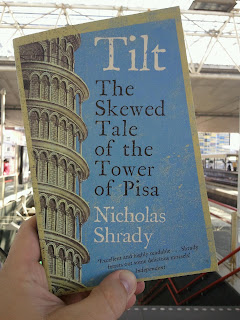
Leisurely Myths of Pisa
Nick gave me this book for my birthday and I guess the presents were themed with myth. Tilt busts a few of those and probably prolongs a few more. Shrady provides a pleasant read of the kind you like to have to hand driving in or out of the holiday town du jour. Meandering from this pretty view to that interesting story and on to that amusing anecdote with a paperified tour guide.
![]() |
| No escaping that tilted shot |
Tilt nicely weaves the history of the iconic tower with that of the city and some of its famous inhabitants. It stages Pisa's sudden rise to greatness as a maritime republic, and its equally dramatic fall. The revolutionary architecture of the cathedral, baptistry and bell tower built upon its riches. The slowly increasing gradient and the attempts to arrest it (16 commissions over 8 centuries couldn't do it and the last had to fail before it succeeded). How Galileo didn't do his experiments in gravity from the tower. Even Mussolini gets a concrete cameo.
Friday, 10 May 2013
Making a miracle happen
Nice booklet
based on annual lecture commemorating the lifting of the siege of Leiden in 1574. The
lecture is always connected to the siege, and in this case on the logistical
side. De Heijer shows that the flooding of the Holland countryside and the relief expedition
were a pretty desperate gamble and required frantic improvisation.
Henk den Heijer, Holland onder water. De logistiek achter het ontzet van Leiden (Leiden 2010).
There had
been some experience with inundation of the low lying parts of Holland
in defence against the Spanish attacks, such as at Alkmaar the previous year. However, there was
no guarantee that the water would rise high enough to make an impact on the
besieging Spanish troops. It was also highly uncertain that the Dutch rebels
would be able to break through to the city. And from a logistical perspective,
everything had to be started from scratch in a few weeks. Finally, unexpected events
caused delays and necessitated further efforts to supply the troops. A Spanish
attack on Dordrecht
diverted resources.
Den Heijer
shows the complex and extensive character of the preparations. Numerous dikes
had to be breached, for which hundreds of pioneers had to be recruited from the
surrounding towns and countryside. In one case it was necessary to occupy a
Spanish held dike before the pioneers could get to work. Also, the countryside
needed to be evacuated.
At the same
time the fleet was collected. This probably amounted to about 70 warships and
250 supporting vessels. Because of the low water levels in the flooded area,
these could only be flat bottomed ships and many were improvised from grain and
peat transports. There were also probably up to another hundreds transports
needed to supply the fleet over the course of the campaign.
The ships were
fitted with a motley collection of guns, mostly light and flexible. A few
heavier pieces were included but these were highly impractical and ineffective.
The whole expedition consisted of about 3000 soldiers, 3000 men to man the
ships and 1000 pioneers. In contemporary terms, this was a major effort.
Labels:
amphibious,
books,
history,
Renaissance
Sunday, 22 July 2012
Spanish gun
Made by royal foundries in Brussels in 1623, by Johannes Sithoff. Probably captured by the Dutch and then used as naval gun.
Ship probably from Amsterdam admiralty and sunk around 1630 near Terschelling
All the latest naval bits were recovered by the Ecuador diving team of Terschelling
Saturday, 21 July 2012
18 pounders from the 1620s
Lifted from an unidentified ship of the Amsterdam admiralty which sank off Terschelling. The guns were probably made in the early 1620s by the Amsterdam master armourer.
Labels:
holiday,
museum,
Renaissance
Wednesday, 4 July 2012
Here I Stand Up to My Ankles in the Med - The Last Crusaders
Last year I spent my holiday with the family on Rhodes, the smallish Greek island with a grand history, just off the Turkish coast. Cities sprang up here around 3,000 years ago, providing legendary Olympic boxing champions and some great classical philosophers. Later, its rethorical schools provided crucial stages in the education of the Roman elite, among whom Caesar. However, the civil war that ended the republic of Rome also led to the destruction of Rhodes.

The island never returned to those glory days, but slowly recovered under the Byzantines and the Genoese. A third golden (or rather silver) age occurred under the rule of the Knights of the Hospital of St. John of Jerusalem between 1309 and 1522. The Knights ended up on Rhodes after choosing the better part of valour by leaving the Holy Land in 1291. Although they first found shelter on Cyprus, the destruction of their fellow crusading order, the Templars, by the French king in 1305 suggested that they'd better get a place for themselves and prove themselves still relevant as a crusading force.
In 1306 a small expeditionary force took two strongholds on Rhodes and in 1309 the Hospitallers agreed a deal to take over the whole island, including its strategic port in the capital. From then on they preyed on Muslim ships (and a lot of Christian ones as well), expanding their outposts to surrounding islands and the Turkish mainland. The Mameluke rulers of Egypt tried to retaliate by besieging Rhodes unsuccessfully in 1440 and again four years later.
But the fall of Byzantium in 1453, the position of the island so close to the Ottoman mainland and across its commercial arteries effectively doomed the Knights' presence. And this is where my choice for holiday reading nicely intersected. I brought along Barnaby Rogerson's The Last Crusaders, which covers the struggle for control of the Mediterranean between 1450 and 1590. What better excuse than to put the great sieges of Rhodes in 1480 and 1522 in the bigger picture? Also, I had just received my copy of the reprinted boardgame Here I Stand, which just begged for some background knowledge to the game.
For players of Here I Stand, the Mediterranean may appear like a minor theatre compared to the epic struggle of the Reformation. And true, the climax of the struggle between Spain and the Ottomans lies beyond the scope of the game. But the southern conflicts already drew much of the attention of the Habsburgs before the big climax of the 1560s and 70s. Francis I, king of France, entered into an alliance with the Turkish Sultan to keep Charles V off balance. The great advance of Suleyman through the Balkans occurred at the same time as the battle of Pavia and the sack of Rome. Later, Charles himself chose to organise his own crusades to Tunis and Algiers rather than take on the Protestants in Germany. Therefore, The Last Crusaders is an excellent companion for putting the game in perspective.

The book is a well written narrative of the developments in the major powers in this conflict: Portugal, Spain, and the Ottoman Empire, as well as the Moroccan dynasties and the Barbary corsairs. It first describes their rise in the late 15th century and then the clashes in the 16th century, culminating in the epic sieges and battles of the 1560s and 1570s, such as Malta, Cyprus and Lepanto. After that, Rogerson contends, all parties involved decided that the cost of control of the Mediterranean were too high and diverted limited means from other crucial conflicts. They either disinvested their overseas commitments or accepted a de facto truce that would never be broken.
Not only is the book fully within the narrative tradition, it also is heavily dependent on biography. All the main players' life and character are sketched in detail, while even the relatively minor cast gets ample attention. In this book, their ideas, childhood trauma's and anxieties determine policies, rather than geopolitical considerations. This provides for a much better read than more analytical studies, but tends to obscure a few larger developments that Rogerson has skilfully woven into the book. Rather than summarise it all, I'm going to pick out those from the book that drew my attention and are relevant to Here I Stand, but I think there is a lot more in the books than what I touch upon here. For example, there's great stuff on the famous corsair captains such as the Barbarossa brothers, Dragut and Uluj Ali and the role of Jewish merchants in the markets for military goods.
Rogerson is a travel writer and historian with long experience in Africa and the Middle East. I only realised while reading the book that I'd already consumed another book by Rogerson, The Heirs of the Prophet Muhammad, which covers the history of the first Caliphs and the schism between the Sunni and Shia in the years immediately following the death of Muhammad. A very engaging and interesting book in itself, the main point for my story here is that Rogerson has a pretty good understanding of the Muslim world and the political implications of religion.
This is especially relevant when it comes to the initial weak legitimacy of the Ottoman dynasty, having no direct hereditary links to the Prophet. On the one hand it influenced their plans for conquest to the point that they strove to control religiously important centres like Jerusalem, Mecca and Medina and to appear as defenders of the faith. On the other hand it also increased the intensity of the conflict following the Shia revival of Persia under sha Ismail, which posed a powerful millenarian alternative to Ottoman rule.
Considerations of religiously founded legitimacy also played its part in the rise of the dynasty in Morocco in response to Portuguese expansion. The Sufi brotherhood traditionally organised communal charity and education and mediated between warring tribes. The authority they derived from these religiously valued activities gave them greater legitimacy when taking up the struggle against the foreign invaders, be they Portuguese, Spanish or Ottoman. It allowed them to first usurp the role of the traditional rulers of southern Morocco, and later to unify the country under their rule.
Religion of course also played a role for the Christians. On the one hand in the crusading tradition of the knightly orders, but also in the sanction of royal rule. After the conquest of Granada in 1492 the pope elevated the Spanish monarch to 'Catholic Kings', which was a major boost to the weak claims of Isabella of Castile to her throne. The crusading tradition strongly supported the position of the Portuguese kings against their Braganza rivals. This could also have negative effects when viewed from a geopolitical perspective, as attempts to strengthen control over Morocco for a long time came at the expense of expansion into Asia and the New World.
But apart from legitimising new and older ruling dynasties, the holy war also became political and part of the process of state formation. Both in Portugal and Spain the knightly orders were put under royal control, and even mere promises of crusade could garner Papal and noble support for extra taxation. The pope granted the 'Catholic Kings' unprecedented control of the clergy and the Inquisition, which became an important tool in keeping the nobility and commercial classes in order.
And strengthening the state was crucial to participate in the game of power and conquest. Access to the new technology and the ability to use it on a grand scale now determined the outcome of military conflict (showing the influence of Rogerson's former tutor Geoffrey Parker). The period covered in this book is that of the military revolution, which was driven by the increasingly destructive power of siege guns which in turn necessitated improved fortifications.
Also, the power struggle required larger armies for longer campaigns, including more specialised troops like gunners and engineers. This necessitated the use of mercenaries rather than noble contingents. Major campaigns now took years of preparation including fleet building programmes and the establishment of vast arsenals.
The Ottomans built up the most powerful siege park which allowed them to blast through the walls of Byzantium, Cairo, Rhodes and Belgrade but also field artillery that won them battles like Mohacs. Use of ships as gun platforms gave the Spanish, Venetians and their allies victory in the climactic battle of Lepanto in 1571. But the large scale use of state of the art machinery drove up the bill and made states seek sources of revenue and intensify the pressure on traditional sources.

By the end of the period all players in the book had mastered the new rules of the military revolution. The Portuguese were driven from Morocco by improved gunnery which made the cost of maintaining their trading posts on the coast prohibitive. Spain was driven from Tunis and Tripoli. The Ottomans were stuck at the end of their logistic lines and economic ability to support expenses.
All this conflict was accompanied by large scale destruction of human lives and property. Sieges with horrendous casualties were followed by brutal sacks which left cities depopulated. Religious minorities were force to convert or cast out with similar results, although the refugees from Spain and Portugal repopulated cities abroad such as Tetouan in Morocco and Thessaloniki in Ottoman Greece (as well as Antwerp and later Amsterdam). Ironically, this greatly damaged the Portuguese and Spanish economies in the long run.
Rogerson is keen to point out that at this time the Muslim world was more civilised and sophisticated than the Christian. Standards of personal hygiene and personal modesty were higher, but also tolerance for other religions. To me this kind of discussion of moral high ground is always touchy, especially because Christianity and Islam have gone through different developments since then which tend to cloud our interpretation. The picture is mixed at best and bleak in any case by today's western standards.
The added taxation of the Jews and Christians in the Ottoman Empire and especially the forced release and conversion of part of the youth if Christian communities surely didn't mean life under the Turk was hunky dory, but for Jews it was certainly better than forced conversion or expulsion as in large parts of Europe. In some cases, as on Cyprus in 1571, the Ottomans were greeted as liberators by Christians. As far as slavery was concerned there was little difference in attitude between Muslims and Christians, and the Ottomans would persecute the heretical Kizilbas movement as bitterly as the Habsburgs would go after the Protestants.
According to Rogerson, the Hospitallers came out on the worse side of the spectrum, contrary to what present day tourist guides of Rhodes would like to you to believe. Some Byzantine possessions refused their offer of protection and rather faced the Ottomans unaided. They raided Muslim and Christian shipping indiscriminately and used the captives to row their galleys. Jewish refugees from Spain were sold by them into slavery. To their merit, however, they provided some of the best medical care to everyone.

All in all the behaviour of the order and the strategic position of the island made Ottoman attack inevitable. The knights withstood the first Ottoman siege in 1480 by a whisker, and were only saved by the struggle for the succession of Mehmet the Conqueror a year later. A rebuilding programme significantly strengthened the defenses but the next attempt in 1522 ended with the honourable retreat of the Knights of St John to Malta, where they withstood yet another Ottoman siege in 1565 and continued their activities until Napoleon conquered the island.
Rhodes spent several mostly quiet centuries under Ottoman rule until the Italians conquered it in 1912. Apart from a sprinkling of nice old mosques in the capital and a colonial extension of the town the impact of these two peoples seems limited. Rhodes is now a Greek holiday island much like the others in atmosphere, but with that historical bonus of a few largely intact fortresses. I heartily recommend a visit.
Full disclosure: I have no connections whatsoever to the Greek Bureau of Tourism.
This post appeared earlier on Fortress Ameritrash.

The island never returned to those glory days, but slowly recovered under the Byzantines and the Genoese. A third golden (or rather silver) age occurred under the rule of the Knights of the Hospital of St. John of Jerusalem between 1309 and 1522. The Knights ended up on Rhodes after choosing the better part of valour by leaving the Holy Land in 1291. Although they first found shelter on Cyprus, the destruction of their fellow crusading order, the Templars, by the French king in 1305 suggested that they'd better get a place for themselves and prove themselves still relevant as a crusading force.
In 1306 a small expeditionary force took two strongholds on Rhodes and in 1309 the Hospitallers agreed a deal to take over the whole island, including its strategic port in the capital. From then on they preyed on Muslim ships (and a lot of Christian ones as well), expanding their outposts to surrounding islands and the Turkish mainland. The Mameluke rulers of Egypt tried to retaliate by besieging Rhodes unsuccessfully in 1440 and again four years later.
But the fall of Byzantium in 1453, the position of the island so close to the Ottoman mainland and across its commercial arteries effectively doomed the Knights' presence. And this is where my choice for holiday reading nicely intersected. I brought along Barnaby Rogerson's The Last Crusaders, which covers the struggle for control of the Mediterranean between 1450 and 1590. What better excuse than to put the great sieges of Rhodes in 1480 and 1522 in the bigger picture? Also, I had just received my copy of the reprinted boardgame Here I Stand, which just begged for some background knowledge to the game.
For players of Here I Stand, the Mediterranean may appear like a minor theatre compared to the epic struggle of the Reformation. And true, the climax of the struggle between Spain and the Ottomans lies beyond the scope of the game. But the southern conflicts already drew much of the attention of the Habsburgs before the big climax of the 1560s and 70s. Francis I, king of France, entered into an alliance with the Turkish Sultan to keep Charles V off balance. The great advance of Suleyman through the Balkans occurred at the same time as the battle of Pavia and the sack of Rome. Later, Charles himself chose to organise his own crusades to Tunis and Algiers rather than take on the Protestants in Germany. Therefore, The Last Crusaders is an excellent companion for putting the game in perspective.

The book is a well written narrative of the developments in the major powers in this conflict: Portugal, Spain, and the Ottoman Empire, as well as the Moroccan dynasties and the Barbary corsairs. It first describes their rise in the late 15th century and then the clashes in the 16th century, culminating in the epic sieges and battles of the 1560s and 1570s, such as Malta, Cyprus and Lepanto. After that, Rogerson contends, all parties involved decided that the cost of control of the Mediterranean were too high and diverted limited means from other crucial conflicts. They either disinvested their overseas commitments or accepted a de facto truce that would never be broken.
Not only is the book fully within the narrative tradition, it also is heavily dependent on biography. All the main players' life and character are sketched in detail, while even the relatively minor cast gets ample attention. In this book, their ideas, childhood trauma's and anxieties determine policies, rather than geopolitical considerations. This provides for a much better read than more analytical studies, but tends to obscure a few larger developments that Rogerson has skilfully woven into the book. Rather than summarise it all, I'm going to pick out those from the book that drew my attention and are relevant to Here I Stand, but I think there is a lot more in the books than what I touch upon here. For example, there's great stuff on the famous corsair captains such as the Barbarossa brothers, Dragut and Uluj Ali and the role of Jewish merchants in the markets for military goods.
Rogerson is a travel writer and historian with long experience in Africa and the Middle East. I only realised while reading the book that I'd already consumed another book by Rogerson, The Heirs of the Prophet Muhammad, which covers the history of the first Caliphs and the schism between the Sunni and Shia in the years immediately following the death of Muhammad. A very engaging and interesting book in itself, the main point for my story here is that Rogerson has a pretty good understanding of the Muslim world and the political implications of religion.
This is especially relevant when it comes to the initial weak legitimacy of the Ottoman dynasty, having no direct hereditary links to the Prophet. On the one hand it influenced their plans for conquest to the point that they strove to control religiously important centres like Jerusalem, Mecca and Medina and to appear as defenders of the faith. On the other hand it also increased the intensity of the conflict following the Shia revival of Persia under sha Ismail, which posed a powerful millenarian alternative to Ottoman rule.
Considerations of religiously founded legitimacy also played its part in the rise of the dynasty in Morocco in response to Portuguese expansion. The Sufi brotherhood traditionally organised communal charity and education and mediated between warring tribes. The authority they derived from these religiously valued activities gave them greater legitimacy when taking up the struggle against the foreign invaders, be they Portuguese, Spanish or Ottoman. It allowed them to first usurp the role of the traditional rulers of southern Morocco, and later to unify the country under their rule.
Religion of course also played a role for the Christians. On the one hand in the crusading tradition of the knightly orders, but also in the sanction of royal rule. After the conquest of Granada in 1492 the pope elevated the Spanish monarch to 'Catholic Kings', which was a major boost to the weak claims of Isabella of Castile to her throne. The crusading tradition strongly supported the position of the Portuguese kings against their Braganza rivals. This could also have negative effects when viewed from a geopolitical perspective, as attempts to strengthen control over Morocco for a long time came at the expense of expansion into Asia and the New World.
But apart from legitimising new and older ruling dynasties, the holy war also became political and part of the process of state formation. Both in Portugal and Spain the knightly orders were put under royal control, and even mere promises of crusade could garner Papal and noble support for extra taxation. The pope granted the 'Catholic Kings' unprecedented control of the clergy and the Inquisition, which became an important tool in keeping the nobility and commercial classes in order.
And strengthening the state was crucial to participate in the game of power and conquest. Access to the new technology and the ability to use it on a grand scale now determined the outcome of military conflict (showing the influence of Rogerson's former tutor Geoffrey Parker). The period covered in this book is that of the military revolution, which was driven by the increasingly destructive power of siege guns which in turn necessitated improved fortifications.
Also, the power struggle required larger armies for longer campaigns, including more specialised troops like gunners and engineers. This necessitated the use of mercenaries rather than noble contingents. Major campaigns now took years of preparation including fleet building programmes and the establishment of vast arsenals.
The Ottomans built up the most powerful siege park which allowed them to blast through the walls of Byzantium, Cairo, Rhodes and Belgrade but also field artillery that won them battles like Mohacs. Use of ships as gun platforms gave the Spanish, Venetians and their allies victory in the climactic battle of Lepanto in 1571. But the large scale use of state of the art machinery drove up the bill and made states seek sources of revenue and intensify the pressure on traditional sources.

By the end of the period all players in the book had mastered the new rules of the military revolution. The Portuguese were driven from Morocco by improved gunnery which made the cost of maintaining their trading posts on the coast prohibitive. Spain was driven from Tunis and Tripoli. The Ottomans were stuck at the end of their logistic lines and economic ability to support expenses.
All this conflict was accompanied by large scale destruction of human lives and property. Sieges with horrendous casualties were followed by brutal sacks which left cities depopulated. Religious minorities were force to convert or cast out with similar results, although the refugees from Spain and Portugal repopulated cities abroad such as Tetouan in Morocco and Thessaloniki in Ottoman Greece (as well as Antwerp and later Amsterdam). Ironically, this greatly damaged the Portuguese and Spanish economies in the long run.
Rogerson is keen to point out that at this time the Muslim world was more civilised and sophisticated than the Christian. Standards of personal hygiene and personal modesty were higher, but also tolerance for other religions. To me this kind of discussion of moral high ground is always touchy, especially because Christianity and Islam have gone through different developments since then which tend to cloud our interpretation. The picture is mixed at best and bleak in any case by today's western standards.
The added taxation of the Jews and Christians in the Ottoman Empire and especially the forced release and conversion of part of the youth if Christian communities surely didn't mean life under the Turk was hunky dory, but for Jews it was certainly better than forced conversion or expulsion as in large parts of Europe. In some cases, as on Cyprus in 1571, the Ottomans were greeted as liberators by Christians. As far as slavery was concerned there was little difference in attitude between Muslims and Christians, and the Ottomans would persecute the heretical Kizilbas movement as bitterly as the Habsburgs would go after the Protestants.
According to Rogerson, the Hospitallers came out on the worse side of the spectrum, contrary to what present day tourist guides of Rhodes would like to you to believe. Some Byzantine possessions refused their offer of protection and rather faced the Ottomans unaided. They raided Muslim and Christian shipping indiscriminately and used the captives to row their galleys. Jewish refugees from Spain were sold by them into slavery. To their merit, however, they provided some of the best medical care to everyone.
All in all the behaviour of the order and the strategic position of the island made Ottoman attack inevitable. The knights withstood the first Ottoman siege in 1480 by a whisker, and were only saved by the struggle for the succession of Mehmet the Conqueror a year later. A rebuilding programme significantly strengthened the defenses but the next attempt in 1522 ended with the honourable retreat of the Knights of St John to Malta, where they withstood yet another Ottoman siege in 1565 and continued their activities until Napoleon conquered the island.
Rhodes spent several mostly quiet centuries under Ottoman rule until the Italians conquered it in 1912. Apart from a sprinkling of nice old mosques in the capital and a colonial extension of the town the impact of these two peoples seems limited. Rhodes is now a Greek holiday island much like the others in atmosphere, but with that historical bonus of a few largely intact fortresses. I heartily recommend a visit.
Full disclosure: I have no connections whatsoever to the Greek Bureau of Tourism.
This post appeared earlier on Fortress Ameritrash.
Subscribe to:
Comments (Atom)