Monday, 29 July 2013

Jolly Monks

A fine addition to my Dux Brittaniarum host, a bunch of priests to rob and despoil.


 Part one of my new Foundry shipment.  

Tuesday, 23 July 2013

Armies of the Balkan Wars

With my interest piqued in the Balkan Wars because of their effect on the outbreak of WWI, chance has it that I had just received my copy of Armies of the Balkan Wars 1912-13 from Osprey's Men At Arms series. It's written by Philip Jowett, who's written a dozen Ospreys on first half of the 20th century subjects and illustrated by Stephen Walsh who has done over 30 books for Osprey now.


Armies of the Balkan Wars follows the standard MAA format: it starts out with a short introduction and chronology of the two wars. I hadn't realised the wars were so close after each other and that the second war had been so bloody, despite lasting only a month. Another factor I'd not taken into account was that the war against Italy (in Libya and the Aegean) was only ended in October 1912.

Reading other stuff about the road towards WWI makes me also see how much of the politics is left out (eg the Russian involvement in creating the anti-Ottoman coalition). I understand why MAA leaves it out, but the complicated politics of the region deserve more. Especially as the book's subtitle claims this was the 'priming charge for the Great War' but nevere really explains how.

Then follows the major section on all the belligerents. Most armies used an age-based system of conscription, allowing them to raise considerable reserves. Also there was a small additional reservoir of irregulars in the Ottoman territories and foreign volunteers that fought on the side of the ant-Ottoman coalition. However, that also meant that the quality of the majority of troops was low. Especially the Turkish army in Macedonia was hampered by being composed mostly of local reserve troops.

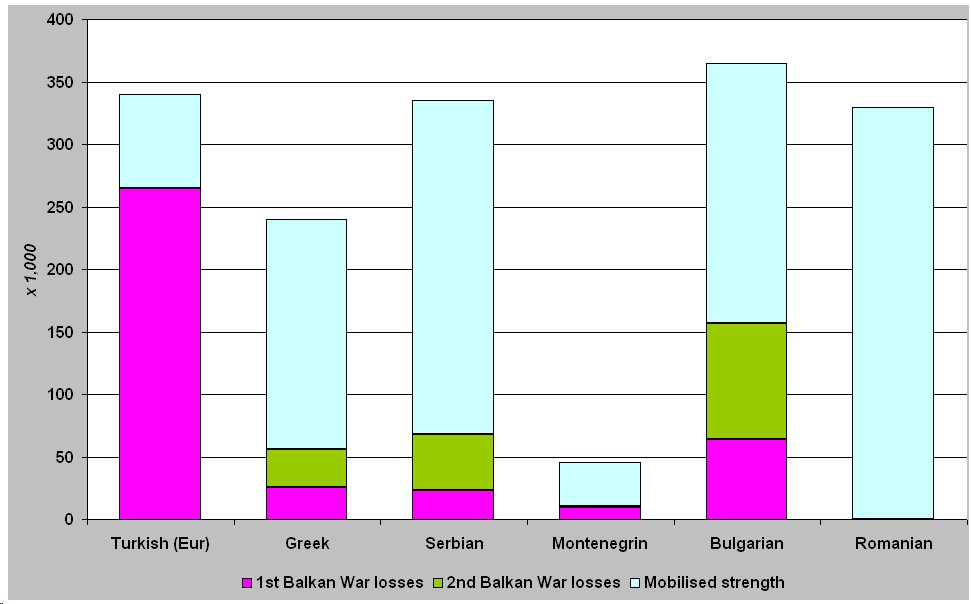
The most remarkable effort was made by Montenegro, a microstate of only 250,000 inhabitants that raised an army of 40,000 by conscription all men between ages 17 and 62. The fact that it lost over 10,000 men during the war was not only a high price to pay for the army, but for the country as well.

The strength and losses of the belligerent states. No records
of Romanian or Turkish losses in the 2nd Balkan War

The graph shows that losses in the two war, although short, were heavy. This had to do with the backward logistics and medical arrangements, amplified by the stationary nature of the war (sieges). Of the 265,000 losses in the Turkish army in the First Balkan War, 75,000 resulted from disease and 115,000 were taken prisoner. I assume these numbers include deserters as well.

From the section on weaponry and other equipment we can conclude that most armies were in short supply to fully equip their war time armies. Although the anti-Ottoman coalition managed to plug most of these gaps with remaindered equipment of more advanced armies, the result was an even greater lack of standardisation and more logistical problems. That leads to the same conclusion as the small section on uniforms, which is that it all wasn't very uniform.

All in all the book is not special. The Men At Arms formula remains very general and I tend to prefer the campaign series for detail. I was impressed by the photographs and illustrations though.

Saturday, 20 July 2013

Musical Intermezzo


Been listening to 35007, an awesome Dutch space rock combo that recorded a few brilliant albums a decade ago. Saw them live once and was hooked.


Now I have Metric's first album on, which includes beauties like Empty, Glass Ceiling, Too Little, Too Late, Monster Hospital and Handshakes.


Friday, 19 July 2013

Godzilla in Amsterdam - A Civilian Crisis Game

From the dark water it rose. The ferry rolled heavily to port as the frightened passengers stared incredulously into the air and the fiery eyes of the monster. Their panicked cries smothered in the waves as the boat capsized into the river. Without noticing, the monster made landfall, placing its feet carelessly on and between the sleepy crowd of early commuters at the Central Station. As fear spread quickly, soon the alarm rang at all police stations and the mayor was awakened. Within an hour the crisis team was convened at the mayor's office, determined to deal with the thread as it presented itself.


As nobody knew Godzilla's drive and had no way of dealing with her, the first efforts were aimed at saving the roaming tourists and local population. Entrance into the town centre was blocked. Another objective was to save as much of the art treasures and monumental areas of the town for future generations. With Godzilla striding towards Museum Square, this became an increasing concern.

But while a team of brilliant scientists was set up to deal with the monster, the local services proved quite capable of limiting the immediate destruction. The fire brigade limited fires around Godzilla to a minimum, tourist were led out of town. And then disaster struck...

The Game Map
Fearing the potential damage to the Rijksmuseum, the Van Gogh Gallery and the monumental Concertgebouw, the government had ordered the air force to prepare an air strike. The air force took this as a remit to actually bomb and laid all its powers of annihilation on Godzilla, destroying large amounts of fire brigade and ambulance material. The museums were levelled as hysterical conservators frantically laid down their lives in a heroic, but utterly futile effort to save Rembrandt's Night Watch and Van Gogh's Sunflowers.


All to the displeasure of the monster, which only became more enraged and determined to reach its goal. With the government and the rescue effort in shambles, all hope was laid in the hands of the scientists, who had been happily discussing alternative theories of Godzilla's descent and interesting evolutionary traits not commonly known in other bipedal reptiles.

They were rudely awakened to the enormity of their task and despite their pleas to save the specimen for future scientific research, they were persuaded at last to rather render their services to save human lives. The solution then proved relatively simple.

In the meantime Godzilla had continued her way leaving a smouldering wasteland in her trail. She was now reaching the edge of the city centre, where masses of refugees had been collected as well as the inbound commuters. No way in hell that these people could be evacuated from there in time.

In their race against the clock the scientist managed to apply their device to the monster and release the hollow charges to puncture its armoured scales, thereby releasing a compound (the composition of which is still to this day classified) that finally ended the life of Godzilla. Writhing in her dying flames, the giant reptile's anguished cries echoed over the badly damaged city...

Where the politicians immediately set out a parliamentary investigation of the decisions that led to the fateful bombing mission...

Then prime minister Jan Peter Balkenende
cleared by the parliamentary investigation
Godzilla is a game that employs more political aspects than operational games. In Godzilla the players were all members of the police, fire brigade and ambulance service in the great city of Amsterdam. The mayor and his staff were to coordinate the life saving effort faced with the towering hulk of the monster rising up from the river. In the background the Dutch government was bringing in fresh assets, like the armed forces and the team of brilliant scientists.

Most players stood around the table taking care of their units, convening for a few minutes every turn as their leaders coordinated their efforts. The mayor's office, the government and the headquarters of the armed forces were further away and relied on reports from the mayor to decide on issues off the map and dealt with anxious journalists.


If you are interested in playing in a megagame sometime, have a look at Megagame Makers. They do about six games a year in London and Leeds in the UK. Or Megagames NL, who do one game a year in the Netherlands.

Thursday, 18 July 2013

Muskets & Tomahawks (and More) in the Mail

In the mail the long awaited:


Some nice French & Indian Wars minis as well:

Coureurs du Bois and Indians
Maroons, revolting slaves, slave hunting dogs


and a few French Revolutionary.

To fight the revolting slaves

And I couldn't resist Sam Mustafa's Maurice.


None of this will see immediate action, but I hope to get at least the F&IW ready for a battle this year.

Tuesday, 16 July 2013

Age of Renaissance - Old Skool Ameritrash

I played two games of Age of Renaissance in the last month. It had been almost a decade since we last played it, so we all had to have a good look at the rules. Although rusty, we were back up to speed by the end of the first evening.


Age of Renaissance is an Old Skool Ameritrash game by Avalon Hill. As suggested by the title, the game is set in the period leading up to the Renaissance, starting in the 8th century. The game is not about empires conquering territories but about trade metropolises dominating markets. The trade empires are Venice, Genoa, Barcelona, Paris, London and Hamburg.

Movement by sea is the best way to expand your trade empire. You start out with slow galleys that have to hug the coastline. Although you can extend the range (and carrying capacity) of your galleys, improving shipbuilding technology first removes range limits, first to all of Europe, then to the East Indies and finally the New World.

A familiar map, very early in the first game. With five players, Hamburg
(and the Baltic and Russia region) isn't included


The map is asymmetric with the most high value areas in the Levant (the eastern board of the Mediterranean), the Black Sea and East Indies and New World. This favours Venice and Genoa, because they are closest to the Levant and the Black Sea. It also means Paris, Hamburg and London should be aggressive (or locked out from the juicy bits).

My list of technological advances, about 3/4 into the game
In the right corner below, you see my biddings
The game mechanics are a development on the original Civilization, and similar in feel but a bit more complex. Like in Civilization there are trade goods where the value grows exponentially the more you have, there’s a tech tree and conflict is abstracted and requires a minimum number of counters to engage.

The trade goods are not based on cities but on areas on the map you control and they each produce different goods like timber, wine, spice and ivory. The tech tree is a bit more structured and expanded, and all the technologies now provide benefits in the game. And conflict is influenced by control of neighbouring areas and technology.

A few sample event cards
The major change to the game as opposed to Civilization is the addition of event cards: you can play them to score trade goods and bonuses on technology or tactical advantages in conflict. There’s also a number of catastrophes such as famine, epidemics and religious strife that will increase the misery of your population. 

The Misery track is another addition to the game. As a result of catastrophes and certain technologies, your people will suffer, and at the end of the game, misery will cost you points. And the higher you are on the track, the bigger the steps, so the harder it becomes to reduce misery. Money and some technologies allow you to reduce misery, but it takes some effort to keep on top of it.

The event cards can be very powerful: scoring a high value trade good or a good leader bonus can buy you an extra technology, a tactical advantage can make you win two more areas. And a catastrophe can lose you half your money. Pretty powerful stuff that can determine the outcome of a game and will have players arguing whether the player targeted is the one in front or not.

The Black Sea and the Levant, cornered mostly by
Genoa and Venice in the four player game
Your basic economy depends on the number of areas you control, but as said above the type of area makes a difference when trade cards are scored by playing event cards. The value of your harvest is determined by the square of the number of areas you hold in that trade good, so monopolies can be very profitable. It’s not possible for all trade goods and sometimes it’s better not to monopolise a good because other players won’t score their cards if you’re the only one benefiting. On the other hand, if you have a trade good card yourself and you can try to collect a few more areas to improve your haul.

As an old skool Ameritrash game, it has many of the flaws associated with the genre. The game is long, taking 5 to 6 hours with 4 players (longer with more players) but that also increases the sense of epic achievement by the end. There is the possibility of a runaway leader if nobody goes after him and it is prone to king making. Like Civilization, there’s lots of calculation going on to optimise your score, and that is something not everybody likes to do in their spare time.

The game is also different with fewer players. There’s too much room in a 4 player game, while 5 players is too hard on Barcelona (with London breathing down its neck). I would like to try six players sometime again because that might be the best balance.

Were it designed or republished today it would be more streamlined to fit into 3 hours. I should try the recent Romanian game Warriors & Traders to see how that works, because it basically has the same theme. But despite all its flaws Age of Renaissance is still worth digging out once every couple of years and probably a great game when you're in school or university and have more time to burn.

Tuesday, 9 July 2013

The Shadow Host

Today I had the urge to finish a bunch of miniatures that I had in my cross hairs for some time. It´s a set of great looking warriors of the cursed kingdom under the southern mountains from the War of the Ring range by Games Workshop. They're plastics and wonderfully sculpted with great dynamism.

The Shadow Host

I knew they should be relatively easy to do. A couple of months I got them out and glued them together and on slotta bases. Then nothing happened for a long time.


Even when I bought a can of  black spray paint for the base coat, a Saturday ago, I actually didn´t expect much to happen. However, the next Tuesday I actually got those guys out and subjected them to a black storm.


And today I wanted to see how I could achieve the desired effect, so I started on a few minis to try out the dry brushing followed by a green wash and then a another dry brush for highlights. They had to look ghostly.


I was so pleased, I finished them all of in two further short sessions. And I'm pretty pleased with the result, although it still needs a layer (or two) of varnish and some basing. This was of course the easiest of the easiest of paint jobs, so nothing to be proud of. If only all painting could be that simple.

Monday, 8 July 2013

Experiencing Muskets and Tomahawks

In January a couple of people from the Dutch Miniature Wargaming group on Facebook decided to meet up and have a beer and a chat. The idea was to meet people from all over the country in a central location. For the third outing we opted for a game of Muskets and Tomahawks in Zutphen.

My militia guarding the flank supported by Minutemen in the woods

I had already picked up on the buzz for this skirmish rule set for North American colonial warfare in the 18th and early 19th century. It combines mission driven scenario's with a card driven turn sequence.

Firefight between my sharpshooters & Minutemen and the Hessians.
Although I won round one, they later wiped out my sharpshooters

M&T works with a point system to determine the forces. 200 point gives you three to four units and enough to start with.  There is quite a range of troops types, from British grenadiers to Canadian Coureurs du Bois and New England militia. Each has special traits that give them the historical feel (eg some units have the 'native' trait, which means they are harder to spot because they are better at using the local terrain).Further variety is provided by optional upgrades to units and traits to your leaders.

Indians charging into the flank of the Continental Army. Although the Continentals were destroyed,
the braves were too hard hit to threaten the issue on the other flank

Both sides get open and hidden objectives to win the game. For example, your force may have the objective to torch the enemy buildings or inflict as many casualties as possible. On the other hand, your leader can have the instructions not to get within 6" of the enemy, or to make a glorious charge. It's up to you to reconcile these objectives.


The Hessian Jaeger taken in the flank. This further weakened the Imperialist force
The mechanics are simple. Combat is D6s with to hit and 'saving throws'. The card driven turn sequence allows for some gambles. You can try to race your opponent while reloading. Do I wait or go now? It´s a nice tactical challenge.


I was very much taken by the rules and how it plays out on the table. Enough tactics to be a challenge, but still fast and fun. Apparently only with skirmish sets are designers able to break from the urge to add too much detail and turn the game into an accounting excercise.

The coup de grace. Because they have lost more than 50% of their force,
the Imperialist Morale card is added to the deck. When it came up, 
all the imperialists units had to check morale at -2. Goodbye!

All in all a great day in good company. Leo, thanks for your good natured reaction to your grenadiers getting wiped out. Jasper and Christy thanks for the hospitality and good luck with the book on the Duke of Alva (where do I pre-order?).

Looking forward to the next Wargame-biertje

Friday, 5 July 2013

Leisurely Myths of Pisa

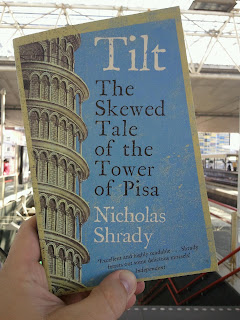
Nick gave me this book for my birthday and I guess the presents were themed with myth. Tilt busts a few of those and probably prolongs a few more. Shrady provides a pleasant read of the kind you like to have to hand driving in or out of the holiday town du jour. Meandering from this pretty view to that interesting story and on to that amusing anecdote with a paperified tour guide.


No escaping that tilted shot

Tilt nicely weaves the history of the iconic tower with that of the city and some of its famous inhabitants. It stages Pisa's sudden rise to greatness as a maritime republic, and its equally dramatic fall. The revolutionary architecture of the cathedral, baptistry and bell tower built upon its riches. The slowly increasing gradient and the attempts to arrest it (16 commissions over 8 centuries couldn't do it and the last had to fail before it succeeded). How Galileo didn't do his experiments in gravity from the tower. Even Mussolini gets a concrete cameo.

Tuesday, 2 July 2013

Another bunch of interesting blog posts

Another batch of blog posts you might not have seen otherwise


Let´s start with digital cryptologist and security expert Bruce Schneier. I am very impressed by his sensible attitudes towards terrorist threats and his insight into cyber war. And I loved his book Liars & Outliers.

On hig blog he gives interesting pointers to research on (digital) security such as the cost of terrorism in Pakistan

the Japanese response to terrorism

US offensive cyber war strategy

and on the psychology of conspiracy theories


And a few more by those dastardly people at the Guardian 

A map showing all events in the Syrian civil war.

The Global Peace Index 2013, including the cost of war.

Arms exports from the EU

followed by an infographic on the world´s armies

and the refugee statistics from the UN High Commissioner for Refugees

What do you think of an analysis of comic book sales and movies?

Image by Sean McLachlan
And a few posts by lesser knowns

Sean McLachlan on castles in Spain and Slovakia

A short movie showing the strategic positions around Damascus of the Syrian government and rebels.